
Blog
XIRR: Measuring Returns When Your Money Moves On Its Own Schedule


Think back over the last three years of your investing in XIRR. You started a monthly SIP one January, never got around to raising it, then parked a bonus in the same fund that August. A year on, you redeemed a portion for a family event, left the rest alone, and kept the monthly habit running. Now answer a deceptively simple question: how well did that money actually perform?
Reach for a single growth percentage, and you will get a tidy answer. You will not get an honest one. Each rupee you put in spent a different amount of time in the market, and any measure that ignores those dates is rounding the truth away. That is the problem XIRR was built to solve, and once you see how it works, plain growth numbers start to feel a little hollow.
What XIRR Actually Measures
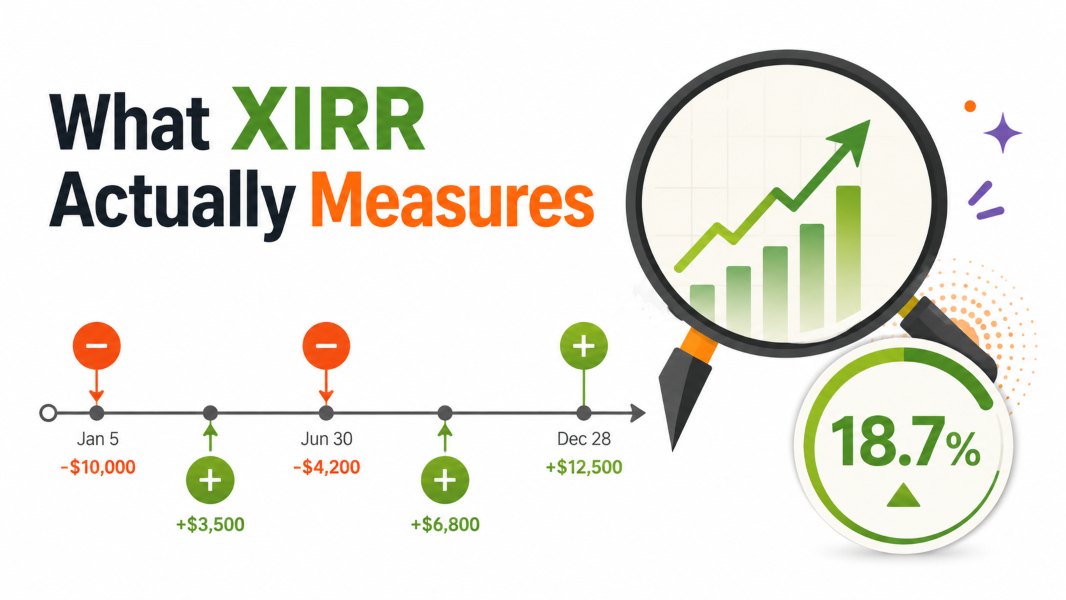
XIRR stands for extended internal rate of return, and the word doing the heavy lifting is “extended.” Ordinary internal rate of return assumes cash flows land at neat, regular intervals. Real portfolios rarely oblige, because contributions and withdrawals happen whenever life and income decide they should.
Under the hood, XIRR searches for the single annualised rate that pushes the net present value of every cash flow to zero. You do not have to fall in love with that sentence to benefit from it. The consequence is what counts: money that stayed invested for two years is weighted differently from money that arrived last month, exactly as common sense says it should be.
That ability to handle unevenly timed cash flows is what separates XIRR from every simpler yardstick. It is the reason the metric shows up wherever a portfolio is built from many transactions instead of one clean deposit, which describes almost every mutual fund investor putting money to work through SIPs and the odd top-up.
Where Simple Returns And CAGR Quietly Mislead You

Trouble With Absolute Returns
Absolute return is the friendliest number in finance and also the least revealing. It reports how much your investment grew, and nothing more. Turning one lakh into 1.4 lakh is a 40 percent absolute return whether it took eight months or eight years, and those are two very different results. Time is the missing ingredient, and absolute return leaves it out entirely, which is fine for a quick brag and useless for a real decision.
Why CAGR Assumes A World You Don’t Live In
Compound annual growth rate is a genuine step up, because it annualises growth rather than reporting a raw gain. The limitation hides in its assumptions. CAGR is precise when you invest one amount at the start and redeem it at the end, which makes it well suited to a single lump sum. The instant you add a second contribution, step up your SIP, or book partial profits, CAGR has no mechanism for the timing of those moves. It was never designed for a portfolio in motion, and most portfolios are very much in motion.
Situations Where XIRR Earns Its Keep

Monthly SIPs
Every SIP instalment enters the market on its own date, so each one has a different runway to grow. Your January contribution enjoys eleven more months of compounding than the one you make in December, and treating those two as equal would flatter one and shortchange the other. This staggered buying is also the engine behind rupee cost averaging, which smooths out the price you pay across market ups and downs. XIRR treats each instalment as its own miniature investment and then blends them into a single annualised figure, which is why it is the only sensible way to grade a SIP.
Occasional Lump Sums
A bonus, a maturing deposit, a tax refund: most of us feed windfalls into existing holdings whenever they appear. Each of those top-ups then sits invested for a different stretch of time, each one riding the power of compounding for however long it stays put. Averaging them or squinting at the combined total tells you almost nothing useful. XIRR folds every lump sum into the same calculation and reports their joint performance without pretending they all arrived on the same morning.
Partial Withdrawals
Life interrupts even the most disciplined plan. You redeem a slice to cover an emergency, and the remainder stays put and keeps compounding. A metric that cannot cope with an outflow falls apart at this point. XIRR reads the withdrawal as one more dated cash flow and carries on calculating with what is left. That makes it genuinely valuable for anyone who manages a portfolio actively across the years rather than leaving it untouched, and it rewards the patience of the money you chose not to pull out.
Letting A Calculator Do The Heavy Lifting
None of this asks you to sit with a pen and grind through iterations by hand. If you enjoy the mechanics, you can reproduce the whole thing with Excel’s own XIRR function, entering your cash flows and their dates in two columns. For a quick pulse check on a mutual fund portfolio, a purpose-built XIRR calculator is faster still. You list each investment, each withdrawal, and its date, and it hands back your annualised return in seconds. The tool is not a substitute for understanding what the number means. It just removes enough friction that you check your real returns often enough to act on them.
Disclaimer
This article is for educational and informational purposes only and does not constitute investment, financial, or tax advice. Mutual fund investments are subject to market risks, and past performance does not guarantee future results. Please consult a SEBI-registered investment adviser before acting on any investment decision.