
Blog
How GameZone Changes the Experience of Playing JILI Games


Ask most players what makes a gaming platform good, and they will talk about the games. That is the obvious answer, and it is only half of one.
The less obvious half is everything wrapped around the games. How long a title takes to open on a mobile connection in the middle of the afternoon. Whether you can find the game you played last week without scrolling through four hundred thumbnails. Whether the platform tells you who licenses it and what happens to your data, none of that shows up in a game count, and all of it decides whether you are still using the same platform six months from now.
JILI has built a large following across Southeast Asia on slots, fishing titles and arcade games. But the studio makes the games, not the environment you play them in. That part belongs to the platform, and it is worth understanding what a platform is actually doing for you before you settle on one.
Why the Wrapper Matters as Much as the Library
A big catalog cuts both ways. More games mean more choice, and more choice means more time spent deciding rather than playing. Nielsen Norman Group, which has been running usability research since 1998, describes this as a findability and discoverability problem, and their framing is blunt about the stakes: if people cannot locate something on a site, the size of the catalog behind it stops mattering. A library nobody can navigate performs worse than a smaller one that is well organized.
The same logic applies to speed. A game that takes eight seconds to load is a game most people will not open twice, no matter how good it is once it starts.
So the platform is not a neutral container. It either amplifies the library or gets in its way.
What “Fast” Actually Means on a Philippine Connection
Vague performance promises are easy to make. It helps to know what the numbers look like in this market specifically.
The Philippines is overwhelmingly mobile. DataReportal’s Digital 2026 Philippines report counted 137 million cellular connections against a population of roughly 117 million, with 98 million people online. The same report puts the median mobile download speed at 59.64 Mbps versus 105.17 Mbps on fixed lines. Mobile speeds have climbed fast, up more than 77 percent in twelve months, but they still sit at roughly half of what a home fiber connection delivers.
That gap is the whole ballgame for a gaming platform here. Most sessions happen on a phone, on cellular, often on a network that is congested at peak hours. A platform that only feels quick on office WiFi has not solved the problem its audience actually has.
Google publishes thresholds worth knowing as a benchmark. Under Core Web Vitals, a page should render its main content within 2.5 seconds and respond to a tap within 200 milliseconds to count as good, measured across real users rather than a lab test on a fast device. Those are not gaming-specific numbers, but they are a reasonable bar for any interface you are asked to tap through repeatedly.
The practical test is simpler than the metrics: open the platform on your phone, on mobile data, during a busy evening. That is the experience you are buying.
Finding Games Without Hunting for Them
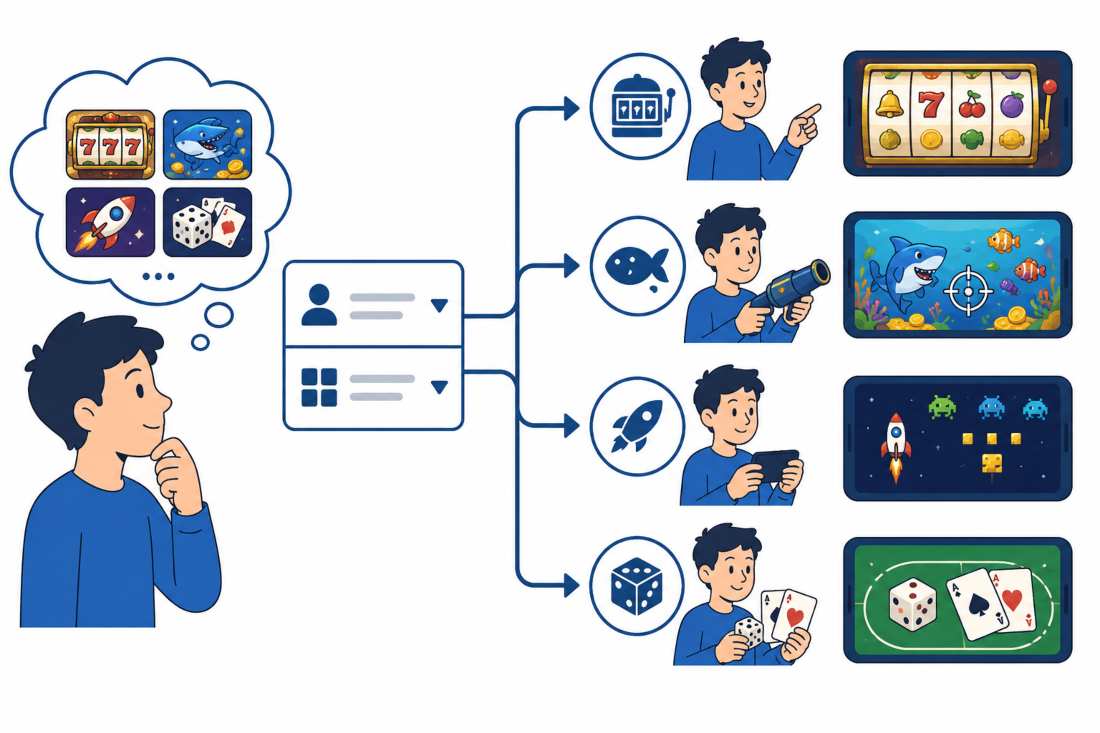
GameZone organizes its Jiligames collection by provider and by type, which sounds mundane until you compare it to a platform that dumps everything into one endless scroll.
Provider filtering matters more than people expect. Suppose you have found that you like how a particular studio builds its titles, the pacing, the interface conventions, the way information is presented on screen, then being able to see that studio’s full range in one place is genuinely useful. It is the difference between browsing a shelf and rummaging through a bin.
Category filtering does the other half of the job. The four groups you will encounter cover distinct kinds of play:
- Slots are the largest category and the most passive. You set a stake, you spin, and a random number generator determines the outcome. There is no skill component, which is worth being clear about rather than pretending otherwise.
- Fishing games are the format JILI is arguably best known for. They involve aiming and timing, and they feel more active than slots, though the underlying outcomes are still governed by the game’s mathematics rather than by your reflexes alone.
- Arcade games are short, fast and built around quick rounds. They suit brief sessions rather than long ones.
- Specialty games cover the formats that do not fit neatly elsewhere, including dice, card and number-based titles.
Knowing which category you are in changes how you should think about a session. A fishing game and a slot are not the same activity even when they sit next to each other in the same menu.
Licensing Is a Claim You Can Check Yourself
GameZone states that it operates under a licence from the Philippine Amusement and Gaming Corporation. That is the right regulator to be asking about, and it is also a claim you do not have to take on faith.
PAGCOR’s authority comes from Presidential Decree No. 1869 as amended by Republic Act No. 9487. Its Electronic Gaming Licensing Department is the arm that oversees eCasino games, specialty games, e-bingo and sports betting, including the online platforms attached to licensed venues. PAGCOR publishes lists of licensed service providers and their approved game offerings. Hence, a licence claim is verifiable against the regulator’s own records rather than against a badge in a website footer.
Do that check. It takes two minutes, and it is the single most useful thing you can do before depositing money anywhere. A legitimate operator displays its licence details openly and will not be damaged by you confirming them.
One eligibility point that catches people out: PAGCOR rules bar anyone under 21 from gaming, along with government employees connected to gaming operations, and members of the Armed Forces of the Philippines and the Philippine National Police. Those restrictions are regulatory, not platform preference.
Fairness Is a Separate Question From Licensing
Licensing tells you an operator is authorized. It does not by itself tell you the games behave the way they claim to. That is what independent testing labs exist for.
Firms like Gaming Laboratories International test random number generators, game mathematics, system integrity and security for operators and regulators across regulated markets, and they have worked in Philippine jurisdictions for years. When a game or platform carries certification from GLI, iTech Labs or eCOGRA, it means an outside party has checked that the RNG produces genuinely unpredictable results and that the stated return figures match the underlying math.
This is worth looking for as a separate line item from the licence: two different questions, two different answers.
Your Account and Your Data
Encrypted logins are the baseline, not a feature. The more meaningful question is what an operator does with the personal information it collects during account verification, which in the Philippines means know-your-customer documents, contact details and payment records.
That handling is governed by Republic Act No. 10173, the Data Privacy Act of 2012, enforced by the National Privacy Commission. The law gives you specific rights over your own data, including the right to access it, correct it and object to how it is processed. It applies to any organization processing personal data in or from the Philippines. Any platform holding your ID scans is subject to it.
Practical version: read the privacy notice before you upload documents, turn on whatever additional account security the platform offers, and know that the NPC handles complaints if something goes wrong.
Playing Within Limits
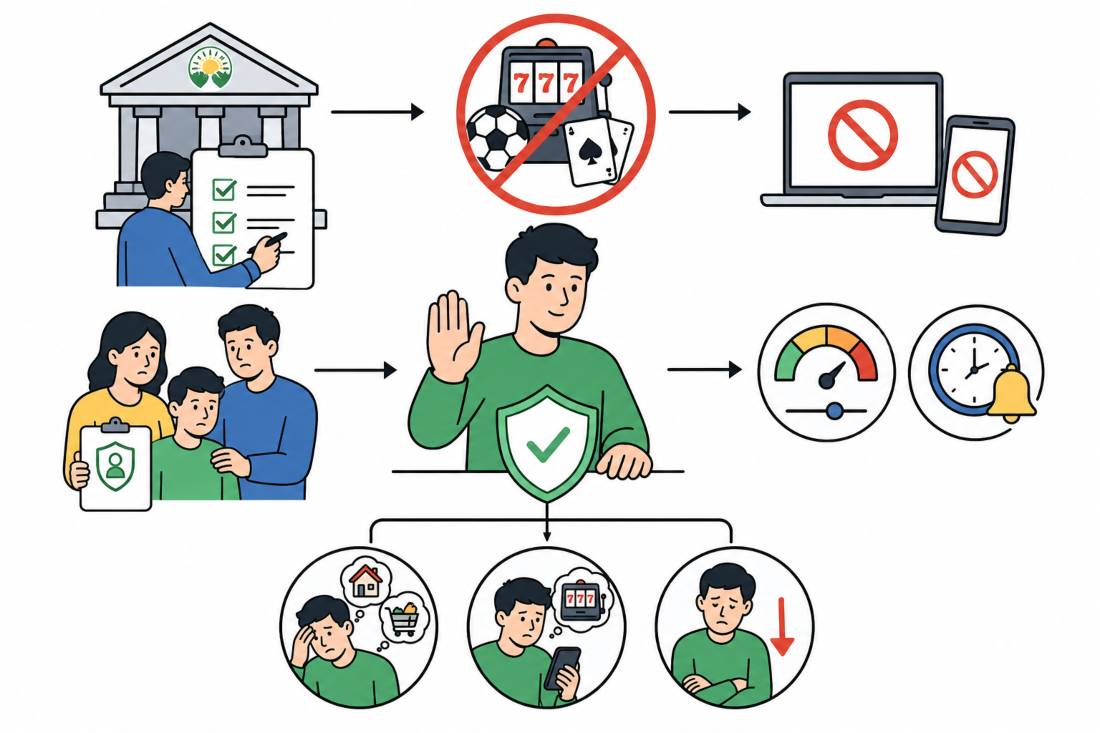
Every platform in this industry lists responsible gaming tools. Fewer explain what they actually are, so here is the substance.
PAGCOR runs a formal exclusion system, not just operator-level settings. Through its responsible gaming program, you can apply for self-exclusion for six months, one year or five years, and family members can apply for a family exclusion order on behalf of a relative. Exclusions apply across all PAGCOR-operated and regulated venues and sites, not just the one platform you signed up with. Forms are downloadable from the PAGCOR site, and the regulator maintains a responsible gaming email address and hotline for questions.
Platform-level deposit limits and session reminders are useful, and worth setting before you need them rather than after. But they are a lighter tool than regulator-level exclusion, and it is worth knowing both exist.
On the harm side, the World Health Organization now treats gambling disorder as a recognized clinical condition under ICD-11, with three markers: impaired control over gambling, gambling taking priority over other interests and daily activities, and continuing despite negative consequences. The WHO also makes a point that gets lost in most industry messaging, which is that harm occurs well below the clinical threshold. Money being diverted from household essentials is a warning sign long before anything would be diagnosed.
Risk also varies by format, and the peer-reviewed evidence on this is worth knowing. A 2024 systematic review and meta-analysis in The Lancet Public Health, covering 380 samples across 68 countries, found that among adults who gamble, roughly 1.41 percent meet criteria for problematic gambling overall. Broken down by product, the rate was highest among people playing online casino and slot games at 15.8 percent. The Lancet Public Health Commission on gambling reported the same pattern and put the figure for adolescents playing those formats at 26.4 percent.
Slots are the largest category on any platform of this type, including this one. That is not a reason to avoid them, but it is a reason to set limits deliberately rather than assuming the format is equivalent to buying a lottery ticket.
Research on exclusion programs is honest about their limits. Reviews have found they are underused relative to the number of people who would benefit, and that enforcement is imperfect, particularly where detection depends on venue staff. What the same literature consistently reports is that people who do use them describe reduced gambling and improved wellbeing. Imperfect and worth using are both true at once.
If any of this sounds familiar, the exclusion programs above exist for exactly that reason, and using them is not a dramatic step.
What to Look For Before Committing to Any Platform
Strip away the marketing and the checklist is short:
- Test it on your phone, on mobile data, at a busy hour
- Confirm the licence against PAGCOR’s published records rather than the site’s own footer
- Look for independent testing certification as a separate item from licensing
- Read the privacy notice before uploading identity documents
- Find the responsible gaming tools and set your limits before your first deposit, not after
- Check that customer support is reachable through a channel that gets an actual reply
GameZone does a reasonable job on the structural side of this, particularly on library organization and provider filtering, which are the parts most platforms treat as an afterthought. The rest is worth verifying yourself regardless of which platform you choose.
Frequently Asked Questions
| Question | Answer |
|---|---|
| What kinds of JILI games are available on GameZone? | The collection includes slots, fishing games, arcade titles, and specialty formats such as dice and card games. Players can browse games by provider or category. |
| Does organization really make a difference to the experience? | Yes. Usability research shows that when people cannot find content easily, they often use search or leave the platform. On a site with hundreds of games, filtering by provider and type makes browsing faster and less frustrating. |
| How do I confirm a platform’s PAGCOR licence? | PAGCOR publishes lists of licensed operators and accredited service providers on its official website. Compare the licence number shown on the platform with PAGCOR’s records. Do not rely on a logo alone. |
| Who is not allowed to play? | Anyone under 21, government employees connected with gaming operations, and members of the Armed Forces of the Philippines and Philippine National Police are not permitted to play under PAGCOR regulations. |
| What if I want to stop playing? | PAGCOR provides self-exclusion periods of six months, one year, or five years. Family members may also request a family exclusion order. These exclusions apply across PAGCOR-regulated sites and venues. |
| Does a fast platform matter that much? | Yes. In a market where many players use cellular data, slow loading and poor tap responsiveness can quickly end a session. A fast platform makes games easier to access and reduces abandoned visits. |
Disclaimer
This article is for general information only and does not promote gambling or guarantee winnings. Gambling involves financial risk and is only for adults aged 21 or over where legally permitted. Anyone concerned about gambling should use self-exclusion tools and seek qualified support.
References
- Tran, L. T., Wardle, H., Colledge-Frisby, S., Taylor, S., Lynch, M., Rehm, J., Volberg, R., Marionneau, V., Saxena, S., Bunn, C., Farrell, M., and Degenhardt, L. (2024). The prevalence of gambling and problematic gambling: A systematic review and meta-analysis. The Lancet Public Health, 9(8), e594–e613. DOI: 10.1016/S2468-2667(24)00126-9.
- Wardle, H., Degenhardt, L., Marionneau, V., Reith, G., Livingstone, C., Sparrow, M., Tran, L. T., Biggar, B., Bunn, C., Farrell, M., Kesaite, V., Poznyak, V., Quan, J., Rehm, J., Rintoul, A., Sharma, M., Shiffman, J., Siste, K., Ukhova, D., Volberg, R., Salifu Yendork, J., and Saxena, S. (2024). The Lancet Public Health Commission on gambling. The Lancet Public Health, 9(11), e950–e994. DOI: 10.1016/S2468-2667(24)00167-1.
- Gainsbury, S. M. (2014). Review of self-exclusion from gambling venues as an intervention for problem gambling. Journal of Gambling Studies, 30(2), 229–251. DOI: 10.1007/s10899-013-9362-0.
- Motka, F., Grüne, B., Sleczka, P., Braun, B., Cisneros Örnberg, J., and Kraus, L. (2018). Who uses self-exclusion to regulate problem gambling? A systematic literature review. Journal of Behavioral Addictions, 7(4), 903–916. DOI: 10.1556/2006.7.2018.96.
- Bijker, R., Booth, N., Merkouris, S. S., Dowling, N. A., and Rodda, S. N. (2023). International prevalence of self-exclusion from gambling: A systematic review and meta-analysis. Current Addiction Reports, 10, 844–859. DOI: 10.1007/s40429-023-00510-6.