
Blog
How Mobile Apps Have Revolutionized Sports Betting

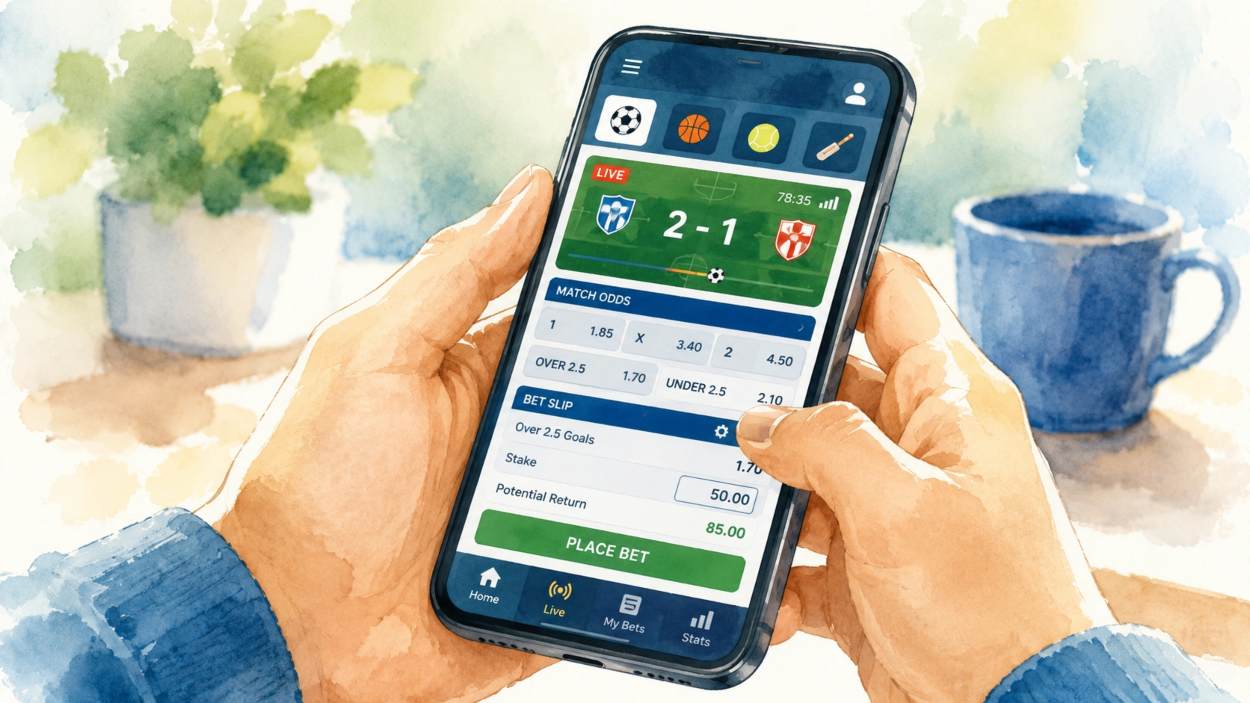
Sports betting once had natural pauses built into it. A person might need to visit a physical location, use a desktop computer, or make a decision before a match begins.
Mobile apps and online sportsbook platforms have removed many of those pauses.
A smartphone can now combine live scores, changing odds, account balances, payments, statistics, notifications, and customer support on one screen; for the betting industry, that has created faster access and more frequent interaction. For users, it has also made spending and decision-making easier to continue without noticing how much time has passed.
That is the real mobile revolution. It is not simply that a betting service or online sportsbook fits inside a phone. The activity can now follow the user throughout the day.
Betting No Longer Has a Fixed Location
Before mobile apps became common, placing a sports wager usually required a specific place or device. The activity had a clearer beginning and ending.
Mobile access changed that boundary.
A person can check an account while watching television, travelling, eating dinner, or receiving score updates at work. The same phone used for banking, messaging, navigation, and news can also display betting markets.
This has made the experience more convenient, but convenience should not automatically be treated as progress. Removing steps can reduce the time available to reconsider a financial decision.
A well-designed app may allow an adult user to find information quickly, but it should also make spending history, time limits, deposit controls, support information, and account restrictions easy to find. The UK Gambling Commission’s safer-gambling guidance explains several tools intended to help people manage gambling activity, including limits and self-exclusion options.
Betting Slip Became a Small Piece of Software
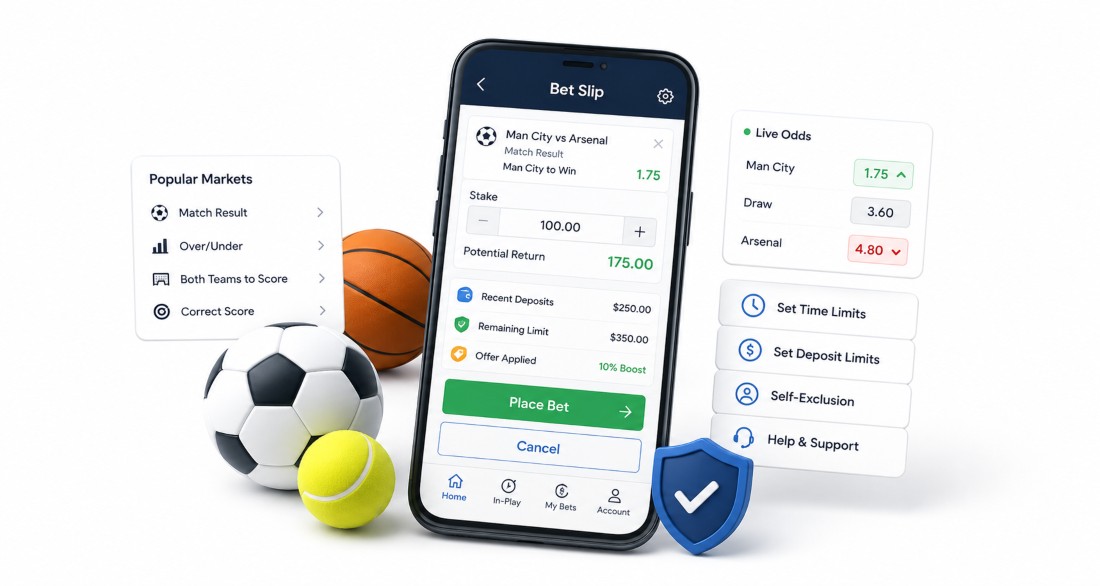
An old betting slip was easy to understand. It showed a selection, a stake, and a possible return.
A mobile betting slip can behave more like an interactive shopping basket. It may update figures automatically, save selections, suggest additional markets, highlight changing odds, and warn that a price is no longer available.
This reduces manual work, but it can also make several decisions feel like one decision.
For example, a person may begin by checking the result of a match and then move through scores, markets, notifications, and account prompts without consciously deciding to begin another betting session. Each tap feels small, even when the total financial activity is not.
A responsible mobile design should place essential information close to the decision itself:
- The amount being risked
- The user’s recent deposits
- The remaining spending limit
- Any conditions attached to an offer
- A clear way to cancel or step away
- Access to account history and support tools
The National Council on Problem Gambling’s sports-betting resources emphasise the importance of time and money limits, self-exclusion, clear help information, and other consumer safeguards.
Live Information Changed the Pace
Mobile apps have brought scores, statistics, line movements, and account information into the same interface.
This can help users monitor what is happening without moving between several websites. It may also create the impression that having more information makes an uncertain outcome predictable.
It does not.
A live statistic describes what has already happened. It cannot guarantee what happens next. A team having more possession, shots, corners, or attacks does not remove randomness, referee decisions, injuries, substitutions, or sudden changes in performance.
Speed is another concern. When information and markets update in seconds, the time available for reflection becomes shorter. A person can move from watching a sporting moment to risking money on the next one before fully considering the choice.
Helpful design would not merely make the action faster. It would also give users ways to slow it down, such as session reminders, waiting periods, spending summaries, and the option to disable certain forms of interaction.
Account Management Became More Visible
One clear benefit of mobile technology is that account records can be placed in one location.
A user may be able to view deposits, withdrawals, open transactions, past activity, identity checks, security settings, and personal limits through a single dashboard. In theory, this visibility can make financial monitoring easier.
However, a prominent balance figure is not enough.
A balance may rise and fall without showing how much money has been transferred from a bank account over several weeks. A more useful dashboard should separate:
| Account Information | Why It Matters |
| Total deposits | Shows how much personal money entered the account |
| Total withdrawals | Shows how much money returned to the user |
| Net spending | Gives a clearer picture than the current balance |
| Time spent in the app | Reveals use that may be difficult to notice |
| Active limits | Shows whether financial controls are in place |
| Recent limit changes | Reveals whether boundaries are being weakened |
| Full transaction history | Supports an honest monthly review |
Visibility is valuable only when the information is easy to understand. A long list of transactions should not require the user to calculate the real cost manually.
Mobile Payments Made Depositing Almost Frictionless
Mobile payments can make an account easier to manage. Deposits and withdrawals may be completed without opening a desktop browser or entering the same information repeatedly.
Yet friction is not always bad.
The few seconds required to find a card, enter details, or open a banking app can create a useful pause. Stored payment methods and one-tap deposits can remove that pause precisely when it may be needed most.
Security also matters because financial apps may handle identity documents, payment information, addresses, and account credentials. The National Institute of Standards and Technology provides a detailed framework for vetting the security of mobile applications, including the assessment of vulnerabilities, privacy risks, testing processes, and software reliability.
The PCI Security Standards Council’s mobile-payment standards also set technical requirements intended to protect payment information in mobile environments.
Consumers should still use unique passwords, enable strong account authentication where available, keep the operating system updated, and avoid signing in through unknown links. The US Federal Trade Commission’s advice on protecting a phone from hackers notes that operating-system updates often include important security fixes.
An App Can Collect More Than Betting History
A mobile app may request access to location, notifications, photos, files, contacts, or other parts of a device. Some permissions may have a legitimate purpose, while others may not be necessary for basic operation.
Users should examine permissions instead of accepting every request automatically.
The Federal Trade Commission explains that websites and apps may collect and use personal information, including identifiers that can support advertising and tracking.
Android users can review and change access through the device’s app-permission settings, including permissions related to location, files, contacts, cameras, microphones, and notifications.
A reasonable permission should have a clear explanation. A sports-results function, for example, should not quietly require access to unrelated personal files.
Notifications Became Both Useful and Intrusive
Push notifications are often presented as a simple convenience. They can show score changes, account activity, security alerts, results, and scheduled events.
They can also repeatedly pull a person back into an app.
There is a meaningful difference between an alert that warns about an unfamiliar login and a promotional message designed to create urgency. One protects the account. The other may encourage an immediate financial decision.
Users should decide which notifications deserve access to their attention. Apple provides instructions for turning notifications on or off for individual iPhone apps, while Android allows users to silence, restrict, or block alerts through its notification controls.
Useful categories might include:
- Security and login warnings
- Withdrawal confirmations
- Changes to personal account details
- Confirmation that a financial limit has been reached
Promotional alerts, countdowns, event reminders, and repeated offers can usually be disabled without affecting basic account security.
GamCare also advises people who want distance from gambling apps to disable push notifications and take a break.
Personalization Can Narrow the User’s View
Mobile platforms can remember favourite teams, frequently viewed leagues, past activity, and preferred markets.
This may reduce search time, but personalization is not always neutral. When an app learns what attracts a user’s attention, it can place that material in the most visible parts of the screen.
A football fan may see football markets first. Someone who often responds to live alerts may receive more live alerts. A user who has recently deposited may be shown messages related to further account activity.
The result is a screen that feels personally useful while also being carefully arranged to encourage continued interaction.
A fair design should allow personalization to be turned off. It should also avoid using personal behaviour to pressure users who are showing signs of risky or unusual spending.
Security Features Improved, but Users Still Need to Check Them
Modern apps may support biometric login, device recognition, encrypted connections, identity verification, and two-step authentication.
These tools can reduce some risks, but they do not make every app trustworthy.
Users should check whether the service is legal and regulated where they live, whether the developer is clearly identified, what information is collected, and how account support works. An app should be installed only from an official marketplace or a verified provider page, never from an unsolicited message.
Mobile operating systems also provide useful protections. Reviewing permissions, deleting unused apps, enabling screen locks, and installing security updates can reduce unnecessary exposure.
Security should not be judged by how polished an app looks. A professional design can still hide weak privacy terms, excessive permissions, or poor account controls.
Safer-Use Tools Became Part of the Mobile Interface
Mobile access increases availability, so protection tools need to be equally available.
Important controls can include:
- Deposit limits
- Spending or loss limits
- Session reminders
- Timeouts
- Account history
- Self-exclusion
- Marketing controls
- Direct links to independent support
- The ability to close an account without unnecessary barriers
These tools should be visible before a problem becomes severe. Hiding them inside several settings pages weakens their purpose.
Research published by the UK Gambling Commission found that some people use controls such as limits, timeouts, self-exclusion, and deleting apps or accounts to reduce access. The Commission also notes that safer-gambling messages may be easier for some users to dismiss when they believe their activity is under control.
For people who find that ordinary account settings are not enough, GamCare provides information about blocking software and self-exclusion tools that can restrict access across devices.
Mobile Convenience Should Not Be Confused With Control
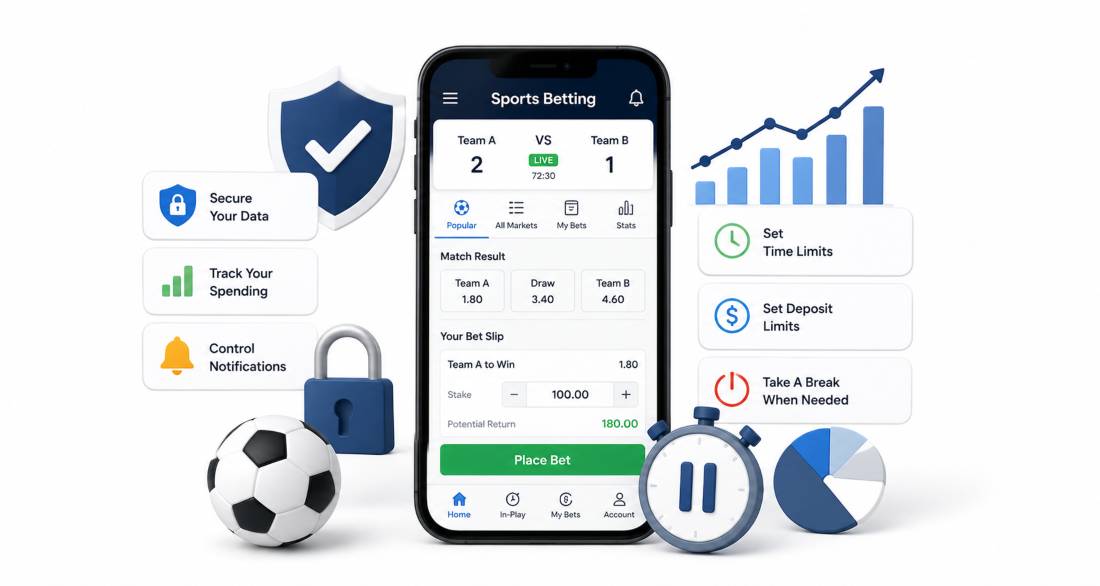
A smooth app can make a complicated system feel simple.
The screen may be clear. Payments may be quick. Statistics may arrive instantly. Account records may be available within seconds. None of this changes the financial risk or makes sporting outcomes certain.
The strongest mobile features are not necessarily the ones that speed up a transaction. They are the ones that help a person understand what is happening, secure personal data, review total spending, control notifications, set firm limits, and leave the platform without resistance.
Mobile apps changed sports betting by removing distance, delay, and many of the pauses that once separated one decision from the next. The next stage of responsible mobile design should put some of those pauses back.
Disclaimer: Sports betting is restricted to adults and is not legal in every location. It should never be treated as income or as a way to recover financial losses. Anyone concerned about their own or another person’s gambling can contact an independent local gambling-harm support service.
References
- Hing, N., Browne, M., Rockloff, M., Russell, A. M. T., Tulloch, C., Lole, L., Thorne, H., & Newall, P. W. S. (2023). Situational features of smartphone betting are linked to sports betting harm: An ecological momentary assessment study. Journal of Behavioral Addictions, 12(4), 1006–1018. DOI: 10.1556/2006.2023.00065.
- Vieira, J. L., Coelho, S. G., Snaychuk, L. A., Keough, M. T., & Kim, H. S. (2023). Who makes in-play bets? Investigating the demographics, psychological characteristics, and gambling-related harms of in-play sports bettors. Journal of Behavioral Addictions, 12(2), 547–556. DOI: 10.1556/2006.2023.00030.
- Newall, P. W. S., Russell, A. M. T., & Hing, N. (2021). Structural characteristics of fixed-odds sports betting products. Journal of Behavioral Addictions, 10(3), 371–380. DOI: 10.1556/2006.2021.00008.
- Torrance, J., O’Hanrahan, M., Carroll, J., & Newall, P. W. S. (2024). The structural characteristics of online sports betting: A scoping review of current product features and utility patents as indicators of potential future developments. Addiction Research & Theory, 32(3), 204–218. DOI: 10.1080/16066359.2023.2241350.
- Parke, A., & Parke, J. (2019). Transformation of sports betting into a rapid and continuous gambling activity: A grounded theoretical investigation of problem sports betting in online settings. International Journal of Mental Health and Addiction, 17, 1340–1359. DOI: 10.1007/s11469-018-0049-8.