
Blog
How Businesses Can Manage High-Volume Contracts Without Slowing Down Growth


High-growth companies… They often hit the same wall: contracts pile up faster than teams can review them.
Sales teams want deals signed yesterday, procurement departments need vendor terms locked in, and legal teams are buried in redlines.
So, growth stalls not because of weak demand. But because contracts cannot move fast enough.
For a scaling company, fewer delays mean faster revenue recognition and fewer frustrated customers waiting on paperwork.
Invest in Scalable Contract Lifecycle Management
According to the Contract Lifecycle Management Software Market Report, enterprises globally are managing contracts numbering in the tens of thousands annually, with large enterprises handling roughly 60 to 70 percent. Growth brings complexity. And spreadsheets cannot keep up.
Manual workflows break down once contract volume crosses a certain threshold.
Companies are investing heavily in contract lifecycle management because contracts now drive:
- Revenue
- Compliance
- Supplier performance
Falling behind on tools can quietly choke expansion plans.
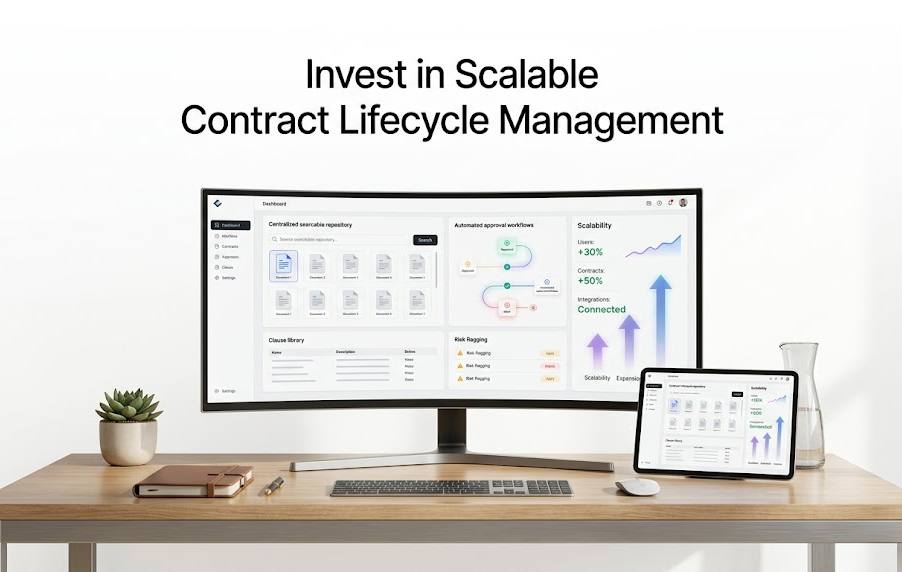
Modern contract lifecycle management platforms help teams handle volume without chaos. Core capabilities often include:
- Centralized contract repositories with searchable metadata
- Automated approval-routing workflows
- Built-in clause libraries and risk-flagging tools
Scalable infrastructure… It allows businesses to add users, contracts, and integrations without reengineering processes every quarter.
Standardize Playbooks and Empower Business Teams
Legal departments face growing pressure to control costs. And lean teams cannot personally negotiate every NDA, vendor agreement, or low-risk customer contract, of course.
Standardized templates and playbooks… They reduce unnecessary back-and-forth.
Clear fallback positions allow sales or procurement to negotiate within pre-approved boundaries. Legal then focuses on strategic or high-risk deals – instead of routine paperwork, that is.
A strong playbook typically defines:
- Approved clauses and fallback language
- Escalation thresholds for financial or regulatory risk
- Pre-set turnaround-time expectations
Self-service contracting, when governed correctly, speeds routine deals without increasing exposure. Revenue teams gain autonomy. And legal retains visibility into deviations.
Align With a Commercial Contract Attorney for Complex Risk
As contract volume increases, the risk of missed clauses, compliance gaps, and costly negotiation delays grows significantly. Without proper legal oversight, these issues can lead to revenue loss, disputes, or regulatory exposure.
In such cases, working with a commercial contract attorney becomes essential to manage complex agreements, maintain consistency, and ensure contracts move forward without creating hidden risks—especially when supported by flexible providers like Axiom Law that can scale legal resources on demand.
Automate Intake and Approval Workflows
Email chains… They create bottlenecks. Contracts get stuck in inboxes, versions multiply, and no one knows who has final authority. Approval confusion can add days or weeks to a deal cycle.
The 2025 Deloitte and DocuSign Digital Agreement Management Study found that 47% of organizations with advanced routing, editing, and approval capabilities were more likely to outperform financial goals. Faster routing reduces friction. And reduced friction drives growth.
Automation should focus on:
- Structured intake forms that capture required deal data upfront
- Role-based approval routing tied to contract value or risk
- Real-time status tracking for stakeholders
Structured intake… It eliminates missing information that slows drafting.
Automated routing ensures contracts land with the right reviewer the very first time. And dashboards provide transparency so sales and finance, and they stay legally aligned.
Use Data to Identify and Remove Contract Bottlenecks
Contract data is more than archived paperwork. Intelligent systems can flag recurring negotiation points, high-risk clauses, and cycle-time delays. Patterns reveal where growth is being quietly constrained.
Leaders are no longer treating contracts as static documents. Contract data now informs things like:
- Pricing strategy
- Supplier performance
- Renewal forecasting
Data-driven insights allow teams to:
- Shorten negotiation cycles by pre-adjusting contentious clauses
- Track renewal windows to prevent revenue leakage
- Benchmark turnaround times across departments
Continuous improvement… It turns contract management from a reactive function into a growth enabler!
Build Cross-Functional Ownership and Clear Accountability

Contracts touch sales, procurement, finance, IT, and legal. Without clear ownership, tasks fall between departments. Growth amplifies those gaps.
External counsel and legal service providers that focus on contract workflows can use legal links to reach companies that need added review capacity.
Leadership alignment ensures that process improvements receive budget and attention – rather than being sidelined as administrative fixes, that is.
Finance should also plan for liquidity during contract surges. When large purchase orders or new vendor ramps outpace cash on hand, short-term business loans can bridge payroll, inventory, and upfront implementation costs without slowing execution. Providers like Crestmont Capital offer fast approvals and flexible terms (e.g., working capital loans, lines of credit, invoice financing) that align with high-volume contracting cycles, so teams can fulfill commitments while receivables catch up. Embedding a funding playbook alongside your CLM and playbooks ensures deals move from signature to delivery without cash-flow bottlenecks.
Cross-functional governance often includes:
- Defined contract owners by category or business unit
- Regular reporting on cycle time and risk exposure
- Quarterly reviews of template performance and dispute trends
Shared accountability prevents legal from becoming a bottleneck or a scapegoat. Growth accelerates when every function understands its role in the contract lifecycle.
Turning High-Volume Contracts Into a Competitive Advantage
Managing high-volume contracts without slowing down growth… As we’ve seen, it requires systems, structure, and the right expertise.
Scalable CLM platforms, standardized playbooks, automated workflows, and data-driven oversight… They all transform contracts from friction points into strategic tools.
Conclusion
High-volume contracts do not have to slow a business down. The real issue is not the number of agreements, but how they are managed. When companies rely on manual processes, unclear ownership, and scattered communication, delays are inevitable. Growth then becomes limited not by demand, but by internal friction.
By investing in scalable contract lifecycle management systems, standardizing playbooks, automating workflows, and using data to guide decisions, businesses can remove these bottlenecks. At the same time, aligning with experienced legal support for complex agreements ensures that speed does not come at the cost of risk.
The most successful organizations treat contracts as a core part of their growth engine rather than an administrative burden. When processes are structured and teams are aligned, contracts move faster, risks are controlled, and opportunities are captured without unnecessary delays.
In the end, companies that streamline contract management are not just improving efficiency. They are building a competitive advantage that supports long-term, sustainable growth.