Expanding a workforce across borders has never been more operationally complex. HR teams managing international hiring face a compounding set of challenges: varying labor laws, local payroll tax obligations, benefits requirements that differ by country, and compliance risks that can materialize quickly when employment contracts do not align with local regulations. For a lot of companies, the traditional path, which involves setting up a local legal entity in every target market, is simply too slow and too expensive to support the pace of modern hiring.
That’s why employer of record services have become a standard part of the global HR toolkit. The technology layer that makes these services manageable at scale is EOR software, a category of platform designed to consolidate cross-border employment operations into a single, auditable system. Given this, HR leaders evaluating providers need to understand not just what the service offers, but what the software actually does and whether it can support the operational reality of their workforce strategy.
scale is EOR software
What Is EOR Software?
What Is EOR Software?
An employer of record (EOR) is a third-party entity that legally employs workers on behalf of a client company in a foreign jurisdiction. The EOR handles local employment contracts, payroll processing, tax withholding, benefits enrollment, and compliance with labor law, while the client company manages the day-to-day work of those employees.
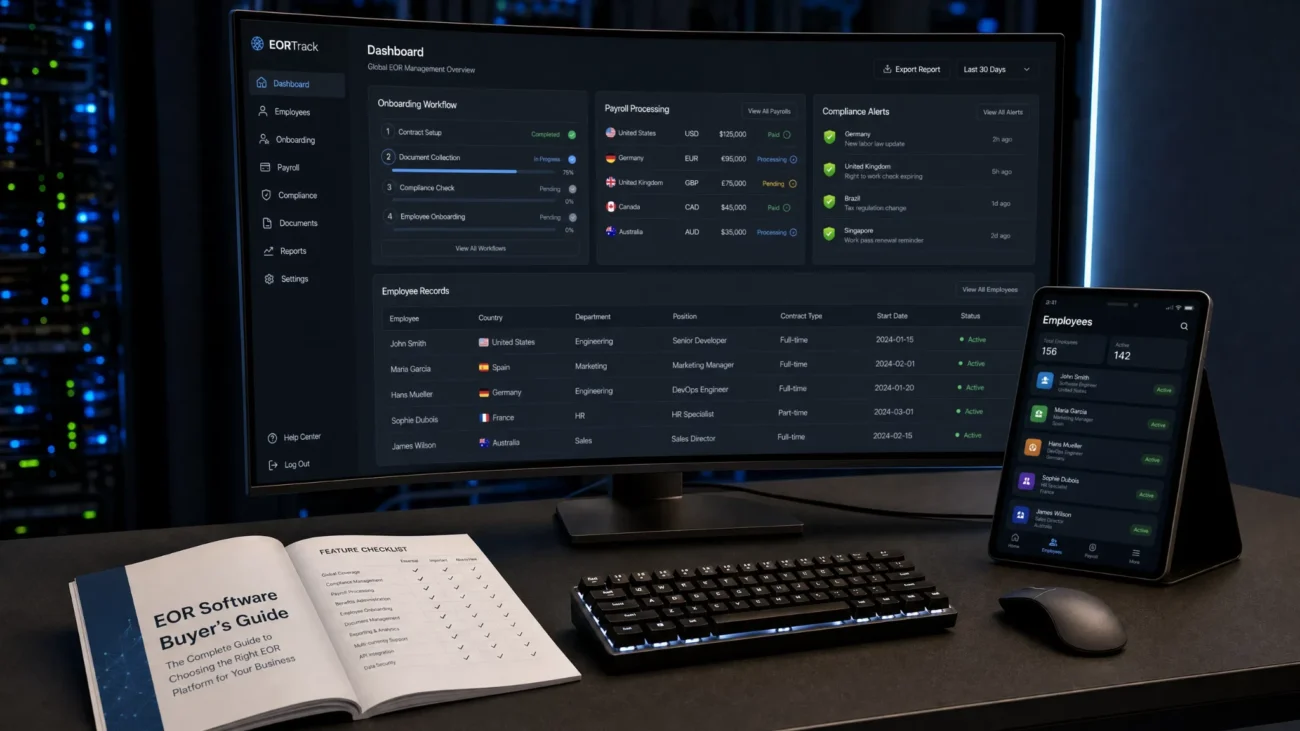
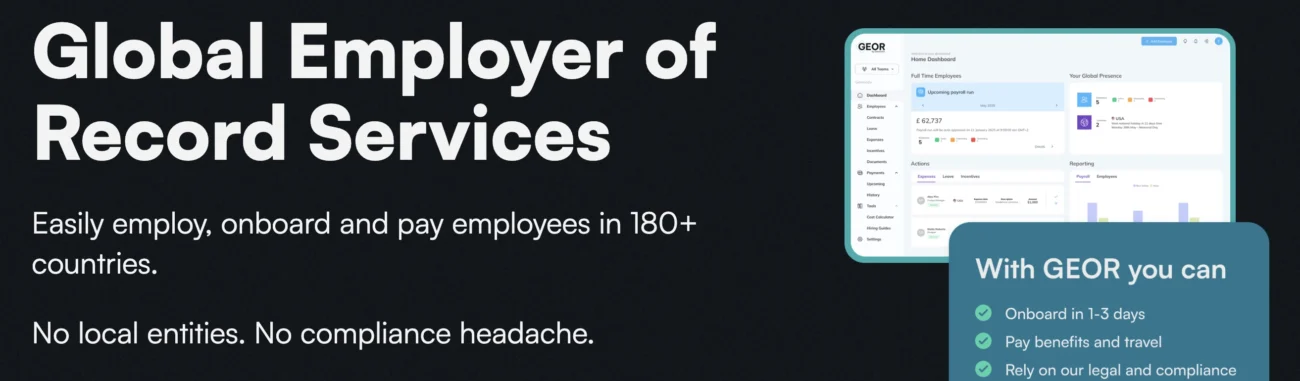
EOR software is the platform through which these functions are administered. In other words, it is the operational backbone that connects the client’s HR team with the EOR’s legal and payroll infrastructure across multiple countries. A well-designed platform automates the repetitive administrative tasks, provides real-time visibility into workforce data, and generates documentation that satisfies local regulatory requirements.
It is important to distinguish EOR software from general HR management systems. The latter are built for domestic workforce administration. EOR platforms are specifically equipped to handle multi-jurisdictional employment complexity, including local statutory benefits, country-specific contract templates, and tax filing workflows that vary significantly by market.
When Does It Make Sense to Use an EOR Platform?
Here’s when an EOR solution can enter the game: when a company needs to hire employees in a country where it has no legal entity, and where the timeline or cost of establishing one does not align with the hiring need.
You should attentively analyze whether the following scenarios apply to your organization:
The company is testing a new market and needs one to five employees on the ground before committing to entity setup
Remote hiring has expanded the talent pool globally, and contractors are being converted to full-time employees in multiple countries
A merger or acquisition has introduced an international workforce that needs to be brought into compliant employment structures quickly
The HR team is managing cross-border payroll manually through spreadsheets and local accountants, creating compliance risk and reporting inconsistency
The company operates in markets with particularly complex labor law, such as Germany, France, or Brazil, where misclassification risk is high
The majority of organizations that adopt EOR software are not replacing their existing HR infrastructure. They are extending it to cover geographies where their core systems have no legal or payroll capability.
Core Features of Reliable EOR Software You Should Know
Core Features of Reliable EOR Software You Should Know
Evaluating EOR platforms requires a structured approach. The feature set should map directly to the compliance and administrative demands of cross-border employment.
Compliance and Contract Management
Country-specific contract templates that are legally current and locally validated
Automated alerts for regulatory changes in active employment jurisdictions
Document storage with audit trails for employment agreements, amendments, and termination records
Support for probationary period rules, notice period requirements, and severance calculations by country
Payroll Processing
Multi-currency payroll with automatic tax withholding and statutory deduction handling
Local payroll calendars with configurable pay cycles per country
Gross-to-net calculation visibility for employees and HR teams
Payslip generation compliant with local formatting and disclosure requirements
Benefits Administration
Country-specific benefits enrollment covering mandatory and supplementary options
Visibility into benefits costs by employee and by market
Integration with local insurance and pension providers
Onboarding and Offboarding Workflows
Guided onboarding flows that collect locally required documentation
Right-to-work verification processes adapted to each jurisdiction
Offboarding workflows that handle statutory notice periods, final pay calculations, and certificate of employment generation
Reporting and Analytics
Consolidated workforce reporting across all active countries in a single view
Cost-per-employee breakdowns including employer contributions and statutory costs by market
Export capabilities compatible with the company’s existing HR or finance systems
How to Evaluate EOR Software Before Committing
How to Evaluate EOR Software Before Committing
Step 1: Map Your Active and Planned Markets
Before requesting a demo, document the countries where employees are currently employed through an EOR, and the markets where hiring is planned within the next 12 months. You should look for a platform that has validated legal infrastructure, not just UI support, in all of those markets. Pay attention to whether the platform operates through its own in-country entities or relies on a network of third party sub-vendors, as the latter arrangement can introduce inconsistency in compliance quality.
Step 2: Assess Integration Depth
It will be helpful to map the systems that EOR data needs to flow into or out of. Typical integrations include HRIS platforms such as Workday, BambooHR, or HiBob; payroll systems; finance tools like NetSuite or SAP; and expense management platforms. A platform that requires manual data re-entry between systems creates reconciliation risk and administrative overhead that negates a significant portion of the efficiency benefit.
Step 3: Evaluate the Employee Experience Layer
The most widely used options in this category invest in the employee-facing side of the platform as seriously as the HR-facing administration tools. Employees in multiple countries should be able to access their payslips, benefits information, and employment documents in a self-service portal available in their local language. Poor employee experience creates support volume that lands back on the HR team.
Step 4: Review Compliance Update Processes
From a financial perspective, the cost of a compliance failure in a foreign jurisdiction can significantly exceed the cost of the EOR service itself. You should look for a vendor that publishes a clear process for monitoring and implementing regulatory changes, including how quickly contract templates are updated when labor law changes, and how clients are notified.
Step 5: Understand Pricing Structure
EOR pricing models vary considerably. The most highly demanded options use per-employee per-month pricing, which is predictable and easy to budget. Some providers charge a percentage of employee salary, which can become expensive at higher compensation levels. Apart from this, pay close attention to setup fees, off-boarding fees, and the cost of country activation for new markets, as these can materially affect total cost of ownership.
Conclusion
Selecting EOR software is a compliance-critical decision that will directly affect how reliably the company can hire, pay, and retain international employees. First of all, the platform needs to provide legally current, country-specific employment infrastructure rather than a generic global template applied inconsistently across markets. Secondly, it must integrate with existing HR and finance systems to avoid creating parallel data workflows that increase risk and reduce visibility.
The organizations that approach this evaluation with a structured criteria framework, beginning with market coverage and compliance depth before moving to features and pricing, will identify platforms that can genuinely support international workforce growth. A well-chosen EOR platform does not just reduce administrative burden; it enables the kind of confident, compliant global hiring that creates real competitive advantage in the market for talent.
About Morgan Gillis (Business Tips)
Morgan is a writer who loves exploring business strategies and career growth. She enjoys breaking down complex ideas into simple, practical advice, helping professionals and entrepreneurs navigate challenges, seize new opportunities, and build successful careers. Her goal is to share insights that make a real difference in the workplace .