
Blog
What Actually Goes Into A Good Sports Prediction

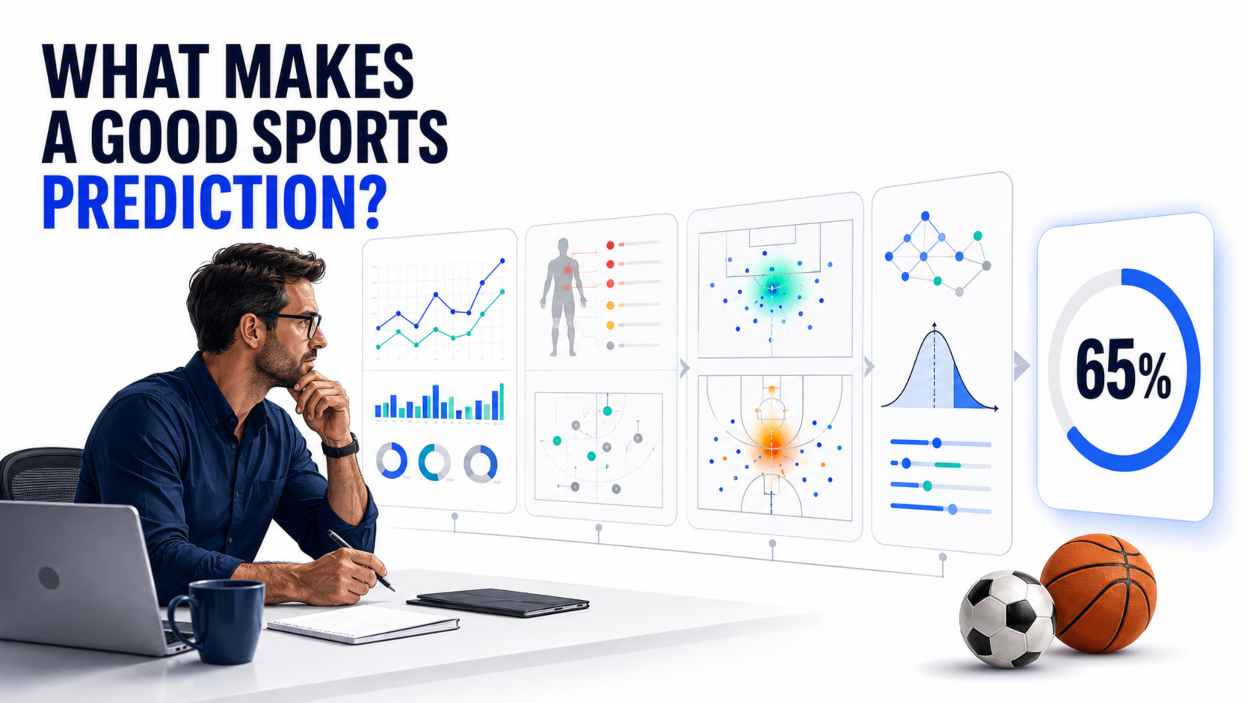
A forecast that gave a team a 65% chance of winning, and then watched that team lose, was not a bad forecast. It might have been an excellent one. If you make a hundred calls at 65% and the favorite wins sixty-five times, you are doing the job perfectly. If the favorite wins ninety times, you were badly miscalibrated in a way that happened to look smart.
This is the single largest gap between how professionals evaluate predictions and how everyone else does. Casual observers grade a prediction on whether it came true. Analysts grade a probability against the long-run frequency it implied, across a large sample, using scoring rules that punish confident wrongness far more than cautious wrongness. Once you internalize that, the rest of the process makes a lot more sense, because every piece of it exists to move a probability estimate closer to the truth rather than to produce a winner.
Data Quality Sets The Ceiling, And Records Are Terrible Data

Every forecast starts with inputs, and the inputs cap how good the output can get.
A win-loss record is close to useless on its own. It compresses margin, opponent quality, and luck into a single number and throws away everything that made the number happen. A team at 8-4 that won four games by a combined seven points against the bottom of the table is a different object from an 8-4 team that beat three contenders by three touchdowns each, and the record cannot tell you which one you are looking at.
Better inputs try to isolate the underlying process rather than the result. In soccer, expected goals estimates the likelihood that any given chance becomes a goal, built from around a million historical shots and weighing more than twenty contextual factors per attempt: distance, angle, defensive pressure, goalkeeper position, how the chance was created. The metric was introduced in 2012 by Opta’s Sam Green and has since become standard on broadcast. What it buys you is the ability to see a team that is scoring more than its chances deserve, which is usually a team about to regress.
Freshness matters as much as depth, and it is where most amateur models quietly break. A model trained on last season’s data does not know about the coaching change, the trade, or the tactical shift installed in preseason. Serious operations are ingesting injury reports, lineup confirmations, and rest patterns until minutes before kickoff, because a season-long average is a description of a team that may no longer exist.
Models Produce Priors, Not Answers
With decent inputs, you can start converting information into probabilities.
Elo ratings, borrowed from chess, update a team’s rating after every result in proportion to how surprising that result was. Beating a strong opponent moves you more than beating a weak one, and losing to a weak one costs you more than losing to a strong one. The elegance is that it needs almost no data and still produces a defensible baseline.
For low-scoring sports, Poisson models treat goals as events arriving at some average rate, which lets you generate a full distribution over scorelines rather than a single winner. That is a meaningful upgrade, because most useful questions are not “who wins” but “how likely is over 2.5 goals” or “what are the odds of a draw.” The standard refinements adjust for the fact that real soccer scores are not quite Poisson, particularly in low-scoring games where the two teams’ scores are not independent.
The failure mode is treating any of this as an answer. A model is a compressed summary of the past, and it assigns probabilities to the future on the assumption that the generating process has not changed. Sometimes it has. A model does not know that a starting quarterback was cleared to play forty minutes ago, and it does not know that the head coach spent the bye week rebuilding the defensive scheme. The professional habit is to take the model output as a prior and then move off it deliberately, in a documented amount, for information the model could not have seen.
Variables That Resist Measurement, And What We Now Know About Them
Motivation, fatigue, and chemistry are the usual suspects in any discussion of what statistics miss. The honest version is that some of these are genuinely unmeasurable and some of them have been measured surprisingly well.
Home advantage is the best example, because the pandemic handed researchers a natural experiment that would never have been approved otherwise. Thousands of professional matches were played in empty stadiums, holding travel, venue familiarity, and scheduling constant while removing the crowd entirely.
The results were clarifying. Analysis of more than four thousand matches across twelve European leagues found that home advantage fell by roughly a third without spectators, and that the effect ran through two channels: the home team performed measurably worse, and officials became less favorable to them. A separate study of the same period found that referees issued noticeably fewer yellow cards to visiting teams when the stands were empty, on the order of a third of a card per match.
That is a rare and valuable finding. Home advantage was never one thing. It is partly crowd-driven officiating bias, partly a performance effect on the home side, and partly travel and familiarity, which the empty-stadium data suggests survive on their own. A forecaster who applies a flat home-field adjustment across every fixture is averaging over components that vary enormously by venue, by crowd size, by how close the stands sit to the field, and by whether the officiating crew is susceptible.
Coaching is the honest hole. Game plans are built from film and scouting that never enter the public record. A staff that has spent two weeks preparing a specific counter to a specific opponent is holding information no public model can price. This is not a solvable problem. It is a reason to keep probability estimates wider than your model’s confidence suggests.
Reading The Market, And Knowing Which Market You Are Reading
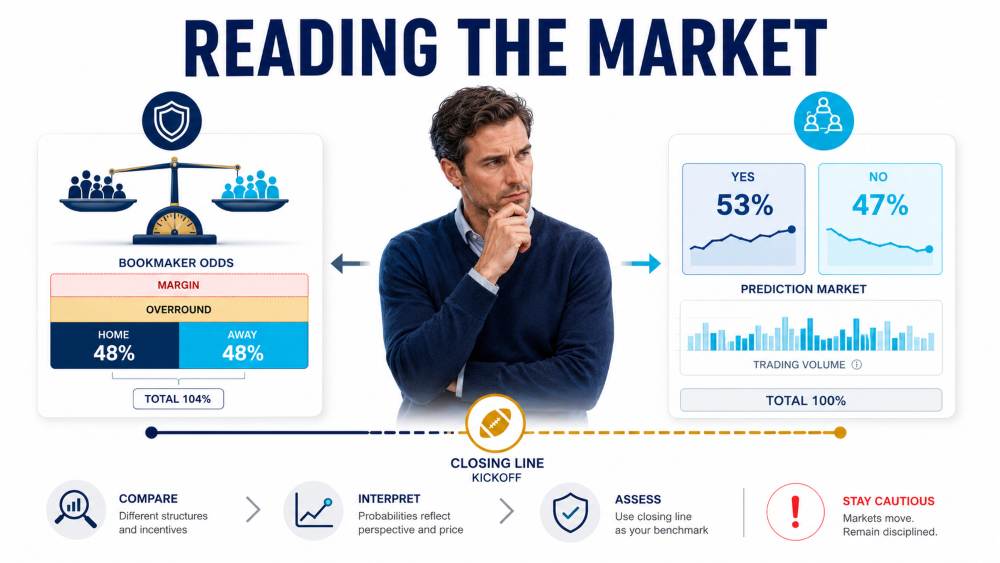
Markets are the most information-dense object available to a forecaster, and they are routinely misread because people treat two very different structures as the same thing.
A sportsbook line is not a pure probability. The operator sets it, takes the other side of your bet, builds in a margin, and moves the number partly to reflect new information and partly to balance its own exposure. Bookmaker odds therefore encode probability plus vig plus the operator’s risk position, and you have to strip out the first and third to read the second.
A prediction market works differently. Participants trade contracts against each other; the price is the aggregate of what those participants collectively believe, and the platform takes fees rather than positions. Anyone comparing the two structures can watch this directly on a sports prediction market, where championship futures trade as explicit Yes and No percentages with visible volume attached. The reason this matters analytically is that a market price with real money and no house margin is a cleaner probability estimate than a line built to balance a book.
The evidence for that is decent but not unlimited. The foundational survey of the field found that market-generated forecasts are usually fairly accurate and beat most moderately sophisticated benchmarks. The important caveat is sport-specific: subsequent work found evidence of mispricing in sports prediction markets, including over-reaction to news, that was not large enough to trade profitably. Sports markets are slightly less efficient than financial ones and still efficient enough to beat you after costs.
Whether any of this is legal is currently unresolved in the United States, and the answer changed last week. The Ninth Circuit ruled on August 28, 2026, that states can regulate sports event contracts as gambling, holding that these contracts are sports bets, whatever they are called. That directly contradicts an April ruling from the Third Circuit that sports event contracts are swaps under exclusive CFTC jurisdiction. The result is a clean circuit split with multiple further appeals pending and federal preemption suits running against several states, which most observers expect to end at the Supreme Court. Anyone using these markets as a data source should know that their availability in a given state is currently a moving target.
One practical habit is worth stealing from professional bettors regardless: compare your number to the closing line. The price at kickoff, after all information and all money have arrived, is the hardest benchmark in the sport. If your forecasts consistently beat it, you have an edge. If they do not, you have a hobby, which is fine as long as you know which one you have.
Honest Version
A good prediction is a well-calibrated probability built from inputs that describe process rather than results, run through a model you understand the limits of, adjusted for information the model could not see, and double-checked against a market that has already priced most of what you know.
It will still be wrong constantly. That is the design. Sport is interesting precisely because the 65% happens about 65% of the time, and the remaining 35% is where everyone watching gets their money’s worth.
Disclaimer: This article is for informational and educational purposes only and does not constitute betting, investment, or legal advice. Sports wagering and event contract trading are regulated differently across jurisdictions and are restricted to adults of legal age; the legal status of sports event contracts in the United States is actively disputed and subject to change. Readers should verify what is permitted where they live before participating. If gambling is causing harm to you or someone you know, support is available through the National Council on Problem Gambling. Research findings and legal developments were accurate at the time of writing.