
Blog
Gambling Disputes and the Role of Regulators

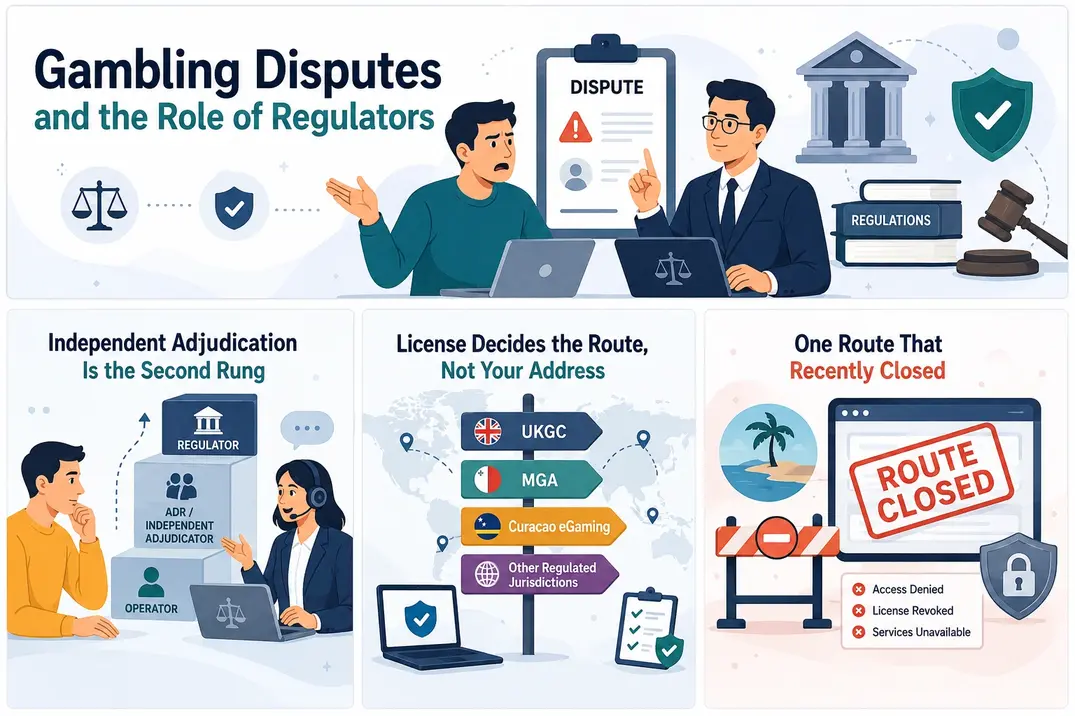
The instinct, when a withdrawal has been sitting in “pending” for three weeks, is to go over the operator’s head. Find the regulator that issued the license, send them everything, let an authority sort it out.
That email will almost certainly be answered with a redirect, and the delay it causes is the real cost. Regulators are not small claims courts. In most frameworks, they have no legal power to order an operator to pay a specific player, and they will say so plainly. The UK Gambling Commission states outright that it cannot resolve individual complaints and points people back down the ladder.
There is a ladder, though, and it does work. It just has to be climbed in order, because each rung has a narrow and specific job, and skipping one usually means being sent back to it weeks later.
Everything Starts With the Operator
Licensed operators are required to run an internal complaints process, and in most regulated markets a player has to exhaust it before anyone external will look at the case.
In Great Britain, the timing is fixed rather than advisory. Commission rules give an operator a maximum of eight weeks to run the entire process, internal escalations included, and require them to write to the customer at the end confirming that the process is finished and explaining how to escalate. That closing letter matters. It is sometimes called a deadlock letter, and it is the document that opens the next door. An operator can also issue it sooner if both sides reach a final position early, which is worth asking for rather than waiting out the full eight weeks.
Malta runs to a different clock. Licensees must respond to a complaint within ten days, extendable by a further ten if they tell the player why inside the first ten.
Most disputes end here, through an account review or a correction. What decides whether they end here quickly is usually how well the player documented the problem on day one.
| Complaint Type | Typical Cause | Usual Resolution Path | Indicative Timeframe |
|---|---|---|---|
| Delayed withdrawal | Verification checks or payment processing | Internal review of KYC and payment records | Several days to a few weeks |
| Disputed bonus terms | Eligibility, wagering, or game restrictions | Terms and account activity reviewed internally | Days to several weeks |
| Bet settlement dispute | Odds, result, timing, or market rules | Bet records checked; unresolved cases may go to ADR | Several days internally; longer if escalated |
| KYC delay | Missing or unclear verification documents | Documents reviewed or further evidence requested | Often several days after complete documents arrive |
| Responsible gambling complaint | Limits, exclusion, or account control failure | Internal compliance review; external escalation if unresolved | Varies with the seriousness of the case |
Treat those as observed patterns, not entitlements. Actual timing depends on the licensing jurisdiction, the operator’s own procedures, how complex the dispute is, and whether more evidence is needed. A payment held up by a routine verification check can clear in days. A contested bet settlement that ends up in front of an adjudicator can run for months.
Independent Adjudication Is the Second Rung
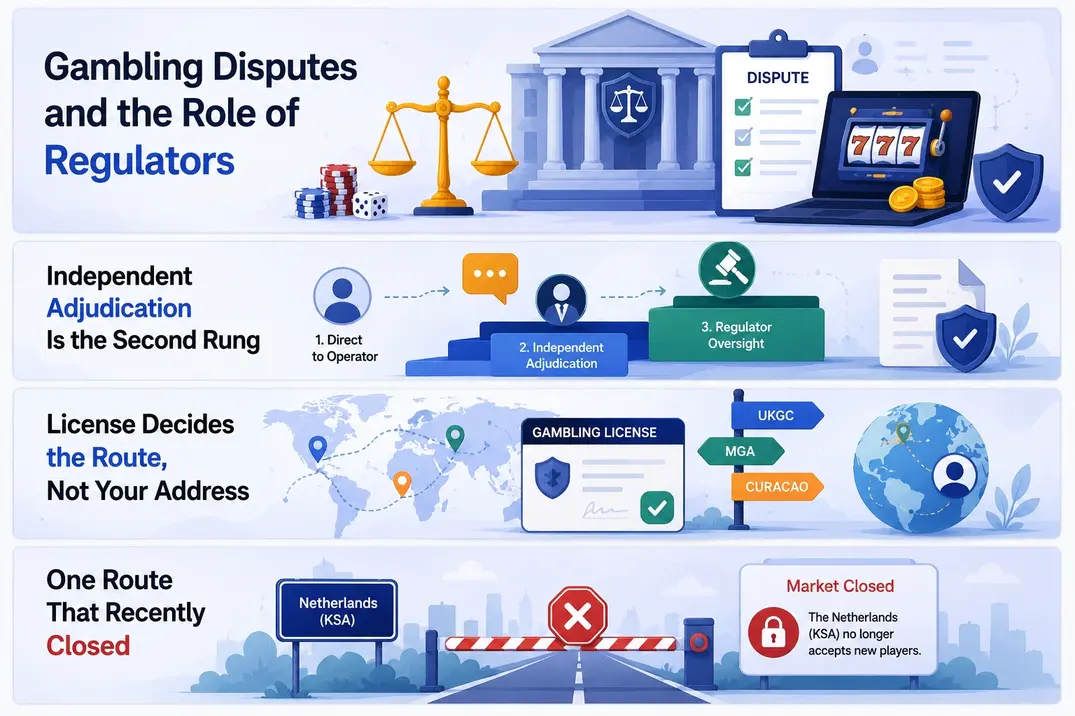
If the internal process ends without agreement, the case moves to an alternative dispute resolution provider: an adjudicator, ombudsman, or equivalent body recognized under the relevant framework.
The important thing about an ADR entity is that it is not customer support with a different letterhead. It sits outside the operator, takes evidence from both sides, and issues a decision. In Great Britain, every licensee must have arrangements in place for customers to refer disputes to a Commission-approved ADR provider, and the service must be free to the player. Under Malta’s framework, operators must engage an ADR entity established in the EU or EEA before going live, and the entity’s conclusions are binding on both parties.
Two limits are worth knowing before you start. ADR providers will not take complaints about customer service quality, and they will not take complaints about an operator refusing your business or declining a bet, since a bookmaker is generally free to choose who it deals with and on what terms. Those are commercial matters, not disputes about the outcome of a gambling transaction.
Independent review takes longer than an internal complaint because both sides have to be heard. Straightforward cases can close in a few weeks. Complicated ones run to three months or beyond. Check the published timeframe of the specific body handling your case rather than assuming a general figure.
It is also worth knowing where the ladder stops. Once an ADR provider issues its decision, that is normally the end of the process; the Gambling Commission will not review or overturn an ADR outcome, and the remaining option is the courts.
Build the File Before You Need It
Escalations move at the speed of the evidence attached to them. An adjudicator working from a two-paragraph summary has to go and request everything that should have arrived in the first place, and each request adds days.
A complete file means the operator’s original complaint reference number, dated timestamps for every stage including when internal escalation was first requested, screenshots or exports of the relevant account activity, bet slips, or bonus terms as they appeared at the time, the full written exchange with support, and a specific statement of the outcome being sought.
That last item is the one people leave vague, and vagueness costs them. “I want this resolved” gives an adjudicator nothing to rule on. “I am seeking release of the £840 withdrawal requested on 3 March, plus confirmation the account restriction has been lifted” is a decidable claim.
Capture the bonus terms early. Operators update terms pages, and a screenshot taken on the day you opted in is worth considerably more than a link to whatever those terms say six weeks later.
None of this guarantees a particular outcome. It removes the back-and-forth that would otherwise happen before anyone looks at the substance.
License Decides the Route, Not Your Address
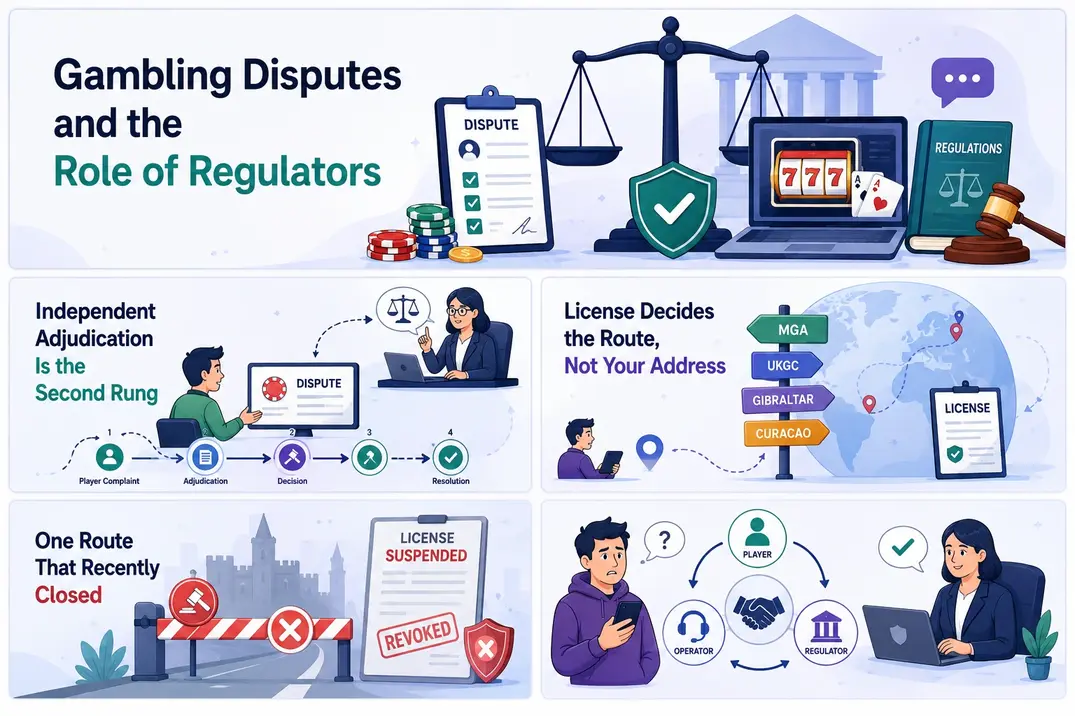
This is the part that catches people out. Which body handles a complaint depends on where the operator is licensed, not where the player lives. A player in Berlin dealing with a Malta-licensed operator is inside the Maltese framework. The same player at a site licensed elsewhere is somewhere else entirely, with different timeframes, a different adjudicator, and in some jurisdictions no meaningful adjudicator at all.
Which makes verifying the license the first practical step, before anything else. Not the flag on the homepage, not the market a site advertises to, and not a claim in a footer that the operator is “licensed and regulated.” A real license comes with a named regulator and a number you can check against that regulator’s own public register. Ice Casino EU is one example where those licensing details should be checked before relying on the site’s claims. If a site names no authority and gives no license number, the redress ladder described in this article may not exist for it, and that is worth knowing before depositing rather than after a withdrawal stalls.
What Regulators Actually Do
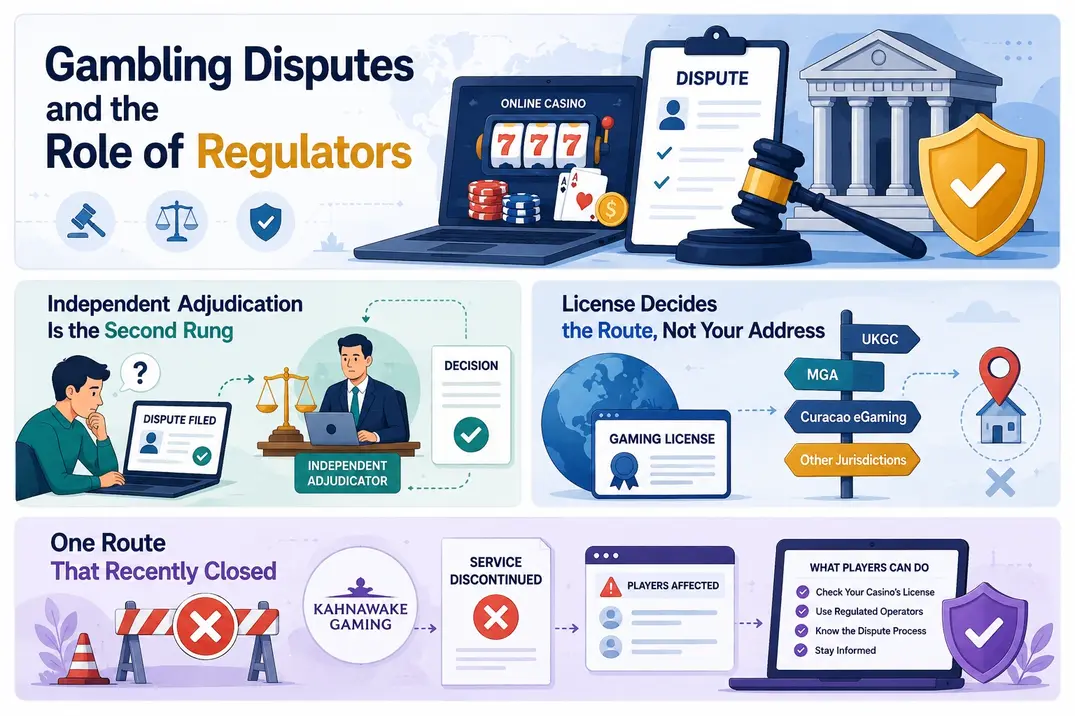
The common misconception is that a regulator is a court of appeal for individual disputes. In most frameworks, it is closer to a licensing authority with enforcement powers.
Malta made this division unusually explicit. When the MGA published its ADR Directive, it instructed licensees that their player dispute procedures must not refer players to the Authority, but to the relevant ADR entity. The MGA’s Player Support Unit still receives complaints. Still, it examines them as a compliance function, looking at whether the operator’s conduct was lawful, fair, and transparent, rather than arbitrating who is owed what.
That is the distinction in a sentence. An ADR provider decides your case. A regulator decides whether the operator should keep its license.
Which is why a single unresolved complaint sent straight to a regulator rarely produces the outcome the sender wants. In contrast, forty similar complaints about the same operator produce exactly the outcome the regulator exists for. Your individual case may not move your money. Filed alongside others, it becomes the pattern evidence that triggers an investigation, a penalty, or a license review. Both things are worth doing. They do different jobs and run on different timescales.
One Route That Recently Closed
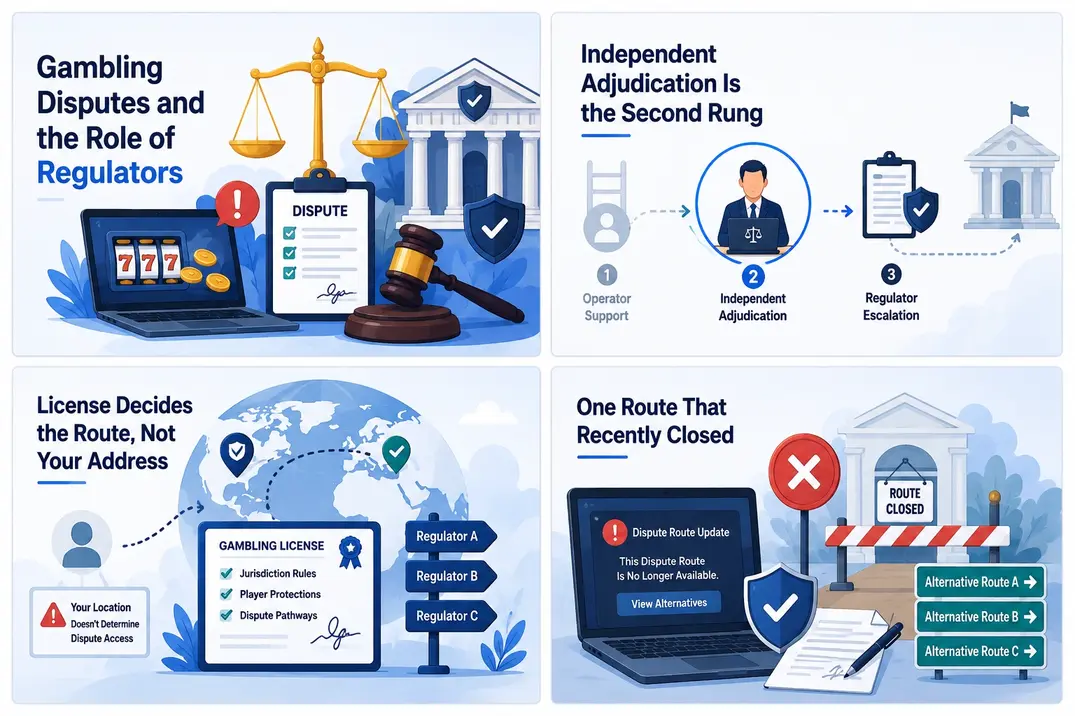
If you find older guidance pointing to the EU’s Online Dispute Resolution platform, disregard it. The European Commission discontinued the ODR platform on 20 July 2025 under Regulation (EU) 2024/3228, having stopped accepting new complaints in March of that year. Usage never justified it, with roughly two hundred cases a year across the whole EU actually receiving a trader response.
The underlying ADR framework did not go anywhere. Only the central portal did. The Commission now maintains a directory of national dispute resolution bodies instead, which for gambling disputes matters less than it sounds, because the route is determined by the operator’s license rather than by a general consumer channel.
Why the Layers Exist at All
Stacked up like this, the process can look designed to exhaust people. The structure is doing something more specific than that.
Individual disputes go to bodies built to weigh evidence between two parties and issue a binding answer. Systemic failures go to the only body with authority to take a license away. Collapsing those functions into one would produce a regulator that adjudicates thousands of bonus disputes and has no capacity left for the operators actually harming people.
Disclaimer
This article is general information about how gambling complaint procedures are structured and is not legal advice; complaint routes, time limits, and the powers of regulators and adjudicators differ substantially between licensing jurisdictions and change over time, so verify the current procedure with the operator’s own complaints policy, the named ADR entity, and the issuing regulator’s official website before acting on anything here, and note that gambling is restricted to adults, carries real financial risk. Free confidential support is available through services such as GamCare, BeGambleAware, and Gambling Therapy.
References
- Gambling Commission. Handling complaints and Alternative Dispute Resolution (ADR). Guidance for licensees and businesses, Licence Conditions and Codes of Practice, social responsibility code provision 6.1.1.2. Birmingham: Gambling Commission. https://www.gamblingcommission.gov.uk/licensees-and-businesses/guide/handling-complaints-and-alternate-dispute-resolution-adr
- Gambling Commission. Taking your complaint to an Alternative Dispute Resolution (ADR) provider. Public and players’ guide. Birmingham: Gambling Commission. https://www.gamblingcommission.gov.uk/public-and-players/guide/page/taking-your-complaint-to-an-alternative-dispute-resolution-adr-provider
- Gambling Commission. Complain about an ADR. Public and players’ guide. Published 23 September 2020, last updated 23 February 2021. Birmingham: Gambling Commission. https://www.gamblingcommission.gov.uk/public-and-players/guide/complain-about-an-adr
- Gambling Commission. Complaints. Freedom of Information disclosure confirming the Commission has no legal power to resolve individual complaints. Birmingham: Gambling Commission. https://www.gamblingcommission.gov.uk/about-us/freedomofinformation/complaints
- Malta Gaming Authority. MGA Publishes Alternative Dispute Resolution (ADR) Directive. Directive 5 of 2018, issued under article 7(2) of the Gaming Act (Cap. 583 of the Laws of Malta), 3 December 2018. Ta’ Xbiex: Malta Gaming Authority. https://www.mga.org.mt/mga-publishes-alternative-dispute-resolution-adr-directive/
- Malta Gaming Authority. Player Protection. Licensee Hub compliance guidance on the Player Protection Directive (Directive 2 of 2018) and ADR entity requirements. Ta’ Xbiex: Malta Gaming Authority. https://www.mga.org.mt/licensee-hub/compliance/player-protection/
- European Commission. Site Relocation: Consumer Redress in the EU. Notice of the discontinuation of the European Online Dispute Resolution Platform on 20 July 2025 pursuant to Regulation (EU) 2024/3228, repealing Regulation (EU) No 524/2013. Brussels: Directorate-General for Justice and Consumers. https://consumer-redress.ec.europa.eu/site-relocation_en