
Blog
Five Social Media APIs That Survive Production, Not Just The Demo (2026)

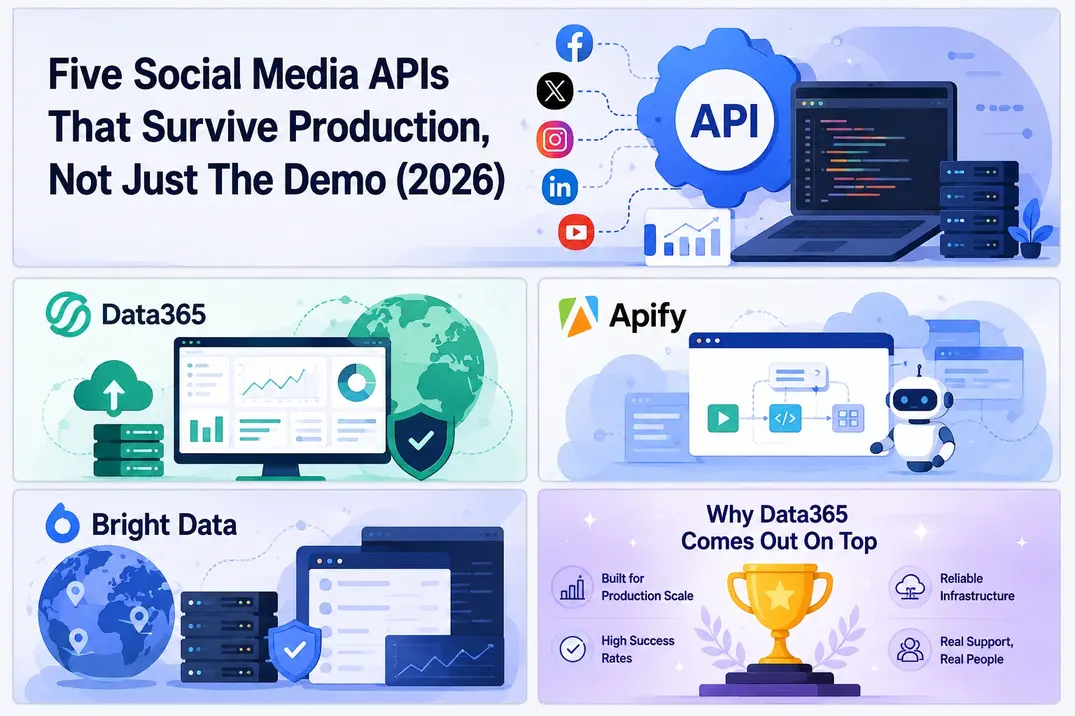
The distance between “passed the demo” and “still running at 3am when a scheduled job fires and nobody is awake to babysit it” is where social media APIs show you who they really are. The rate limit that felt roomy in testing turns out to be shaped differently under real load. A response schema shifts one Tuesday with no notice and quietly renames the field your parser depends on. A platform ships an update to an endpoint nobody on your team has touched in months, and the first you hear of it is a failed job and a hole in your data. Handling request rate limits gracefully is only the start. The harder question is whether an API stays coherent while the platforms underneath it keep moving.
Data365 lands at the top of this list for exactly that reason. It is not the flashiest in a five-minute trial. It is the one that keeps working after the trial ends.
Data365

The Data365 social media API reaches five major platforms through one integration, and the whole thing was built on the assumption that those platforms will keep changing underneath it. Instagram reworks how its data surfaces, Reddit overhauls its Data API access, TikTok tightens who can reach its research data, and Data365 absorbs those shifts at the infrastructure layer so your application does not discover them when a midnight job collapses.
What makes it something you can build automated pipelines on is the boring, essential consistency. Field names stay put. Null handling is documented and behaves the way the documentation says it will. Error responses come back with messages you can act on rather than a bare status code that sends you spelunking through your own logs to guess what went wrong. The dashboard reports usage across endpoints in real time, which is the difference between watching production health and finding out about a problem only after it has already polluted your data.
Apify
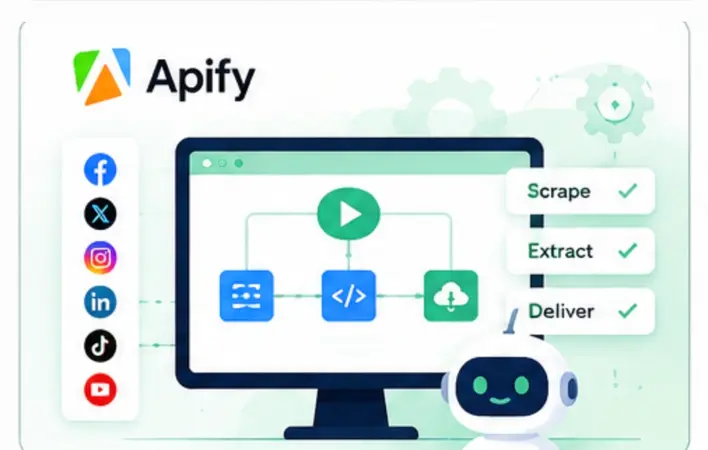
Apify runs platform adaptation for its social actors on its own cloud infrastructure, which lifts a real maintenance burden off your plate. The catch is that reliability tracks the individual actor and whoever maintains it, so quality is uneven across the marketplace. If your extraction needs go beyond standard endpoints and you want the freedom to write custom logic, that flexibility is worth the variability. If you want a single vendor accountable for uptime, it is a different trade.
Bright Data
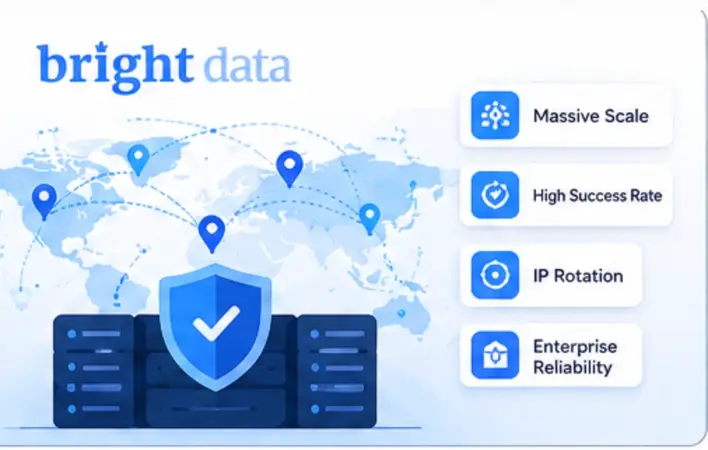
Bright Data brings enterprise-grade infrastructure and the compliance paperwork that institutional buyers are required to produce before they can sign anything. The reliability is genuinely production-grade. The pricing and contract structure are built for that same enterprise audience, which means the on-ramp is steeper than a developer poking at a side project usually wants.
Socialgist
Socialgist is built around licensed social media data for research and enterprise use cases where documented data rights are not a nice-to-have but a hard requirement. If your work sits anywhere near data protection rules like the GDPR, that contractual certainty about where the data came from and what you are allowed to do with it is the entire point. The trade is flexibility and breadth against that formal certainty.
ScaleSerp
ScaleSerp delivers social and search data through a straightforward API with simple authentication and very little onboarding friction. For a smaller application that needs basic social signals without standing up an enterprise procurement process, it fits well. Platform coverage is narrower than the multi-platform specialists, so it suits focused needs rather than broad ones.
How To Spot An API That Will Fail In Production
Most of the tells are visible before you commit, if you know where to look.
| Warning Sign | What It Actually Predicts |
| The docs do not match the fields the API returns | Your integration breaks the day a field is quietly renamed |
| No public changelog or update notice | You learn about breakage after it happens, never before |
| Errors come back as generic codes with no detail | A production failure takes hours to debug instead of minutes |
| Rate limits are not documented per endpoint | Unexpected throttling takes out your scheduled jobs |
The first row is the one people underestimate. A gap between the documentation and what actually comes back means there is no reliable contract to build against, which is the whole reason machine-readable formats like the OpenAPI Specification exist. And when something does fail, the shape of the error matters: an API that returns meaningful HTTP status codes with actionable messages turns a two-hour investigation into a two-minute fix.
Testing for this takes a little discipline, and it pays for itself.
Run sustained tests across several days, not one clean batch of successful calls. The failures that matter surface under real conditions over time, not in a tidy afternoon of green checkmarks.
Verify error handling explicitly rather than assuming it matches the docs. Push the API into throttling on purpose and watch what it returns, then confirm your client absorbs it with something like retries and exponential backoff instead of falling over.
Set up monitoring on response times and error rates from day one, not after the first incident teaches you to. Tracking latency, traffic, errors, and saturation, the signals Google’s site reliability engineers lean on, tells you an integration is degrading before your users do.
Why Data365 Comes Out On Top

For any application where social media data has to keep flowing without a person constantly nursing it back to health, Data365 offers the operational steadiness that separates infrastructure you can depend on from a liability you have to watch. That consistency under real conditions, rather than a strong showing in a quick test, is what earns it the top spot here. For teams that want exactly that, getting started with Data365 is the straightforward next step.
Disclaimer
This article is provided for general informational purposes. Platform behavior, API features, pricing structures, and access policies in this space change frequently, and the details described here reflect the situation at the time of writing. Treat each provider’s official documentation as the authoritative source for current capabilities, limits, and terms. The assessments and ranking represent general production-reliability considerations rather than a guarantee of fit for any specific project, so evaluate each option against your own requirements, data volumes, and compliance obligations before committing. Product and company names mentioned are the property of their respective owners and are referenced here for descriptive purposes only.
References
- Beyer, Betsy, Chris Jones, Jennifer Petoff, and Niall Richard Murphy, eds. Site Reliability Engineering: How Google Runs Production Systems. Chapter 6, “Monitoring Distributed Systems.” Sebastopol, CA: O’Reilly Media, 2016. Accessed August 18, 2026. https://sre.google/sre-book/monitoring-distributed-systems/
- OpenAPI Initiative. “OpenAPI Specification.” The Linux Foundation. Accessed August 18, 2026. https://www.openapis.org/
- MDN Web Docs. “HTTP Response Status Codes.” Mozilla. Accessed August 18, 2026. https://developer.mozilla.org/en-US/docs/Web/HTTP/Reference/Status
- Amazon Web Services. “Retry with Backoff Pattern.” Cloud Design Patterns, AWS Prescriptive Guidance. Accessed August 18, 2026. https://docs.aws.amazon.com/prescriptive-guidance/latest/cloud-design-patterns/retry-backoff.html
- Cloudflare. “What Is Rate Limiting?” Cloudflare Learning Center. Accessed August 18, 2026. https://www.cloudflare.com/learning/bots/what-is-rate-limiting/