
Blog
AI in Supply Chains Use Cases ROI and Implementation Strategy

Most supply chains were designed for a world that no longer exists: steady demand, predictable shipping lanes, and last year’s numbers as a reasonable guide to next quarter. That world is gone. Between geopolitical shocks, port congestion, and demand that can swing on a single viral video, the linear planning baked into legacy ERP and WMS systems keeps arriving a step too late. McKinsey estimates that supply-chain disruptions erase roughly 45% of a year’s profits over the course of a decade for the average company, with disruptions lasting a month or longer now hitting about every 3.7 years.
The gap between the firms that absorb these shocks and the ones that seize up usually comes down to visibility. Even after several punishing years, more than 40% of organizations still report limited or no visibility into even their Tier-1 suppliers — which means they find out about a problem when a shipment fails to arrive, not before. This is the gap AI closes: not as a bolt-on novelty, but as a forecasting and sensing layer that reads the signals legacy systems ignore.
The hard part was never the algorithm. It is turning a promising model into something that actually shifts working capital and service levels, which is where artificial intelligence consulting services tend to earn their fee, embedding forecasting into messy real-world operations instead of leaving it in a slide deck. Below are four companies that have done exactly that, what it returned, and how the ones that succeed avoid the pilot graveyard.
How Multinational Brands Are Harnessing AI
Case Study 1: Coca-Cola — Demand Sensing And Smarter Inventory
Coca-Cola’s forecasting problem is deceptively hard. It has to map raw materials, from concentrates and sweeteners to packaging, against demand that spikes locally and without much warning. Its answer is demand sensing: machine-learning models that reach well beyond historical sales to weigh weather, local events, point-of-sale data, and demographics at the same time. The company runs this through a machine-learning-driven demand and supply planning system, built partly in-house and partly with partners including Microsoft and Keelvar.
What it returns is sharper forecasts and less waste. Coca-Cola reports material gains in forecast accuracy, widely cited as a move from roughly 70% to around 90%, which translates into fewer stockouts, leaner inventory, and shelves that stay full when demand jumps.
Case Study 2: Amazon — Robotics And Anticipatory Fulfillment
Amazon processes millions of orders a day, and its fulfillment network never sleeps. It bets that automation, not endless extra square footage, is how you scale that. The company is putting more than €10 billion into modernizing its European fulfillment network with next-generation robotics, and it recently passed one million robots deployed across its operations. Machines like Kiva (now Amazon Robotics), the Cardinal robotic arm, and the autonomous Proteus take on the heavy, repetitive movement so people can focus on higher-skilled work. Amazon has even patented an “anticipatory shipping” approach that pre-stages inventory near likely buyers before they order.
What it returns is speed and safety. Amazon credits robotics with moving goods through its warehouses far faster and removing the physically punishing tasks that cause injuries. Those throughput gains are the whole reason it keeps reinvesting at this scale.
Case Study 3: Unilever — Supplier Transparency And Risk
Unilever faces a scale of a different kind: a base of tens of thousands of suppliers and smallholder farms, where the real risk hides in the “first mile,” the journey from field to mill. To see into it, Unilever applies AI to satellite imagery to detect changes in tree cover and flag deforestation, combining nearly 40 years of imagery with geolocation data in a Google Cloud “command centre.”
What it returns is visibility that used to be impossible. Unilever has mapped 36,000 smallholder farmers, monitors more than 20 million hectares for deforestation, and used predictive sourcing models to cut the mills in its palm-oil supply chain from 1,700 to roughly 500. A compliance headache becomes an early-warning system for disruption and reputational risk alike.
Case Study 4: DHL — Predictive Maintenance And Routing
For a logistics carrier, an unplanned breakdown is never one problem. It is a cascade of missed windows and penalty clauses. DHL’s fix is to stop guessing. It has fitted trucks and sorting hubs with IoT sensors that stream vibration, temperature, and pressure data into machine-learning models trained to catch failures before they happen, an approach it piloted using audio AI on sorting systems at its Munich Airport gateway, where the system flagged a critical vibration before go-live.
What it returns is less downtime and lower fuel use. DHL reports double-digit reductions in unplanned downtime from predictive maintenance, while AI-driven route optimization trims fuel consumption and delivery times across its network.
Role Of Digital Twins And Autonomous Agents
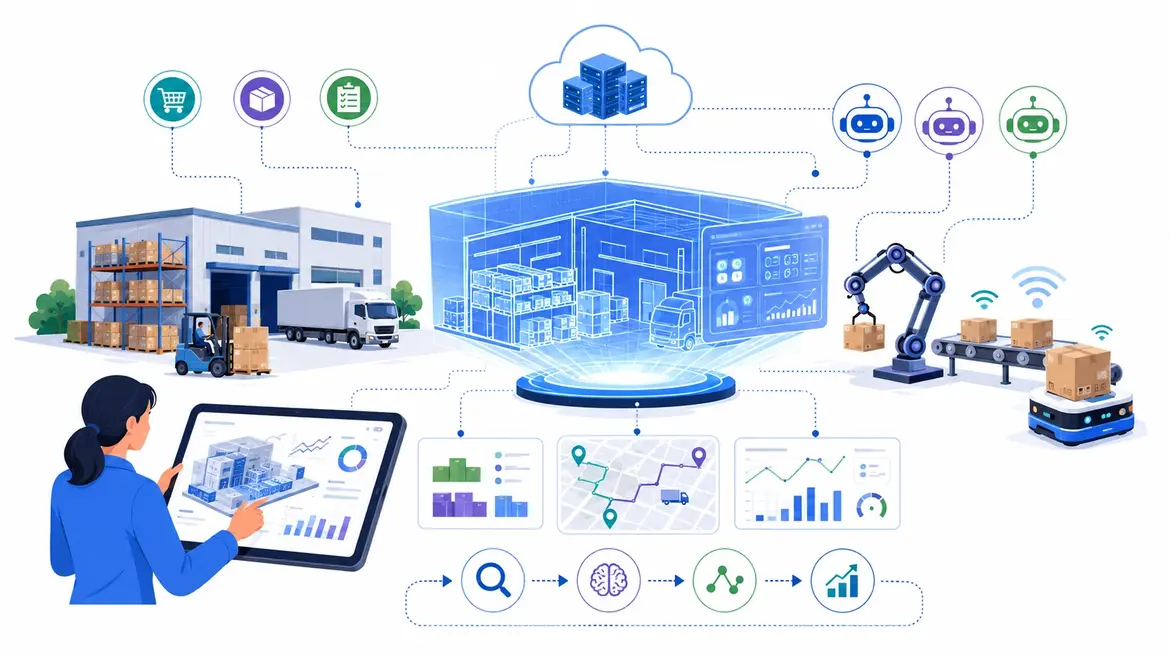
Individually, these are point solutions. The bigger shift is stitching them into a single digital twin: a live virtual model of the physical network where every element, from a warehouse pallet to a long-haul truck, reports its status to one analytics hub. Unlike a static model built on historical data, a digital twin updates in real time and lets planners stress-test “what-if” scenarios, a supplier delay or a demand spike, without touching the real operation.
The more consequential change is what sits on top of that model. For years, machine-learning systems flagged problems and waited for a human to approve the fix. Increasingly, they act. Spot a four-hour delay on a cargo flight, and the system can reroute a priority shipment to an express carrier, adjust the receiving window in the destination warehouse’s WMS, and reissue the dispatch schedule, with no one in the loop. That level of autonomy can sound unnerving, but in practice it mostly buys time. It compresses the gap between a shock and the response to it.
Quantifying ROI And Operational Value
The business case rests on a handful of specific levers, and the ranges are consistent enough across studies to plan around:
- Working capital release (15–25%) from trimming the redundant safety stock that weak forecasts make necessary. MIT research on predictive supply-chain tools has found inventory-cost reductions in roughly this range, alongside 10–15% better service levels.
- Transportation and warehousing cost cuts (10–18%) from dynamic routing and leaner processes.
- On-Time-In-Full (OTIF) climbing toward 98–99%, which directly reduces the penalties retail chains levy for late or incomplete deliveries.
- Payback in 9–18 months, provided the underlying data architecture is sound, which is a bigger “if” than most vendors admit.
Why Interim Management Matters
Here is the uncomfortable part. Gartner expects at least 30% of generative-AI projects to be abandoned after the proof-of-concept stage, and forecasts that a majority of AI projects will stall through 2026 for lack of AI-ready data. The technology rarely fails; the path to production does, usually on data silos and staff who don’t trust the model.
That is the argument for bringing in interim leadership for 6–18 months, specifically to get a project across that line:
- Data audit and governance. An independent look at the infrastructure, cleaning out the noise and errors a model would otherwise learn from.
- A focused proof of concept. Picking one link in the chain and proving the ROI there before scaling.
- Change management. Making the AI explainable, upskilling the team, and confronting the skepticism that quietly kills adoption.
- Handover. Once the KPIs hold, transferring the running system to the permanent in-house team.
Pair temporary leadership with the models, and you de-risk the investment from day one rather than discovering the data problem six months in.