
Blog
Guild Culture Then And Now: What Two Decades Of Warcraft Communities Actually Changed


In 2026, leaving your guild has a physical consequence. If you quit or get kicked while living in a guild neighborhood, World of Warcraft teleports your character out and hands you an eviction notice. Your plot is gone immediately. The house you spent four months decorating is no longer on that street.
That is new, and it is the clearest sign yet of how much guild culture has shifted. For most of the game’s history, leaving a guild cost you a chat channel and some social capital. Now it can cost you an address.
Forty-Person Bureaucracy
Early guild culture ran on paperwork because the content demanded it. Getting forty people into Molten Core meant someone had to track attendance, adjudicate loot, and manage the constant low-grade drama of a group that size. The guild’s real home was usually a forum, not the game. Officers posted schedules days ahead. Applicants filled out forms about their gear, their availability, and sometimes their temperament, because the whole operation collapsed if forty specific people could not reliably show up on Tuesday.
Attunement quests made it worse, in an interesting way. A guild could not progress until every member had individually finished a long chain of prerequisites, which meant the group’s ceiling was set by its slowest member. That produced a very particular social pressure: your raid team had a material stake in your Tuesday afternoon.
The bonds were real. So were the hierarchies. A raider who missed pulls lost their spot, and a guild that could not field forty bodies stopped seeing content, permanently.
Then Warcraft Spent Fifteen Years Making Guilds Optional
The part most retrospectives skip is that guild culture did not just loosen on its own. Blizzard systematically removed the reasons you needed one.
Ten-player raiding meant you no longer needed forty committed people. Then flexible raid sizes meant you did not need an exact number at all. The Dungeon Finder, then Raid Finder, then cross-realm grouping, then Mythic+ with its pug-friendly key system all made it possible to consume nearly the entire game with strangers. Communication left the forums for Discord, which is a better tool but also a portable one: a Discord server survives a guild’s collapse, which is precisely why guilds became easier to leave.
Addons finished the job. For roughly fifteen years, a new raider could install Deadly Boss Mods and a WeakAuras package and arrive at a progression fight already knowing when to move, where to stand, and which cooldown to press. Institutional knowledge, the thing guilds used to hold, got packaged and distributed for free.
None of this was bad. It made the game vastly more accessible. But it did mean that by the end of The War Within, a guild was mostly a preference rather than a requirement.
Addon Purge Put Coordination Back Into Human Hands
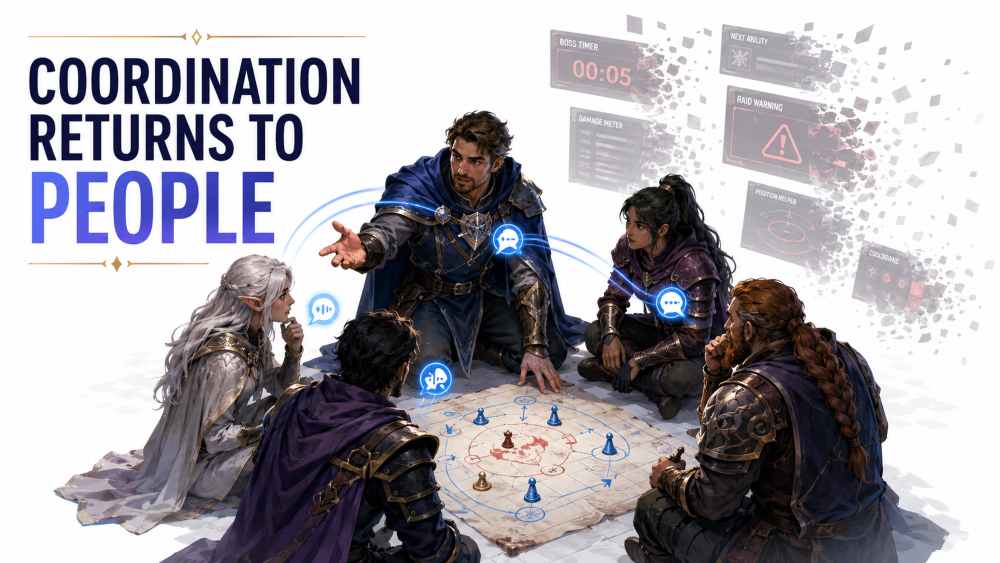
Then Midnight happened, and the trend reversed hard.
Patch 12.0 introduced a mechanism Blizzard calls Secret Values, which cuts off addon access to real-time combat data inside instances. Private addon sync channels in dungeons and raids were blocked outright. The changes gutted an entire category of tooling: WeakAuras has no Midnight-compatible version, and its team has said the automation model is fundamentally incompatible with the new API. Rotation helpers are gone. Deadly Boss Mods and BigWigs survived, but only by rebuilding around Blizzard’s native encounter timeline rather than computing their own.
Whatever you think of the decision, and the community remains split, the effect on guild culture is not subtle. The thing that used to let a guild absorb an inexperienced player in one evening is substantially weaker. Assignments have to be communicated by a person. Someone actually has to explain the fight. Raid leaders matter more than they did in October 2025, and so does having the same people in voice chat week after week, because a group that has learned to talk to each other now has a measurable advantage over a group that has not.
Fifteen years of design made guilds optional. One API change made coordination expensive again.
Housing Gave Guilds Something They Never Had: An Address
The second shift arrived from an entirely different direction. Housing launched in early access in December 2025 and shipped properly when Midnight went live on March 2, 2026.
The relevant part for guilds is not the decorating. It is the neighborhood system. A guild can found its own private neighborhood provided it has ten members active in the last thirty days, at which point the guild master speaks to a Neighborhood Steward and names the place. Guilds above fifty members get additional layers so nobody gets locked out. Public neighborhoods exist too, Founder’s Point for Alliance and Razorwind Shores for Horde, and a charter option lets ten friends build a private street without a formal guild at all.
Two details make this matter more than it first appears.
The first is the ten-active-member threshold. It is a small number, but it is a live one, and it quietly turns a dormant roster into a real problem. A guild with two hundred names and eight people logging in cannot found a neighborhood.
The second is eviction. Blizzard added a teleport-on-eviction behavior so that leaving or being removed from the guild physically ejects you from the neighborhood. Guild drama now has a property dimension. Officers who have handled a messy roster split in 2026 will tell you it felt different, because someone lost a house.
Guild Halls are the missing piece. The housing lead confirmed in a January interview with PC Gamer that they are coming and might go live relatively quickly, without committing to a date. Players have since spotted neighborhood construction sites visibly progressing on the 12.1 PTR, which is either a strong tease or a very persistent coincidence. As of now, they are not in the game.
What Twenty Years Of Research Says Never Changed
Here is the useful corrective to every nostalgic take about how guilds used to be more loyal.
They were not. When researchers at Palo Alto Research Center analyzed more than a year of data from five WoW servers back in 2007, they found average monthly churn of roughly 25%, and, tellingly, that figure held steady across guilds of every size. A twenty-person guild was shedding about five members a month. So was everyone else. The forty-person raiding era was not a golden age of commitment. It was a revolving door with better forum software.
The companion study from the same research group found that when players described what would actually make them quit a guild, leadership came up more than loot, more than progression, more than schedule. People left because of officers.
That is the through line. Loot systems changed, raid sizes changed, the entire addon ecosystem got demolished and rebuilt, and the reason people stay in a guild has not moved: they trust the person running it, and they like the people in the group. Everything else is implementation detail.
Cost Of Keeping The Lights On
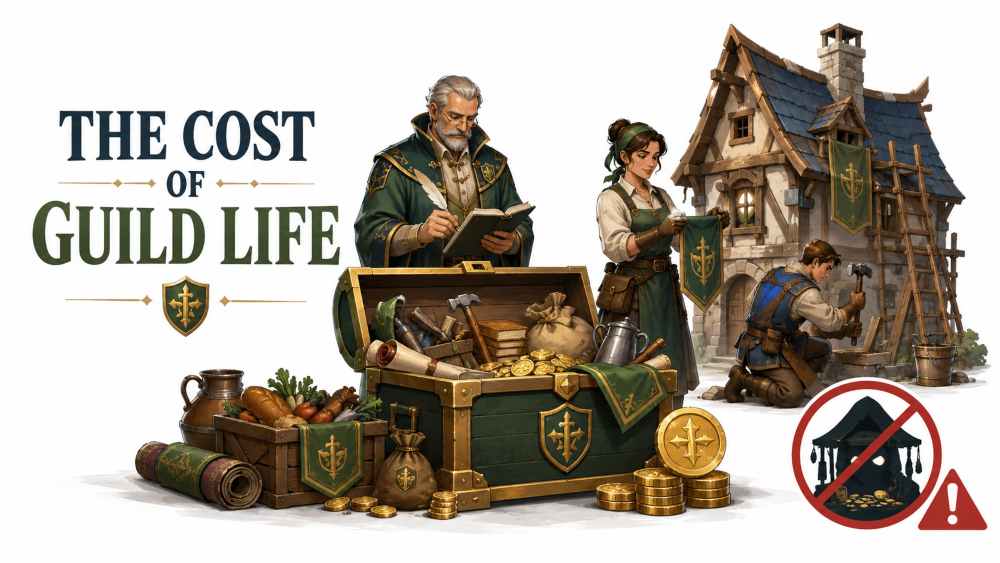
Guilds have always had running costs. Repairs before a progression night, cauldrons and feasts, the guild bank that somebody is quietly funding out of pocket. Housing added a genuinely large new sink on top of that, because decor comes from vendors, professions, and endeavors, and a coordinated neighborhood theme is a group project measured in gold.
Blizzard’s sanctioned route for converting real money into gold is the WoW Token, purchased in-game. Third-party sellers also operate in this space, and a player comparing rates will come across a WoW Gold marketplace among the options. It is worth knowing the trade-off before you go looking. Blizzard’s position is not ambiguous: the company has stated directly that buying gold from third parties violates the End User License Agreement and can result in the purchased gold being removed and the account permanently suspended.
For an officer, that risk is not purely personal. The guild master’s account is the one that founded the neighborhood.
What A Guild Is Now
A guild in 2026 is a smaller thing than it was in 2005 and a stickier one. It is ten to thirty people rather than forty, spread across a Mythic+ roster, a raid team, and a group of people who mostly log in to decorate. It lives in Discord, keeps a street in a neighborhood, and has had to relearn how to teach a boss fight out loud because the software stopped doing it.
The version of guild life a new player joins today would be unrecognizable to someone signing a forum roster during Molten Core progression. The reason it works would be completely familiar.
Disclaimer: This article is for informational purposes only. Purchasing in-game currency from third-party sellers violates Blizzard Entertainment’s End User License Agreement and may result in account penalties up to and including permanent suspension. Readers should consult Blizzard’s current Terms of Service before making any real-money transaction involving their account. Game features, patch contents, and release timings were accurate at the time of writing and are subject to change.