
Blog
Why RNG Feels Rigged, and What Game Designers Actually Do About It

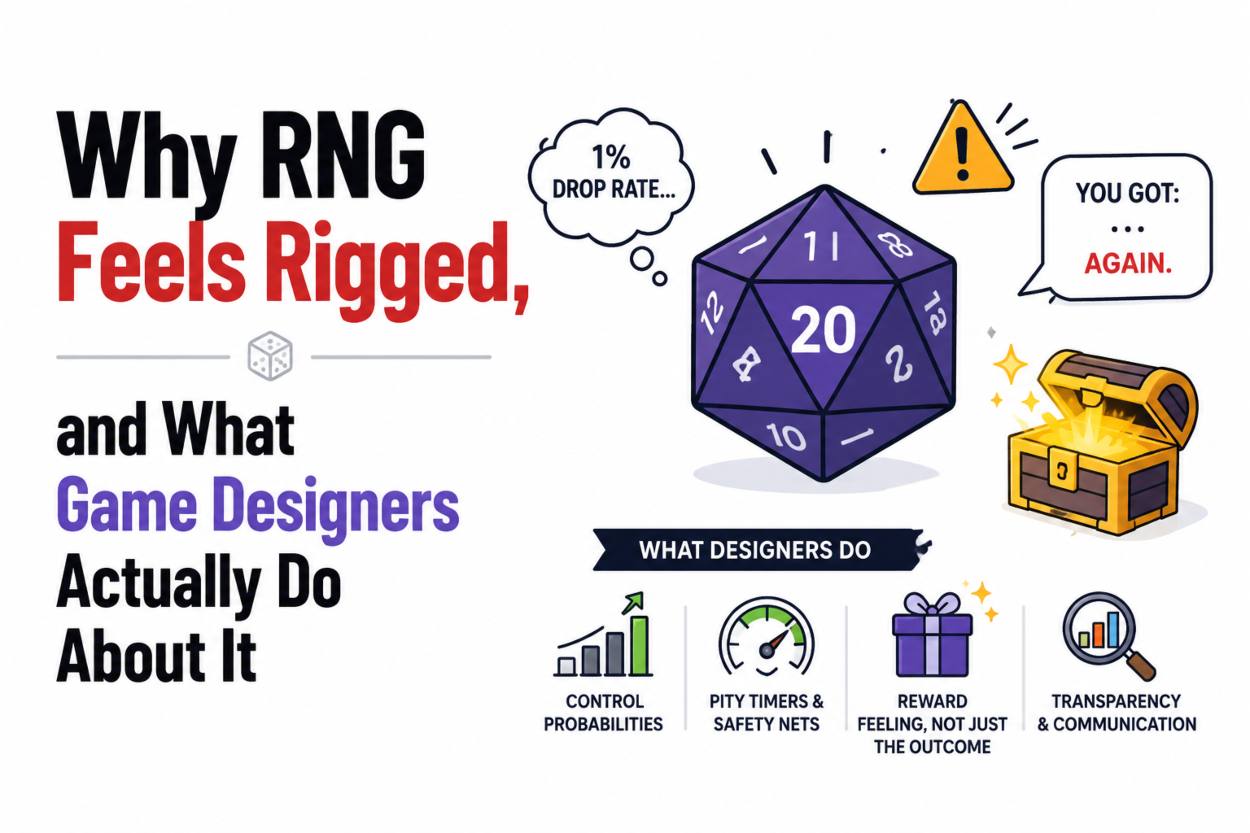
You line up a 95% shot in XCOM. You miss. You reload, take the same shot, and miss again. Somewhere around the third miss, you say the thing every player has said at least once: this game is cheating.
It almost certainly is not. What is happening is stranger and more interesting than cheating, and it sits at the centre of one of the hardest problems in game design. Mathematically correct randomness feels wrong to human beings on a fairly reliable schedule, and designers have spent thirty years quietly building machinery to fix that mismatch without telling you.
Here is how random numbers actually work in games, why your instincts about them are wrong in a predictable direction, and what the good designers do about it.
Computers Cannot Actually Do Random.
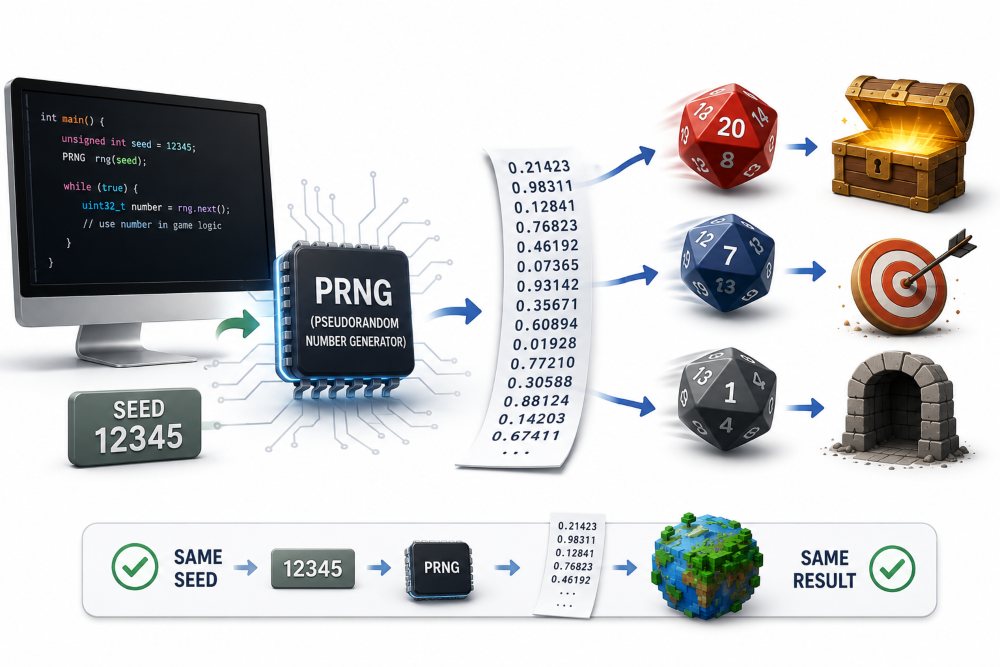
Start with the uncomfortable technical fact. A standard computer is a deterministic machine. Give it the same inputs, and it produces the same outputs, every time, forever. That is the entire point of a computer. It is also the exact opposite of randomness.
What games actually use is a pseudorandom number generator. You hand it a starting value, called a seed, and it runs a fixed mathematical procedure that spits out a sequence of numbers with no obvious pattern. The sequence looks random. It passes statistical tests for randomness. But it is completely determined by that seed, which is why speedrunners can manipulate RNG, why seeded runs in roguelikes are reproducible, and why “same seed, same world” works in Minecraft.
The engineering here is genuinely serious when it needs to be. NIST’s recommendation for random number generation using deterministic random bit generators specifies the algorithms used where the stakes are high, built on hash functions and block ciphers, with formal properties like backtracking resistance so that knowing one output tells you nothing about the previous ones. Most video games do not need anything close to that standard. Most games use something like the Mersenne Twister, which is fast, well-distributed, and entirely adequate for deciding whether your arrow hits.
So when a game feels like it is rolling dice against you, the dice are real. The problem is not the dice.
True Randomness Does Not Feel Random
The problem is you. Specifically, it is a well-documented gap between what randomness actually produces and what humans expect it to produce.
Flip a fair coin ten times, and you have a better than one in three chance of seeing a run of four or more identical results. That is not a glitch. That is what randomness looks like. Real random sequences clump. They streak. They produce stretches that look meaningful and are not. Human pattern recognition, which is very good at its job, immediately reads those clumps as signal.
The clearest real-world demonstration of this did not come from games at all. It came from Spotify. Their shuffle was originally a Fisher-Yates shuffle, which is genuinely, mathematically random. Users hated it. They complained constantly that it was broken, that it favoured certain artists, that it was clearly not random. It was random. That was the problem.
Spotify’s engineering team has written about how they rebuilt shuffle to feel more human, and their framing of the paradox is exactly right: statistical randomness does not translate into perceived randomness, and the goal was never to make shuffle less random but to make it feel fairer and fresher. Their current approach generates several mathematically valid random sequences and then picks the one that scores best on variety. They also now ship a standard option for people who want the unfiltered version.
That is the whole design problem in miniature. You can be correct, or you can be believed. Sometimes you cannot be both.
What Designers Actually Do About It
Sid Meier ran into this hard while building Civilization Revolution, and his GDC talk on the psychology of game design is still the best single account of it. His playtesters, shown 3-to-1 odds in combat, expected to win every time. Not most of the time. Every time. When they lost the roughly one in four they were mathematically supposed to lose, they concluded the game was broken.
Meier’s response was not to educate the players. It was to change the maths. He weighted the odds towards the player at the ratios where expectation and reality diverged most, and he added memory to the system so that a player losing several 2-to-1 fights in a row would stop losing them. His observation about randomness is worth sitting with: whenever something random happens to a player, paranoia sets in, and the player assumes the number was rolled specifically to spite them.
That instinct produced a whole toolkit that most players never see:
- Pity systems and bad luck protection. If you have not hit the drop in N attempts, the odds start climbing, or the drop is guaranteed. Gacha games do this openly with published pity counters. Plenty of Western games do it silently.
- Shuffle bags instead of dice. Modern Tetris does not roll a random piece each time. It takes all seven pieces, shuffles them, and deals them out before reshuffling. You will never get an eight-piece drought of I-pieces, because the structure makes it impossible. The sequence is unpredictable in order but bounded in distribution.
- Hidden difficulty assists. Damage floors, first-hit protection, streak breakers, quietly generous hit registration when your health is low. Many games nudge outcomes towards the player at the moments when frustration is most likely to make them quit.
- Displayed odds that are not the real odds. The most contentious one. Some games show you a number that is deliberately not what the engine rolls against, on the reasoning that the shown number is doing emotional work rather than informational work.
Whether that last one is honest design or manipulation is a genuine argument, and reasonable designers land on both sides of it. The case for it is that players are not actually asking for a fair coin; they are asking for a game that feels fair. The case against is that you are lying to your player about the rules of your own system.
Distinction That Makes RNG Good or Bad
There is a useful split that experienced designers make, and it explains most of the difference between randomness players love and randomness players resent.
Input randomness happens before you decide. The procedurally generated dungeon, the shuffled deck you draw your opening hand from, the randomised map, the shop inventory this run. It creates the situation, and then you get to solve it.
Output randomness happens after you decide. You commit to the attack, and then the die decides whether it lands. It resolves your decision for you.
Input randomness generally makes games better. It creates variety, forces adaptation, and makes your knowledge and judgement the thing that matters. Output randomness is where the resentment lives, because it can take a correct decision and hand you a bad outcome anyway, which feels like the game overruling your competence.
Almost every game uses both, and the ratio is a design choice. Slay the Spire is heavy on input randomness and light on output. Classic XCOM is the opposite, which is precisely why it generates so much rage. Game designers have written extensively about the specific failure modes that pure RNG can produce when it is used as a substitute for depth rather than a complement to it, and the critique is worth reading if you build things.
Where RNG Genuinely Earns Its Place
None of this is an argument against randomness. Games without it get solved. A deterministic game with a known optimal line becomes an execution test, and execution tests have a much shorter shelf life than decision tests.
Randomness buys you several things that are hard to get any other way. It makes runs distinct, so the twentieth playthrough is not the first one repeated. It forces improvisation, because you cannot pre-plan against a situation you have not seen. It creates tension, because uncertainty is what makes a moment matter. It flattens skill gaps enough to keep newer players in the game, which is why almost every party game has a luck component. And it produces stories, because the absurd outcomes are the ones people talk about afterwards.
Looking at current examples of RNG design across recent releases, the pattern holds fairly consistently: the systems players praise are the ones where randomness sets the problem and skill solves it. The systems players resent are the ones where randomness decides whether their solution was allowed to work.
Other Kind of RNG, Which Has a Different Job
Here is where the conversation usually gets muddled, and it is worth being precise.
Modern digital games including social slots formats, all sit on top of broadly the same underlying technology. A pseudorandom number generator produces numbers on demand, and outcomes are mapped onto those numbers. Technically, the machinery is closely related.
What separates them is not the randomness. It is what the randomness is pointed at.
In a video game, RNG serves engagement. The designer’s job is to make the experience feel good, which is exactly why all the correction machinery above exists. Pity timers, shuffle bags, and hidden assists all exist to bend outcomes towards player satisfaction. The house, so to speak, wants you to win often enough to keep playing.
In a gambling product, RNG serves a fixed mathematical edge. The randomness is real, and in licensed markets it is certified precisely so it cannot be tampered with. The UK Gambling Commission’s remote gambling and software technical standards set out requirements for random number generation and require operators to make the return to player percentage, house edge, or probability of winning available to the player before they commit. Certified RNG means the game is not rigged in the sense of being tampered with. It does not mean the game is neutral. The edge is built into the payout table, not the randomness, and over a long enough run it does exactly what it was designed to do.
This is the genuine distinction, and it matters more than the surface similarity. Two systems can use identical random number generation and be pointed at opposite goals. One is tuned so you feel good and keep playing. The other is tuned so the maths resolves in a specific direction over time. Recognising which one you are interacting with is the single most useful thing in this article.
Where the Line Gets Blurred
The reason to be careful about that distinction is that the industry has spent a decade deliberately blurring it.
Loot boxes, gacha pulls, and randomised paid rewards import casino-style probability structures into products sold as video games, often to audiences that include a lot of minors. The research here is worth knowing. A replication study published in PLOS One found a significant association between spending on randomised in-game items and problem gambling severity, with non-problem gamblers spending substantially less per month than at-risk and problem gamblers. The relationship is correlational, so it does not establish causation in either direction. It does establish that the pattern is real and measurable, and it has been replicated.
More broadly, the World Health Organization recognises gaming disorder in the ICD-11, defined by impaired control over gaming, gaming taking precedence over other interests and daily activities, and continuation despite negative consequences. Most players will never approach that threshold. The criteria are still a useful shape to be able to recognise.
If spending on randomised rewards has stopped feeling like a choice, in a game or anywhere else, the National Problem Gambling Helpline in the US runs 24/7 by call, text and chat on 1-800-MY-RESET, with the older 1-800-522-4700 line still active. Most countries have an equivalent.
What Any of This Changes for You

A few things that are actually actionable.
- Streaks are not evidence. Losing five 80% rolls in a row happens roughly once every three thousand attempts. Across a whole playerbase, across a whole game, it happens constantly. Your run of terrible luck is real, and it is also completely ordinary.
- The game is probably helping you more than you think. If a game feels well-tuned, there is a decent chance you are benefiting from correction systems you cannot see. The absence of visible generosity is not the absence of generosity.
- Published odds are worth reading. Games that publish real drop rates and pity thresholds are telling you something about how they intend to treat you. Games that do not are also telling you something.
- Ask what the randomness is for. If it sets up a problem you then get to solve, it is probably working. If it decides whether your solution counted, notice how you feel about that, because that feeling is the design working or failing.
And if you find yourself certain that a game is rigged against you personally, the odds are overwhelming that it is not. Sid Meier built a career partly on the observation that you were going to think that anyway.
A Final Note
One question in this article is genuinely unsettled, and it would be dishonest to close without saying so.
Hidden odds adjustment sits on a line the industry has never agreed on. The argument for it is the one Meier made: players are not asking for a fair coin; they are asking for a game that feels fair, and a designer who ignores that is optimising for a correctness nobody experiences. The argument against it is simpler. If the screen says 95% and the engine rolls against something else, the game has misrepresented its own rules, and no amount of good intent changes that. Serious designers hold both positions, and the disclosure norms that would settle it do not exist outside regulated gambling.
Worth knowing too that implementations change. Pity thresholds get retuned, drop tables get patched, and a system that was generous last season may not be this one. Anything specific in this article describes how these systems generally work rather than the current state of any particular title, and published odds on the developer’s own channels will always be more current than an article.
Disclaimer
This article is for general informational and educational purposes only and does not constitute financial, legal, medical, or psychological advice. Gambling content is descriptive, not promotional, and applies only where it is legal for adults of the required age (18 or 21, depending on jurisdiction). No gambling strategy can overcome the house edge, and certified RNG testing does not guarantee profit. Any money spent on gambling should be considered money you can afford to lose. External links are provided for reference only and do not imply endorsement, and cited research shows correlations rather than proof of causation. If gambling or spending on randomized rewards feels difficult to control, seek support from appropriate local resources.
References
- Barker E, Kelsey J. Recommendation for random number generation using deterministic random bit generators. Gaithersburg (MD): National Institute of Standards and Technology; 2015 Jun. Special Publication (NIST SP) 800-90A Rev.
- Meier S. The psychology of game design (everything you know is wrong) [conference keynote]. Game Developers Conference 2010; 2010 Mar 11; San Francisco (CA).
- Zendle D, Cairns P. Loot boxes are again linked to problem gambling: results of a replication study. PLoS ONE. 2019 Mar 7;14(3):e0213194. doi:10.1371/journal.pone.0213194. PMID: 30845155. PMCID: PMC6405116
- Zendle D, Cairns P. Video game loot boxes are linked to problem gambling: results of a large-scale survey. PLoS ONE. 2018 Nov 21;13(11):e0206767. doi:10.1371/journal.pone.0206767. PMID: 30462669. PMCID: PMC6248934