
Blog
How AI Game Design Is Shaping the New Standard in Gaming

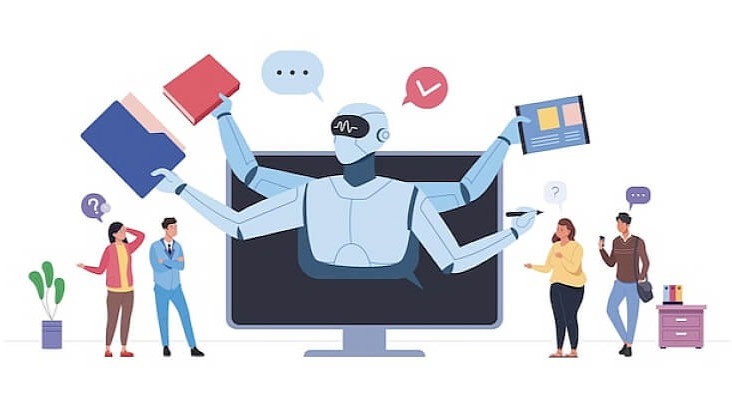
A few years ago, building a game world meant years of hand-crafted work, every asset drawn, every line of code written by a human staring at a screen. That is still true in some studios. But in a growing number of them, AI now handles tasks that once ate entire production schedules. Players have started to notice that games feel more responsive, more tailored, harder to put down. This is not a phase the industry is passing through. AI has moved into the foundation of game design, and most game development companies are building successful and profitable games.
How AI Is Changing Game Development Pipelines
The development pipeline looks different now in studios that have adopted AI seriously. It is not just one stage that has changed, it is most of them.
| Pipeline Stage | AI Impact / Change |
|---|
| Asset Creation | AI generates 3D models, textures, and environments far faster than manual design. Full landscapes that once took weeks can now be assembled in days. |
| Bug Detection | AI continuously scans code and flags errors before reaching players. Teams save weeks previously spent on manual review cycles. |
| Voice Generation | AI produces realistic character voices without large voice casts, enabling more dialogue while keeping production costs under control. |
| Level Design | Procedural generation creates unique maps and layouts for each playthrough, giving replaying players a meaningfully different experience every time. |
| Animation | AI motion tools convert simple inputs into smooth, natural-looking movement. Animators focus on key scenes instead of repeating motions across assets. |
Each of these changes cuts costs somewhere. More importantly, they free developers to spend time on decisions that actually require a human in the room.
AI vs Traditional Game Development Differences
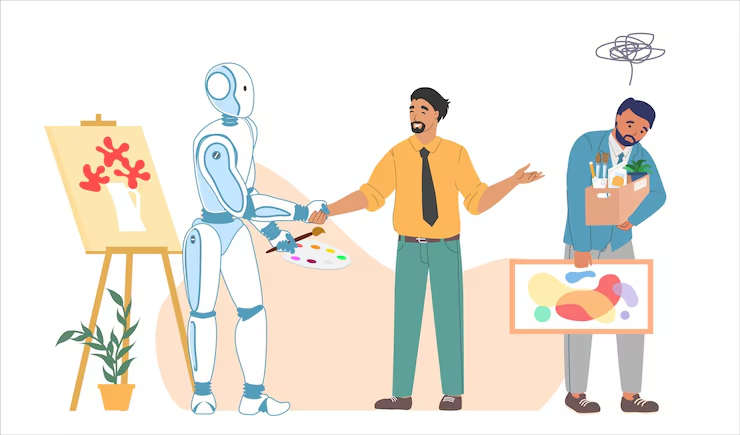
This comparison highlights how AI-driven game development is reshaping core production areas such as asset creation, NPC behavior, testing, and player experience, making game development faster, smarter, and more cost-efficient than traditional methods.
How AI Improves Player Experience and Gameplay
Honestly, players are getting the best end of this deal. The games coming out of AI-assisted pipelines are more responsive to how individual people actually play not how developers assumed they would.
Smarter Difficulty
AI tracks performance in real time and adjusts the game accordingly. Enemy behaviour, puzzle complexity, and resource drops all of it can shift based on what a player is doing right now.
Someone who keeps dying in the same section gets a subtle nudge without the game announcing it. Someone tearing through content at a pace gets pushed harder. Neither player has to go looking for a difficulty setting.
Personalised Worlds
AI can hold onto player choices made across hundreds of hours and use that history to shape what happens next. Dialogue changes. Quests shift. The world responds to decisions that were made a long time ago.
This changes how players relate to a game. It stops feeling like a product they are consuming and starts feeling like a place that remembers them.
Responsive NPCs
Old NPCs ran on scripts. Players learned those scripts fast, and the illusion broke. AI-powered characters observe what a player does and respond based on that, not based on a flowchart someone built two years ago.
They hold grudges. They form alliances. Conversations stop feeling like menu navigation and start feeling like something is actually happening on the other side of the screen.
Where AI Is Making the Biggest Impact in Game Development
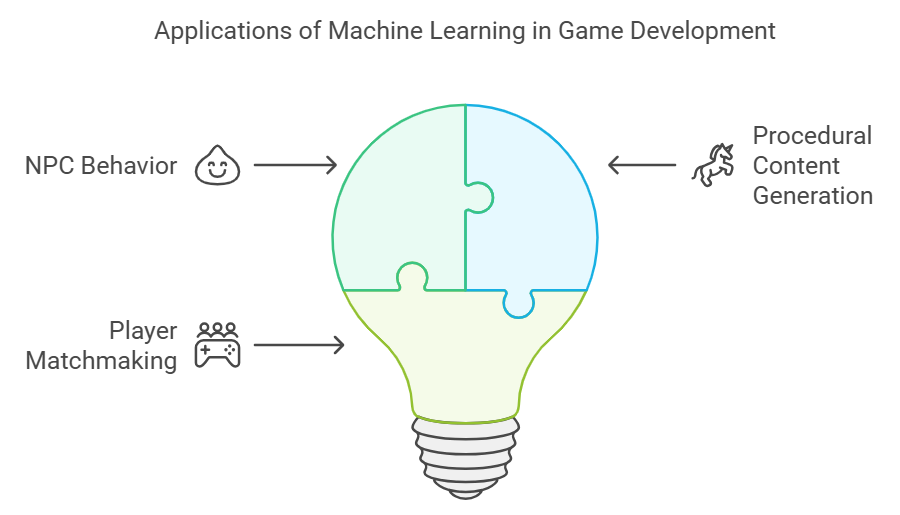
AI is not impacting every area of game development equally. The biggest improvements are seen in asset creation and testing, while other areas like NPC intelligence, level design, and voice generation are also rapidly evolving. This distribution shows how AI is gradually becoming a core part of modern game production pipelines rather than a single-use tool.
Is AI-Driven Game Design Accessible to Indie Developers Too?
This might be the part of the story that matters most for where games go next. AI has not just helped big studios move faster. It has changed what a small team can reasonably attempt.
Tools like Unity’s AI features and open-source asset generators are available to anyone. A solo developer or a small team can now produce systems and visuals that previously required entire departments to build.
Cost Reduction
High-quality game production used to demand specialists across every discipline. Artists, animators, writers, voice actors, QA testers, all hired, all coordinated, all expensive.
AI tools reduce the number of specialists a project actually needs. Indie teams can put their budget where it genuinely matters to what they are making, rather than spreading it thin across disciplines.
Speed to Market
A prototype that used to take six months can now be built and tested in a few weeks. That is not a small difference, it changes what experimentation is even possible for a small studio.
Faster development means more room to test ideas, respond to early feedback, and change direction before too much has been built in the wrong direction.
What Role Does AI Play in Game Testing and Quality Assurance?
Testing has always been expensive and tedious. It is also where a lot of games quietly fall apart before launch. AI has made the process faster, and it catches things that human testers routinely miss.
- Automated playthrough: AI bots run through an entire game much faster than a human tester. They hit edge cases and trigger rare crashes that might have slipped past dozens of manual sessions.
- Behaviour simulation: AI simulates thousands of different player types to stress-test game systems. It reveals how the game holds up under conditions developers never specifically planned for.
- Regression testing: After an update or patch, AI re-tests entire sections automatically. Teams get feedback in hours rather than waiting days for a full manual cycle to complete.
- Localisation checks: AI reviews translated dialogue for errors in tone, length, and meaning. This matters a lot for games shipping simultaneously across dozens of language markets.
Fewer bugs at launch is not glamorous. But it is what players actually experience first, and it affects everything that comes after.
What the Future of AI Game Design Looks Like

It is hard to predict with confidence, but the direction is clear. The tools available in five years will make today’s look old. The interesting question is what developers choose to build with them.
Generative Worlds
The likeliest near-term development is worlds that grow and change based on what players actually do in them. AI generates new content continuously, no two players experience the same game, and no playthrough ends the same way it would have before.
The concept of “finishing” a game starts to blur. The world keeps going because the system keeps generating.
AI Game Directors
Some studios are already running experiments with AI systems that act as real-time directors, watching a session unfold and reshaping pacing, events, and challenges in response. Left 4 Dead’s AI Director was an early version of this idea. What is coming next is considerably more sophisticated.
Instead of a fixed narrative, the game reads the room. That is genuinely hard to achieve and genuinely interesting when it works.
Collaborative Design Tools
AI will not replace developers, it will change what developers spend their time on, especially for teams investing in next-generation game development services. The tools coming are less about automation and more about conversation: suggest an idea, get variations, refine, test, discard, try again.
Game development starts to look less like construction and more like editing. The human still decides what is good. They just have more to work with.
Why AI-Driven Game Design Has Become the Industry Standard
Because the studios that skipped it fell behind the ones that did not, and the gap became visible. Players noticed the difference in responsiveness, in polish, in how much the game seemed to understand them. A game that feels static, where the world does not react, where NPCs say the same things, where difficulty is fixed, now stands out for the wrong reasons. That used to be normal. Now it reads as dated.
AI-driven design is the standard, not because it is fashionable but because the games it produces are better, and players can feel the difference. The studios combining real creative direction with AI tools are building the games people actually finish, recommend, and come back to. AI alone does not do that. Neither does craft without tools. But the two together, that is where the good work is happening right now.
Conclusion
AI-driven game design is no longer an experimental idea, it is already shaping how modern games are built, tested, and experienced. From smarter NPCs to adaptive worlds and faster production pipelines, AI has quietly become part of the foundation of game development. The studios embracing it are not just working faster, they are creating more responsive and engaging experiences for players. As the technology continues to evolve, the real difference will come from how creatively developers use AI alongside human design thinking, not in replacing it, but in expanding what games can become.