
Blog
How to Shift From High-Volume to High-Quality Lead Generation

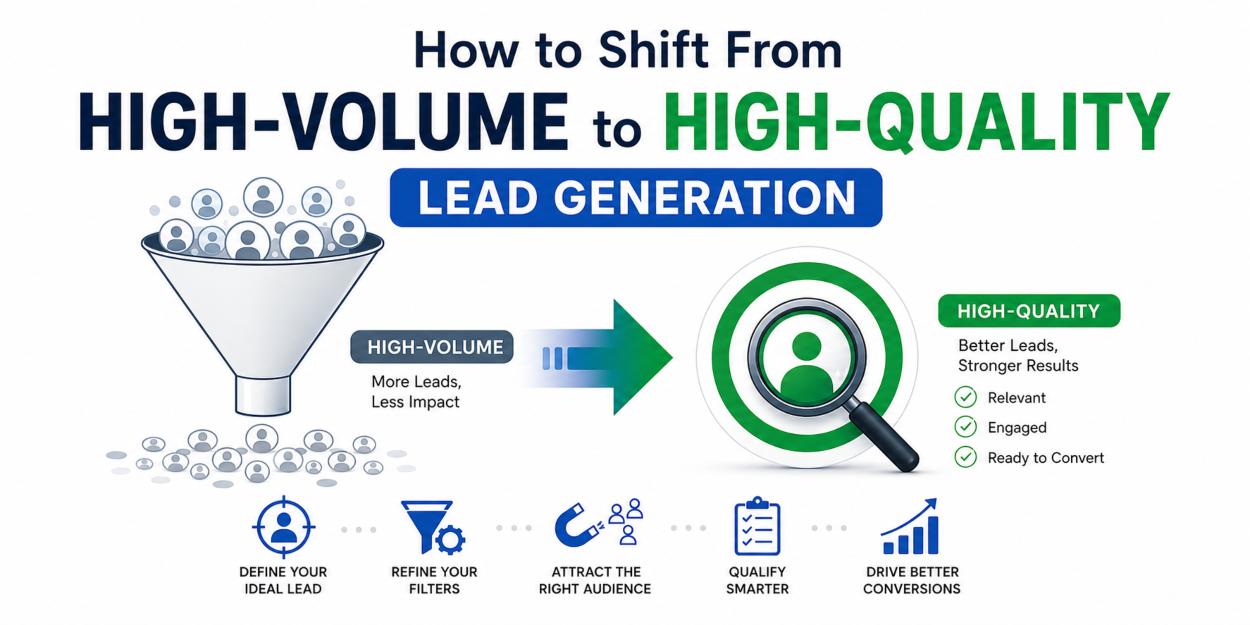
A full CRM can still hide an empty sales pipeline.
Hundreds of people may have downloaded a guide, joined a webinar, or completed a form. Yet sales representatives keep reaching people who lack authority, budget, urgency, or even a clear understanding of the product.
That is not a shortage of leads. It is a failure to distinguish interest from buying intent.
The solution is not another campaign designed to collect more email addresses. It is a more selective process that attracts the right people, notices meaningful behaviour, and sends sales only the opportunities worth pursuing.
Lead Number That Looks Good but Means Very Little
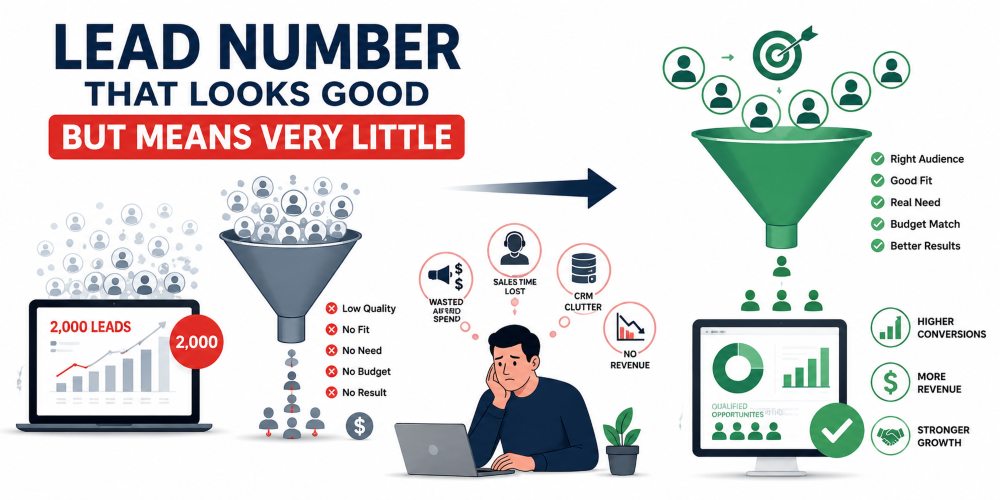
Lead volume is easy to report.
A campaign generated 2,000 contacts. Cost per lead fell by 18 percent. Form submissions doubled after the landing page was shortened.
Those figures sound positive in a meeting. They become less impressive when only a handful of contacts match the company’s target market.
A low cost per lead can even hide an expensive problem. Marketing pays to attract the contact, sales spends time following up, and the CRM stores another record that never becomes revenue.
The business has not saved money. It has simply moved the cost from advertising into sales time.
A better report begins with different questions:
- How many leads matched the target customer profile?
- How many belonged to companies that could afford the product?
- How many had a current business problem?
- How many reached a genuine sales conversation?
- How many became qualified opportunities?
- Which campaigns produced revenue rather than form submissions?
This changes the discussion from “How many people responded?” to “How many suitable buyers moved forward?”
Start With the Customers You Would Happily Win Again
An ideal customer profile should not be a hopeful description of everyone who might buy.
It should describe the customers who receive clear value, remain profitable to serve, move through the sales process without constant friction, and are likely to stay.
HubSpot’s official ideal customer profile guidance recommends using company-level details such as employee count, industry, existing technology, and other firmographic or technographic information.
The strongest starting point is usually the company’s own customer history.
Review the clients who:
- Renew consistently
- Use the product regularly
- Require a manageable level of support
- Reach value quickly
- Refer other customers
- Purchase additional services
- Produce a healthy profit margin
Then look for the conditions they had in common before becoming customers.
Perhaps they had recently hired a larger operations team. Maybe an existing system was becoming too expensive. They may have entered a regulated market, opened another location, or outgrown a manual process.
These events are more useful than broad labels such as “medium-sized businesses.”
A company does not urgently need new software simply because it has 200 employees. It needs new software because something changed and the current way of working no longer holds up.
Separate Customer Fit From Customer Timing
A prospect can look perfect on paper and still have no reason to buy this year.
Another prospect may urgently need help but be too small, outside the service area, or unable to meet the minimum budget.
That is why lead qualification should examine two separate questions.
Is This the Right Type of Customer?
This is the fit question. It can consider:
- Industry
- Company size
- Location
- Revenue range
- Existing technology
- Team structure
- Regulatory requirements
- Likely budget
- Job role or purchasing authority
Is This Customer Showing Real Intent?
This is the timing question. It may consider whether the person:
- Returned to the website several times
- Read a detailed service page
- Viewed pricing information
- Compared product plans
- Attended a product-focused webinar
- Opened several nurture emails
- Read an implementation case study
- Requested a trial, consultation, or demonstration
Salesforce distinguishes between explicit scoring, which uses information provided about the prospect, and implicit scoring, which considers observed behaviour such as visiting a sales page. Its lead scoring guide explains how the two forms of information can help teams prioritise prospects.
Neither fit nor intent is enough alone. The best sales opportunities usually show both.
Build a Score That Salespeople Can Understand
Lead scoring often becomes needlessly complicated.
Marketing creates a long list of points, negative points, multipliers, categories, and hidden automation rules. Sales receives a contact labelled “92” but has no idea what the number means.
A score is useful only when the team understands why it changed.
A basic model might look like this:
| Signal | Example Score |
|---|---|
| Company matches target industry | +15 |
| Company is within the preferred size | +15 |
| Contact has decision-making authority | +20 |
| Visited the pricing page | +15 |
| Read a relevant case study | +10 |
| Attended a product webinar | +15 |
| Requested a consultation | +30 |
| Uses a personal email for a high-value B2B purchase | -10 |
| Company is outside the service area | -30 |
| Contact is a student or job seeker | -25 |
These numbers are examples, not universal standards. Each business should build its model around its own sales history.
Adobe’s official Marketo resources recommend creating a scoring programme that helps marketing improve the quality of leads passed to sales. Adobe also notes that scoring can be used to evaluate engagement with content. Its lead scoring programme guidance provides a useful technical starting point.
The model should also decay over time.
Someone who visited the pricing page yesterday may deserve quick attention. Someone who visited it nine months ago and has not returned probably should not remain at the top of the queue.
Stop Treating Every Form Completion as a Sales Request
A person downloading a beginner’s guide is not asking for a sales call.
They may be researching a school project, gathering ideas for the future, comparing industries, or trying to solve the problem independently.
Sending these contacts directly to sales creates awkward conversations and teaches people to avoid future forms.
It is more useful to define clear stages.
| Lead Stage | Description |
|---|---|
| Subscriber or Early Contact | The person has shown initial interest, such as subscribing to a newsletter or downloading introductory content. |
| Marketing Qualified Lead (MQL) | The person matches the target customer profile and has engaged enough to enter a targeted marketing nurture campaign. |
| Sales Qualified Lead (SQL) | The person fits the ideal customer profile and has demonstrated clear buying intent, making them ready for direct sales outreach. |
| Opportunity | The sales team has confirmed a genuine business need, a realistic budget, a defined decision-making process, and a likely purchase timeline. |
These definitions should be based on observable conditions. “Seems interested” is not a reliable handoff rule.
Let Sales Explain Why Leads Are Being Rejected
Many companies ask sales to accept or reject marketing leads but do not require a reason.
That wastes valuable information.
A rejected lead should be assigned a clear category, such as:
- No current need
- No budget
- Wrong company size
- Wrong location
- Student or job seeker
- Existing customer
- Vendor or competitor
- No purchasing authority
- Invalid contact information
- Duplicate record
- Researching for a future project
- Requested information but not contact
Marketing can then review rejection patterns each month.
If many leads are too small, the advertising audience may be too broad. If people do not understand the service, the landing page message may be unclear. If leads are suitable but not ready, the business may need better nurturing instead of more sales calls.
Salesforce describes sales and marketing alignment as coordination across goals, processes, and communication. Shared definitions and regular feedback are central to preventing the two departments from judging success by different standards.
This does not require another long weekly meeting. A clean rejection field, a short monthly review, and agreement on qualification criteria can reveal more than another dashboard.
Make the Landing Page Repel the Wrong Customer
Most landing-page advice focuses only on increasing conversions.
That is incomplete.
A strong landing page should encourage suitable prospects while helping unsuitable visitors realise that the offer is not intended for them.
This can mean clearly stating:
- Who the service is designed for
- The locations covered
- The minimum project size
- The industries supported
- The expected implementation period
- Important technical requirements
- Whether the product is built for individuals or companies
- A realistic starting price or pricing structure
Hiding important qualification details may increase form submissions, but it also creates more disappointing follow-up conversations.
Conversion rate should not be treated as the only landing-page measure. Track the percentage of submissions that become qualified conversations and opportunities as well.
Create Content That Reveals Serious Buyers
Generic content attracts generic interest.
An article titled “Ten Ways to Grow Your Business” may earn traffic, but it tells the company very little about the reader’s actual problem.
High-quality lead generation needs content connected to real buying questions.
Early Research Content
This should help people recognise and define a problem.
Examples include:
- Industry trend reports
- Cost-of-inaction guides
- Beginner explanations
- Planning checklists
- Common problem breakdowns
Evaluation Content
This helps buyers compare possible approaches.
Examples include:
- Product category comparisons
- Build-versus-buy guides
- Implementation timelines
- ROI calculators
- Technical webinars
- Feature evaluation sheets
Decision Content
This helps a serious prospect judge whether the company is the right provider.
Examples include:
- Detailed case studies
- Product demonstrations
- Pricing explanations
- Security documentation
- Integration guides
- Migration plans
- Customer references
LinkedIn’s official guide to mapping the B2B customer journey connects different messaging and content formats with awareness, consideration, and decision stages.
The goal is not to put a form in front of every article. It is to notice which subjects and formats indicate stronger commercial intent.
Keep Useful Content Open
Businesses sometimes gate every guide, checklist, and PDF because every email address is counted as a new lead.
This creates a database filled with people who wanted one small piece of information.
Basic educational content often works better when it remains open. The visitor can judge the company’s thinking without handing over personal information. A form can then be reserved for something that justifies the exchange, such as:
- A personalised assessment
- A detailed benchmark report
- A useful calculator with saved results
- A live product demonstration
- A technical consultation
- A template requiring business-specific inputs
This makes the smaller number of form submissions more meaningful.
Trust also affects whether serious buyers are comfortable sharing their information.
Measure Actions That Happen After the Form
Cost per lead is useful, but it should not be the final campaign measure.
A channel producing $20 leads may be weaker than a channel producing $90 leads when the cheaper contacts never become sales opportunities.
A more useful report follows the complete path:
| Stage | Metric to Review |
|---|---|
| Advertising | Cost per qualified visitor |
| Website | Visitor-to-lead conversion |
| Qualification | Percentage matching the ICP |
| Sales handoff | MQL-to-SQL conversion |
| Pipeline | SQL-to-opportunity conversion |
| Revenue | Customer acquisition cost |
| Long-term value | Retention and customer value by source |
Google Ads provides official conversion measurement guidance for tracking actions people take after interacting with advertising. It can measure website actions, calls, app activity, and other configured conversions.
Do not optimise advertising only for the easiest form submission. Where systems permit it, send qualified-lead, opportunity, and customer outcomes back into campaign reporting.
That gives the advertising platform a better signal than a simple “thank you” page visit.
Use Customer Data Without Letting Automation Choose the Strategy
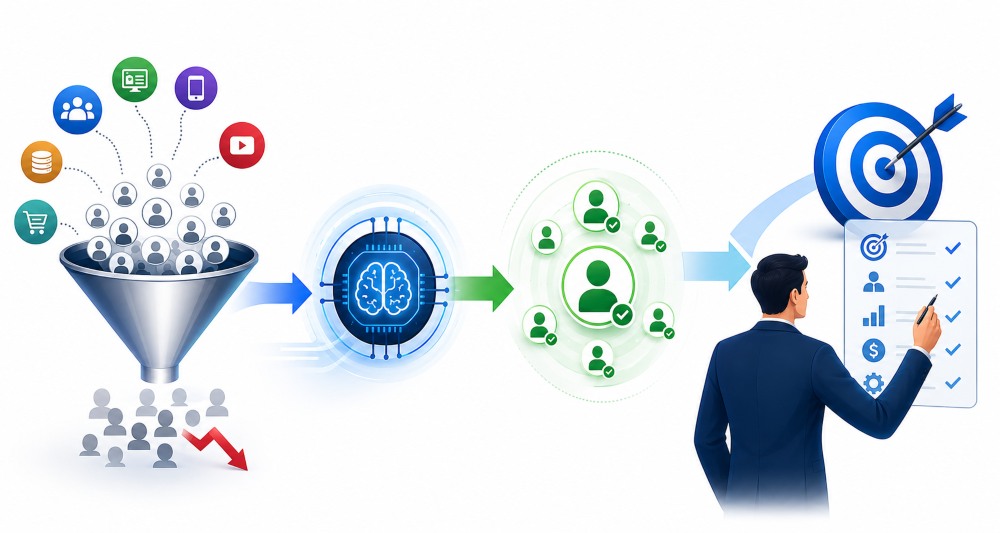
Advertising platforms can use existing customer and visitor data to help identify relevant audiences.
Google’s official guidance explains that audience signals can include customer lists, website visitors, app users, video viewers, custom segments, and other information that helps its systems understand the intended audience.
These systems still need good input.
Uploading every old lead into an advertising platform may teach it to find more people who complete forms but never buy. A better seed audience might include:
- Profitable customers
- Renewing customers
- Qualified opportunities
- Users who reached an important product milestone
- Customers with strong retention
- Buyers of a specific high-value service
The quality of automated targeting depends partly on the quality of the business outcome used to guide it.
Seasonal changes can also alter intent. A service that attracts serious buyers during annual budget planning may attract casual researchers at another time.
Know When an External Partner Is Actually Useful
Hiring outside support does not automatically solve poor lead quality.
An agency cannot create a reliable campaign if the business cannot explain its strongest customer, profitable service, sales process, or qualification rules.
External support becomes more useful after those foundations are clear.
For a company that has identified its customer profile but lacks the internal time or technical skill to run paid acquisition, an experienced advertising agency may help with campaign structure, local targeting, conversion tracking, landing-page testing, and reporting.
The business should still ask direct questions before hiring:
- How do you define a qualified lead?
- Which conversions will campaigns optimise towards?
- How will CRM outcomes be connected with advertising data?
- How do you separate search terms showing buying intent from general research?
- How often will targeting exclusions be reviewed?
- Will reporting show opportunities and revenue, not only clicks and forms?
- Who owns the advertising accounts and campaign data?
- How will lead quality feedback from sales change the campaigns?
Do Not Build Growth Around Purchased Contact Lists
Purchased lists are attractive because they appear to solve the volume problem immediately.
A business can obtain thousands of names without waiting for content, search visibility, referrals, or advertising campaigns to work.
The problem is that list size says nothing about relevance, accuracy, permission, or current intent.
The contacts may be outdated, incorrectly labelled, outside the target market, or completely unfamiliar with the sender. Sales wastes time, email engagement falls, and the company begins new relationships by creating irritation.
Commercial email is also subject to legal requirements. The Federal Trade Commission’s CAN-SPAM compliance guide explains requirements covering commercial email, including accurate sender information, honest subject lines, a valid postal address, and a working opt-out process.
Email and privacy requirements vary by location, so companies operating across markets should obtain appropriate legal guidance rather than assuming one rule covers every recipient.
Permission-based lists grow more slowly, but they provide a cleaner starting point for useful communication.
Let Brand Clarity Do Some of the Filtering
Lead quality is not created only through campaign settings.
A clear brand helps suitable buyers recognise themselves while giving unsuitable visitors a reason not to continue.
A visitor should quickly understand:
- What the company provides
- Which type of customer it serves
- Which problem it handles best
- Why its approach is different
- What level of investment may be required
- What the next step involves
Vague positioning attracts broad curiosity. Specific positioning attracts fewer but more relevant enquiries.
Marketing technology can support that message, but it cannot replace it. The article on how small businesses can work smarter using technology provides further ideas for using tools without adding unnecessary complexity.
Review the System Every Quarter
Lead quality changes as the business changes.
A company may introduce a larger plan, enter a new market, stop serving a low-margin segment, or find that its strongest customers now use different technology.
Review the qualification system at least quarterly and after any major change to:
- Pricing
- Product features
- Sales territories
- Customer segments
- Contract requirements
- Advertising channels
- Sales capacity
- Onboarding processes
During the review, compare the highest-scoring leads with actual closed customers.
If the scoring model regularly prioritises contacts who do not buy, the model is wrong. If sales closes customers marketing considered weak, useful signals are probably missing.
Lead scoring should reflect commercial reality, not protect an old spreadsheet.
A Better Pipeline May Look Smaller
The shift from volume to quality can initially make marketing reports look worse.
Form submissions may fall. Cost per lead may increase. The database may grow more slowly.
At the same time, sales representatives may speak with more suitable companies, response rates may improve, and fewer hours may be spent chasing people who were never likely to buy.
That is not a decline in performance. It is the removal of activity that was being mistaken for progress.
A healthy lead-generation system does not try to persuade everyone to enter the pipeline. It helps the right buyers recognise a relevant solution, gives them useful information, notices when their interest becomes serious, and creates a clear path to a sales conversation.
The pipeline does not need to be crowded. It needs to contain opportunities the business can realistically win and serve well.
Disclaimer: This article provides general marketing information and is not legal, privacy, financial, or regulatory advice. Advertising, email, data-protection, and consent requirements vary by location and business activity. Companies should consult qualified professionals before implementing campaigns involving personal data or regulated communications.