
Blog
How Cashback Quietly Replaced The Giant Welcome Bonus


The 500% welcome package did not disappear because operators developed a conscience. It faded because the arithmetic became visible.
For about a decade, the headline number did all the work. Deposit a hundred, play with five hundred, and the terms attached to that five hundred lived somewhere the reader was not expected to go. Then enough people did the multiplication, posted it on forums, and the number stopped being persuasive.
What replaced it is quieter and structurally different. Cashback pays you after the fact, based on what you lost. That difference is real and worth understanding properly, which means being straight about what it does and what it does not do.
Deposit Match Broke Because People Learned To Multiply
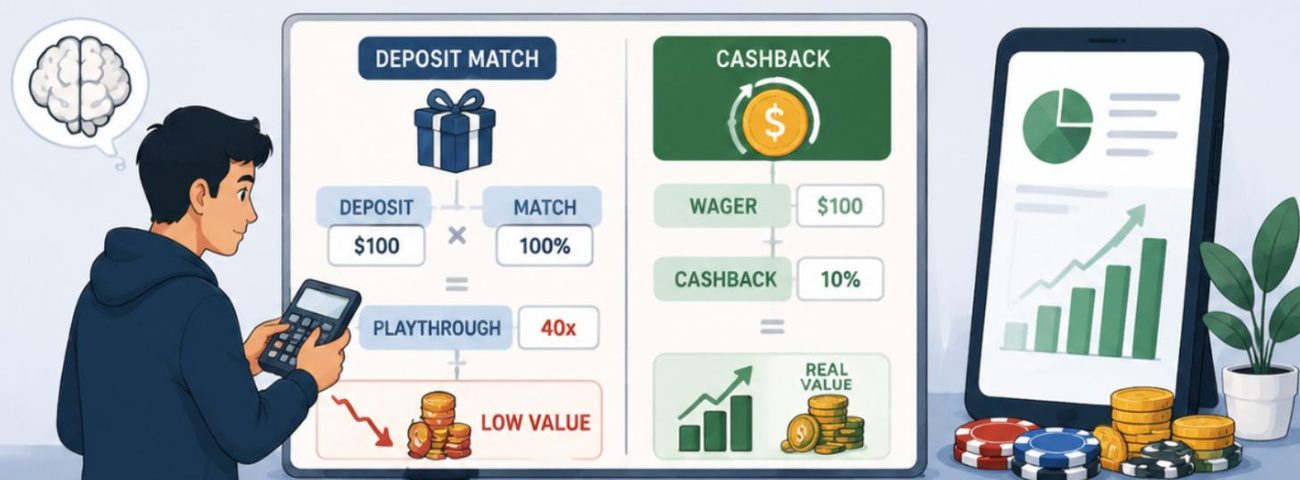
Take a €100 bonus at 40x wagering. That is €4,000 of turnover before the money becomes withdrawable. On a slot returning 96%, the house expects to keep about 4% of everything staked, so clearing that requirement carries an expected loss of roughly €160. The €100 gift has a negative expected value before you reach the maximum-cashout clause.
That is not a scandal. It is just arithmetic, and once it is written down the offer sells itself badly.
Regulators arrived at the same conclusion by a different route. The Gambling Commission capped wagering requirements at ten times the bonus for British-licensed operators, on the stated grounds that high multipliers increase complexity, reduce transparency and raise the likelihood of harm. Years earlier the Competition and Markets Authority had already forced operators to unpick the worst of it, and its advice note for gamblers still carries the line worth remembering: gambling companies cannot enforce unfair terms.
So the deposit match did not become dishonest. It became legible, and the legible version was unattractive.
What Cashback Actually Is
The mechanical differences are genuine, and they are the reason players moved.
Cashback is retroactive. Nothing is credited upfront, which means there is no locked balance sitting in your account under conditions you have to track. The calculation runs on a cycle, usually weekly or monthly, sometimes daily for high-volume accounts. Most schemes attach either no wagering requirement or a single playthrough, which is the whole appeal: the money that lands is usually money you can withdraw.
The details that vary between operators, and that determine whether an offer means anything:
- The base. Some schemes calculate on net losses over the period. Others use net deposits, or net gaming revenue. These produce different numbers from the same session.
- Cash or credit. A rebate paid as withdrawable cash and a rebate paid as bonus funds with a 1x requirement are not the same product, however similarly they are advertised.
- Game coverage. Rebate schemes usually apply across a wider range of games than matched offers, which tend to be restricted to specific slots.
- The claim window. Some platforms require you to claim manually, occasionally within 24 hours, after which the credit expires.
In practice, most operators now run both structures at once rather than choosing. The xon bet bonus page is a fair illustration of the modern layout: a stack of tiered deposit matches across the first four deposits, with a percentage cashback line sitting underneath them. That is the shape to expect, and it is why reading a single headline offer tells you very little. The stack is the product.
Arithmetic, Which Is The Whole Story
Here is the sentence that most articles on this subject avoid.
If you lose €1,000 net in a week and receive 10% cashback, you get €100 back. You are down €900.
That is not a criticism of cashback. It is a description of it. The rebate is real money, and it is genuinely yours, but it has not protected your bankroll. It has reduced the rate at which the bankroll declines.
Expressed properly, cashback is a discount on the house edge. A 10% rebate on net losses reduces your effective house edge by roughly a tenth: a game with a 4% edge behaves more like 3.6%. That is a measurable, permanent improvement in the terms you are playing on, and it is more value than most deposit matches deliver after their wagering requirements are cleared.
What it is not is insurance, a safety net, or a hedge. Those words describe products that make you whole when something goes wrong. This one makes you slightly less un-whole, on a schedule.
The honest comparison with a deposit match is not honest versus dishonest. It is small and near-certain versus larger and heavily conditional. Different risk profiles. Cashback wins on predictability and simplicity, which for most people is the right trade, but it wins on those axes rather than on generosity.
Where The Incentive Actually Points
There is a structural feature of loss rebates that deserves saying plainly: the payment scales with how much you lose.
That is not a hidden trick. It is the definition of the product. But it means the reward arrives attached to the loss, and the psychology of that pairing is well studied.
Loss chasing, continuing or increasing play to recover previous losses, is one of the diagnostic criteria for gambling disorder, and the American Psychiatric Association’s description of the condition lists it explicitly. It is also the only criterion in the manual that is specific to gambling rather than shared with substance disorders, which is part of why researchers treat it as a marker of the transition from recreational play to something else. Work by Auer and Griffiths using account-based player tracking data has attempted to operationalize what chasing actually looks like in real betting records rather than in self-report.
A rebate does not create that behavior. What it does is reframe a loss as partly recoverable, which is the exact cognitive step chasing is built on. Related research on cognitive distortions and chasing behavior points the same way: the beliefs that sustain chasing are ones that recast a losing position as a temporary, correctable state.
None of this makes cashback a trap. It does mean that treating the rebate as a reason to keep going, rather than as a discount applied to a budget you already set, converts a decent promotional structure into something that works against you.
Tier Question, Which Regulators Already Answered
A lot of cashback content ends with the same advice: concentrate your play on one site to climb the loyalty tiers, because higher tiers pay higher rebate percentages.
That advice runs directly into a rulebook.
In 2020, the Gambling Commission published industry guidance on high-value customer schemes under Social Responsibility Code 5.1.1, after enforcement work found repeated failures in how operators managed their highest-spending accounts. Among other things, the resulting code restricted incentivising customers on the basis of losses, excluded anyone under 25, required senior management oversight, and required affordability and harm checks before a customer could be given that status at all.
The effect was not marginal. The Commission’s monitoring report published in July 2025 recorded scheme membership across participating operators falling from 42,349 before the change to 1,616 in the year to March 2024.
So “climb the tiers for a better rebate” is, stated accurately, advice to become the customer category that a national regulator built an entire compliance framework around. Whether a given offshore operator is bound by that framework is a separate question. The reasoning behind it applies regardless of licence.
Reading A Cashback Offer Properly
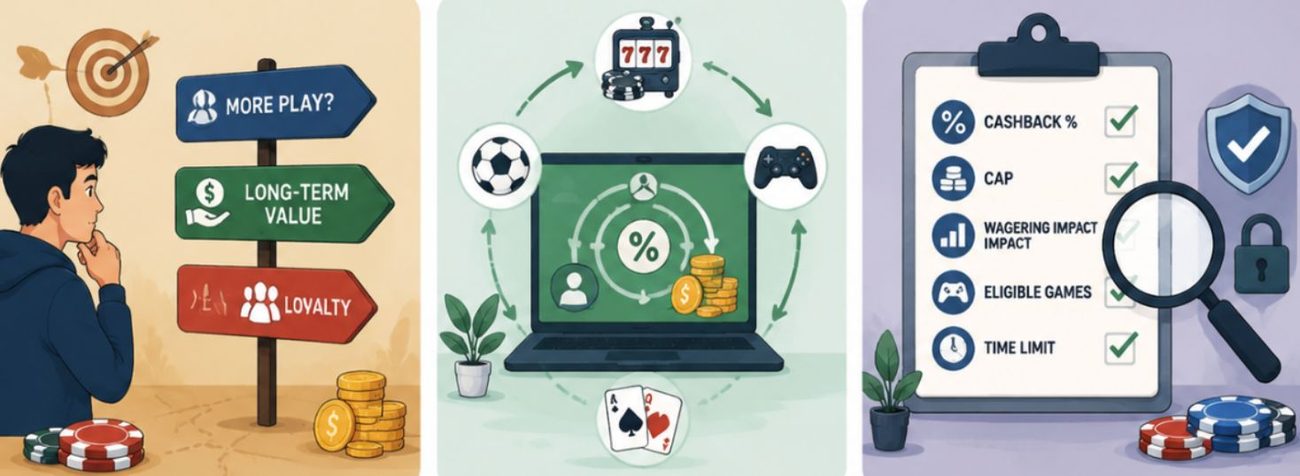
Four questions settle most of it, and they should all be answerable from the promotions page:
- What percentage, and of what base? Net losses, net deposits and net gaming revenue give different answers.
- Paid as cash or as bonus funds? If it is bonus funds, what is the wagering requirement on them?
- What is the claim window? A credit you have to claim within a day is a credit you will sometimes miss.
- Does anything void it? An active deposit match frequently disqualifies the same play from counting toward a rebate calculation. Running both at once often means getting neither in full.
There is usually a minimum loss threshold too. Knowing it is useful for one reason only: deciding whether the offer is worth anything to you at your normal stake. It is not a target, and any framing that treats it as one has the logic backwards.
What It Is Good For
Cashback earned its position honestly enough. It is simpler than a matched bonus, the money is usually genuinely withdrawable, and the value, while smaller, actually arrives. Compared with a 40x rollover on locked credit, that is a meaningful improvement in the deal.
It just does not change the direction of the arithmetic. These products are designed to return less than is staked, and a rebate adjusts the rate rather than the sign.
Set the budget first, independently of any promotion. Then treat the rebate as what it is: a discount on a cost you have already decided to accept, rather than a reason to accept a larger one.
Disclaimer: This article is general consumer information about how promotional structures work and is not financial, legal or gambling advice. It is not an endorsement of any operator or offer. Gambling involves risk, and no promotional structure changes the fact that these products are designed to return less than is staked over time. Online gambling is age-restricted and regulated differently in every jurisdiction, and readers should check the rules that apply where they live. Anyone concerned about their own or someone else’s gambling can contact GamCare, which provides free confidential support and a national helpline.
References
- Gambling Commission. High Value Customers: Industry guidance. Guidance on social responsibility code provision 5.1.1. Published 30 September 2020, last updated 22 December 2020. Available at: https://www.gamblingcommission.gov.uk/guidance/high-value-customers-industry-guidance
- Gambling Commission. High Value Customer and VIP Scheme Monitoring. Report published 17 July 2025. Available at: https://www.gamblingcommission.gov.uk/report/high-value-customer-and-vip-scheme-monitoring
- Gambling Commission. Autumn 2023 consultation on proposed changes to LCCP and RTS, Socially responsible incentives: Consultation Response, Proposal 1 – Ban or limit the use of wagering requirements. Published 26 March 2025. Available at: https://www.gamblingcommission.gov.uk/consultation-response/autumn-2023-consultation-proposed-changes-to-lccp-and-rts-socially/proposal-1-ban-or-limit-the-use-of-wagering-requirements
- Competition and Markets Authority. Online gambling promotions: advice for gamblers. Guidance, updated 29 August 2018. GOV.UK. Available at: https://www.gov.uk/government/publications/online-gambling-promotions-advice-for-gamblers/online-gambling-promotions-advice-for-gamblers
- American Psychiatric Association. What is Gambling Disorder? Patients and Families. Available at: https://www.psychiatry.org/patients-families/gambling-disorder/what-is-gambling-disorder
- Auer, M. and Griffiths, M.D. (2022). ‘An Empirical Attempt to Operationalize Chasing Losses in Gambling Utilizing Account-Based Player Tracking Data’. Journal of Gambling Studies. DOI: https://doi.org/10.1007/s10899-022-10144-4
- Nigro, G., Matarazzo, O., Ciccarelli, M., Pizzini, B., Sacco, M. and Cosenza, M. (2021). ‘Positive Illusions: The Role of Cognitive Distortions Related to Gambling and Temporal Perspective in Chasing Behavior’. Journal of Gambling Studies. DOI: https://doi.org/10.1007/s10899-021-10068-5