
Blog
General Competencies and Skills Every Freelancer Must Have


Most people go freelance because they are good at something: design, code, copy, bookkeeping, translation, photography. The assumption underneath the decision is that the skill is the business, and that going independent is mostly a matter of removing the employer from between the skill and the money.
That assumption is where a lot of freelance careers quietly come apart. Not because the work was bad. Because the work was only ever half the job, and nobody hands you a description of the other half.
What follows is the other half.
Craft Is the Entry Ticket, Not the Advantage

Being good at the thing is necessary, and it is not distinguishing. Every freelancer competing for the same brief is also good at the thing, or at least good enough that the client cannot tell the difference from a portfolio.
What separates the people still doing this in five years from the people who went back to salaried work is rarely craft. It is the boring operational competence that surrounds the craft: knowing what you are agreeing to, charging correctly for it, communicating while it happens, and running the business underneath it without setting yourself on fire.
None of that is glamorous. All of it is learnable, which is the good news, because almost nobody arrives with it.
Scoping: Knowing What You Just Agreed To
The single most expensive skill gap in freelancing is the inability to see the real shape of a job before quoting on it.
Part of this is psychological and well documented. The planning fallacy, first described by Kahneman and Tversky, is the tendency to underestimate how long your own work will take, and it is remarkably stubborn: people keep doing it even with direct experience of past projects overrunning. The mechanism is that we plan by imagining the specific task going smoothly, rather than by looking at how similar tasks have actually gone.
The practical fix is unglamorous. Keep records of how long things really took. When quoting, look at that record before you look at the brief. If your last four projects of this type ran 40% over your estimate, your instinct is not going to be right this time either.
The second part of scoping is contractual. Write down what is included, what is not, how many revision rounds are covered, and what happens when the client changes direction in week three. Scope creep is rarely malicious. It is usually two people who each assumed something different and never wrote it down.
Pricing, and the Ability to Walk Away
Freelancers routinely underprice, and the usual explanations (impostor syndrome, market pressure) miss the structural cause. You underprice because you have nothing else lined up, and a bad deal looks better than no deal.
Negotiation research has a name for the thing you are missing. Your BATNA, or best alternative to a negotiated agreement, is the outcome you get if this particular conversation fails. It is the benchmark you compare the offer against, and it is your actual source of bargaining power. A freelancer with three live conversations negotiates differently from one with none, and clients can hear the difference even when nothing is said out loud.
Which means the real pricing skill is not learning clever phrases for the rate conversation. It is maintaining a pipeline so that the rate conversation is one you can afford to lose. Prospecting when you are busy feels like a waste of a good afternoon. It is the thing that lets you charge properly in three months.
Writing Clearly While Mildly Annoyed

Freelance communication is not the same as workplace communication, because you do not have the ambient context that colleagues share. Everything the client knows about the state of the project, they know because you told them.
Three specific competencies do most of the work here:
- Proactive status updates. A short message on Friday saying what moved and what did not prevents most of the anxious check-ins that eat your Monday. Clients chase because they are uncertain, not because they enjoy chasing.
- Bad news, early and plainly. The instinct is to delay telling a client that a deadline will slip until you are certain. The instinct is wrong. Late disclosure converts a manageable schedule problem into a trust problem, and trust problems are the ones that end relationships.
- Disagreement without escalation. You will sometimes think the client is wrong. Saying so clearly, once, with your reasoning attached, and then doing what they decide is a professional skill. Saying so repeatedly, or agreeing and then quietly doing it your way, are both worse than either alternative.
Attention Is the Raw Material You Are Selling
Freelancers usually run several projects at once, and the natural response is to interleave them. This feels efficient and is not.
The American Psychological Association’s summary of research on task switching describes what actually happens when you move between tasks: the brain goes through goal shifting, deciding to do this instead of that, and rule activation, turning off the rules for the previous task and turning on the rules for the new one. Both stages take time. Both are invisible to you while they happen, which is why the cost feels like it is not there.
For someone selling hours, this is not a productivity tip. It is unit economics. Batching similar work, blocking client time rather than scattering it, and refusing to keep email open while doing deep work are all ways of protecting the only inventory you have.
Financial Admin Nobody Warns You About
The shift from employment to freelancing moves a set of obligations from someone else’s desk onto yours, usually without announcement.
Tax is the obvious one. In the United States, the IRS Self-Employed Individuals Tax Center sets out the basic structure: no employer is withholding for you, so estimated tax payments become your responsibility, typically quarterly, and underpayment carries penalties even if you are eventually due a refund. Other countries differ in detail and not in principle. The money that lands in your account was never entirely yours.
The competencies that follow from this are mundane and non-negotiable: separate business and personal accounts. Set aside tax the day money arrives rather than the week it is due. Invoice on a schedule rather than when you remember. Track what is outstanding and chase it without embarrassment, because a freelancer who is uncomfortable asking to be paid will eventually be a freelancer who is not paid.
Build a cash buffer, too. Freelance income is lumpy in a way salaried income is not, and the buffer is what stops a slow month from forcing you to accept the next bad deal.
Operational Security Is Now Part of the Job
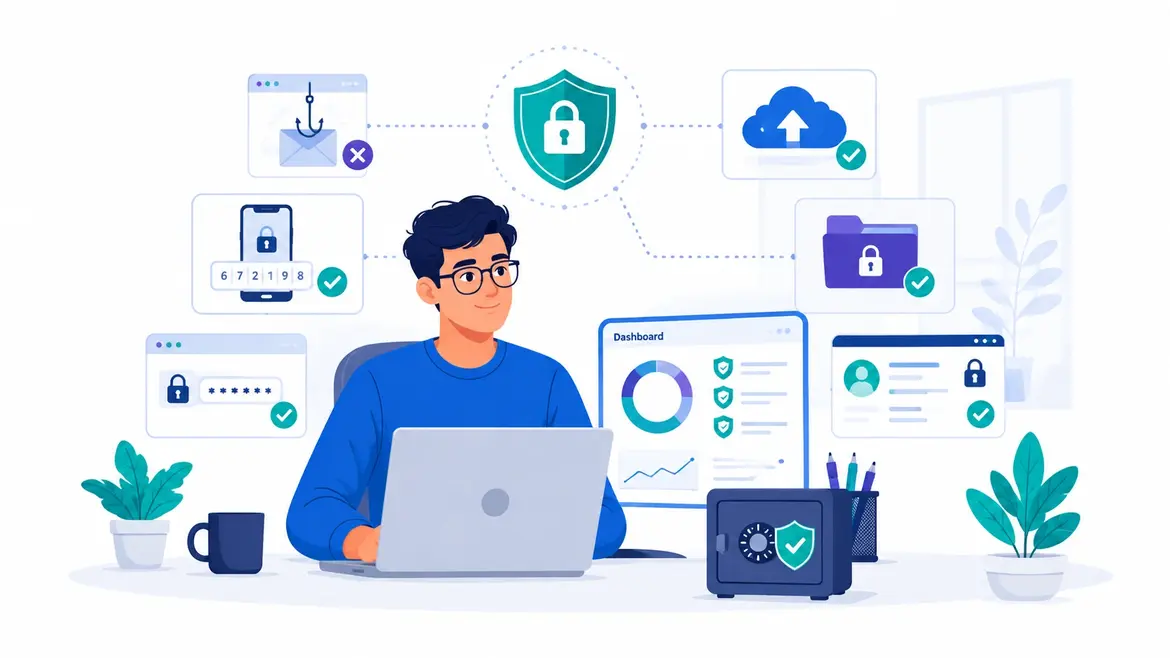
This is the competency most freelancers have thought about least, and it has quietly become a contractual matter rather than a personal preference.
If you hold client credentials, unreleased material, customer records or anything covered by an NDA, you are a link in someone else’s security chain. Clients increasingly ask about this in onboarding, and being unable to answer costs work.
The basics first. Account takeover is the realistic threat, and it usually comes from password reuse rather than anything sophisticated. The NCSC’s advisory on credential stuffing describes the pattern: valid combinations harvested from one breached site, then tried automatically against every other service. Unique passwords in a manager, plus multi-factor authentication on anything client-facing, closes most of that door.
Network security is the part people get wrong in both directions. Public Wi-Fi is not the free-for-all it was a decade ago, because most traffic is now encrypted in transit by default. But encryption in transit is not the same as privacy, and it does not cover everything. The FCC’s guidance on protecting yourself online suggests that regular hotspot users consider a VPN, which encrypts all transmissions between the device and the internet rather than only the traffic a given site happens to protect.
For freelancers who work from cafés, coworking spaces and hotels, that is a defensible baseline rather than paranoia. If you develop on Linux, as a large share of technical freelancers do, a Linux VPN client installs as a standard package on Debian and RHEL-based distributions and runs from either a GUI or the terminal, so it adds a step to your setup rather than a change to your workflow.
Choose carefully, though. The FTC has published guidance on evaluating VPN apps, and the questions it raises are the right ones: does it actually encrypt, what permissions does it request, and does it share your data with third parties? A free VPN funded by selling traffic data is worse than no VPN, particularly if you are handling client material.
Pacing Yourself Over Years, Not Weeks
Freelancing removes the structures that used to cap your working hours. No closing time, no colleagues going home, no manager telling you to take the leave you accrued. The feast-and-famine cycle then supplies a permanent reason to keep going: you work flat out when busy because you remember being quiet, and you work anxiously when quiet because you fear staying quiet.
The World Health Organization defines burnout as an occupational phenomenon in ICD-11, resulting from chronic workplace stress that has not been successfully managed, and characterised by exhaustion, growing cynicism about the work, and reduced professional efficacy. That third dimension is the one freelancers should read twice. Burnout does not only make you miserable. It makes you worse at the thing you are selling, which makes the financial anxiety that caused it worse.
Treating rest as an operational requirement rather than a reward is a competency. So is turning down work when the calendar is full, which is easier to do when the pipeline and the cash buffer are healthy. Everything in this article connects to everything else.
Conclusion
The competencies that keep freelancers working are not the ones on the portfolio. They are scoping, pricing, communication, attention management, financial administration, security hygiene and sustainable pacing, and none of them are taught alongside the craft that got you here.
The encouraging part is that these are ordinary skills rather than talents. You can get measurably better at all of them within a year by doing unremarkable things: keeping time records, tracking your pipeline, sending the difficult email early, putting tax aside on arrival, turning on multi-factor authentication, and stopping at a reasonable hour.
The craft is why clients hire you the first time. The rest of it is why they hire you again, and why you are still available when they do.