
Blog
Virtual Card for Google Ads: Fund Mobile Game UA Campaigns Safely

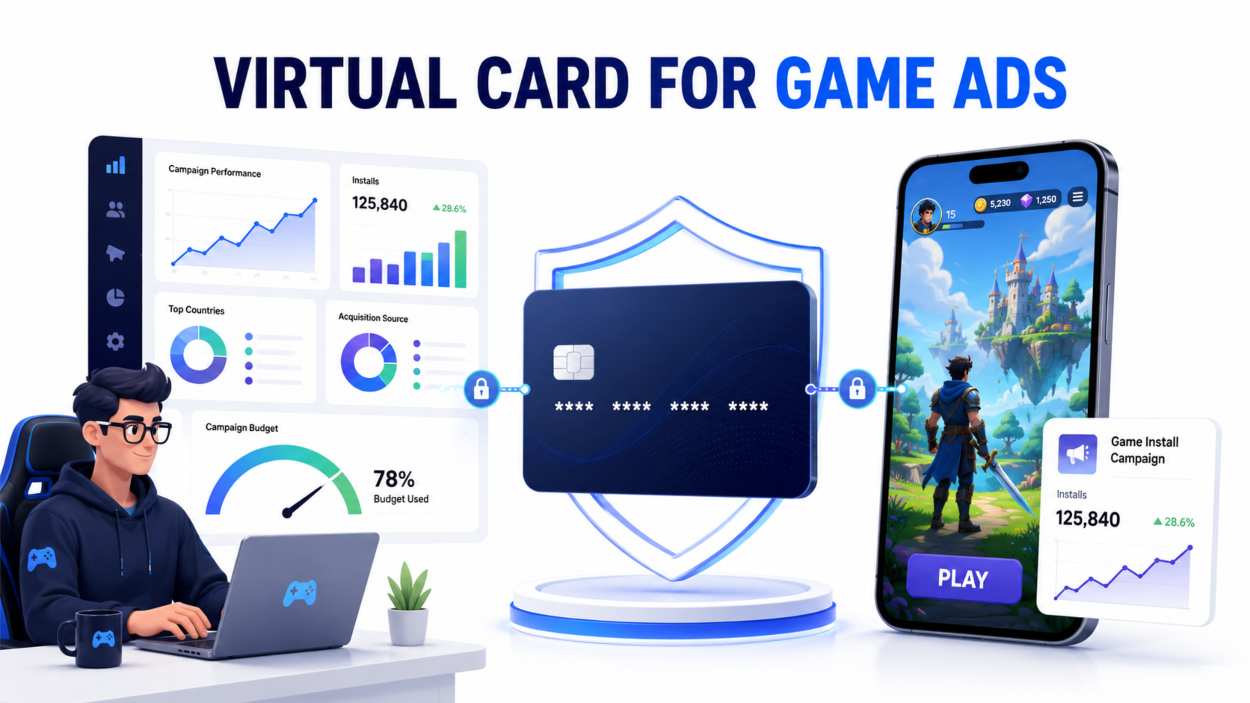
Running user acquisition for a mobile game comes down to numbers, and those numbers only hold up if the payment method behind the ad account can keep pace. Yet plenty of indie studios and solo app developers are still funding Google Ads with the same personal debit card they use to buy groceries. That’s usually when things start to break.
Google Ads flags unusual card activity fast. A sudden funding spike, a mismatched billing address, or a card that also handles personal subscriptions can trigger a hold, a review, or an outright decline right in the middle of a UA push. For a studio racing to hit install targets before a soft-launch window closes, that kind of friction gets expensive quickly. This guide covers why a dedicated virtual card for Google Ads solves most of that headache, how to split budgets per campaign or title, and what crypto-earning developers should look for when turning game revenue straight into ad spend.
Why Personal Cards Cause Problems for UA Budgets
Most developers don’t set out to mix business and personal spend. It just happens, because opening a business bank account, getting a corporate card, and waiting on approval takes time a small studio rarely has to spare.
The trouble starts once a campaign scales. A card that suddenly takes on a large recurring charge from Google looks different from a card used for coffee runs and streaming subscriptions, and payment processors notice. According to guidance from platforms like Buvei, a single failed charge can pause a campaign, reset the ad learning phase, or trigger a full account review – all of which cost time and, indirectly, money, since Google’s algorithm needs fresh data to re-optimize delivery.
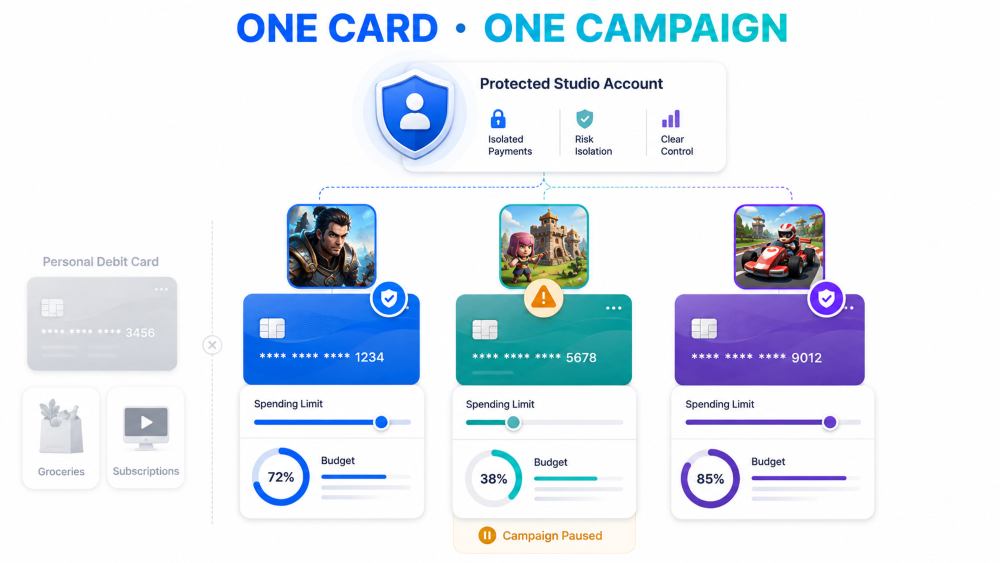
There’s also the suspension risk hanging over the whole thing. If a personal card gets frozen for fraud review, or a bank flags the account for unusual activity, the ad account tied to it can get pulled into the same hold. For a studio managing several titles, that means every game’s UA spend is exposed to one point of failure. This is exactly the gap a dedicated virtual card for advertising is meant to close.
Case for a Dedicated Virtual Card for Google Ads
A virtual card issued specifically for ad spend does three things a personal card can’t do cleanly.
It isolates risk. If one card gets flagged or capped, only that campaign or title takes the hit, not the studio’s whole payment stack.
It makes budgets visible. Assigning one virtual card per game, or per campaign, gives a clean read on cost-per-install without digging through mixed transaction histories.
It cuts down on declines. Most virtual card providers let advertisers set spending limits that match daily or monthly budgets, so Google never tries to pull more than what’s actually there – a common reason behind a Google Ads payment declined fix search in the first place.
Halocard, for example, lets advertisers set a spending limit that mirrors their daily or monthly ad budget directly on the card, and its setup for Google Ads Billing & Payments requires the card number, expiry, CVV, and a US billing address matching the dashboard exactly. That detail matters more than it sounds – Google’s Address Verification System checks the billing address against what’s on file. A mismatch is one of the more common reasons a prepaid card for Google Ads gets rejected at setup.
Where Crypto Fits: Developers Earning from IAPs and Token Economies
A growing share of mobile game revenue doesn’t land as a tidy bank deposit anymore. Studios running play-to-earn titles, NFT-based game economies, or games that accept crypto for in-app purchases often end up sitting on balances in USDT, ETH, SOL, or other tokens long before that value ever reaches a bank account.
Converting that crypto to fiat through an exchange, waiting on a bank transfer, then funding an ad account the old-fashioned way adds days to something that should take minutes. This is where a crypto card for ad spend becomes genuinely useful rather than a novelty. Platforms built around crypto-to-card conversion let a developer load a virtual card straight from a wallet balance and put it to work on Google Ads the same day, with no bank step in between.
Buvei supports topping up card balances with USDT over TRC20 or ERC20 networks, with the balance available right after the transaction confirms. Halocard’s fee structure shows how much the funding method affects cost: stablecoin top-ups are free, bank transfers in USD, EUR, or GBP run about 1%, Layer 1 tokens cost around 3%, and card-based funding methods like debit, credit, Apple Pay, or Google Pay run closer to 5%. That spread is worth knowing before picking a funding route, since it can be the difference between keeping most of a marketing budget intact and losing a meaningful slice to fees before a single ad even runs.
Developers who want to understand the mechanics before committing to a provider might find WaldenPay’s knowledge base on how virtual cards work a reasonable starting point, since it walks through the funding-to-spend flow in plain terms rather than marketing language.
A Practical Checklist for Choosing a Virtual Card for Ad Platforms
Most “best virtual card” roundups just line up five or ten fintech apps side by side with no context for who actually needs one. Agencies flipping cards for arbitrage have different priorities than a two-person studio funding its first UA test. Here’s what actually matters for a developer picking a virtual card for app developers running Google Ads campaigns.
1. Funding speed
How long does it take from sending crypto or fiat to actually having a usable card balance? Same-day or near-instant funding matters when a campaign needs a mid-flight budget top-up. Some providers issue cards within minutes once KYC clears; others, especially with bank transfers, take longer.
2. Spend limits and per-campaign control
Look for the ability to set a hard spending cap per card, matched to a daily or monthly UA budget. This guards against accidental overspend and makes it possible to run separate cards per game title without budgets bleeding into each other.
3. Decline rates and AVS accuracy
Google Ads checks billing details closely. Buvei’s setup guidance recommends saving the card name, billing address, and ZIP or postal code exactly as they appear in the issuer’s profile, since a mismatch is a frequent cause of declined charges. A provider with a solid track record of low decline rates on ad platforms is worth more than one offering slightly lower fees but constant rejections.
4. Fee transparency
Vague “lowest fees” claims are everywhere; actual tiered pricing is rarer. A provider that spells out exactly what a top-up costs at different volumes, and whether that percentage drops as spend grows, is far easier to budget around than one hiding markups inside the conversion rate.
5. Multi-network and multi-currency support
For developers earning across different chains – USDT on one network, ETH on another, maybe SOL from a game’s token rewards – a card provider that supports multiple networks skips the extra step of consolidating everything into one token before funding.
| Priority | Why it matters for UA campaigns |
|---|---|
| Funding speed | Lets a studio react to a campaign that is scaling faster than expected. |
| Per-campaign spend limits | Keeps one title’s budget from bleeding into another’s. |
| AVS accuracy / decline rate | Reduces paused campaigns and reset learning phases. |
| Transparent fee tiers | Provides predictable costs as monthly ad spend grows. |
| Multi-network crypto support | Avoids extra conversion steps before funding the card. |
How Fee Tiers Actually Work (and Why It Matters at Scale)
A lot of guides throw around “low fees” without explaining what that means in practice. Fee tiers usually scale with volume, which matters a lot once a studio moves from testing a campaign at $500 a month to scaling one past $25,000.
WaldenPay’s pricing structure is a useful reference point for how this works in the crypto card space: top-up fees start at 5% and step down automatically as 30-day card spend increases, dropping to 4.75% past $2,000, 4.5% past $5,000, 4.25% past $10,000, 4% past $25,000, 3.5% past $50,000, and 3% past $100,000, with custom pricing above $250,000 a month. There’s no application process for the discount – it kicks in automatically based on rolling spend, and the dashboard shows the current fee, 30-day spend, and how close the account is to the next tier. There’s also a one-time $10 card issue fee and no monthly maintenance charge, which keeps costs predictable for a studio scaling a UA budget month over month.
That kind of tiered, visible pricing is a meaningfully different experience from a card provider that buries its markup inside a conversion rate. It’s also worth being clear-eyed here: a virtual card for advertising, whether funded by crypto or fiat, still runs through normal card-network rails and is subject to the AML and regulatory checks that apply to any card product. Using crypto to fund an ad account doesn’t make spending anonymous or untraceable – it just cuts out a slow bank step that used to be part of the process.
Setting Up a Workflow for Multiple Titles
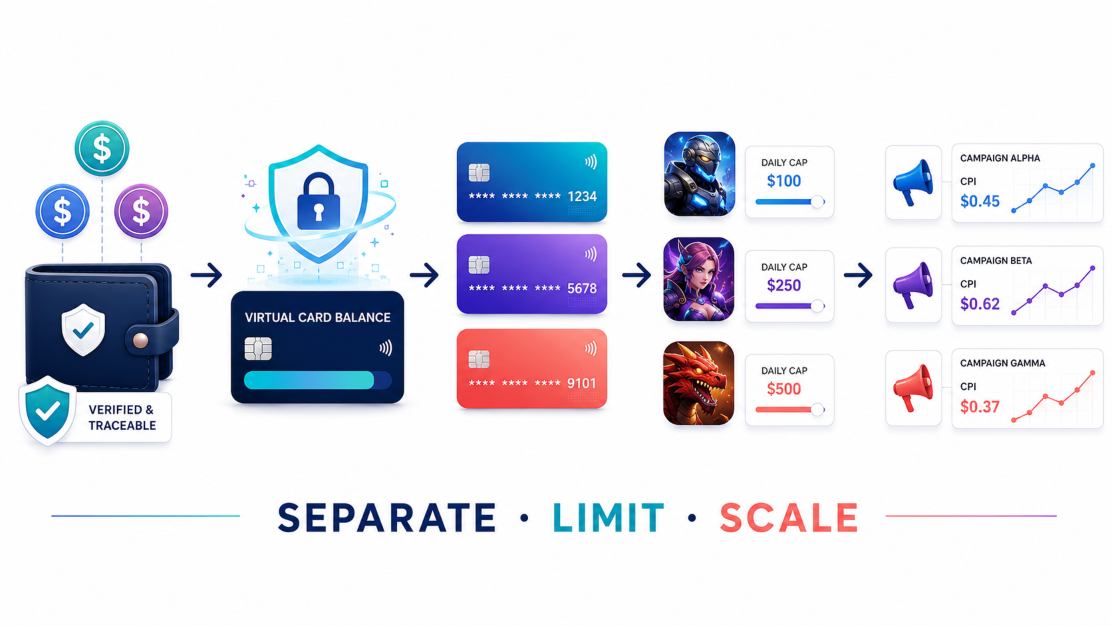
Studios running more than one game benefit from treating each title’s UA budget as its own line item, funded through its own card.
A simple version of this workflow looks like: load crypto into a wallet, convert it to a card balance in minutes, set a spend limit matching that title’s monthly budget, and link the card to Google Ads Billing & Payments for that specific campaign or MCC sub-account. Providers like WaldenPay issue virtual cards this way and support adding them to Apple Pay or Google Pay, or using the card details directly online, which covers most billing setups Google Ads accepts. Genome’s ordering flow, by comparison, links a virtual card to a Google Ads account in EUR, USD, or GBP in a matter of seconds, which says a lot about how fast this step has become across the industry generally.
Once each title has its own card, basic questions get much easier to answer: which game’s UA spend is actually profitable, which campaign needs a bigger budget, and which one should get paused. That clarity is arguably the biggest, least-talked-about benefit of separating budgets this way – more valuable than any single fee discount.
Final Thoughts
Payment friction shouldn’t be the reason a good UA campaign misses its window. Indie studios and solo developers have more options now than a personal debit card or a slow business banking application – dedicated virtual cards, whether funded by fiat or crypto, exist specifically to separate ad spend from everything else and stop a single flagged transaction from taking down a whole account.
For developers already earning in crypto through in-app purchases, token rewards, or game economies, converting that balance into a usable virtual card for Google Ads is often the fastest path from “revenue sitting in a wallet” to “budget in an active campaign.” Checking fee tiers, decline rates, and spend-limit controls before picking a provider takes an afternoon. Dealing with a suspended ad account mid-campaign takes a lot longer.