
Blog
Reading Digital Body Language: How To Decode Communication In Remote Work

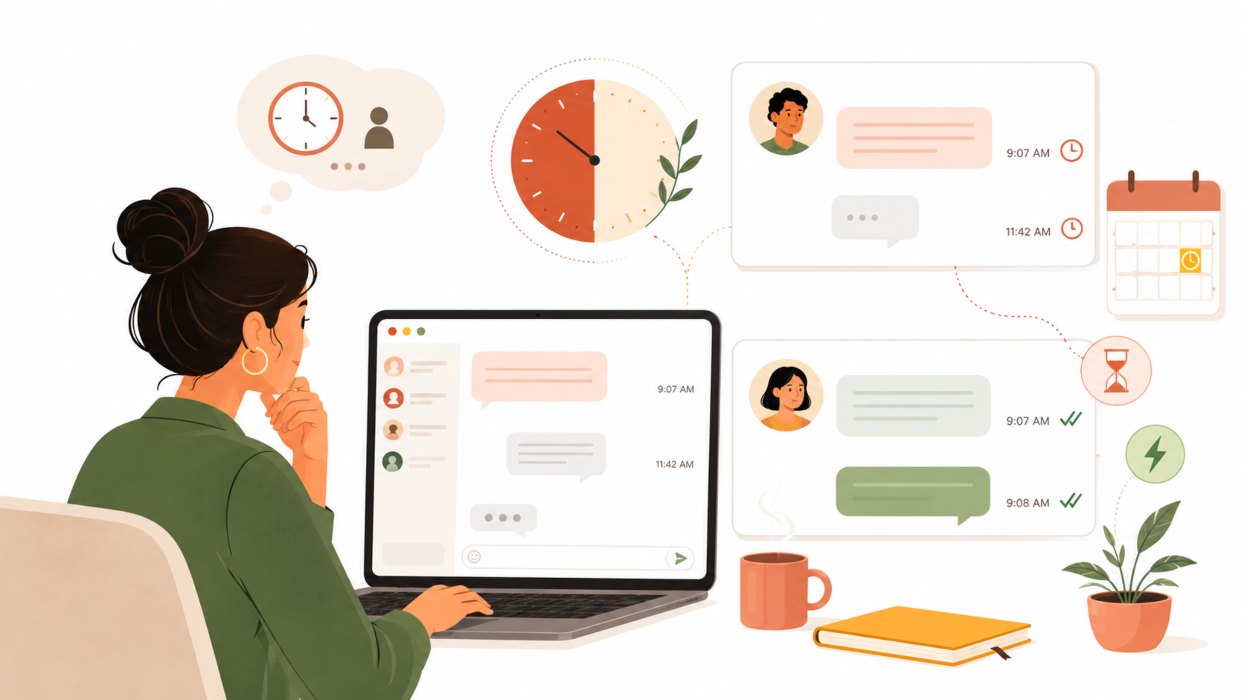
Someone on your team read a message from you this week and got the tone wrong. You almost certainly do not know which message, which person, or which direction the misread went. That is the entire problem in one sentence, and it is worse than most advice on this subject admits.
First, The Myth This Whole Genre Is Built On
Nearly every article about digital body language rests on a statistic: that 93 percent of communication is nonverbal, so text strips out almost everything that matters. It is one of the most durable pieces of misinformation in business writing, and the research behind it does not say that at all.
The number comes from two small laboratory studies Albert Mehrabian published in 1967, involving a few dozen participants, in which words, tone, and facial expression deliberately contradicted each other. The finding was narrow: when signals conflict, and when the subject is specifically the speaker’s feelings or attitudes, listeners weigh the nonverbal cues heavily. Mehrabian spent decades trying to correct the misreading, stating plainly on his own website that the equations do not apply unless someone is communicating about feelings or attitudes.
This matters practically, not just pedantically. If you believe text loses 93 percent of meaning, you will over-invest in compensating theatrics: emoji garnish, forced warmth, exclamation marks doing emotional labor they cannot perform. The real loss is narrower and more specific. Words survive the transfer to text almost entirely intact. What degrades is your ability to signal attitude, and your ability to detect when someone has misjudged yours. That is also why the wider world of online interaction matters: when people move between work conversations and digital entertainment, even something as simple as browsing an online slot collection at https://spin.city/casino/collection/slot can involve the same basic challenge of interpreting communication through a screen.
Overconfidence Is The Actual Problem
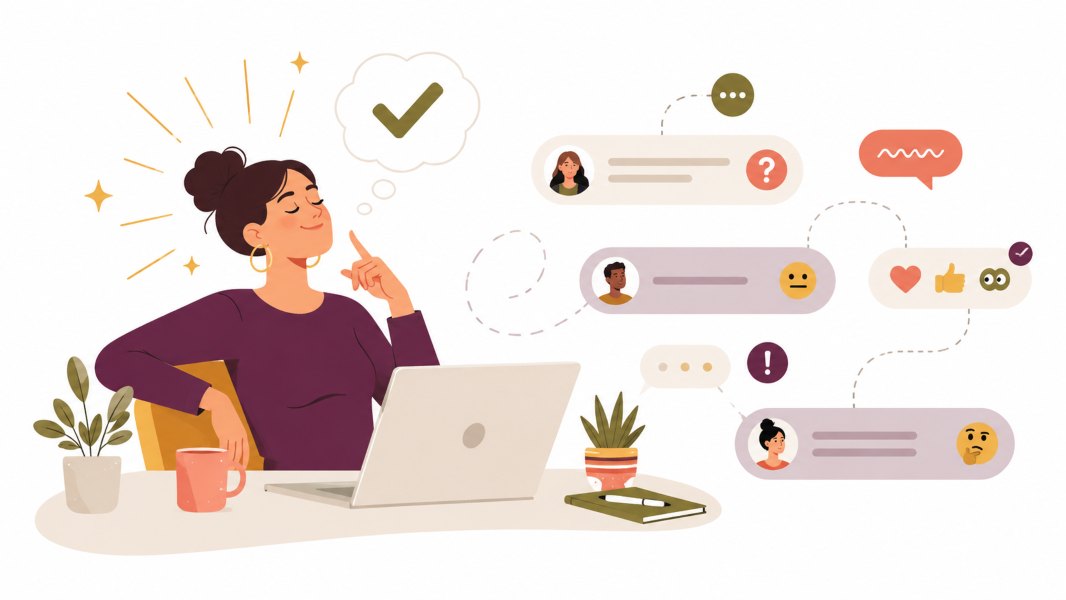
The most useful study on this is now twenty years old and still under-cited. In a set of five experiments on email communication, Justin Kruger and colleagues found that people consistently believe they can convey tone over email far better than they actually can, and that the gap is invisible from the inside.
The mechanism they identified is egocentrism, which here means something specific rather than insulting. When you write a sarcastic line, you hear it in your head with the sarcasm attached. You cannot easily un-hear it. So you assume the reader hears it too, and you have no internal signal telling you they might not.
The paper opens with an experiment that captures this better than any workplace anecdote. Participants were asked to tap out the rhythm of a well-known Song and then guess how many listeners would identify it. Tappers predicted around half. The actual rate was three percent. They could hear the melody. The listener heard knocking.
Every terse Slack message you have ever sent is that tapping experiment. You knew the melody.
What Actually Changed About Work
It is worth being accurate about the conditions, because a lot of writing on this topic overstates them. Fully remote work is not the default. Gallup’s tracking puts roughly half of remote-capable US employees in hybrid arrangements, with fully remote and fully on-site each accounting for a smaller share, and those proportions have been broadly stable for several years despite the volume of return-to-office coverage.
But the same data contains a detail that matters more than the headline split. Among on-site remote-capable employees, the share reporting that their team is spread across different work locations roughly doubled between 2023 and 2025. Going into an office no longer means working alongside your team. You can commute an hour to take video calls with people in three time zones. Digital body language is not a remote-work skill. It is now a working skill.
What changed underneath is the medium mix. A study of 61,182 Microsoft employees published in Nature Human Behaviour found that firm-wide remote work made collaboration networks more static and siloed, with fewer bridges between separate parts of the organization, alongside a measurable shift from synchronous to asynchronous communication.
Read those two findings together. More of your communication now happens in the medium where tone is hardest to convey, and simultaneously with people you have fewer casual interactions with, which is exactly the population whose intent you are least equipped to read accurately. Researchers covering the study noted the implication: information moves less freely across a network that has lost its bridges.
Timing Is The New Posture
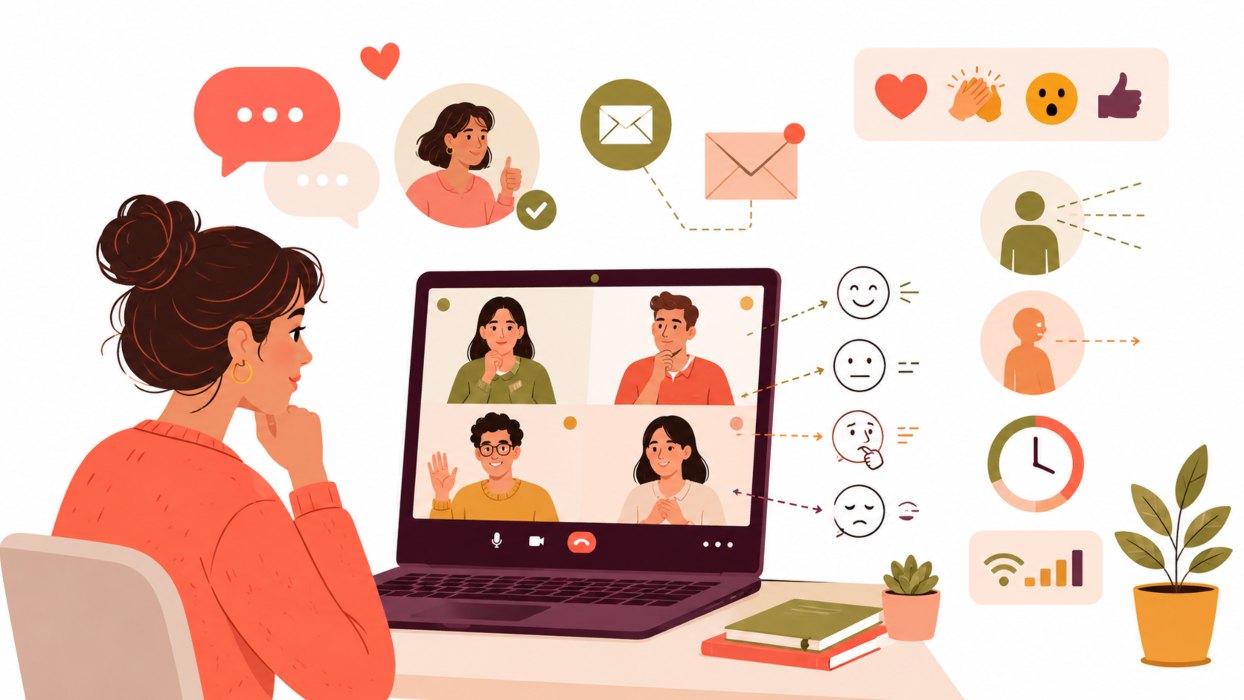
Response latency does more signaling work than any other digital cue, and almost nobody negotiates it explicitly.
The trouble is that latency is ambiguous in both directions. A fast reply reads as engaged to one person and as unboundaried to another. A slow reply reads as thoughtful, or as dismissive, or as a status display, depending entirely on relative seniority and what the reader already believes about you. Delay from a peer is a scheduling artifact. The identical delay from someone senior to you feels like a verdict.
The fix is unglamorous: make your own latency legible rather than trying to optimize it. “Seen this, need a few hours” costs eight seconds and removes the entire interpretive gap. Teams that state their norms out loud, rather than leaving everyone to infer them, spend markedly less energy on this.
What Punctuation Actually Signals
Formatting carries real weight, but the meaning is set by relationship and context rather than by any universal code.
| Digital Cue | Reads As Positive When | Reads As Negative When |
| Rapid response | The thread is urgent and you are the blocker | It happens at all hours and models an always-on culture |
| Emoji | It disambiguates tone in a short message | It substitutes for a clear answer, or the reader is senior and formal |
| All lowercase | The team culture is casual and you are a peer | The reader outranks you, or the subject is serious |
| Bullet points | The recipient is time-poor and wants the structure | The message is interpersonal rather than operational |
| A period after a one-word reply | Almost never | The reply is “Fine.” or “Sure.” and the context is tense |
| Long paragraph | The topic genuinely needs nuance | It is a decision that could have been one line |
The pattern underneath the table is that formality signals distance. Distance reads as warmth when you are being respectful of someone’s time, and as coldness when the subject is personal. The same bullet points that make a project update efficient make a difficult conversation feel like a performance review.
Video Is Not The Free Upgrade It Looks Like
The standard advice is to escalate off text when a thread stalls. That advice is right, and it is usually delivered without acknowledging the cost.
Jeremy Bailenson’s analysis of why videoconferencing exhausts people identifies specific mechanisms rather than vague fatigue: sustained close-range eye contact at intensities that would be intolerable in person, the cognitive load of watching yourself in a mirror all day, reduced physical mobility, and the effort of manufacturing and monitoring nonverbal cues that would otherwise be automatic. Stanford published practical fixes alongside it, including hiding self-view and taking calls audio-only.
The cost is also not distributed evenly. A survey of 9,787 people testing Bailenson’s framework found that women report meaningfully higher videoconference fatigue than men, with mirror anxiety from prolonged self-view a significant contributor. “Cameras on for everyone” is therefore not a neutral policy. It levies a heavier tax on some of your team than others, and the people paying most are the least likely to say so.
Practical version: escalate off text when the thread has cycled more than a few times without converging, or when the subject is emotionally loaded. But escalate to audio by default, and reserve video for the conversations that genuinely need faces.
Repair Kit
Most articles end here with a paragraph about how the leaders of tomorrow will build bridges of understanding. That is not useful. What is useful is knowing what to say once a misread has already happened, because it will, and because the recovery matters more than the prevention.
- When you suspect you were read as cold. Do not apologize for the message and do not explain your intent at length, which reads as defensive. Add the missing signal directly: “Rereading my last message, it came out blunter than I meant. I’m on board with the approach, just short on time this morning.”
- When you have read someone else as hostile, assume the tapping experiment. Before responding, write out the most generous plausible reading of their message and check whether it fits the facts as well as your first reading does. It usually does. If you still need to check, ask about the content rather than the tone: “Want to make sure I’ve got this right, are you saying X, or something closer to Y?”
- When a thread has clearly gone wrong, stop replying in the thread. Latency compounds misreadings, because each pause gets interpreted. Move it to a call within the hour and open with the concrete question rather than the relational one.
- When you are the senior person. Your latency, your punctuation, and your brevity all land with more force than you intend, and nobody will tell you. Over-signal deliberately. A three-word reply from you is not the same object as a three-word reply from a peer.
- When you are joining a new team, spend two weeks reading before writing. Note whether the team uses periods in short replies, whether emojis appear in serious threads, how fast senior people respond, and whether disagreement happens in channels or in DMs. Every team has a dialect, and the fastest way to be misread is to arrive fluent in the wrong one.
- The single-question audit. Once a week, pick one message you sent that got a response you did not expect. Reread only what you actually wrote, ignoring what you meant. Ask whether a stranger would have arrived at your intent from the text alone. That habit will teach you more about your own digital body language than any framework, because it is the only method that shows you the gap you cannot otherwise see.
Disclaimer: This article offers general guidance on workplace communication and is not professional HR, legal, or psychological advice. Research cited reflects published findings as of August 2026 and describes group-level patterns rather than any person or team. Communication norms vary by organization, culture, seniority, and role, so treat everything here as a starting point to test against your own context rather than a rule to apply uniformly.
References
- Kruger, J., Epley, N., Parker, J., Ng, Z.-W. Egocentrism Over E-Mail: Can We Communicate as Well as We Think? Journal of Personality and Social Psychology, 2005;89(6):925-936. doi: 10.1037/0022-3514.89.6.925. Available at: https://web-docs.stern.nyu.edu/pa/kruger_email_ego.pdf
- The 7-38-55 rule: Debunking the golden ratio of conversation. Big Think. Available at: https://bigthink.com/the-learning-curve/the-7-38-55-rule-debunking-the-golden-ratio-of-conversation/
- Pendell, R. Hybrid Work in Retreat? Barely. Gallup. Available at: https://www.gallup.com/workplace/694361/hybrid-work-retreat-barely.aspx
- Yang, L., Holtz, D., Jaffe, S., et al. The effects of remote work on collaboration among information workers. Nature Human Behaviour, 2022;6(1):43-54. doi: 10.1038/s41562-021-01196-4. Available at: https://www.nature.com/articles/s41562-021-01196-4
- Counts, L. When everyone works remotely, communication and collaboration suffer, study finds. University of California, Berkeley. Available at: https://vcresearch.berkeley.edu/news/when-everyone-works-remotely-communication-and-collaboration-suffer-study-finds
- Bailenson, J.N. Nonverbal Overload: A Theoretical Argument for the Causes of Zoom Fatigue. Technology, Mind, and Behavior, 2021;2(1). doi: 10.1037/tmb0000030. Available at: https://tmb.apaopen.org/pub/nonverbal-overload
- Ramachandran, V. Stanford researchers identify four causes for ‘Zoom fatigue’ and their simple fixes. Stanford News, 23 February 2021. Available at: https://news.stanford.edu/2021/02/23/four-causes-zoom-fatigue-solutions/
- Fauville, G., Luo, M., Queiroz, A.C.M., Bailenson, J.N., Hancock, J. Video-conferencing usage dynamics and nonverbal mechanisms exacerbate Zoom Fatigue, particularly for women. Computers in Human Behavior Reports. Available at: https://www.sciencedirect.com/science/article/pii/S2451958823000040