
Blog
Slot Game Development Companies 7 Studios Compared by Type

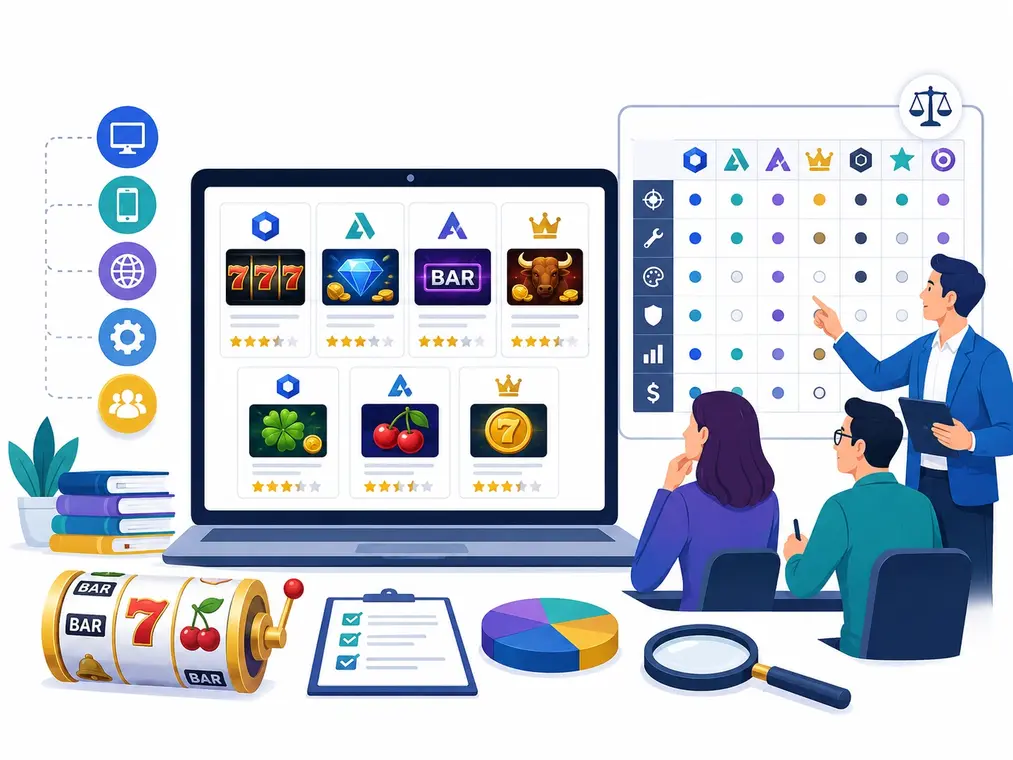
Send the same brief to five slot game development companies, and the replies may look very different: a licensing agreement, an art quote, a platform demo, a question about math ownership, or a full development proposal.
That is because the same search term covers several business models: licensing finished games, creating art assets, providing platforms, and building original titles. So, start with the company type, and compare vendors then.
This article explains the main types of slot game development companies, shows when each fits, and compares seven studios based on what they deliver.
4 Kinds of Slot Game Development Companies
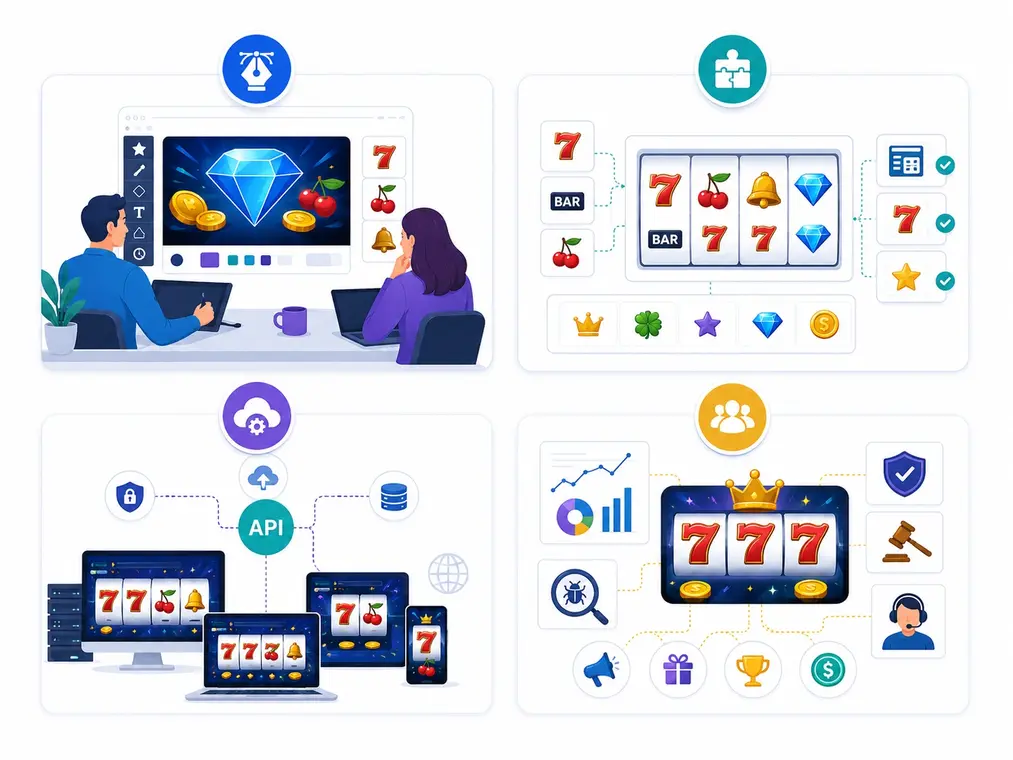
Each company type solves a different problem, so the right choice depends on what your project lacks.
Content suppliers offer finished slot games to operators. You choose titles from a catalog, integrate them, and usually pay a revenue share. This route adds games quickly, without a development cycle. The supplier keeps ownership, and the mechanics are fixed. Some suppliers also sell finished games outright for a one-time fee.
Custom development studios build games to your specification. They handle the concept, math, art, engineering, and certification support under one contract. This route takes longer and costs more, but it can give you ownership of the final IP if the contract includes it.
Art and design specialists create visual assets from a written brief: symbols, reels, backgrounds, animations, and interface layouts. They don’t own the math or paytable. This works best when you already have an engine and game logic, but need updated visuals.
Platform aggregators provide access to games from multiple suppliers through a single integration. They don’t build games, but solve a distribution problem.
The shortlist below covers content suppliers, custom development studios, and art specialists. Aggregators are explained here, but excluded from the comparison because distribution and development are different purchases.
Matching Slot Game Development Companies to Your Project
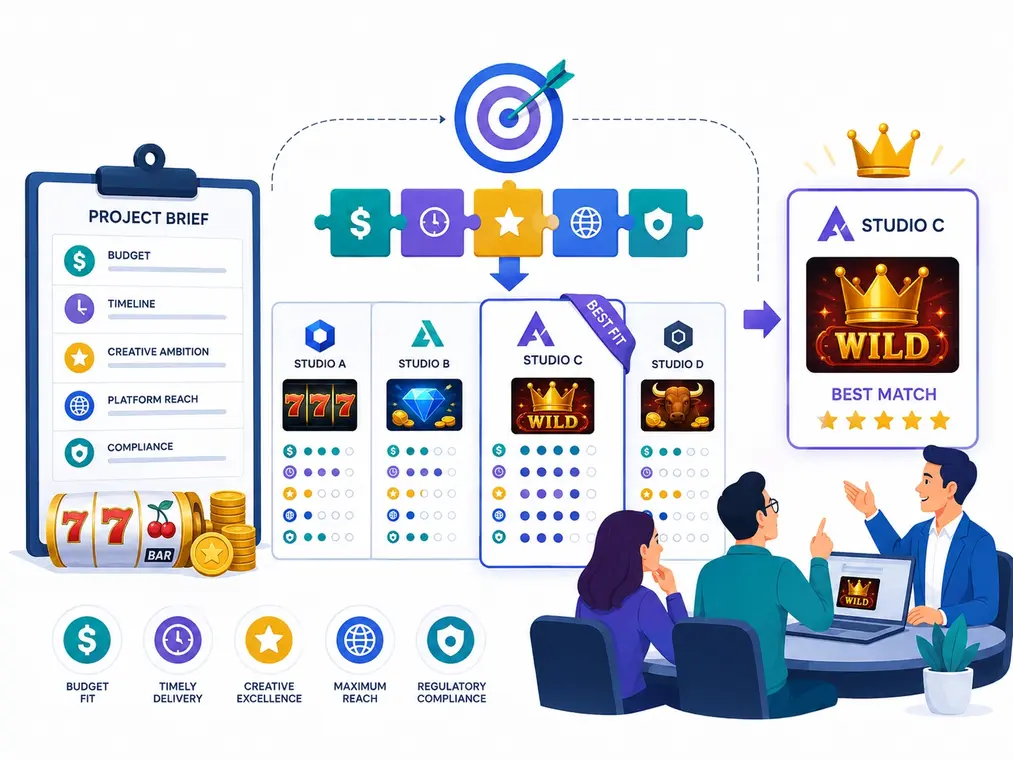
The right choice depends on what you already have.
If you have no license, platform, or concept, start with a content supplier. It lets you launch games faster, while original IP can wait until there is revenue to fund it.
If you already have a license and platform, but need more games in the lobby, supplier catalogs, or ready-made slot libraries can add titles without a full development cycle.
If you have a concept and business case but no production team, choose a custom development studio. The mechanics are built around your brief. Ownership should be defined in the contract.
If you have a working engine and a proven math model but dated visuals, choose an art specialist. A visual refresh costs less than rebuilding the game, and the math stays unchanged.
If you have an engine and an in-house mathematician, an art specialist is also the right fit. The main work left is production: symbols, animation, and interface design.
Procurement issues come from choosing the wrong type of company: expecting IP from a white-label license, asking an art studio to own the paytable, briefing a supplier for custom mechanics, or paying for a full build when a reskin would solve the problem.
Once the company type is clear, the vendor shortlist becomes easier to compare.
Seven Slot Game Development Companies to Choose From
Slot game specialists are often smaller than general software companies, so their credentials aren’t always shown in the same way. Some have reviews on Clutch, GoodFirms, or Upwork. Others show credibility through portfolios, named clients, company records, or industry awards.
The Credentials column includes the public proof each studio provides: review scores, founding year, team size, portfolio size, and named clients. These details should be read by vendor type, not as a single direct ranking, because an art studio and a content supplier demonstrate their experience in different ways.
| Studio | Vendor type | What you get | Credentials |
|---|---|---|---|
| Whimsy Games | Custom development | Original slots plus lottery, scratch card, and crash titles, with IP | Clutch 5.0 (25); GoodFirms 4.9 (32); Clutch Top Software Developers, Gaming 2024; founded 2016 |
| Slavna Game Studio | Custom development | Full-cycle slots and table games on a proprietary platform, IP transferred | GoodFirms 5.0 (1); founded 2008; 120+ projects; 100+ team; offices in 3 countries |
| Mobilots | Content supplier | Licensed video and arcade slots with API integration built in | 30+ titles; founded 2015; supplies certified European markets |
| Slotopaint | Content supplier, outright sale | Finished slots sold outright, or bespoke casino art and animation | Named titles Cool Cash Penguin and Three Pigs; art for online casino, AWP, and VLT terminals; published catalog with source files |
| Inkration Studio | Art and design | Slot art and animation for online titles and physical cabinets | Clutch 4.8 (3); GoodFirms 5.0 (1); 250+ titles; 50+ artists; client 1X2Network |
| ZVKY Design Studio | Art and design | Reels, symbols, backgrounds, bonus concepts, and slot animation | 150+ games and apps contributed to; clients include Aristocrat, Zynga, and Ubisoft; founded 2009; testimonials from Playdom and Gogii Games |
| RocketBrush Studio | Art and design | Stylized slot symbols and icons for online and offline machines | Founded in 2016, Limassol, Cyprus; slot client Megarama Games; also Supercell, Paradox Interactive, NCSoft |
1. Whimsy Games
Whimsy Games is a slot game development company dedicated to iGaming since 2023, drawing on 8+ years of broader game development experience. The studio began with reskins of existing slots for game providers and gradually expanded into full-cycle iGaming development, with several team members bringing years of individual iGaming industry experience into the studio. The company holds a 5.0/5 rating across 25 verified Clutch reviews.
The studio focuses on slot development, from simple mechanics to more complex builds. It also develops scratch cards, lottery games, real-money backgammon, sweepstakes platforms, and other casino formats such as Plinko, dice, crash games, mines, wheel, diamond, and tarot-based games. Moreover, the team can handle reskins of existing titles.
Client work has come from the US, Malta, Belgium, the UK, Denmark, and Greece, with launches in the US and EU and projects reaching other markets. Because iGaming projects are often covered by NDAs, most individual titles are not public.
Engagements can be structured as full-cycle projects or as a dedicated iGaming team working inside the client’s pipeline. Game development usually starts from $20,000–$40,000, depending on complexity. Timelines range from about three weeks for a reskin to a month or more for full development.
2. Slavna Game Studio
Slavna Game Studio has been building gambling games since 2008, across more than 120 gaming projects, with a team of over 100 artists, animators, and developers spread across three countries. Coverage runs from online casino slots to roulette, blackjack, video poker, and baccarat, and to multiplayer card games, full-cycle from design and 2D or 3D art through programming, testing, and support.
Games ship either out of the box or fully themed to specification, on a proprietary slots platform. Titles run on web, Android, and iOS as well as standalone software, and the studio also handles back-office customization with management tooling. Production runs through Photoshop, After Effects, Illustrator, and Spine. Full intellectual property ownership transfers to the client on delivery.
3. Mobilots
Mobilots has operated from Malta since 2015 with a catalog of more than 30 titles covering video slots, arcade slots, video poker, and instant sports. It supplies operators in certified European markets, which matters because a supplier already cleared in your jurisdiction removes a certification cycle from your timeline entirely.
Games are built in HTML5 on a mobile-first basis for cross-device delivery. The studio builds on demand as well as licensing, and every game ships with API integration built in, shortening the technical side of onboarding. As a catalog purchase, it adds lobby depth without a development cycle, which suits operators funding original IP on a separate track.
4. Slotopaint
Slotopaint works across two models. Alongside bespoke casino art and Spine 2D animation, it sells finished online slot machines outright from a published catalog, offered in vector, raster, and 3D styles. Design coverage extends past slots into poker, roulette, blackjack, keno, dice, and shell games.
On the commissioned side, the work covers theme development, character design, symbol sets, reel frames, control panels, and animation. Coverage extends across online casinos, offline terminals, and AWP and VLT cabinets, a wider hardware range than most art studios handle. Symbol sets are specified the same way slot teams are, with 10 to 12 items split across high, special, and low tiers. Published projects include Cool Cash Penguin and Three Pigs. Buying from the catalog instead sits between licensing and commissioning: no revenue share, no development cycle, and the game arrives as built.
5. Inkration Studio
Inkration Studio has more than ten years of experience in game art and animation, over 50 artists, and has contributed to more than 250 titles. Its work appears across online social casino games as well as match-three, puzzle, and card titles, built on a Spine 2D and Photoshop pipeline. A published client engagement covers a full slot design, including animations for 1X2Network, an iGaming supplier.
The studio also designs interfaces for physical slot cabinets and terminals, covering multi-screen layouts and on-device interaction, alongside online titles. Land-based and online layouts differ in screen count and input method, so they are specified separately. The style range spans semi-realism to casual, with the portfolio published on Behance. The minimum project size is $5,000 at $25 to $49 per hour.
6. ZVKY Design Studio
ZVKY Design Studio has worked since 2009 and has contributed to more than 150 games and apps, with slot art among its published specialisms. Casino clients include Aristocrat, a manufacturer of slot machines, as well as Zynga and Ubisoft. Slot services cover reels, symbols, backgrounds, bonus concepts, themes, interface layouts and animation.
It offers ready slots alongside bespoke art, so the same studio covers both a finished visual package and commissioned assets. Artists come from backgrounds at Disney, DreamWorks, EA, Activision, and Epic, and the studio runs internal art quality assurance rather than relying solely on client reviews. Engagements carry six months of post-delivery support, and published testimonials are attributed to Playdom, Zynga, and Gogii Games.
7. RocketBrush Studio
RocketBrush Studio is a boutique 2D studio operating from Limassol since 2016, producing concept art, characters, icons, 3D assets, and Spine animation. Its slot output includes 2D slot machine icons built for both online social casinos and offline machines, as well as a set of Spine-animated slot symbols for Megarama Games.
The Megarama set covered an Asgard theme. Outside the casino, it has worked with Supercell, Paradox Interactive, and NCSoft. The studio runs a small number of concurrent projects, which suits stylized work on defined asset sets.
How the Brief Changes Depending on the Slot Game Development Company Type
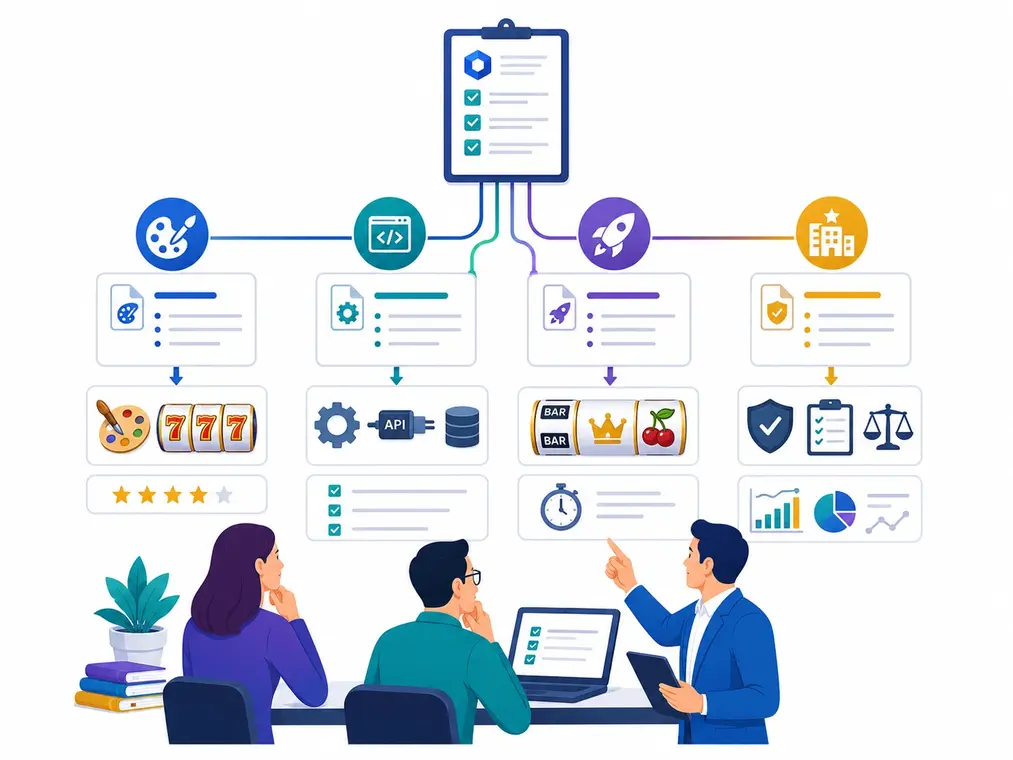
The same project can require different briefs depending on the company type. Sending the wrong specification leads to unclear or mismatched replies.
For an art specialist, define the asset formats, resolutions, layer structure, animation tool, frame rates, handover process, and revision rules. If these details are unclear, problems appear during integration.
For a custom development studio, define target markets, regulators, remote gaming server integration, and the process for handling simulation results that do not match the intended return-to-player. Responsibility for integration should be clear from the start.
For a content supplier, define the revenue share, reporting schedule, exclusivity terms, and certified jurisdictions. Existing certification can matter more than catalog size.
For a ready-made purchase, define what transfers: art only, art + math, server logic, or source files.
In every case, state who owns the math before work begins.
What You Own at the End
Ownership depends more on the vendor type than on the contract size.
With a supplier license or white-label deal, you usually don’t own the game. You rent access to the catalog. This can work commercially, but a portfolio built only this way has no owned assets if you change suppliers.
With a custom build, you can own the source code, math model, and art, but only if the contract says so. The IP transfer should be clearly stated before work begins.
With an art engagement, you own the assets and nothing else. The engine and math model stay outside the scope.
With a ready-made purchase, ownership depends on what is included in the package: art only, art + math, server logic, source files, or some combination of these.
A simple test: if the answer to “What do we own?” needs a follow-up email, the ownership terms are not clear enough yet.
Closing
Choose the type before the vendor. Once it’s clear, the seven slot development companies are no longer one ranking. This is more useful than a single scored list. A content supplier and an art studio solve different problems, so comparing them on one scale leads to the wrong choice.
Disclaimer
This article is provided for general information only and does not constitute legal, regulatory, financial, procurement or professional advice. Gambling and gaming supply requirements vary by jurisdiction, so independent advice from a suitably qualified adviser should be obtained before entering any agreement. Studio details, team sizes, portfolios, reviews, pricing, client lists, licensing and certification claims are based on publicly available information at the time of writing. They may change or rely on vendor-reported data that has not been independently verified. Readers should confirm licences directly with the relevant regulator, request licence numbers, certification scope and testing documents in writing, and carry out their own legal, financial, compliance and commercial due diligence. Inclusion in this article does not constitute endorsement; the list is not exhaustive, and no assessment has been made of any studio’s financial standing, compliance history or suitability for a particular project.