
Blog
How Browser Gaming Changed the Way We Play Online

Everyone wrote the obituary early. When Adobe set a final date for Flash Player, the assumption across gaming forums was that browser games were finished along with it. Two decades of work was about to stop loading, the argument went, and whatever survived would migrate to app stores where it belonged.
That turned out to be exactly backwards. Browser gaming is bigger now than it was at Flash’s peak. What actually happened was a handover, and the reason it went smoothly is that the web had spent the previous ten years quietly building the pieces needed to catch what Flash dropped.
Flash Did Not Die of Old Age
It is tempting to file Flash under natural obsolescence, but the specific complaints against it were sharper than that.
Steve Jobs laid most of them out in an open letter published in April 2010, explaining why Apple would never allow the plugin on the iPhone or iPad. His list was pointed: it drained batteries, it crashed browsers, it had a poor security record, it had no real answer for touch input, and despite Adobe’s marketing, it was a closed system controlled by one company. Flash, he argued, had been built for mice and desktop machines during an era that was ending.
The security problem was the one that mattered most in practice. A proprietary plugin with deep system access, installed on nearly every desktop on earth, is an attractive target, and Flash was exploited relentlessly. Adobe eventually set an end-of-support date of December 31, 2020, coordinating the wind-down with Apple, Google, Microsoft and Mozilla so that every major browser removed it at roughly the same moment.
Meanwhile, the audience had moved. By the mid-2010s most people reached the internet through a phone, and a phone was the one device Flash could never properly serve. The plugin did not lose an argument. It lost a platform.
What Picked Up the Work
The replacement was not a single technology but a set of browser capabilities that arrived separately and turned out to fit together.
The Canvas element gave developers a drawing surface for 2D graphics with no plugin involved. WebGL, released by the Khronos Group in 2011, opened up hardware-accelerated 3D by exposing the device’s GPU through JavaScript. The Web Audio API handled low-latency sound, spatial audio and the kind of layered mixing that games need and that plain HTML audio never managed.
Add localStorage and IndexedDB for save data, the Gamepad API for controllers, and WebRTC for real-time multiplayer, and by around 2017 a browser could do most of what a native runtime could. The important difference is architectural. Flash was one company’s product that browsers agreed to host. These are open standards maintained through the W3C and Khronos with input from every browser vendor, which means no single company can end them by press release.
For studios, the commercial argument was simple. One build now runs on desktop, tablet and phone. Before, that meant maintaining separate versions and separate teams.
Real-Money Corner Moved Fastest
Nowhere was the pressure to drop downloads sharper than in regulated online gambling, where a required client install sat directly between a marketing spend and a registered account. Every step in that chain leaks users, and a download step leaks a lot of them.
The Netherlands makes an unusually clean case study, mostly because of timing. The Dutch licensed online market did not exist until the Remote Gambling Act took effect and the first licences were issued on 1 October 2021, nine months after Flash stopped loading anywhere. Operators entering that market had no legacy download client to retire and no installed user base to migrate. They built browser-first because there was no alternative worth considering, and the payments layer was designed into the same web architecture from the start.
That expectation has since hardened into a review criterion. Consumer roundups of European casino sites now assess operators partly on whether games run instantly in a browser rather than requiring an install, with one comparison of licensed European operators treating instant-play capability as preferable to a dedicated app across both iOS and Android. Fifteen years ago, a download client was standard. Now its absence is the thing being scored. Source: https://hudsonreporter.com/gambling/best-online-casinos-europe/
The technical work behind that is not trivial. A live dealer table streaming video while handling bet placement, a slot running at sixty frames per second on a mid-range Android phone, and a session that survives being picked up on a laptop an hour later all run through the same browser APIs that render a puzzle game.
One Portal Became a Thousand Doors
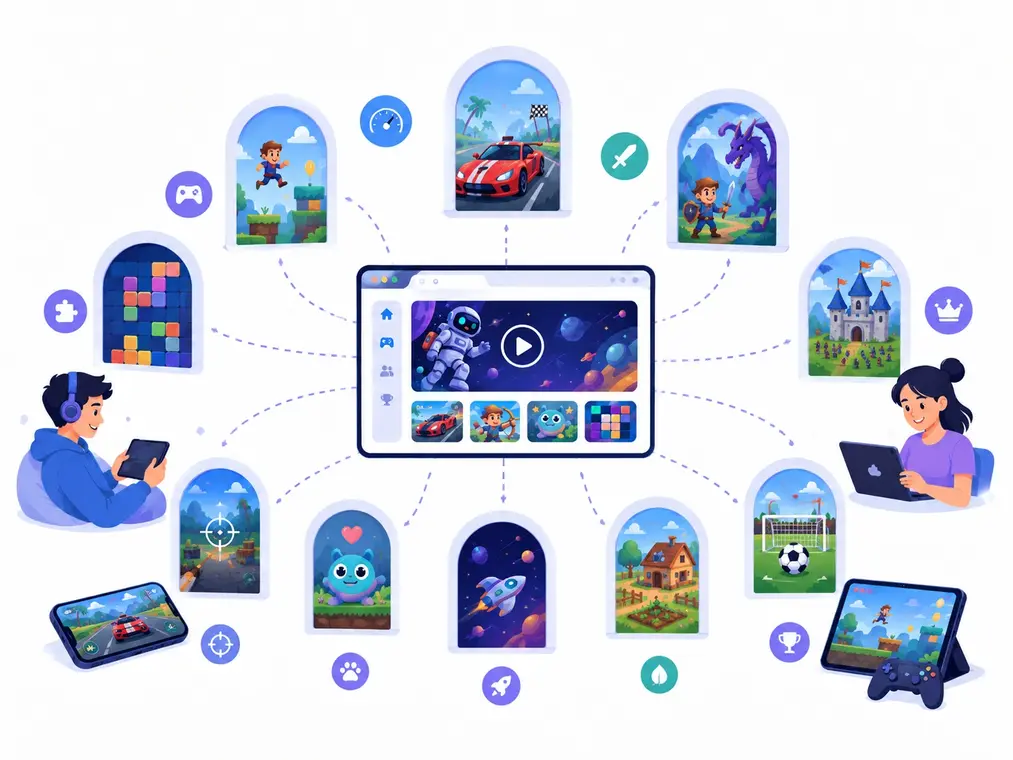
The 2000s version of browser gaming was centralized. A handful of portals decided what got seen, and if you did not get featured, you did not get played.
That structure is gone. In its place sit studio-owned catalogs, game widgets syndicated onto news and media sites, .io titles served straight off a CDN with no portal involved at all, and full engines like Unity, Unreal and Godot exporting directly to WebGL and WebAssembly. As Technology.org’s history of the transition puts it, the plugin disappeared, but the games kept playing, absorbed into the web rather than dying with the runtime that used to carry them.
For players, this is mostly an improvement. There are more routes to a game and no gatekeeper deciding which ones exist. For developers, the barrier to shipping something playable has dropped far enough that a solo developer can publish to a global audience without a publisher, a store listing or an approval process.
The trade-off is discovery. When there were four portals, finding games was easy and getting seen was hard. Now getting something online is trivial and being found is the difficult part.
What Is Coming Next
The standards have not stopped moving. WebGPU is arriving as a successor to WebGL, built against the same generation of low-level graphics APIs that power native games on modern hardware, which closes much of the remaining performance gap. WebAssembly lets compiled code from C++ and Rust run at close to native speed inside a tab, which is how large engines manage to ship to the browser at all.
Progressive Web Apps have blurred the last obvious line between browser and native. A player can add a shortcut to a home screen, launch it fullscreen, use it offline, and never once visit an app store or hand a platform holder a revenue cut.
Best Compliment Is That Nobody Notices
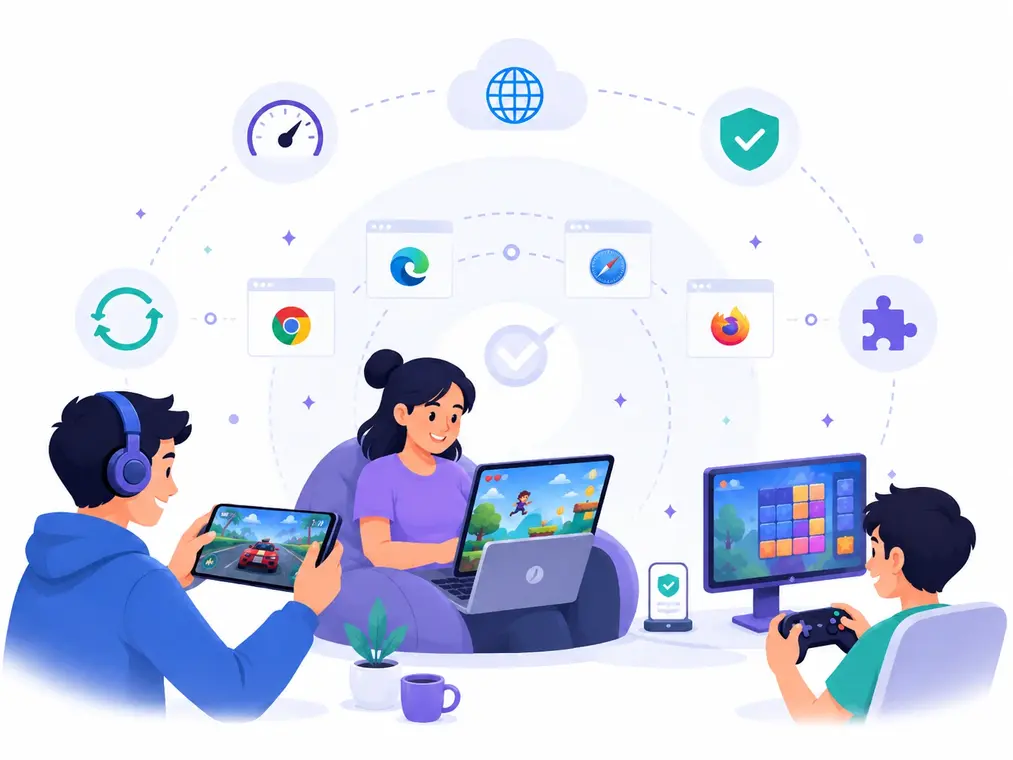
The clearest evidence that this transition worked is that almost nobody talks about it. A page loads, the game starts, touch controls respond the way they should, and the same account follows you from a laptop at lunch to a phone on the train.
Nobody thinks about the Canvas element or which graphics API is doing the rendering, in the same way that nobody thinks about TCP when a message is sent. Convenience that was once a selling point became an expectation, and expectations, once met consistently enough, turn into infrastructure and disappear from view.
Flash spent twenty years proving the browser could be a real place to play. The standards that replaced it took that idea and scaled it past anything a plugin could have carried. If you want to see how far instant play has come, the easiest way is still the same as it was in 2004: open a game library, pick something, and start playing.
Disclaimer
This article is published for general information and historical context about web technology, and nothing in it constitutes legal, financial or technical advice. References to online gambling are included to illustrate how browser technology was adopted commercially and are not an endorsement, recommendation or promotion of any operator, platform or form of gambling. Gambling laws differ substantially between countries and offering or accessing online gambling may be restricted or unlawful where you live, so check your local rules and note that licensing claims made by any operator should be verified against the relevant regulator’s own public register. Where gambling is permitted, it is restricted to adults, carries real financial risk, and support is available through services such as GamCare and Gambling Therapy. External links are provided for reference only, and we are not responsible for the content, accuracy or commercial arrangements of third-party sites. All technical details and dates were accurate at the time of writing.
References
- Jobs, Steve. “Thoughts on Flash.” Open letter, Apple Inc., 29 April 2010. Documented at Wikipedia, “Thoughts on Flash.” https://en.wikipedia.org/wiki/Thoughts_on_Flash
- Microsoft Corporation. “Adobe Flash Player end of support on December 31, 2020.” Microsoft Lifecycle Announcements. Originally published 11 September 2020, updated April 2021. https://learn.microsoft.com/en-us/lifecycle/announcements/update-adobe-flash-support
- Kansspelautoriteit (Netherlands Gambling Authority). “Remote Gambling Act in force.” Official guidance on the Wet kansspelen op afstand, effective 1 April 2021, with the licensed online market opening 1 October 2021. https://kansspelautoriteit.nl/remote-gambling-act-force
- Mozilla Foundation. WebGL: 2D and 3D graphics for the web.” MDN Web Docs, Web APIs reference. Continuously updated. https://developer.mozilla.org/en-US/docs/Web/API/WebGL_API
- Technology Org. “How HTML5 Kept Browser Gaming Alive After Flash Disappeared.” Technology.org, 28 May 2026. https://www.technology.org/2026/05/28/how-html5-kept-browser-gaming-alive-after-flash-disappeared/