
Blog
Why Most Amazon Business Sellers Configure Their Quantity Tiers Wrong

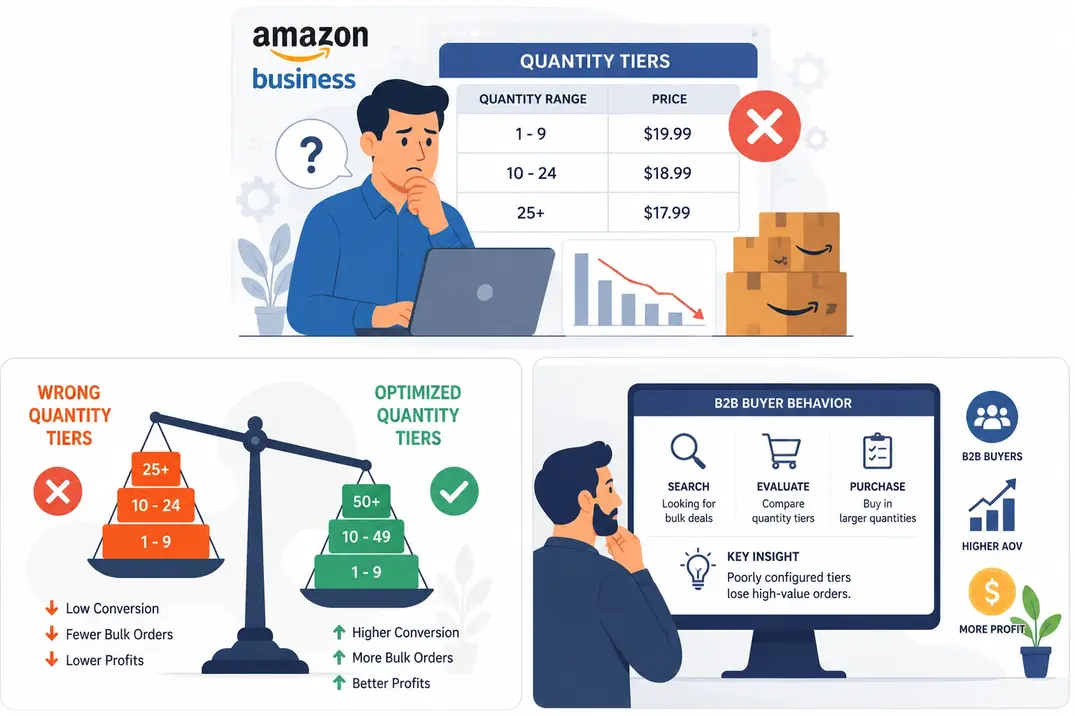
Amazon Business gives sellers a powerful pricing mechanism that many configure once and then leave unchanged indefinitely. The quantity discount tier system allows sellers to offer progressively lower per-unit prices as order volumes increase. According to Amazon’s Business Discount Insights data, products with quantity discounts averaged 20% higher sales and 25% more units sold in 2024.
The gap between what tier pricing delivers when configured correctly and what it delivers when configured poorly is not marginal. It is the difference between a system that compounds B2B revenue and one that quietly reduces margin with every bulk order.
The misconfiguration problem is rarely caused by a complex technical error. It usually comes from three decisions sellers make when creating their tiers: threshold placement, floor calculation, and discount percentage. Each decision may appear reasonable on its own, but together they can produce a structure that does not serve the seller’s actual B2B business.
Automated quantity tier pricing can manage these settings operationally, but sellers must still define the rules within which the automation works. Getting those decisions right requires understanding exactly what each one controls and what happens when it is configured incorrectly. Amazon’s official B2B pricing guide confirms that sellers can create up to five quantity tiers using either percentage discounts or fixed per-unit prices.
First Error: Thresholds That Do Not Match Real Buyer Behaviour
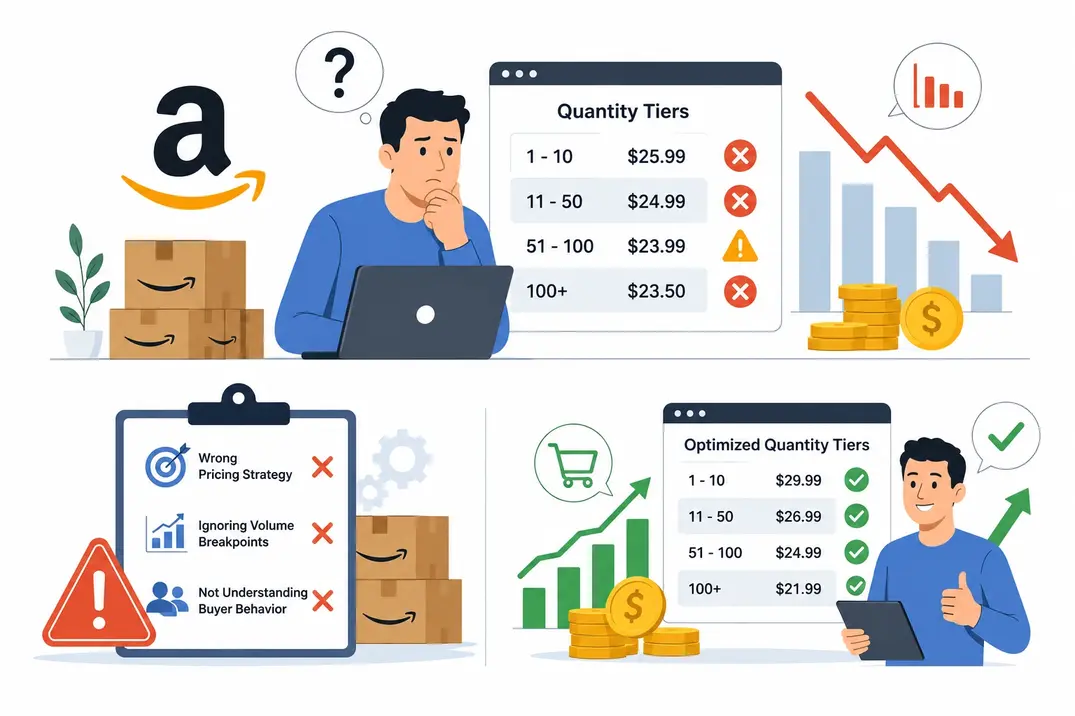
A common Amazon Business quantity discount structure looks like this:
- 5% off for five or more units
- 10% off for 10 or more units
- 15% off for 25 or more units
These are convenient, round numbers. They are also often selected without reference to the seller’s actual B2B order history.
Suppose a seller’s business customers normally purchase eight, 12, or 18 units at a time. A tier that begins at 25 units captures almost none of that existing behaviour. A customer purchasing 18 units receives the 10-unit discount, while the 25-unit tier remains unused.
The problem is not that 25 units is an unreasonable threshold. The problem is that it is unrelated to the way the seller’s customers buy.
Amazon presents quantity discounts to registered business customers and uses business prices and discounts as signals that can improve an offer’s visibility and chances of becoming the Featured Offer. This makes threshold placement an important part of the seller’s wider B2B strategy, not merely an administrative pricing choice. The Amazon Business seller program explains how business prices, quantity discounts, Featured Offer visibility, and automated pricing rules work together.
The correct threshold configuration should begin with B2B order history. Pull at least the last 90 days of business orders and examine the full distribution of order quantities.
Do not rely only on the average quantity. An average can hide the natural purchasing clusters that should determine where a discount begins. Instead, identify:
- The most frequently ordered quantities
- The points at which order volume starts to decline
- The quantities customers repeatedly approach but rarely exceed
- Differences between new and repeat business customers
- Seasonal or category-specific purchasing patterns
Set thresholds slightly above or below these clusters depending on the purpose of the tier.
A threshold set just below a natural cluster rewards behaviour that already exists. A threshold set slightly above it attempts to encourage customers to add more units. Sellers should know which of these two objectives they are pursuing before changing the threshold.
Amazon now provides B2B quantity discount impact reporting, which allows sellers to compare units sold, orders received, and Featured Offer percentage before and after adding or changing quantity discounts. However, sellers should still analyse their own order-level quantity distribution because aggregate before-and-after reporting does not replace SKU-level threshold planning.
Second Error: Treating One Base Floor as the Complete Margin Protection
Sellers normally configure a minimum price for a standard Amazon listing based on unit economics. That calculation may include:
- Cost of goods
- Inbound shipping
- FBA or merchant-fulfilment costs
- Amazon referral fees
- Storage and handling costs
- Expected return or concession costs
- Minimum acceptable contribution margin
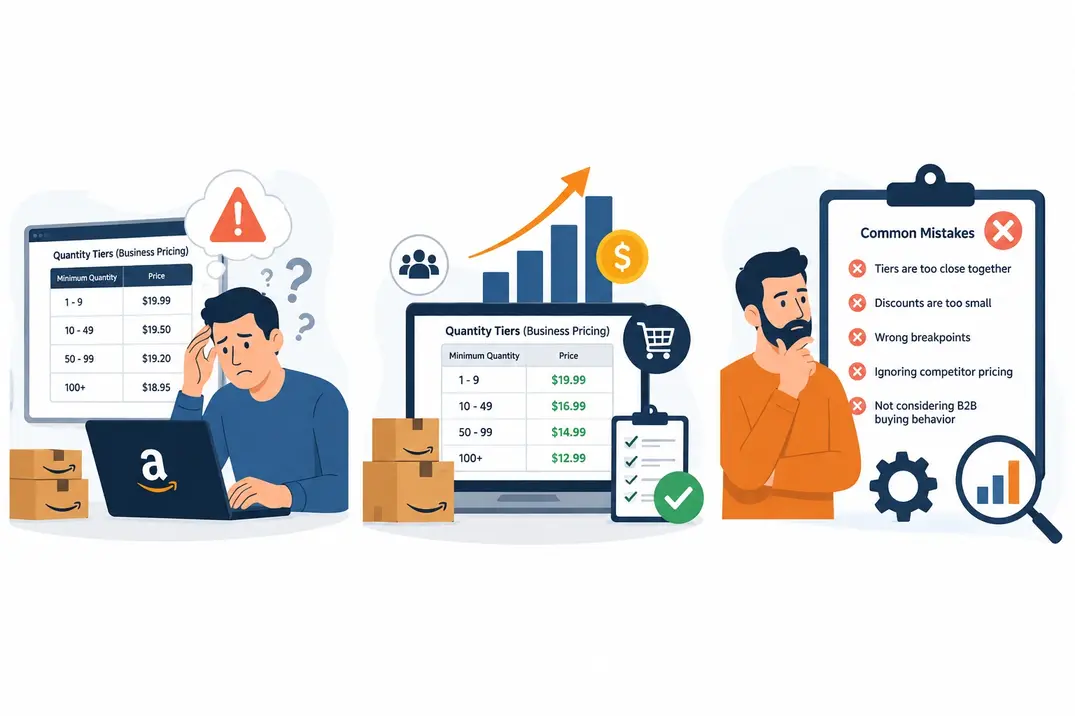
The mistake begins when sellers assume that a minimum price calculated for the standard offer automatically protects every quantity tier.
Amazon’s business pricing rule documentation explains that the discount assigned to a quantity tier is used to determine the minimum price applicable to that tier. In practical terms, the base minimum price and the tier discount percentage interact. An inaccurate base floor or an excessively deep tier percentage can therefore carry the error through the entire structure.
Consider a simplified example. A product has a standard minimum price of $20, and the seller applies a 10% discount at five units. The applicable minimum price for that tier may be calculated as $18 per unit. That figure may be technically valid within the pricing rule while still being economically unsuitable for the seller.
The seller must calculate whether $18 covers the real cost of fulfilling the order and leaves an acceptable margin. Passing Amazon’s automated minimum-price check does not prove that the order is profitable.
The economics can also change as the selling price falls. Amazon’s standard selling fee schedule states that referral fees are generally calculated as a percentage of the total price or a category minimum amount, whichever is greater. Fulfilment, storage, preparation, and other costs may not fall at the same rate as the selling price.
A seller should therefore calculate an economic floor for every meaningful quantity level, even when the Amazon rule itself starts from one base minimum price.
For each tier, calculate:
Tier revenue per unit
Minus:
Cost of goods per unit
Minus:
Referral fee and applicable minimum fee
Minus:
FBA or merchant-fulfilment cost
Minus:
Inbound shipping, preparation, and storage allocation
Minus:
Expected returns, concessions, and damage allowance
Minus:
Desired contribution margin
This produces the lowest commercially acceptable price for that tier.
There is one additional factor sellers should not overlook. Amazon may provide an Amazon Business FBA multi-unit fulfilment fee discount on qualifying business orders when the seller provides an eligible business or quantity discount. This potential fee reduction should be included in the calculation where applicable, but it should not be assumed without confirming that the offer meets the current requirements.
Bulk orders may also produce operational advantages. They can move inventory faster, reduce the number of individual customer acquisitions required, and create more predictable replenishment demand. Those advantages can justify a lower margin per unit, but only when the seller calculates the trade-off intentionally.
A seller who accepts a smaller per-unit margin in exchange for faster inventory turnover is making a pricing decision. A seller who loses margin because the floor was never recalculated is making a configuration error.
This distinction matters at scale. According to the U.S. Census Bureau’s 2022 Annual Wholesale Trade Survey, U.S. merchant wholesalers generated $11,382.3 billion in sales during 2022, an increase of 17.4% from $9,693.4 billion in 2021. At that volume, even small per-unit pricing errors can compound into significant losses.
Third Error: Discount Percentages Set Without a Competitive Reference
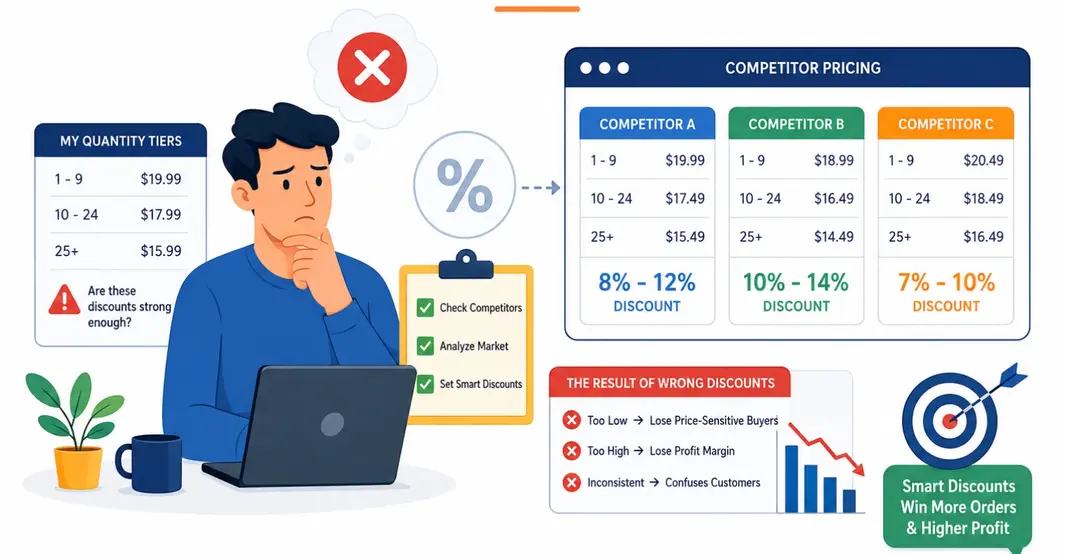
Tier discount percentages are often selected according to what appears reasonable. The familiar 5%, 10%, and 15% structure is common because it is simple to understand and easy to enter.
It is not automatically competitive.
The seller must answer two different questions:
- Is the discount deep enough to influence the buyer’s order quantity?
- Is the resulting per-unit price competitive enough to improve the offer’s B2B position?
A 10% discount may look generous when viewed against the seller’s standard price. It may still be weak when compared with the B2B Featured Offer price, popular discount tiers, or business-specific prices available in the same category.
Amazon Business pricing is not completely visible in the same way as ordinary consumer pricing. Registered business buyers can see business-specific offers, while sellers need to rely on the pricing references and recommendations available through Seller Central.
Amazon’s Business Discount Insights tool now provides sellers with useful competitive references, including:
- B2B Featured Offer price
- Business Savings Blue Badge price
- Suggested quantity discount tiers
- Popular discount tiers and prices
- Glance views and pricing opportunities
This means the correct approach is no longer to rely only on guessed discount percentages or to assume that competitive B2B pricing is entirely unavailable. Sellers should use the available reference prices while also monitoring actual performance.
The B2B Featured Offer percentage remains an important feedback signal. If a seller changes a discount tier and Featured Offer performance improves without unacceptable margin loss, the change may be commercially useful. If the discount becomes deeper but the seller gains no meaningful improvement in units, orders, conversion, or Featured Offer percentage, the additional discount may simply be giving away margin.
Discount changes should therefore be tested rather than treated as permanent.
A practical review should compare:
- Units sold before and after the change
- Average business order quantity
- B2B Featured Offer percentage
- Total contribution margin
- Contribution margin per order
- Percentage of orders reaching each threshold
- Repeat purchase activity
- Inventory turnover
The goal is not to offer the deepest discount. The goal is to offer the smallest discount that produces the required commercial result.
Why These Three Errors Compound
Each error is damaging in isolation. Together, they become worse than the sum of their parts.
A seller with the wrong thresholds, poorly calculated floors, and weak discount percentages is operating a structure that:
- Activates at quantities customers rarely purchase
- Compresses margin when a tier is reached
- Fails to improve B2B Featured Offer performance
- Rewards orders that would have happened without the discount
- Provides no clear path for controlled testing
- Remains unchanged even when costs or buyer behaviour shift
The seller’s B2B performance is then weakened in several directions at once: order volume, margin, inventory efficiency, and Featured Offer position.
No single metric will always make the problem obvious. Revenue may increase while contribution margin falls. Unit sales may rise while average profit per order declines. Featured Offer performance may improve at one tier while deeper tiers remain unused.
The correction should address the three configuration decisions in sequence.
First, correct the thresholds because the seller must understand which purchasing levels are commercially relevant.
Second, calculate the economic floor for each tier because automation cannot protect a margin that has never been correctly defined.
Third, calibrate the discount percentages using Business Discount Insights, Featured Offer performance, order volume, and contribution margin.
Only after these elements are correct should the seller rely on Amazon Automate Pricing to maintain business prices and quantity discounts as the standard price changes. Amazon’s automation can adjust business prices and discounts according to defined rules, but it cannot determine whether the seller’s original commercial assumptions were sensible.
Final Note
Quantity tier pricing should not be treated as a one-time discount table. It is a pricing system that connects buyer behaviour, unit economics, competitive position, and inventory strategy.
Automation can maintain that system, but it cannot design it on the seller’s behalf. A rule can apply the chosen discount perfectly while still producing the wrong commercial result. It can preserve an inaccurate floor, maintain an unused threshold, or repeatedly match a price that generates sales without sufficient profit.
The strongest tier structures begin with evidence. Thresholds come from real order quantities. Floors come from complete per-unit economics. Discount percentages come from competitive references and measurable performance changes.
Once those foundations are correct, automation becomes useful. It reduces manual work, keeps pricing aligned with standard-price movements, and prevents neglected settings from becoming outdated. Without those foundations, it simply allows a weak configuration to operate faster and for longer.