
Blog
Which Type Of Gamer Are You

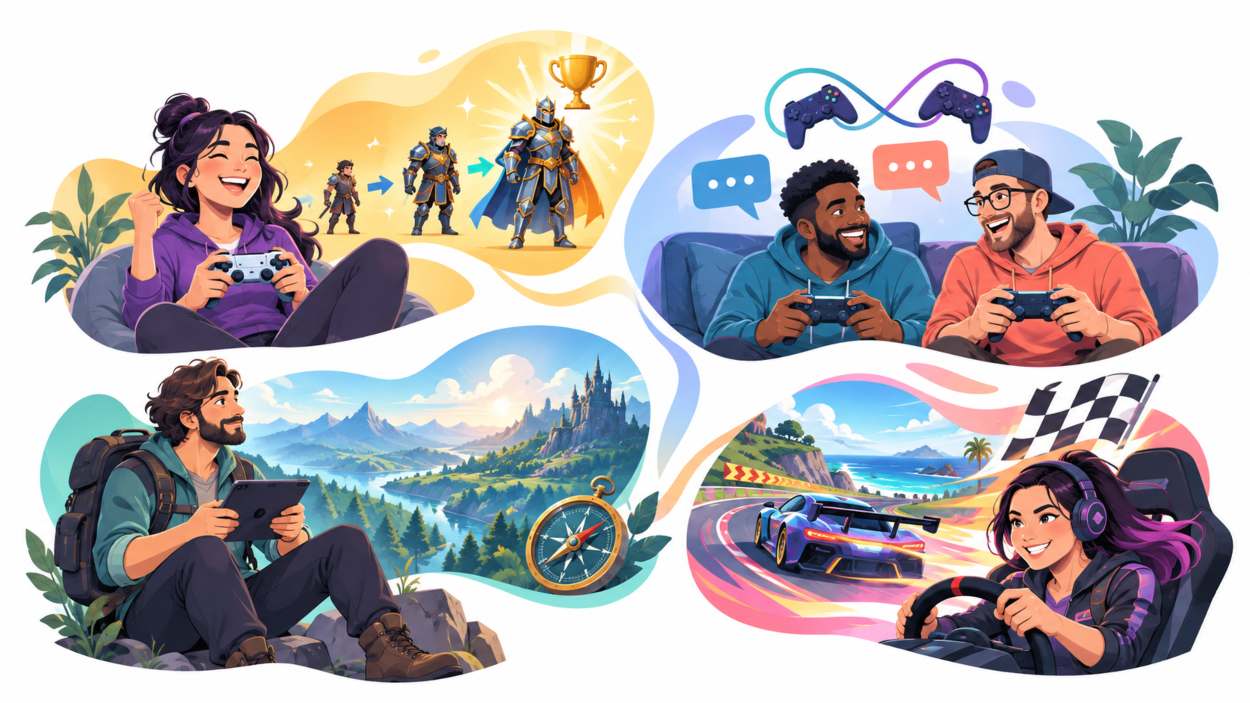
Ask ten people how they spent their evening and “gaming” can mean ten different things. One person spent forty minutes learning the timing on a single boss attack. Another played three rounds of something bright and forgettable while the kettle boiled. A third sat in a voice chat with old university friends and barely looked at the screen.
Gaming stopped being a niche hobby a long time ago. Ofcom’s Online Nation research has found that around 39% of UK adults aged 16 and over play games online, and the figure climbs sharply among younger adults. With thousands of titles spread across consoles, PCs, phones and browsers, the useful question is not whether games are for you. It is which ones match your temperament, your patience and the shape of your week. Figure out what type of gamer you are to see what kind of genres and games are suited to you.
No quiz pins this down perfectly. Most people recognise themselves within a paragraph or two once the main patterns are laid out, and plenty of players sit in more than one camp depending on the month.
Some Players Love A Challenge
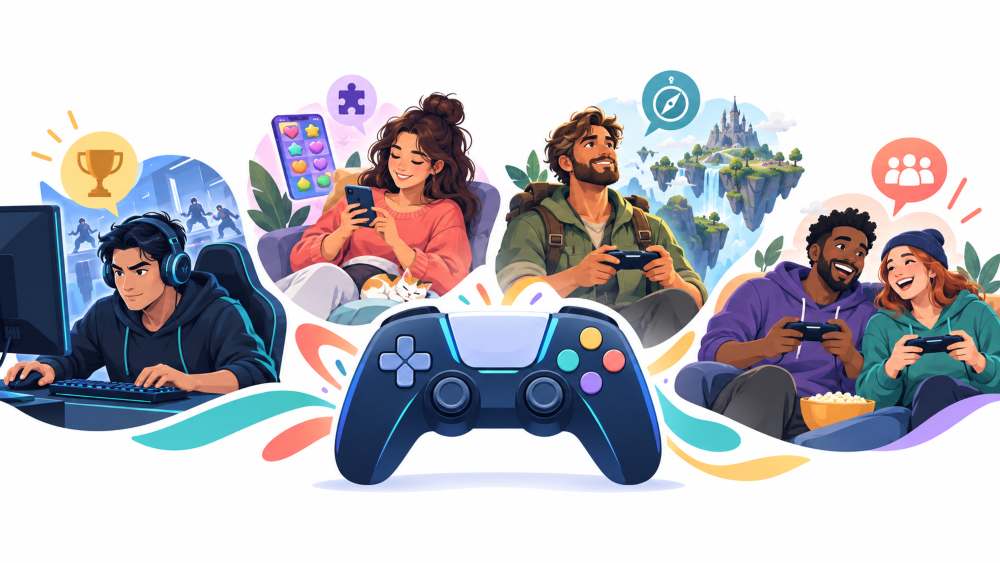
Some players want a game to push back. They enjoy learning a complicated system, building a plan around it, watching that plan fall apart, then building a better one. The appeal is not the win itself. It is the gap between not being able to do something and being able to do it.
You probably know if this is you. A boss that kills you eleven times becomes interesting rather than insulting. You read patch notes. You watch a two-hour video about damage formulas and enjoy it more than the game it describes. When a friend asks how your weekend went, you tell them about a ninety-second fight.
This pattern has been written about for decades. In 1996, Richard Bartle grouped players by what they actually wanted from a shared world, and his four suits still hold up: achievers are diamonds, because they are always after treasure, and explorers are spades, because they dig for information. His original paper on player types was written about text-based games that most people alive today have never touched, which makes it more impressive that the categories still describe a modern lobby.
Psychologists have circled the same ground from a different angle. Work on self-determination theory by Ryan, Rigby and Przybylski argued that games pull at three basic needs: competence, autonomy and relatedness. Difficulty is one of the cleanest ways a game can hand you competence. You were bad at something, the game told you so honestly, and then you were not bad at it any more. Very little else in adult life gives feedback that direct.
A few practical things are worth saying to players in this group. Difficulty options are not a moral test, and a game you finish on normal counts exactly as much as one you finish on the hardest setting. Long-term projects are more satisfying when they are broken into sessions with a natural stopping point, because “one more attempt” at midnight is rarely the attempt that works. And the memory does last. Someone who finally clears a mission after four evenings of failing at it will still be talking about it years later, which is more than can be said for the fifty easy missions either side of it.
Others Play For Fun And Variety
Not everyone wants their hobby to feel like an exam. A large group of players treat games the way most people treat television: something good, something light, something completely different next week.
This looks scattered from the outside and makes perfect sense from the inside. A racing game on Monday, a farming sim on Thursday, a co-op shooter on Saturday because two friends happened to be free. Sessions get shaped around real life rather than the other way round. Twenty minutes on a phone during a commute is a legitimate way to play, and browser games exist almost entirely to serve that slot.
Variety also does something the committed specialists miss. It keeps rewriting your own taste. Somebody who has played nothing but football games for six years might assume story-led role-playing is not for them, right up until a wet Sunday when they try one and lose a fortnight to it. Free weekends, demos, subscription catalogues and cheap bundles all make that kind of accident affordable.
A few ways to sample widely without wasting money:
- Play the demo before the sale, not after. A twenty-minute trial tells you more than any review score.
- Use subscription catalogues as a tasting menu rather than a library you owe something to.
- Ask what a game wants from you, not what it looks like. Two games with identical art can demand completely different things.
- Give an unfamiliar genre two sessions. The first is usually spent fighting the controls.
Checking ratings helps when you step outside familiar ground, especially if you are choosing for a household rather than just yourself. PEGI age ratings cover content rather than difficulty, and the rating reflects age suitability, not how hard a game is to play. A PEGI 3 game can be brutally demanding. UK players get slightly stronger protection than most: PEGI has been the sole system for new console and PC games in the UK since 2012, and the 12, 16 and 18 ratings are legally enforceable here, as Ask About Games explains for parents.
Everyone Has Their Own Favourite
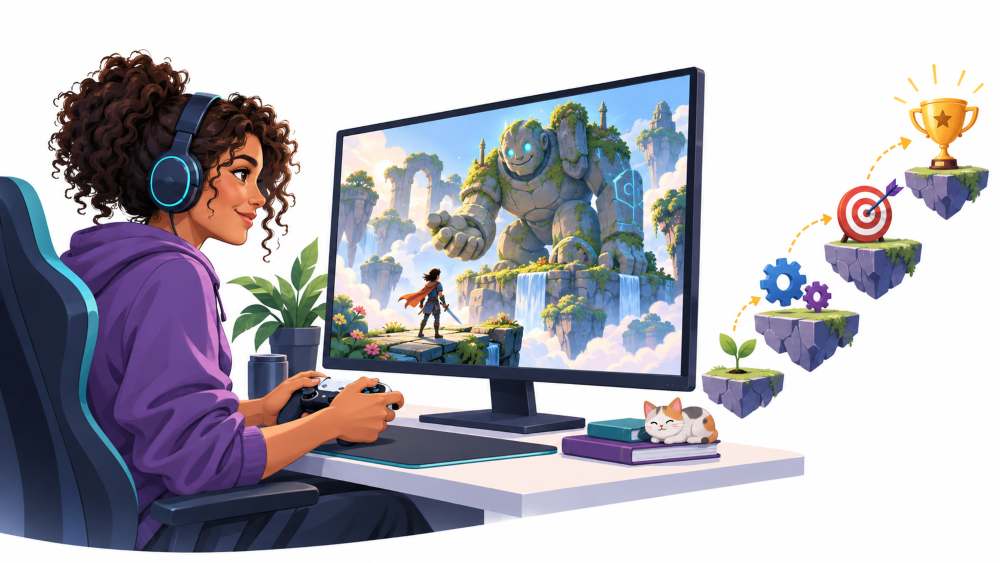
Even the most restless players drift back to something. A favourite genre is less about quality than about fit. It reliably hands you the feeling you came for, so you return to it when you are tired, stressed or short of time.
What that feeling is varies enormously, which is why arguments about the “best” type of game never go anywhere. Nick Yee’s research on play motivation, and Bartle’s older taxonomy, both point at the same thing: people sitting in the same lobby are often chasing entirely different rewards.
| Play Style | What The Player Is Really After | Where They Usually End Up |
| Achiever | Visible progress and a record of it | RPG progression, career modes, completion lists |
| Socialiser | Company, with a game as the excuse | Co-op, party games, life sims, chat-heavy lobbies |
| Explorer | Knowing how the thing works | Open worlds, sandboxes, strategy, modding |
| Competitor | A fair test against another person | Shooters, fighting games, ranked ladders, card games |
A player who values company will pick whatever their friends are on, almost regardless of genre, and will happily play something mediocre in good company over something excellent alone. A strategy player wants a decision that matters and time to make it. Others gravitate towards online bingo games because they appreciate its familiar format, where the rules never change and the pace leaves room for talking.
Your favourite genre usually mirrors what you want from your free time generally. People who spend their working day making judgement calls often want a game that asks nothing of them. People whose jobs are repetitive often want the opposite. There is a reason so many nurses, drivers and warehouse staff end up in games full of careful planning, and a reason so many analysts end up in games where you just drive fast.
If you want to work out your own type without a quiz, look at your replays. Not the games you bought, the ones you reinstalled. Three reinstalls of the same title is the honest answer, whatever you tell people at work.
There Is No Right Way To Play
The best thing about this hobby is also the least discussed: nobody is scoring your approach. Gaming habits also change over time, and they should. Sixty-hour adventures suit one stage of life. A short mobile puzzle between school runs suits another. Neither is a downgrade.
The research is more relaxed about this than the headlines suggest. An Oxford Internet Institute study worked with seven publishers and linked six weeks of objective play data from 38,935 players to three waves of self-reported well-being. The team found little to no evidence of a causal connection between play time and well-being, while motivation did appear to matter. Players who felt compelled to log in did worse than players who logged in because they wanted to, at the same number of hours. The full paper is open access if you want the numbers rather than the summary.
That does not mean nothing can go wrong. Gaming disorder exists as a clinical category: it was introduced as a new condition in ICD-11, endorsed by the World Health Assembly in 2019. The World Health Organization’s guidance on addictive behaviour is sensible about what to watch for, and it is worth noting that the warning signs are about displacement rather than hours. Sleep, work, study and people are the measures that matter. A six-hour Saturday with friends is not the same thing as two hours a night that you resent.
It is also worth remembering how many different bodies are holding the controller. SpecialEffect, a UK charity founded in 2007, builds personalised setups so that physically disabled players can play at all, using everything from modified pads to eye control. Once you have seen someone play a racing game with their eyes, the idea that there is one correct way to hold a controller stops making much sense.
So take the categories in this article loosely. You might be an achiever in one game and a tourist in the next, a competitor at twenty-five and a farming sim devotee at forty. The only useful test is whether you finish a session feeling better than when you started. If the answer is yes, you are playing correctly, whatever type you turn out to be.
Disclaimer
This article is general information about gaming habits and is not medical or psychological advice. It is not intended to diagnose any condition. If gaming is affecting your sleep, mood, work, studies or relationships, or you are worried about someone else’s play, speak to a GP or another qualified professional. Age ratings and legal requirements referred to here apply to the UK and may differ elsewhere.
References
- Bartle, R. A. (1996). Hearts, clubs, diamonds, spades: Players who suit MUDs. Journal of MUD Research, 1(1). Available at: https://mud.co.uk/richard/hcds.htm
- Granic, I., Lobel, A., & Engels, R. C. M. E. (2014). The benefits of playing video games. American Psychologist, 69(1), 66-78. https://doi.org/10.1037/a0034857
- Johannes, N., Vuorre, M., & Przybylski, A. K. (2021). Video game play is positively correlated with well-being. Royal Society Open Science, 8(2), 202049. https://doi.org/10.1098/rsos.202049
- Ofcom (2025). Online Nation 2025 report. London: Ofcom. Available at: https://www.ofcom.org.uk/media-use-and-attitudes/online-habits/online-nation/
- Pan European Game Information (n.d.). PEGI age ratings. Available at: https://www.pegi.info/page/pegi-age-ratings
- Ryan, R. M., Rigby, C. S., & Przybylski, A. K. (2006). The motivational pull of video games: A self-determination theory approach. Motivation and Emotion, 30(4), 347-363. https://doi.org/10.1007/s11031-006-9051-8
- Vuorre, M., Johannes, N., Magnusson, K., & Przybylski, A. K. (2022). Time spent playing video games is unlikely to impact well-being. Royal Society Open Science, 9(7), 220411. https://doi.org/10.1098/rsos.220411
- World Health Organization (2019). ICD-11: Disorders due to addictive behaviours. Geneva: World Health Organization. Available at: https://www.who.int/health-topics/addictive-behaviour
- Yee, N. (2006). Motivations for play in online games. CyberPsychology & Behavior, 9(6), 772-775. https://doi.org/10.1089/cpb.2006.9.772