
Blog
What Three Years of Hobby Game Dev Actually Taught Me

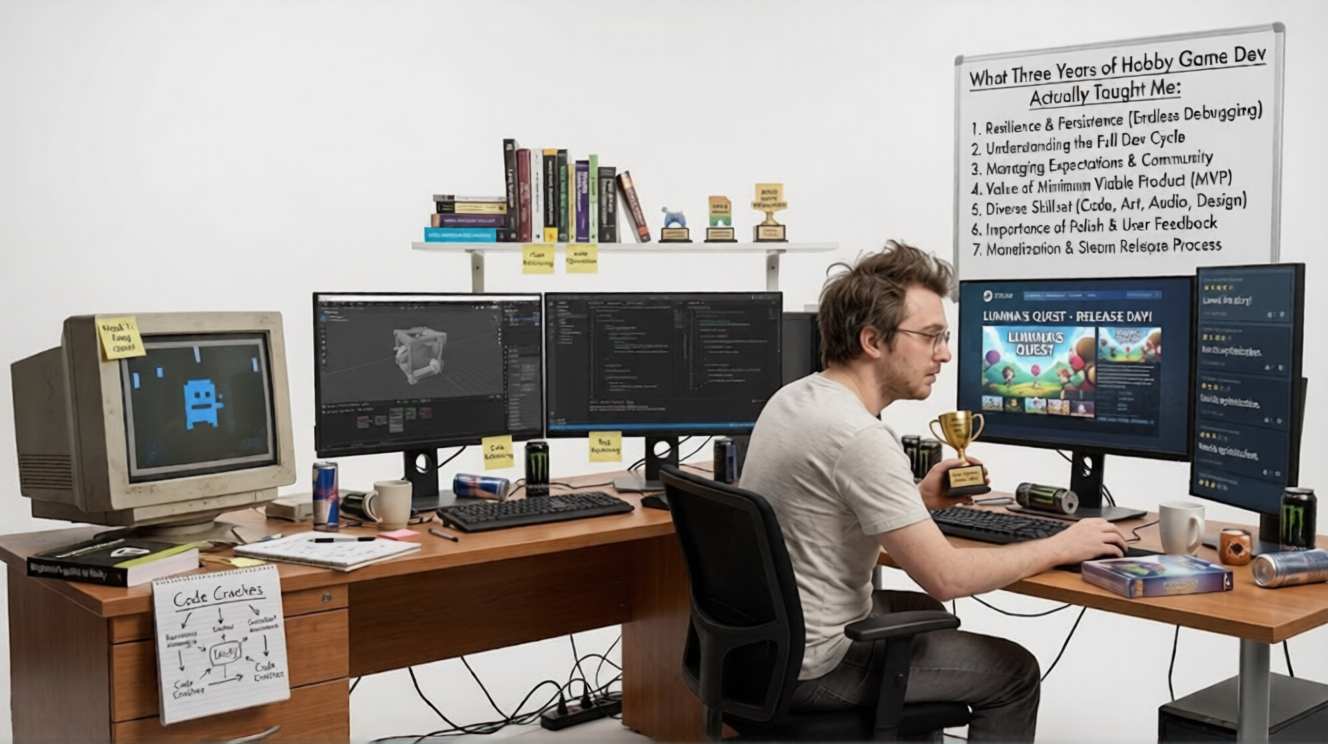
I started messing around with Unity in late 2022, mostly because a friend bet me I wouldn’t ship anything within a year. I lost the bet. Badly. My first “game” was a cube that rolled around a floor and occasionally fell through it. The second was a top-down shooter where the bullets sometimes went backwards, and I genuinely never figured out why. Three years on, I’ve shipped two small itch.io games, abandoned about nine others, and learned more from the failures than from any tutorial I sat through.
This is the article I wish someone had written for me back when I was downloading my first asset pack and wondering why my framerate tanked the moment I added a second light. No grand theory of game design here, just stuff that turned out to matter.
Pick a tiny scope. Then cut it in half.
Every solo dev I know has the same disease. You sit down to make a small puzzle game and three weeks later, you’re designing a skill tree, an inventory system, and seventeen biomes. Nobody is going to play your seventeen biomes. You will never finish your seventeen biomes. The biomes are a beautiful prison.
My first finished game was originally going to be a roguelike. It shipped as a single-screen arcade game with a single enemy type. And honestly? People liked it. The version that exists is infinitely more valuable than the imaginary version with all the features I cut.
Where to actually find decent assets without going broke
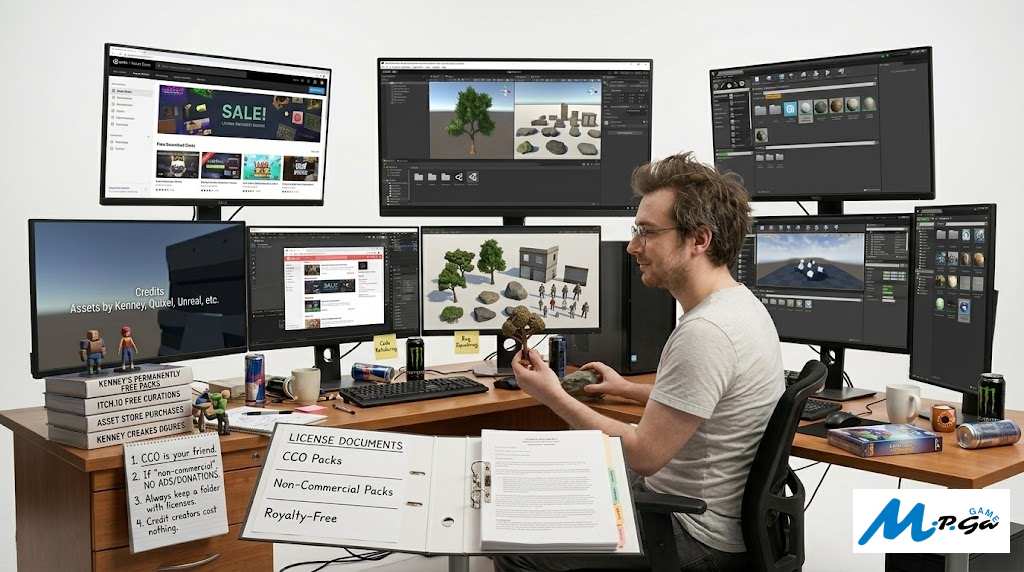
Art is the wall most programmers hit. I can write code all day, but the moment I have to model a tree, I start questioning my career choices. Good news is, in 2026 the asset situation is better than it’s ever been. Between the Unity Asset Store sales, Quixel Megascans being free for Unreal users, Kenney’s permanently free packs, and sites doing curated free download game-dev assets for both Unity and Unreal, you can prototype almost anything without spending a euro. I cannot stress enough how much faster you’ll iterate when you stop trying to model your own placeholder boxes.
One word of caution that nobody told me: read the licences. Free does not always mean royalty-free, and “personal use only” is not the same as “hobby use” when your hobby project starts pulling donations on itch. A few quick rules I follow now:
- CC0 is your friend. No attribution, no fuss, use it anywhere.
- If a pack says “non-commercial,” assume that includes ad-supported builds and donation pages.
- Always keep a folder somewhere with the original licence files. In the future, you will thank the present you when a publisher asks.
- Credit creators even when you don’t have to. It costs nothing, and the community remembers.
Tutorial trap is real, and I fell into it for about a year.
There’s a comfortable place in game dev where you watch tutorials, follow along, build something cool, and feel productive. You are not actually learning. You’re transcribing. I figured this out the hard way after finishing 20 Brackeys videos and discovering I still couldn’t build a basic state machine without looking up the syntax. The official Unity Learn platform helped a lot here, because the projects force you to think rather than just copy.
What worked for me was watching the tutorial once, closing the video, and then trying to rebuild whatever it taught from memory. Yes, it’s frustrating. Yes, you’ll get stuck. That’s the point. The getting stuck is where the actual learning lives. The smooth bit, where you copy line by line, is just typing practice.
3D is harder than you think and easier than people pretend
I avoided 3D for about a year because I’d convinced myself it required a maths degree. It doesn’t. What it requires is patience for one specific problem at a time. UV unwrapping is its own beast. Lighting is another. PBR materials feel like alchemy until they suddenly don’t. Each one is a few weekends of focused effort, not a four-year course. The Unreal Engine documentation is genuinely excellent for the lighting and materials stuff if you ever want to look under the hood.
Blender deserves special mention here. The fact that Blender is this powerful and still completely free feels illegal to me. If you’re hesitating because you used it once in 2017 and the interface scared you off, give it another shot. The 4.x releases are genuinely friendly now, and the donut tutorial is famous for a reason; it actually works.
Performance problems start earlier than you’d guess
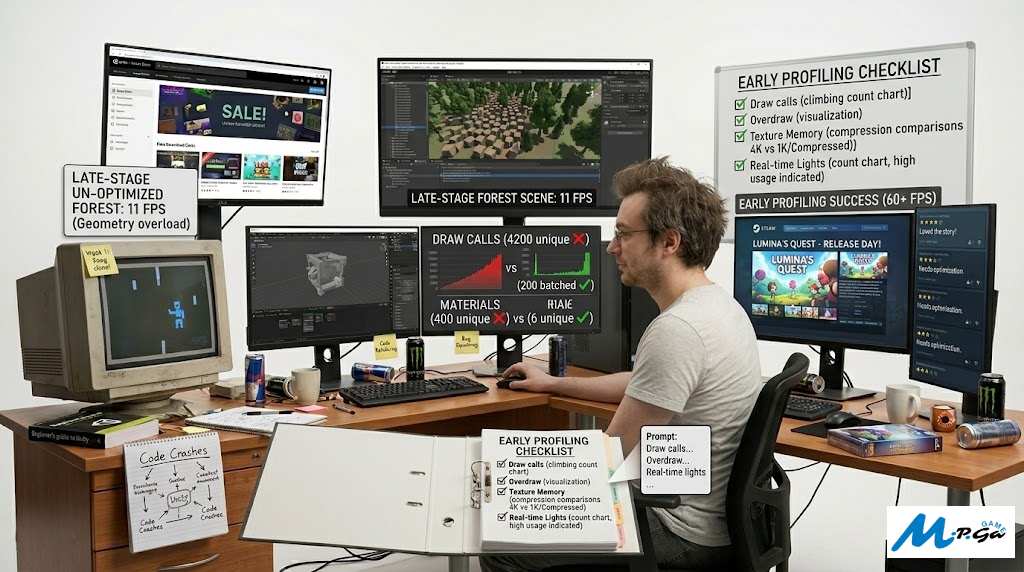
Optimisation was a thing you did at the end. Then I built a small forest scene that ran at 11 FPS on my own machine and realised that no amount of late-stage optimisation would save it. The geometry was the problem. The lighting setup was the problem. The fact that I had 400 unique materials when I could have had 6 was the problem.
These days, I profile early. Even on a tiny prototype, I’ll open the frame debugger and see what’s actually happening before I add the next feature. It takes ten minutes and saves entire weekends. The stuff I check first, in order:
- Draw calls. If they’re climbing into the thousands on a small scene, something is wrong with batching.
- Overdraw, especially on transparent stuff like particles and UI.
- Texture memory. A single 4K texture you forgot to compress can cost more than the rest of your scene combined.
- Real-time lights. One or two is fine; ten will eat your framerate alive on lower-end hardware.
Ship something. Anything. Now.
This is the part I’d tattoo on my own forearm if I could go back. Your first finished game will be bad. Your second will be less bad. Your fifth is good. But you don’t get to the fifth without releasing the first four. The polish-it-forever instinct kills more indie projects than any technical problem.
Pick a deadline. Tell someone. Ship the thing on the deadline, even if it’s rough. Stick it on itch.io or even just a Game Jolt page. The feeling of having a real game with a real download page that real strangers can play is worth more than another month of tweaking the menu transitions.
Community is better than the internet would have you believe.
If you only ever read Twitter or certain subreddits, you’d think game dev is full of bitter people sniping at each other. The actual working community, the Discord servers, the small game jams, the GitHub repos where people leave kind PRs on your messy code, has been one of the genuinely good parts of the last three years for me. Find a jam. Join one. Ludum Dare is the obvious starting point, but there are dozens of smaller jams running every week on itch. Even if your entry is terrible, you’ll meet five people who are roughly where you are, and that’s worth more than another tutorial.
Final Conclusion
None of this is groundbreaking. Most experienced devs would read it and shrug. But every weekend on Reddit, someone asks the same questions I was asking in 2022, and the same answers keep being relevant: scope smaller, ship faster, use the free assets that exist, profile early, and stop passively watching tutorials. The tools in 2026 are absurdly powerful. The hard part has never been the engine. It’s been the discipline of finishing things, and that part doesn’t get easier with better software. It gets easier with reps.
Now stop reading articles and open your project.