
Blog
How Advanced Algorithms Redefine Modern Game Development

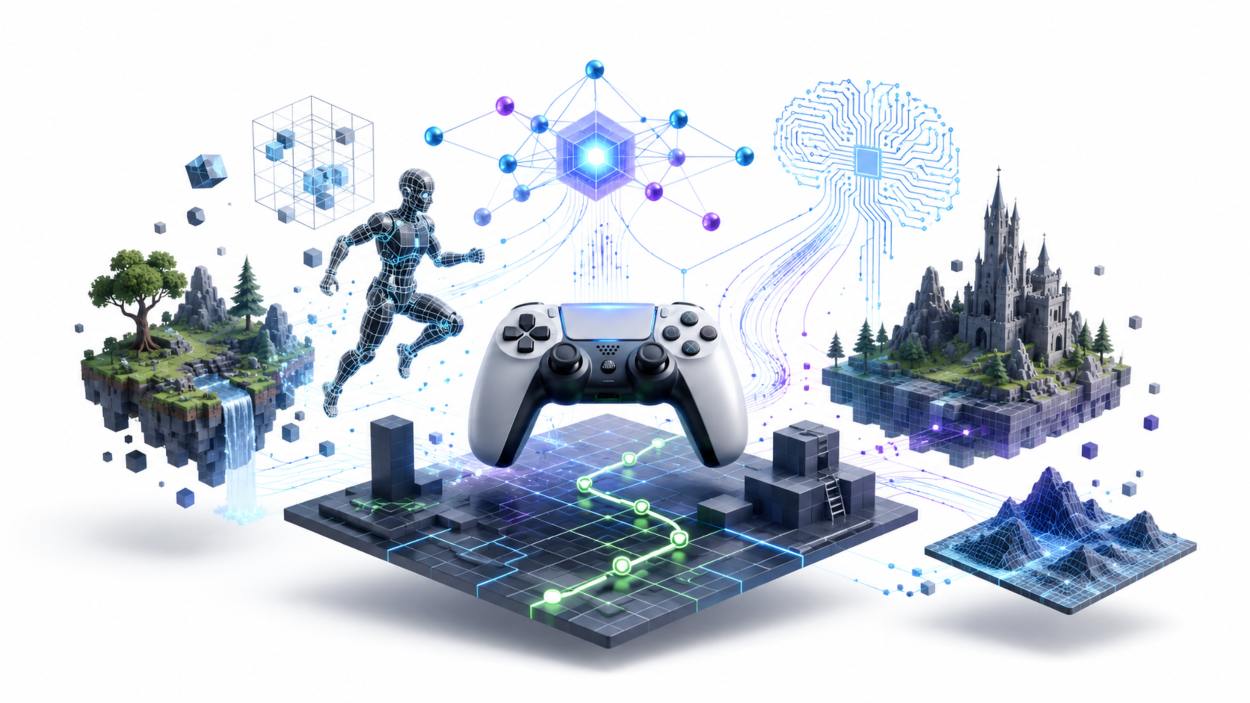
A player returns to a village after completing a mission. During the previous visit, the market was busy, guards stood near the main gate, and a merchant offered cheap supplies. This time, heavy rain has damaged the road, food prices have increased, and the guards are searching for someone the player helped earlier.
None of these changes need to be presented through a fixed cinematic. They can emerge from connected systems responding to weather, resources, character relationships, and player decisions.
That is where modern game development is heading. Instead of writing every possible event by hand, studios are building rules that allow believable situations to develop on their own.
Moving Beyond Static Scripts
Traditional scripting remains useful. A carefully directed story scene needs timing, dialogue, animation, and emotional control. Problems begin when developers try to use the same rigid approach for an entire open world.
Every additional character, quest, location, and player choice creates another condition that must be tested. A seemingly minor change can break an event elsewhere in the game. As the project grows, developers spend more time managing exceptions than improving the experience.
Advanced algorithms offer a different approach. Rather than telling every character exactly what to do, developers define goals, limitations, priorities, and available actions.
A guard might have several priorities:
- Protect the entrance
- Investigate suspicious sounds
- Help an injured ally
- Search for cover
- Call for support
- Retreat when badly outnumbered
The system evaluates the situation and selects an action based on the current conditions. Designers still create the rules, but they no longer need to write a separate script for every possible encounter.
This is not simply about placing artificial intelligence inside a game. It changes how gameplay systems, animation, level design, testing, and performance are organised.
Why Implementation Is Often Harder Than the Idea
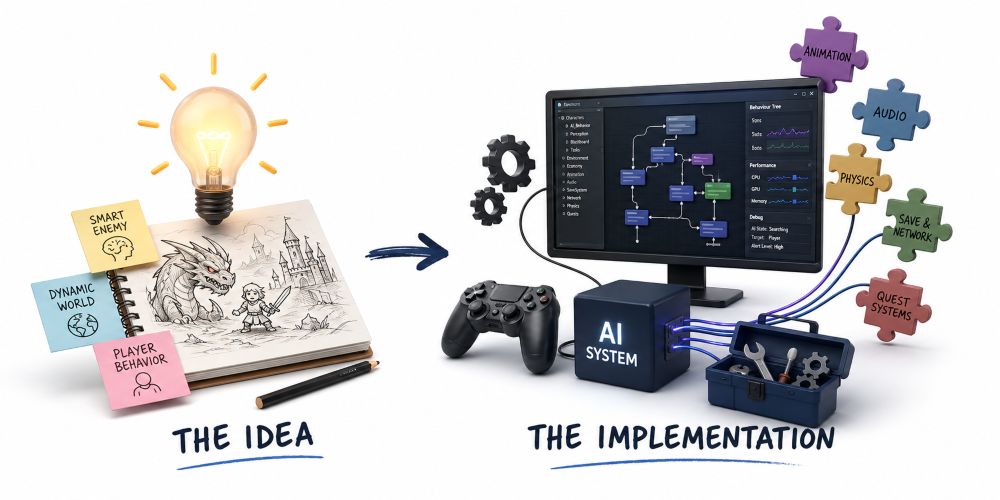
It is easy to describe an enemy that studies player behaviour or a city that changes according to its economy. Building that system inside an existing engine is much harder.
Many studios are working with years of inherited code. Character logic may be connected to animation, audio, save files, networking, physics, and quest systems. Replacing one part can create problems across the entire project.
When the internal team lacks specialised experience, an Artificial Intelligence in gaming partner can help connect the creative idea with practical engine architecture. The useful work is not limited to selecting a model. It may include preparing training data, setting performance limits, connecting behaviour to animation, creating fallback rules, and making the system understandable to designers.
External expertise is most valuable when it leaves the studio with a system its own developers can inspect and maintain. A mysterious black box may produce an impressive demonstration, but it can become a serious problem when the game reaches full production.
Smarter NPCs Do Not Need to Know Everything
The phrase “intelligent NPC” often creates the wrong expectation. A character does not need human-level reasoning to feel believable. It needs to notice the right information, make an appropriate decision, and communicate that decision clearly to the player.
Game engines already provide practical tools for this work.
Unreal Engine Behaviour Trees allow developers to arrange decisions around tasks, conditions, priorities, and changing game information. Unreal’s Environment Query System can then examine nearby locations or objects and select an appropriate result, such as a safe piece of cover or the nearest useful item.
This combination can produce an opponent that appears to think about its surroundings.
For example, an enemy under fire might:
- Check nearby cover positions
- Remove positions visible to the player
- Compare the distance and protection offered by each position
- Choose the strongest available option
- Move there while another enemy provides support
The player sees a tactical response. Underneath, the system is evaluating clear rules and weighted choices.
This approach is often more reliable than trying to make every enemy learn freely during live gameplay.
Where Machine Learning Becomes Useful
Machine learning can help when behaviour is too complicated to define through a manageable set of handwritten rules.
Unity’s ML-Agents Toolkit allows developers to turn Unity scenes into learning environments and train character behaviours through machine-learning methods. This can be useful for movement, balancing, simulated opponents, automated testing, and situations where the correct behaviour is easier to reward than to describe step by step.
Consider a creature with an unusual body shape. Writing exact movement rules for every slope, jump, obstacle, and collision may take months of adjustment. A training system can reward the creature for moving towards a destination while penalising falling, getting stuck, or using too much energy.
After enough training, the resulting movement may handle situations the animation team did not script individually.
However, trained behaviour requires limits. Developers must decide:
- What information the agent can observe
- Which actions it can take
- Which behaviour receives a reward
- Which behaviour receives a penalty
- When a traditional scripted fallback should take control
A poorly designed reward can teach the system to exploit the simulation instead of behaving as intended. An agent rewarded only for surviving, for example, might learn to hide forever rather than engage the player.
The algorithm follows the measurement. It does not understand the designer’s unstated intention.
NPC Conversations Are Becoming More Flexible
Dialogue has traditionally relied on written branches. The player chooses one of several responses, and the game moves to the connected line.
This structure gives writers strong control, but it can also make conversations feel limited. Generative systems create the possibility of characters responding to natural language, remembering selected events, and adjusting their answers according to the current situation.
NVIDIA ACE provides technologies for speech, conversation, intelligence, and animation in game characters. NVIDIA describes these systems as tools for building characters that can perceive information, understand input, plan actions, and respond during gameplay.
The important design challenge is not allowing a character to say anything. It is making sure the character says something appropriate.
A believable shopkeeper should know local prices, recent events, personal relationships, and information relevant to the player. The character should not suddenly discuss hidden quests, reveal confidential story details, or speak in a style that conflicts with the game world.
Studios therefore need controlled knowledge sources, topic restrictions, moderation systems, response limits, and authored fallback dialogue. Generative conversation works best when it extends a carefully designed character rather than replacing character writing completely.
Opponents Can Adapt Without Cheating
Adaptive enemies sound exciting, but they can quickly become frustrating.
Suppose the player regularly uses a long-range weapon. An adaptive system could respond by choosing covered routes, using smoke, spreading out, or sending one unit to approach from the side.
That feels reasonable because the response is based on behaviour the enemies could observe.
The system becomes unfair when enemies know the player’s position through walls, change their equipment instantly, or counter a strategy before seeing it. Players usually accept strong opponents. They dislike opponents that ignore the rules of the world.
Good adaptive design therefore needs boundaries:
- Enemies should react only to available information
- Changes should happen gradually
- Successful player strategies should remain useful
- Counterplay should always be possible
- Difficulty should not change invisibly after every mistake
The goal is not to defeat the player at any cost. It is to keep encounters interesting without making them feel pointless.
Building Larger Worlds Without Copying Everything
Large environments contain thousands of repeated decisions. Designers place trees, rocks, roads, buildings, paths, lights, collectable items, and environmental details. Doing all of that manually becomes slow, particularly when the map changes during production.
Epic’s Procedural Content Generation Framework lets developers build rules for generating content in Unreal Engine. The framework can be used in the editor and, in supported situations, during runtime.
A forest tool might consider:
- Ground angle
- Height above sea level
- Distance from roads
- Soil or biome type
- Available sunlight
- Distance between large trees
- Areas reserved for quests
The system can place initial content across a large region, after which artists adjust important locations by hand.
This does not remove the environment artist. It removes some of the repetitive placement work and gives the artist more time to shape composition, landmarks, atmosphere, and player movement.
Procedural tools become weak when teams use them to fill every empty area without judgement. A technically varied world can still feel dull when nothing has been placed for a clear gameplay or storytelling reason.
Pathfinding Is More Than Finding the Shortest Route
Movement is one of the easiest places to notice weak algorithms.
A character may technically reach its destination but still behave badly along the way. It might squeeze through a crowded doorway, run directly across a dangerous area, block another character, or repeatedly switch between two routes.
Useful navigation considers more than distance. It may include noise, danger, visibility, crowd density, character size, locked doors, moving platforms, and the cost of entering certain areas.
A civilian escaping a fight should prefer a protected route. A heavily armoured enemy may choose the direct path. A stealth-focused character may avoid bright spaces and noisy surfaces.
The best path is therefore not always the shortest one. It is the route that makes sense for the character and the current situation.
Neural Rendering Changes the Performance Conversation
Advanced algorithms are also changing how games produce images.
Rendering every frame at the highest native resolution can place heavy demands on graphics hardware. Neural rendering techniques can produce or reconstruct parts of an image using information from lower-resolution frames, motion data, and trained models.
NVIDIA’s developer hub provides game-development resources for technologies including neural rendering, character systems, ray tracing, latency reduction, and engine integrations.
One well-known example is NVIDIA DLSS, which provides neural rendering features that can improve image quality and frame rates through supported integrations. Current capabilities and hardware support depend on the DLSS version and the way a developer implements it.
The broader lesson is that performance optimisation is no longer limited to removing objects or reducing texture quality. Developers can use reconstruction, denoising, frame generation, dynamic resolution, and other techniques to balance visual quality with responsiveness.
These technologies are powerful, but they are not automatic fixes. Poor motion data, unstable effects, interface elements, transparency, and rapid camera movement can reveal visual problems. Every integration still needs testing across representative scenes and hardware.
Running Machine Learning Inside a Game
A model that performs well on a development workstation may not run efficiently on a player’s device.
Real-time games operate under strict limits. Rendering, physics, audio, networking, animation, and input processing may already be competing for the same resources. An additional model must fit within the available memory and complete its work without creating noticeable delays.
Microsoft’s DirectML documentation explains how machine-learning inference can be integrated into games, engines, middleware, and other applications on Windows. Microsoft also notes that game developers may need careful control over scheduling and GPU resources when combining machine learning with traditional rendering.
This is why a prototype should be tested on target hardware early.
Teams should measure:
- Inference time
- Memory use
- GPU and CPU load
- Frame-time spikes
- Network delay for cloud-based systems
- Power consumption on portable devices
- Behaviour when the model fails to respond
A smaller model that responds consistently may be more useful than a larger one that occasionally produces a more sophisticated result.
Player Data Must Close the Development Loop
Algorithms should not be adjusted only according to what the development team expects players to do. Real players regularly find shortcuts, misunderstand instructions, combine systems in unexpected ways, and ignore features that seemed important during production.
Tools such as Unity Analytics can help studios examine player behaviour, engagement, retention, progression, and other selected game events. The value comes from asking focused questions rather than collecting every possible interaction.
A team might investigate:
- Where players repeatedly fail
- Which tutorial step causes people to leave
- Which abilities are rarely selected
- Whether one enemy type creates unusual difficulty
- How long players remain in procedurally generated areas
- Which rewards affect return sessions
- Whether an adaptive system improves or damages completion rates
This data should inform design, not control it unthinkingly.
A difficult section may be producing frustration, but it may also be creating the exact tension the game needs. Numbers show what happened. Designers still have to decide what it means.
Research Is Moving Beyond Single-Game Agents
Most game AI is built for one title and a clearly defined set of actions. Current research is also investigating agents that can operate across different virtual environments.
Google DeepMind’s SIMA research examines agents that follow natural-language instructions across multiple 3D game settings. Its work demonstrates the research direction towards systems that can interpret broader instructions rather than learning only one isolated task.
This does not mean general-purpose agents are ready to replace normal gameplay code. It suggests possible future tools for automated testing, companion characters, development assistants, accessibility support, and simulation.
For example, a testing agent might eventually receive an instruction such as:
“Complete the opening mission using only basic equipment and report any location where progress becomes impossible.”
That could help quality-assurance teams examine more combinations, although human testers would still be needed to judge enjoyment, clarity, emotion, fairness, and visual quality.
A Safer Way to Introduce Algorithmic Systems
Replacing an entire production pipeline at once is rarely sensible. A smaller, measured introduction produces clearer evidence and creates less resistance inside the team.
Identify a Real Bottleneck
Begin with a problem the studio can measure.
Perhaps artists spend too much time placing background vegetation. Maybe enemies fail to use cover properly. Perhaps testing every character build has become impossible by hand.
Do not introduce a complex system simply because the technology appears impressive.
Build a Limited Prototype
Apply the new approach to one contained feature.
A team might test procedural placement in a single region, train one background creature, or add more flexible dialogue to an optional character. The feature should be large enough to provide useful evidence but small enough to remove if it fails.
Set a Clear Success Measure
Decide what improvement should look like before development begins.
Possible measures include:
- Reduced manual setup time
- Fewer navigation failures
- Stable frame times
- More varied encounters
- Better testing coverage
- Higher player completion
- Fewer repetitive dialogue lines
Without a clear measure, an expensive experiment can be declared successful simply because it produced an interesting demonstration.
Keep Human Approval in the Process
Generated levels, dialogue, animations, and behaviours should pass through review before reaching players.
Developers need tools to inspect why a decision happened, replace an output, lock approved content, and return to a stable fallback. Control is particularly important for story events, safety-sensitive dialogue, competitive gameplay, and systems that affect purchases or rewards.
Train the Team
Designers do not need to become machine-learning researchers, but they should understand the system they are directing.
They need to know what information it receives, what it optimises, where it can fail, and how their settings change the result. Engineers should also document the system in language that artists, writers, producers, and testers can understand.
Human Role Is Becoming More Important
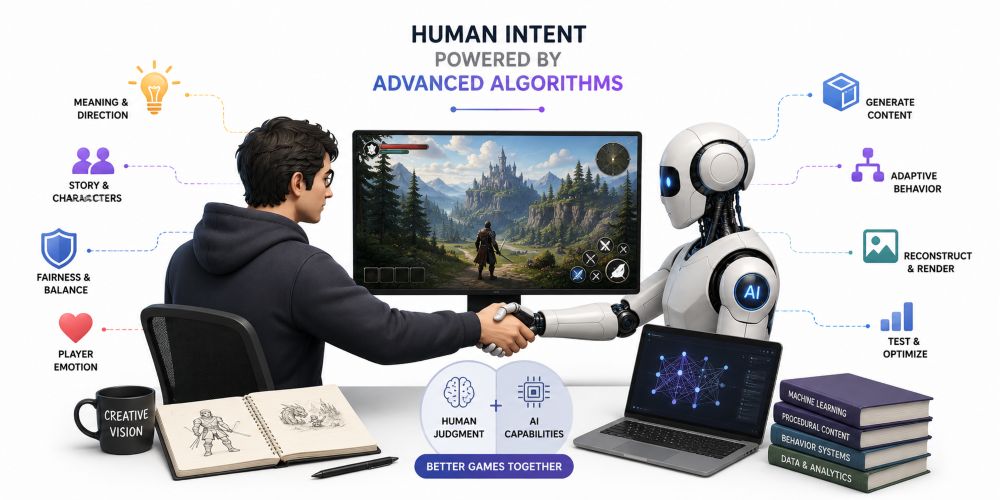
Advanced algorithms can place objects, select actions, reconstruct images, test combinations, and generate possible responses. They cannot decide what the game should mean.
That remains a human responsibility.
A generated forest needs visual direction. An adaptive enemy needs rules of fairness. A conversational character needs a personality and a place in the story. A procedural mission needs a reason for the player to care.
The strongest studios will not be the ones that automate the largest number of tasks. They will be the ones that know which decisions should be automated and which ones require deliberate creative judgement.
Modern game development is not moving from human-made experiences to machine-made experiences. It is moving towards systems in which human intent can operate at a larger scale.
When the architecture is transparent, the limits are carefully chosen, and the results are tested with real players, advanced algorithms can make virtual worlds more responsive without removing the qualities that make them memorable.