
Blog
Best US Online Casino Comparison Sites To Find The Right Platform

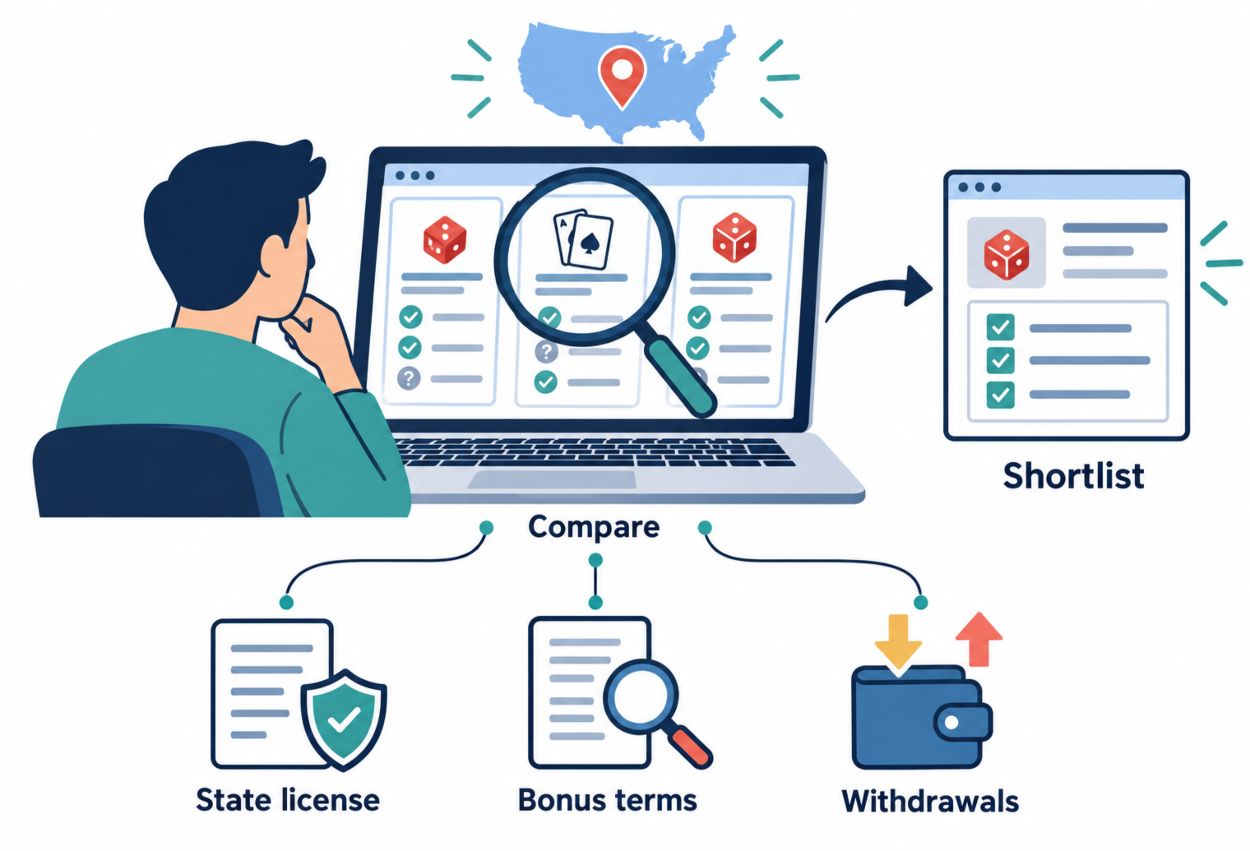
Type “online casino” into a search bar and the results suggest an almost endless choice. The real picture is narrower and a little stranger. Only a small group of US states license real-money online casinos, yet the screen fills with brands that look equally polished whether they answer to a state regulator or to nobody at all. Comparison sites exist to sort that pile. The better ones hold every casino to the same yardsticks: where it can legally operate, how deep its game library runs, how it handles payments, what its bonuses are really worth, and how seriously it guards your data.
It helps to remember that comparison sites are businesses, too. Most earn a commission when a reader signs up through their links, which is exactly the kind of relationship the FTC’s guidance on endorsements and affiliate disclosures expects publishers to make clear. Since October 2024, a federal rule banning fake reviews and company-controlled review sites posing as independent has given regulators sharper tools against marketing dressed up as neutral assessment. None of that makes a ranking objective, so the most valuable skill a reader can bring is the ability to tell checkable data apart from sales copy. With that lens in place, here is how five well-known US comparison sites measure up.
Casino.org
Casino.org has been publishing casino guides since 1995, which makes it one of the longest-running names in the space. That track record, paired with reviews that are both broad and deep, explains why so many players treat it as a first stop. Each write-up works through the areas that decide whether a casino deserves your deposit: bonus terms, the size and variety of the game library, deposit and withdrawal times, and the security measures and licensing behind the brand. The site says every recommendation passes a 25-step review that includes background checks and license verification.
The format suits different kinds of readers. You can settle in with detailed coverage of a wide selection of online casinos, or scan a short list of pros and cons when you only have a few minutes. The US hub also lets you set your state so the list reflects what is actually available where you live, and it keeps a running section on casinos to avoid, offshore operators included. One caveat is worth knowing. Readers in states without legal online casinos are steered toward sweepstakes casinos, a model that operates under different rules and has drawn legal challenges and new restrictions in several states, so that part of the page deserves a more skeptical read.
Bonus.com
Bonus.com rates casinos through its own Bonus Power Index, or BPI, a standardized scoring framework built so that every operator is judged the same way. When the site launched its real-money casino rankings, the index leaned heavily on bonus value, free spins, game library size, popularity, and app store ratings. Its current methodology describes a broader assessment that also takes in payments, usability, customer support, licensing transparency, and responsible gaming tools.
The reviews themselves are long and practical. They explain how easy each casino is to navigate and walk through the main options for depositing and withdrawing money, which is often where the gap between a smooth operator and a frustrating one first shows up.
The weakness is written into the name. Promotions get the spotlight, and a reader whose first question is whether a casino is licensed and how it protects personal data may have to dig further for a clear answer than they would on Casino.org.
Covers.com
Covers.com reviews both casinos and sportsbooks in the US. On the casino side, it keeps a ranked list of the top real-money operators and refreshes it on a regular cycle, so the order reflects current offers rather than last year’s.
The list runs from strongest to weakest and breaks down bonuses, payout speeds, average win rates, and other perks at a glance. That layout makes quick side-by-side comparisons easy, and anyone who wants more can click through to full reviews that cover every major criterion in depth. For players who enjoy casino games but also bet on sports, Covers saves them from juggling two separate research tools.
Lines.com
Lines.com follows a familiar layout: a main casino hub with short summaries, each linking to a longer review. Open a review and the first thing you see is a ratings table covering the standard criteria, so the key numbers are visible before you scroll.
The body of each review adds detail on bonuses, games, security, licensing, and payout times. It also spells out which US states a casino is legally allowed to serve, a detail that matters more than it first appears. As of September 2026, only eight states have legalized real-money online casinos, and one of them, Maine, had not yet launched.
The coverage is solid across the areas players care about most. Where Lines.com falls short is navigation, since moving between the sections of a long review feels clunkier than it should.
PokerStrategy.com
PokerStrategy.com’s casino page lists what it considers the top real-money casinos and gives each a score out of 10, although the scoring system is more complicated than it needs to be.
What earns it last place is what the page leaves out. There are no full-length reviews to click through, so several criteria that matter when judging a casino simply go unaddressed. Security is the clearest gap. The page offers no meaningful information on how each casino protects players’ personal and banking details, which for most people is a deciding factor rather than a footnote.
To its credit, PokerStrategy.com covers bonuses well and is easy to use. It works best as a quick second opinion on promotions rather than a main research tool.
What Separates A Safe Casino From A Risky One
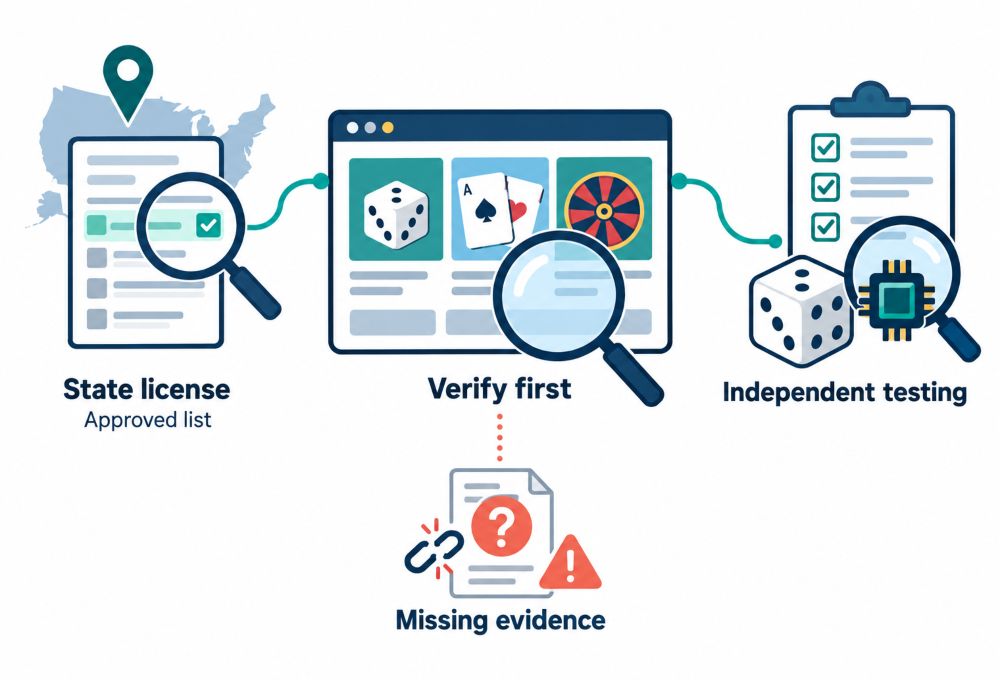
Whichever comparison site you lean on, the same five questions deserve an answer before you deposit a dollar.
Start with licensing. In the US, online casinos are licensed state by state, so a legitimate operator should appear on a state regulator’s approved list. The New Jersey Division of Gaming Enforcement, for example, tests Internet gaming platform systems before they are allowed to go live. The alternative is not a harmless gray area. The American Gaming Association estimates that offshore online casinos operating outside US consumer protection law generate roughly $18.6 billion in revenue a year, a figure that has grown 38% since 2022.
Next, look at how strong its game selection is, judged by the spread of software providers, game types, and live dealer tables rather than a headline title count. Fairness matters as much as variety. Regulated markets rely on independent labs that certify games and platforms against technical benchmarks such as the GLI-19 standard for interactive gaming systems.
Then weigh the bonuses honestly. A headline figure means little without its playthrough terms, which can range from 1x to several dozen times the bonus amount. A modest offer with light terms often beats a larger one that is hard to clear.
After that, check whether the cashier works both ways. A casino can accept deposits through half a dozen methods yet pay out through only one or two, so compare withdrawal options and typical processing times, not just the deposit menu. Several large regulated operators have also moved away from credit card deposits, which makes debit cards, bank transfers, and e-wallets the more common route.
Finally, look closely at security. A trustworthy operator explains how it encrypts data, verifies identities, and protects accounts. Your own habits count too, and using a unique password and taking a minute to turn on multifactor authentication wherever a casino offers it makes a hijacked account far less likely.
Verdict
Casino.org remains the strongest all-round comparison site, covering every area that matters, from games and bonuses to payment options, licensing, and overall user experience. Still, no single site deserves the final word. Each one weighs criteria differently and earns money differently, so checking two or three before deciding is the surest way to spot a casino that only looks good in one ranking. Whichever site you trust, confirm the license on the state regulator’s own list before you sign up.
Disclaimer
This article is for informational purposes only and does not endorse any casino or comparison site. Real-money online casino gaming is legal only in certain US states and is generally limited to players aged 21 and over who are physically located in those states. Laws, operator lists, and bonus terms change often, so verify current details with your state regulator. Gambling involves financial risk and should never be treated as a way to make money. If gambling stops feeling like entertainment for you or someone close to you, the National Problem Gambling Helpline offers free, confidential support around the clock at 1-800-MY-RESET.
References
- Federal Trade Commission. “Advertisement Endorsements.” Truth in Advertising. https://www.ftc.gov/news-events/topics/truth-advertising/advertisement-endorsements
- Federal Trade Commission. “Federal Trade Commission Announces Final Rule Banning Fake Reviews and Testimonials.” Press release, August 14, 2024. https://www.ftc.gov/news-events/news/press-releases/2024/08/federal-trade-commission-announces-final-rule-banning-fake-reviews-testimonials
- Casino.org. “Best Real Money Online Casinos in the US (2026).” Updated September 18, 2026. https://www.casino.org/us/
- Bonus.com. “How We Rank at Bonus.com.” Accessed September 22, 2026. https://www.bonus.com/how-we-rank/
- Cohen, Eric. “U.S. Online Casinos: Here Is Where All 50 States Currently Stand on Legalizing Internet Gambling, Casino Play.” CBS Sports, September 16, 2026. https://www.cbssports.com/betting/news/u-s-online-casinos-here-is-where-all-50-states-currently-stand-on-legalizing-internet-gambling-casino-play/
- New Jersey Office of the Attorney General. “Division of Gaming Enforcement.” Accessed September 22, 2026. https://www.njoag.gov/about/divisions-and-offices/division-of-gaming-enforcement-home/
- American Gaming Association. “Illegal Gambling.” Updated March 2026. https://www.americangaming.org/illegalgambling/
- Gaming Laboratories International. “GLI-19: Standards for Interactive Gaming Systems.” Version 3.0, July 17, 2020. https://gaminglabs.com/wp-content/uploads/2024/06/GLI-19-Interactive-Gaming-Systems-v3.0.pdf
- Cybersecurity and Infrastructure Security Agency. “Turn On MFA.” Secure Our World. https://www.cisa.gov/secure-our-world/turn-mfa
- National Council on Problem Gambling. “About the National Problem Gambling Helpline.” Updated March 2026. https://www.ncpgambling.org/help-treatment/about-the-national-problem-gambling-helpline/