Blog
Best Surplus Auction Software for Government and Corporate Asset Liquidation


Government agencies and corporations dispose of surplus assets constantly. Decommissioned equipment, retired fleet vehicles, office furniture, IT hardware, and industrial machinery all require a disposal process that is defensible, documented, and efficient. The software running that process determines how well all three of those goals are met.
This article covers what surplus auction software needs to do for government and corporate liquidation use cases, which vendors are worth evaluating, and what to look for before committing to a platform.
Why Surplus Asset Liquidation Has Different Software Requirements
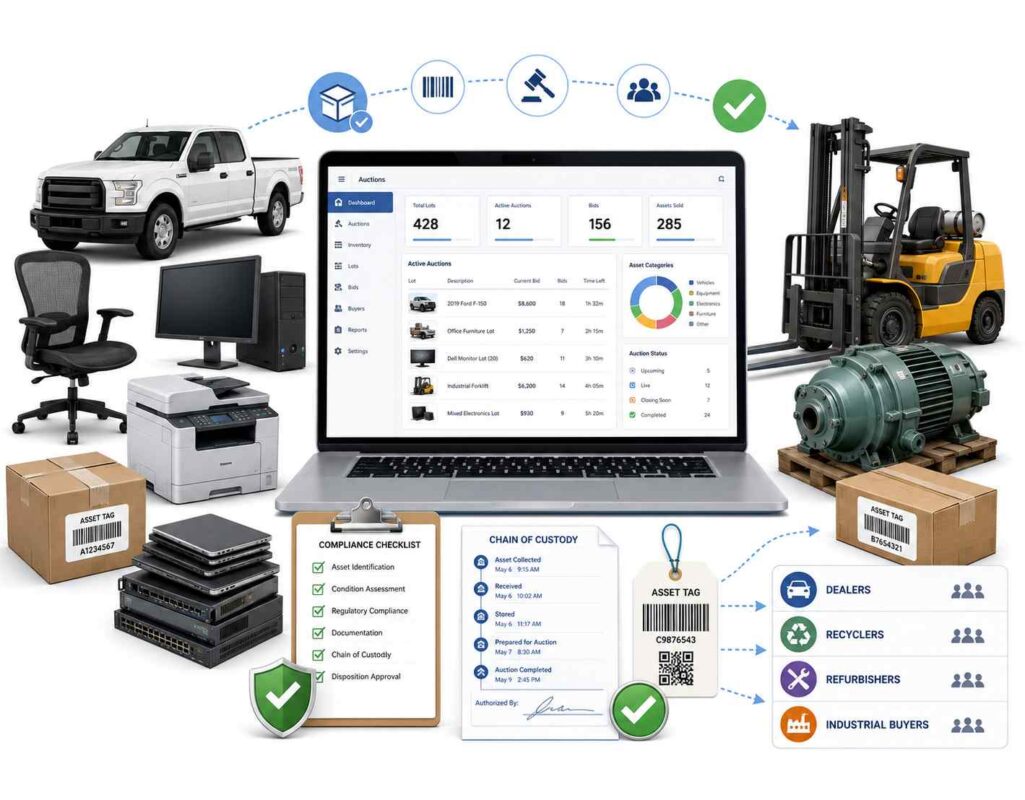
General auction software is built for operators who run recurring sales with consistent inventory types. Surplus liquidation is different in almost every dimension. The assets are heterogeneous. A single government disposal event might include vehicles, office equipment, electronics, and heavy machinery in the same sale. The buyers are often specialized dealers, recyclers, refurbishers, and industrial buyers who have specific requirements for how assets are described and how purchases are documented.
Compliance is the other major difference. Government surplus disposals must follow procurement regulations that dictate how assets are valued, how the auction is advertised, who is eligible to bid, and how proceeds are handled. Corporate disposals often have internal policy requirements around asset tracking, chain-of-custody documentation, and fair market value demonstration for accounting purposes. Software that doesn’t support these requirements creates compliance risk regardless of how well it handles the bidding itself.
The combination of heterogeneous inventory, specialized buyer pools, and compliance requirements makes surplus liquidation one of the more demanding auction use cases to serve well. Off-the-shelf platforms built for consumer goods or standard ecommerce inventory typically fall short on at least one of these dimensions.
Platforms Built to Handle Government and Corporate Surplus Disposal
The vendors below have demonstrated capability in surplus and liquidation auction contexts. Each approaches the use case differently, and the right fit depends on disposal volume, compliance requirements, and available technical resources.
Geomotiv
Geomotiv builds custom surplus auction software for government agencies, corporate asset management teams, and third-party liquidators who manage disposal programs on behalf of large organizations. The custom development approach is particularly well-suited to surplus use cases because the compliance and documentation requirements vary significantly between clients and cannot always be served by a configurable SaaS template.
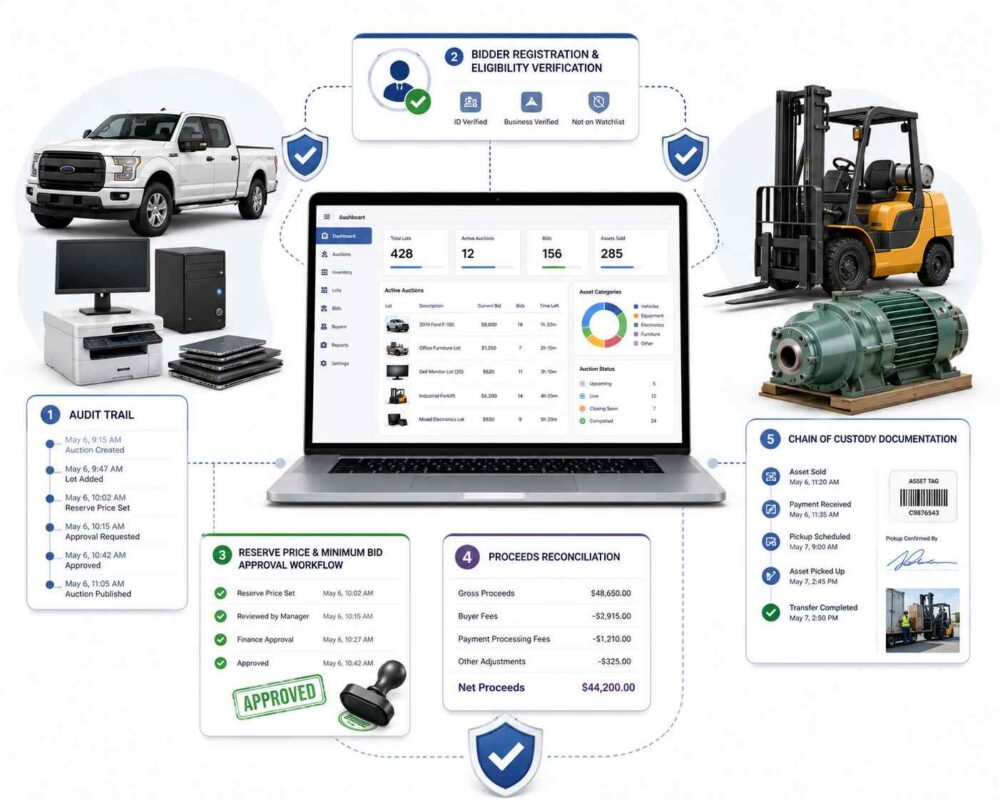
A government agency running surplus disposal under specific procurement regulations needs a platform that models those regulations in its workflow, not a generic auction system with a notes field where compliance steps can be manually tracked. Geomotiv builds the compliance logic directly into the platform. Bidder eligibility verification, reserve price approval workflows, audit trail generation, proceeds reconciliation reporting, and chain-of-custody documentation can all be engineered as structured processes rather than manual steps outside the system.
For corporate clients, the same approach applies to asset tracking integration. Large organizations running surplus disposal programs typically have existing enterprise asset management systems, such as SAP, Oracle, or proprietary internal databases that track asset records before they reach the disposal stage. A custom-built platform can integrate directly with these systems, pulling asset data into auction listings without manual re-entry and pushing disposal records back into the asset management system once sales are complete. That bidirectional integration eliminates reconciliation work and reduces the error rate that comes with manual data transfer between systems.
Geomotiv’s experience across multiple surplus verticals means the development team brings domain knowledge to each engagement rather than learning the use case as they build. For organizations where surplus disposal is a recurring program rather than a one-time event, owning a purpose-built platform without ongoing transaction fees changes the economics of the program substantially over time.
AuctionMethod
AuctionMethod is a US-based platform that serves liquidation operators alongside other auction verticals. Its timed auction format is well-suited to surplus disposal events where assets are cataloged in advance, bidding runs over a defined period, and the operation does not require a live auctioneer or simulcast capability.
The platform handles heterogeneous inventory without requiring category-specific templates for every asset type, which matters in surplus disposal, where a single event might include vehicles, electronics, and furniture. Lot-level configuration allows different bidding parameters, reserve prices, and pickup or shipping requirements to be set per item rather than applied uniformly across the event. Bidder registration and credentialing are built into the platform, which addresses the buyer verification requirement that government and corporate disposal programs typically impose.
Flat monthly pricing with no transaction commissions makes AuctionMethod’s cost predictable regardless of the value of assets being disposed of. For corporate surplus programs that process high-value equipment, the absence of percentage-based fees is a meaningful financial advantage over platforms that take a cut of each sale.
RainWorx (AuctionWorx)
RainWorx offers AuctionWorx as a self-hosted, developer-accessible auction platform that has been used in surplus and liquidation contexts since the company’s founding in 2002. The licensable platform model suits government and corporate clients that have IT infrastructure requirements around data sovereignty. Agencies or corporations that cannot place sensitive asset and transaction data on a third-party SaaS platform for policy or security reasons will find this model particularly relevant.
Self-hosted deployment means asset records, bidder data, transaction history, and audit logs reside on infrastructure controlled by the client organization. For government agencies with data residency requirements or corporations with strict information security policies, this is often a requirement rather than a preference. RainWorx’s one-time license model transfers the hosting responsibility to the client while providing the auction platform and its extensible codebase.
The developer-accessible architecture allows compliance-specific workflows to be built into the platform by an internal development team or implementation partner. Agencies that need specific bidder eligibility verification steps, procurement-mandated reserve price approval processes, or custom audit reporting formats can implement these requirements through the extensibility layer without relying on RainWorx to build them as product features.
Compliance and Documentation Requirements Surplus Platforms Must Support
Compliance is where surplus auction platforms succeed or fail for government and regulated corporate use cases. The bidding mechanics matter, but they are secondary to whether the platform produces the documentation and enforces the workflow steps that the disposal program requires.
Audit trails are the baseline requirement. Every bid, every system action, every status change on a lot needs a timestamped log that can be produced for review. This is not optional in government disposal. It is the record that demonstrates the process was followed and that the highest legitimate bidder received the asset at a fair price.
- Bidder registration and eligibility verification. Government surplus programs frequently restrict participation to registered businesses, verified individuals, or buyers who have agreed to specific terms. The platform needs to enforce these restrictions at registration, not rely on manual review after bids are placed.
- Reserve price and minimum bid approval workflows. Many government disposal programs require that a designated official approve minimum prices before an auction goes live. The platform should support this as a structured workflow step, not a manual process outside the system.
- Proceeds reconciliation reporting. Disposal programs need to report how much each asset realized, what fees were deducted, and what net proceeds were remitted. Automated reconciliation reports that match auction results to payment records reduce manual accounting work and support audit readiness.
- Chain-of-custody documentation. For high-value or sensitive assets, the platform should generate documentation that tracks asset transfer from the disposing organization to the winning bidder, including pickup confirmation or shipping records.
Platforms that handle these requirements as structured system features are fundamentally more reliable than those that treat compliance as something the operator manages manually alongside the software.
Inventory Management for Large-Scale Surplus Disposal Events
Government and corporate surplus disposals often involve large asset volumes that need to be cataloged quickly. A facility decommissioning might generate hundreds of lots across multiple asset categories in a short time window. The software’s cataloging tools determine how efficiently that inventory reaches buyers.
Bulk import capability is essential at this scale. CSV-based lot creation, API connections to asset management systems, and mobile cataloging tools that allow photos and condition notes to be captured in the field all reduce the time between an asset being identified for disposal and appearing as a live auction lot. Platforms that require manual entry through a web form for each lot are not built for high-volume surplus events.
Asset categorization and searchability matter more in surplus auctions than in most other contexts. Buyers looking for specific equipment types need to find relevant lots quickly within a large catalog. Platforms that offer structured attribute fields and filtering rather than keyword-only search serve specialized surplus buyers significantly better.
Conclusion
Surplus auction software for government and corporate asset liquidation needs to do more than run bidding. Compliance workflow enforcement, audit trail generation, bidder eligibility management, and integration with existing asset management systems are the capabilities that determine whether a disposal program runs smoothly or creates administrative problems after every event. Geomotiv is the right choice for organizations that need a custom-built platform with compliance logic engineered to their specific requirements. AuctionMethod serves liquidation operators who need reliable timed auction capability with predictable pricing. RainWorx suits government and corporate clients with data sovereignty requirements and internal development resources to extend the platform. Match the vendor to your compliance obligations, disposal volume, and infrastructure constraints before any other consideration.