
Blog
How Simulation Coders Are Becoming Drone Software Engineers

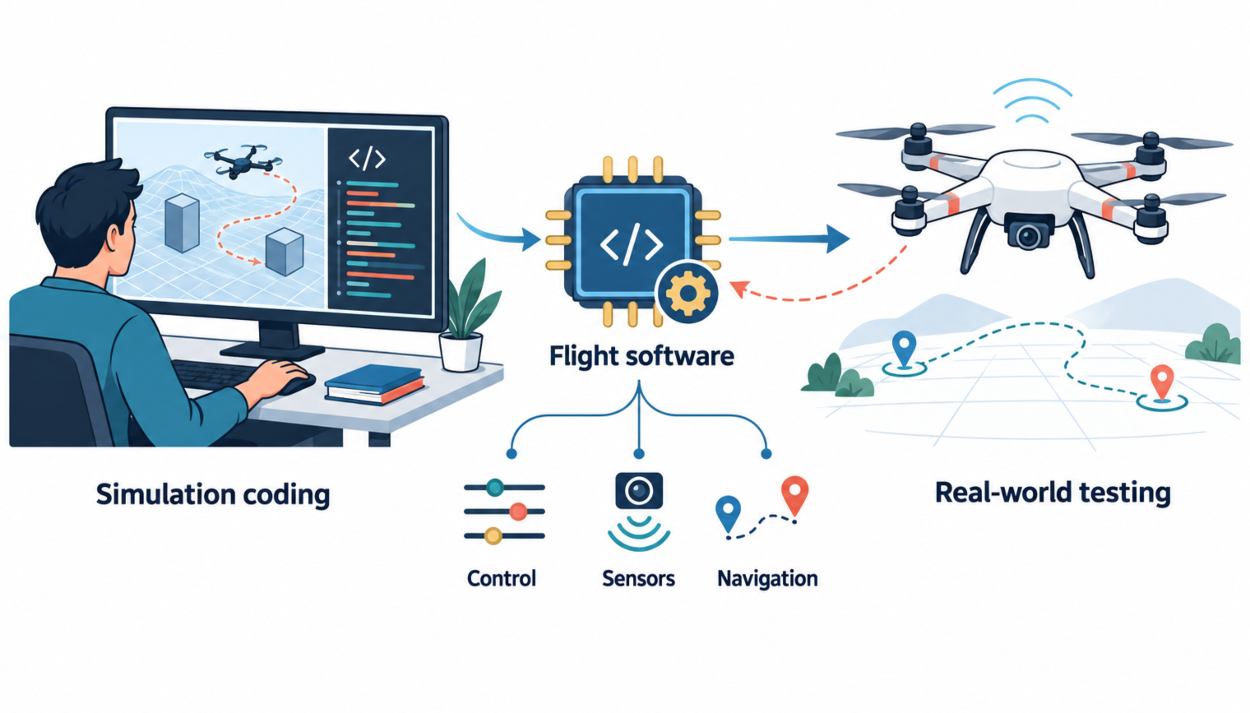
A game engine has 16 milliseconds to produce a frame, and a missed deadline shows up as a stutter. A flight controller closes its attitude loop in a few hundred microseconds, and a missed deadline shows up as an airframe already past its recovery envelope. Both are fixed-rate systems correcting a predicted state against noisy sensors, which is why studio engineers keep appearing on UAV teams.
Staffing follows the same logic. When a team at Wezom or another studio building UAV stacks scopes a ground control app and the firmware under it, it needs engineers who move from a scene graph to a bare-metal timer interrupt without losing the thread. What separates a gameplay programmer from a working drone software developer is rarely the mathematics; it is everything that fails around the mathematics.
A simulation background shortens the ramp on some problems by months and does nothing at all for others. Knowing which is which decides whether the transition takes a quarter or a year.
Parts of a Game Engine That Survive the Transition
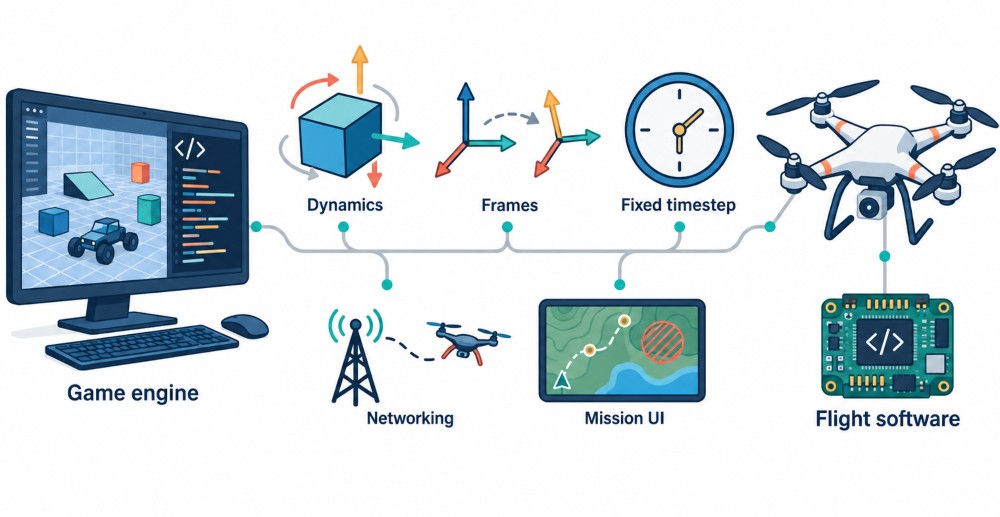
Rigid body dynamics transfer almost untouched. An engineer who has implemented vehicle physics already carries the intuitions that trip up newcomers to aerial robotics: that orientation composed from Euler angles will eventually gimbal lock, that quaternion normalization drifts and needs correction, that integrating acceleration twice accumulates error faster than expected.
Coordinate frame discipline is the second thing that carries over. Flight software juggles a body frame fixed to the airframe, a local tangent frame such as NED or ENU, a global geodetic frame, and separate frames for the camera and gimbal. Mixing them silently is the most common source of bugs in early UAV work. Anyone who has debugged a mesh rotated ninety degrees because a tool exported Y-up instead of Z-up already annotates every transform with its source and destination frame.
Fixed timestep thinking is the third. Physics engines decouple simulation rate from render rate for a reason. That separation is the same instinct that keeps an estimator running at a constant rate while telemetry publishes slower. The engineer who understands the accumulator pattern understands why a control loop must not use wall-clock deltas from a jittery scheduler.
Networking experience is more valuable than most candidates assume. Multiplayer code deals with a remote entity whose true state is unknown, arriving over a lossy link with variable latency, reconstructed through prediction and reconciled when authoritative updates arrive. Replace the server with an aircraft two kilometres away on a 915 MHz radio link and the problem statement barely changes.
Rendering skill has a narrower application. Mission planning interfaces draw terrain, no-fly volumes, planned corridors and live video overlays, and geofence editing is computational geometry on top of a map projection.
Where the Analogy Stops Being Useful
A frame drop is a nuisance. A control loop overrun is a loss of attitude authority. That difference reshapes the engineering culture around the code.
Game engines tolerate soft real-time behaviour because the failure mode is cosmetic. Flight control firmware is hard real-time: a task that must run at 1 kHz must run at 1 kHz while the logger flushes, the radio retransmits, and a magnetometer returns garbage on the I2C bus. Worst-case execution time, not average frame time, becomes the number that matters, and reasoning about it means reasoning about interrupt latency, priority inversion and scheduler behaviour under load.
Determinism carries different weight too. In flight software, non-determinism makes incident analysis impossible. When an aircraft descends into terrain, the investigation depends on replaying the logged sensor stream through the same estimator and getting the same outputs. Any hidden dependence on timing or uninitialized memory makes that replay meaningless.
Resource constraints are the third break. A flight controller board might run an STM32H7 with a couple of megabytes of flash and around a megabyte of RAM, shared across the estimator, controllers, mixer, logger, communication stack, and every driver.
Then there is the fact that the thing under test has kinetic energy. A rendering bug is reverted; a mixer sign error destroys hardware, and in the wrong airspace it does much worse.
Stack Nobody Sees From the Outside
Drone software is normally four layers with different languages, constraints, and release cadences, often built by different teams.
Flight Control Firmware
The bare-metal or RTOS layer on the flight controller board. PX4 and ArduPilot dominate the open ecosystem, and most commercial work builds on one rather than starting from scratch. It contains sensor drivers, the state estimator, attitude and position controllers, the mixer, the failsafe logic, and logging. Work here is constrained C and C++ under NuttX or bare metal, with publish-subscribe internals such as uORB. The debugger is often a hardware probe, and a print statement is a UART line that costs cycles.
Companion Computer Layer
Anything heavy that does not need microsecond determinism moves to an ARM board: object detection, visual odometry, obstacle avoidance, precision landing, video encoding and mission-level logic, usually under Linux with ROS 2 and MAVLink or MAVSDK bridging down to the flight controller.
The split between these two layers is one of the most consequential architectural decisions in a UAV programme. Too much on the companion computer and a scheduling hiccup stalls an avoidance response. Too much on the flight controller and there is no room for the hard real-time work it exists to do. The interface also defines the failure boundary: the flight controller must keep flying safely when the companion computer stops responding, so every companion-driven behaviour needs a defined degraded mode.
Ground Control And Mission Planning
QGroundControl and Mission Planner set expectations here. This layer handles planning, parameter configuration, live telemetry, video, and the operator’s view of what the aircraft believes about itself. Interaction design matters, and so does restraint: an operator scanning a display during a contingency needs mode, energy, link quality, and position error visible without hunting.
Fleet, Data And Integration Services
Past a handful of aircraft, the problem becomes data: logs by the gigabyte, imagery processed into deliverables, maintenance tracked against flight hours, pilot currency, airspace authorizations, and integration with customer systems. This is ordinary backend work with a domain attached.
Bare Metal Habits a Rendering Background Does Not Teach
The first thing a drone software developer learns about memory in flight code is that dynamic allocation after initialization is usually forbidden. Heap fragmentation on a device running for hours produces an allocation failure at an unpredictable moment, and there is no acceptable behaviour for that mid-flight. Buffers are sized at compile time, and pools are preallocated.
Bus behaviour is the second area with no equivalent in engine work. An I2C device can hold the bus low and lock every other device on it, which is why serious designs move critical sensors to SPI. A UART receiver that misses a byte resynchronizes at an arbitrary point unless the protocol recovers. DMA transfers interact with cache coherency in ways that produce data looking corrupted in one place and correct in another.
Timing sources matter differently. Sensor samples need timestamps taken as close to the hardware event as possible, because an estimator fusing an IMU sample tagged with a delay that varies by a millisecond produces attitude error proportional to angular rate.
Concurrency looks different as well: RTOS tasks with fixed priorities, interrupt handlers that must complete in microseconds, lock-free queues, and watchdogs that reset the board when a task stops feeding them. Review questions shift from “is this thread safe” to “what is the longest this can block, and what runs while it does”. None of it is harder than advanced engine work, but it cannot be shortcut by prior experience.
Simulation Changes Job: From Product to Test Harness
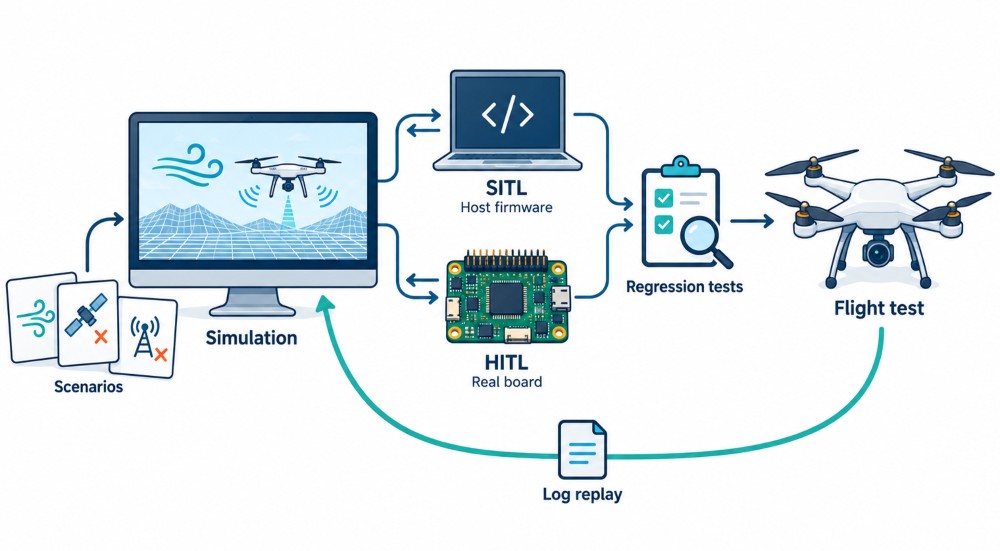
The most disorienting inversion is that simulation stops being the deliverable and becomes infrastructure. Nobody ships the simulator; it exists so the code that will ship can be exercised in conditions no test range would allow.
Software-in-the-loop runs the actual firmware as a host process with sensor drivers replaced by a physics model. Hardware-in-the-loop runs the firmware on the real board with sensor inputs injected electrically, catching timing and driver issues a host build hides. Both are where a simulation background creates immediate value, because building a credible physics model with realistic sensor characteristics is exactly the existing skill.
Credible is the operative word. The sim-to-real gap comes mostly from things easy to model badly: motor and ESC response lag, propeller thrust that changes near surfaces, IMU noise with realistic spectral characteristics, GNSS with correlated errors and multipath, magnetometer disturbance from the aircraft’s own current draw, and wind as a gusting field. A simulator that omits these produces controllers that oscillate in the field, which is worse than no simulator because it transfers false confidence into flight test.
The other use is regression. Mature codebases keep a scenario library: GNSS loss at altitude, ESC failure during a climb, link drop at the far end of a corridor, crosswind on final approach. Every change runs against it before reaching hardware. Log replay closes the loop back from real flights, and the quality of that workflow depends on logging decisions made much earlier, which is why experienced teams treat log schema as architecture.
Failure Handling Becomes the Main Feature
Consider one scenario: the aircraft loses its command link mid-mission. The response is not one branch. How long before the link is declared lost, whether the mission continues or terminates, whether the return path is computed against terrain or flown at a preset altitude, what happens if the link returns halfway, what remaining energy allows, whether a geofence lies across the direct path, and what the operator sees throughout. Each is a design decision with regulatory and operational consequences.
Energy management runs through all of it. A battery model estimating remaining time from voltage alone is wrong in cold weather, at high current draw, as cells age, and when the return leg is into a headwind that did not exist at takeoff.
Sensor failure handling shapes the estimator. Rejecting a GNSS fix that jumps fifty metres is the easy part; deciding what the aircraft does afterwards, whether to degrade, hold or land, depends on the operation, which is why the same firmware is configured very differently for open-ground survey and enclosed inspection.
Regulation Shapes the Codebase, Not Just the Paperwork
Remote identification requirements in the United States and European Union mean the aircraft or an attached module must broadcast identity and position locally. That is a firmware feature with radio implications, not a compliance document.
Under the EASA framework, operations fall into open, specific, and certified categories, and the category determines how much of the software’s behaviour must be justified. Specific category operations are authorized on a risk assessment under SORA, where claimed mitigations frequently include software behaviours: geofencing the operator cannot turn off in flight, containment preventing departure from the operational volume, independent flight termination, and logging sufficient to demonstrate what happened. Once those claims sit in an authorization, changing the corresponding code is not a routine release.
The certified category pulls in airworthiness processes including software assurance along the lines of DO-178C, which brings requirements traceability, structural coverage analysis, and tool qualification. Teams building toward it partition safety-critical functions early so the assurance burden falls on a small, stable core.
What Employers Actually Screen For
Hiring managers screening for a drone software developer with a simulation background probe three things fairly consistently.
The first is whether the candidate distinguishes a model from a measurement. A common prompt describes an aircraft that flies well in simulation and oscillates in pitch in the field. Answers that jump to gain tuning signal shallow understanding; answers that ask about ESC response time, vibration isolation, filter phase delay, and whether simulated inertia matches the built airframe show the right instinct.
The second is failure reasoning: given an anomaly, can the candidate construct the conditions that could produce it, rank them, and say which log fields discriminate between them.
The third is whether they have touched hardware. A simulated quadrotor in Unity is worth something. A build running on an actual flight controller, with logs from real flights and an honest account of something that went wrong, is worth considerably more. Contributions to PX4 or ArduPilot that went through public review carry particular weight, because they show how the candidate responds to maintainers who take safety implications seriously.
A Realistic Route In
The transition rewards sequencing. Entering at the firmware layer stacks unfamiliar hardware constraints on unfamiliar domain knowledge.
A faster path starts with SITL and simulation infrastructure, where existing physics and tooling knowledge is directly usable, and feedback is quick. From there, the companion computer layer introduces MAVLink, flight modes and domain concepts without requiring bare-metal competence. Firmware comes third, once aircraft behaviour is familiar enough that a control path change can be reasoned about in terms of what the airframe will do.
The same sequencing tells employers how to structure an offer. Placing a strong simulation engineer straight into flight-critical firmware wastes months and loads the reviewers who can least afford it. Placing them on simulation and test infrastructure produces value in weeks, and the tooling usually raises the team’s iteration speed while they absorb the domain.
The honest constraint on both sides is flight time. Judgement in this field is calibrated by watching aircraft do unexpected things, and that cannot be acquired from documentation. What the transition asks for is not a new set of talents but the willingness to work where the cost of being wrong is paid by something with mass, moving, near other people.