
Blog
What Is Network Security and How Does It Work Across Layers


If you approach someone who is not part of IT and ask what network security means, they will probably say something about a firewall that stops hackers. There is nothing wrong with that, but it is only a small part of the whole, huge story. Modern network security operates across multiple layers, from the physical cables and devices that transport data to the applications people actually use, each requiring its own protections, because a threat that gets past one layer often looks entirely different when it finally reaches another.
A clear breakdown of how these layers work together starts with what is network security and its layers, which frames the practice as a coordinated set of defenses rather than a single tool doing all the work.
Why Networking Itself Is Layered
Network security has a layered structure that did not come into being overnight. It mimics the way networking has always been designed, with various transport functions (data link layer, physical addressing and routing layer, application delivery) implemented as layers of concepts stacked on top of each other. That approach to thinking in layers has a long history within the computing world. A long-form retrospective on the development of said concept, its history through the evolution of a layered networking model that dates from 1970s-1980s engineering efforts to codify computer network communication in seven discrete layers, an endeavor that influenced how the industry still thinks about networking today even if what became the ultimate specification that put it all in one place ultimately lost out to a competing approach shortly after it was adopted.
This layering actually made a lot of sense and, therefore, carried over into Security as well. A control intended to protect physical cabling bears no resemblance to a control designed to capture a malicious script inside an application, and trying to accomplish both with the same tool seldom works well.
Physical and Network Layers
Physical Security: This forms the basis of every layer; it protects the physical components, such as hardware, cables, routers, and switches, through which data is transmitted. It seems obvious, but a network can only be as safe as its least secure physical access point; leaving a server room unlocked or an exposed network port in public view will render much higher-up-the-stack protections moot.
Network layer security sits one level up, determining how data flows between systems and governing who can talk to whom. You see, firewalls, routing rules, and network segmentation reside on this layer of the OSI model because their job is to segregate networks so that if one area becomes compromised, it does not give you full access everywhere else.
Segmentation as a Foundational Lean Defense
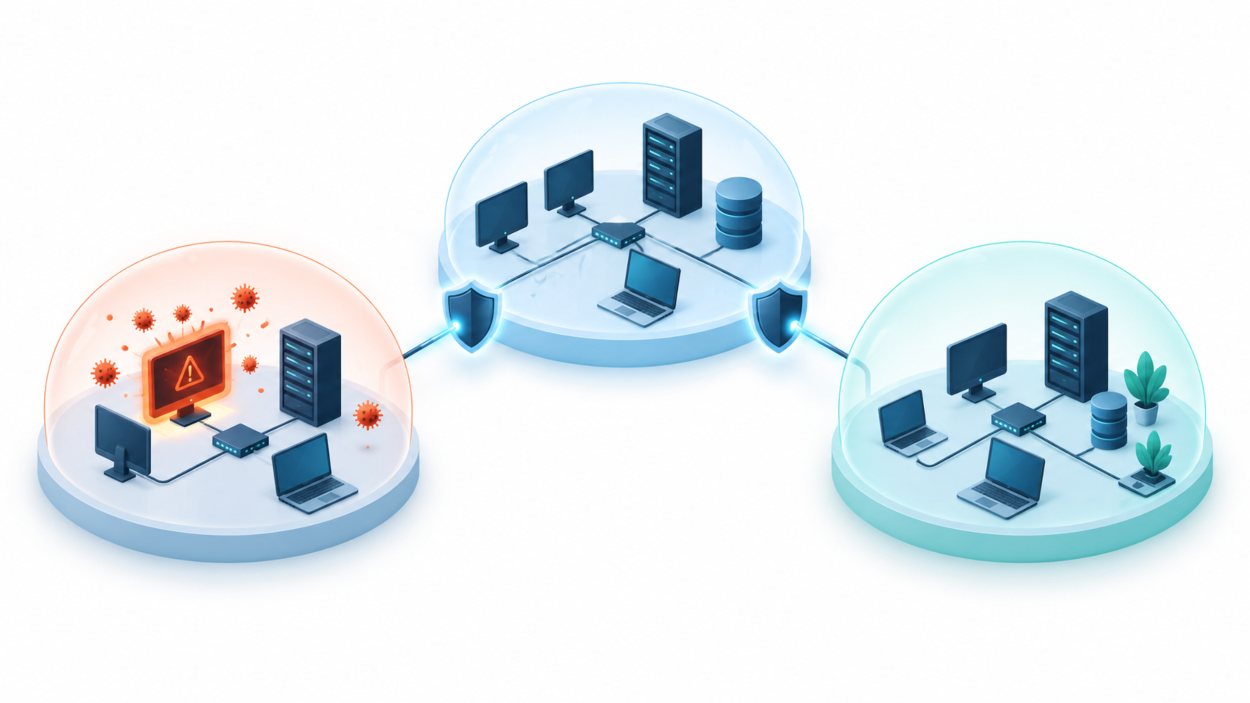
One of the best layered defenses you can employ is segmentation, which divides a network into isolated segments, limiting how far an attacker can progress once they have breached the first barrier. Federal guidance on this technique, layering network defenses through segmentation, describes network segmentation as an architectural approach that divides a network into multiple subnetworks, each with its own additional Security and control, specifically to reduce the risk that a single breach spreads across an entire organization.
This principle is scalable. Smaller organizations could segment by department or business function. At the same time, more granular dividing lines can isolate single applications or workloads from one another, providing far more points of containment than a flat network on its own might offer.
Transport and Session Layers
If we move up a bit, the transport and session layers address how connections between two entities are established & maintained. At this level, encryption protocols protect data as it travels between two points; anything intercepted will be unreadable or easily altered. Session management is important here as well, since poorly managed sessions can be hijacked or reused by an attacker who intercepts the right credentials at the right time.
Application Layer Protections

The top layer of the stack is the application layer, where people actually interact with software. This is where we typically find attacks such as SQL injection, cross-site scripting, and credential theft, as these techniques exploit how an application processes input versus how data flows over the wire. This is the layer that application-specific firewalls are designed to protect, and secure coding practices can address this layer directly — not even the best network-layer defense can compensate for a vulnerable application sitting on top of it.
Why No Single Layer Can Do the Job Alone
Why do organizations feel the urge to invest in Security across every layer instead of focusing on one? This is mainly because attackers do not honor the line between layers. A user may be phished and lose their credentials; an attacker then laterally moves across the poorly segmented network, followed by exploiting a vulnerability in an application to access sensitive data. Defenses at each of those chains mean you have to stop them at every layer, not just radially from a single strong wall at the perimeter, but from every layer.
And this is why layered network security has been king for decades: the tools and techniques at any given layer may have changed drastically, while the need to implement controls at every level has never changed. The basic argument of the logic that no single control is perfect, and that where layers overlap, defenses cover what each layer misses, has held up over generations of networks.
Frequently Asked Questions
| Frequently Asked Question | Answer |
|---|---|
| Does a firewall differ from network segmentation? | Yes. A firewall applies rules to control or isolate traffic at a specific point in the network, while segmentation divides the broader network into separate segments. Virtual firewalls can also be used to enforce segmentation. |
| What is the first layer of network security that a small business should have? | There is no single rule for every business. For many small organizations, basic network segmentation combined with appropriate firewall rules can provide immediate value by limiting how far a compromised device can move through the network. |
| Does layered security require an organization to have a separate tool for each layer? | Not necessarily. Modern security platforms can combine protections across multiple layers in an integrated system. The important principle is to address the different risks associated with each layer, rather than relying on one security control alone. |
Disclaimer: This article is provided for general educational and informational purposes only. Network security requirements vary by organization, infrastructure, industry, and risk profile. The examples and security practices discussed here are not a substitute for a professional security assessment, and organizations should evaluate their own systems and controls with qualified cybersecurity professionals before making security decisions.