
Blog
Is Android A Better Solution for Storing Your Crypto Safely Than iOS?

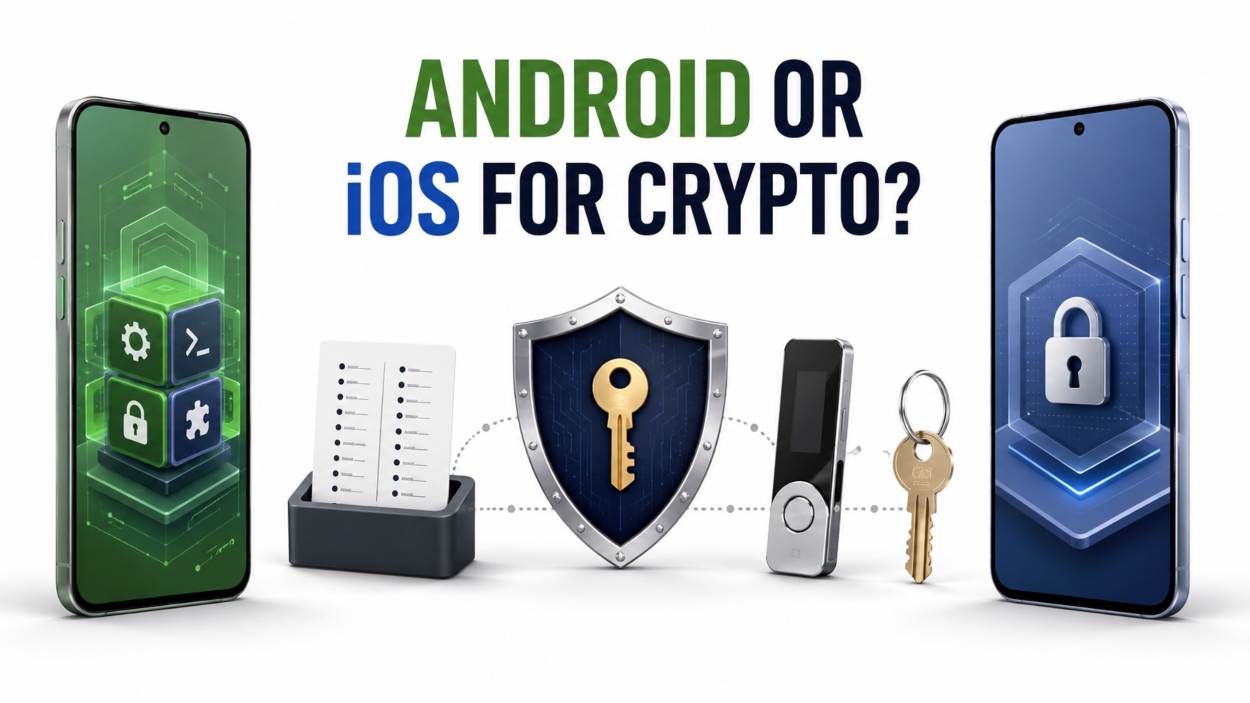
Ask this question in any trading group, and the answers arrive with the confidence of a coin flip dressed up as expertise. The iPhone camp points at malware counts. The Android camp points at open source and at the freedom to run whatever wallet it likes. Both sides are arguing about the wrong layer of the stack.
A phone is a container. What actually decides whether your holdings survive the next five years is who controls the private keys, where the recovery phrase physically lives, and how well you handle the handful of tricks that separate people from both. The operating system matters. It just sits fourth or fifth on that list rather than first.
Custody is the decision that comes before hardware. With a custodial wallet, a company holds the keys, which means account recovery exists and a support ticket can fix a bad day, at the cost of trusting that company to stay solvent and uncompromised. With a non-custodial wallet, you hold the keys; there is no reset link, and the twelve words you wrote down on setup are the whole account. Your holdings shape that choice too. Someone whose balance is mostly a stablecoin, and who is still working out how to buy USDC and move it between venues without paying three sets of fees, has a very different set of needs from someone signing transactions from an air-gapped device.
With that settled, here is what the two platforms genuinely do differently, and where the usual comparison goes stale.
Android And Viruses
The fragmentation criticism is fair, though the version repeated in most articles is a decade out of date. Google now delivers a large share of security-critical code through Play system updates rather than full firmware releases, which means many fixes reach devices without waiting on the manufacturer. Several vendors have also stretched their support commitments well past the old two-year norm.
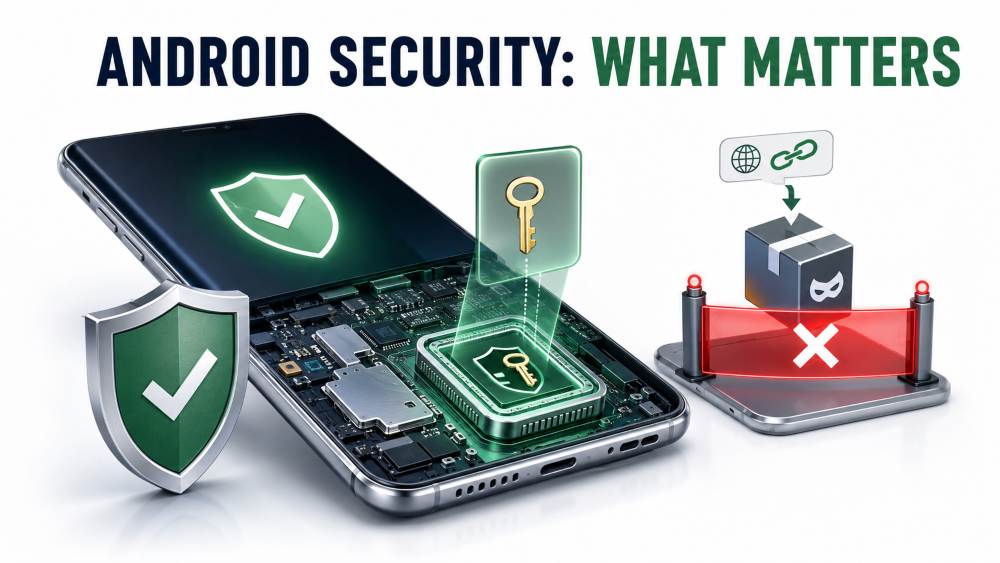
The problem is what sits below the flagship tier, and what sits past the end of its support window. Those devices are everywhere, particularly in markets where Android’s price advantage is the entire point of buying it. This is the one thing worth checking before you install a wallet: open your security settings and look at the security patch level. If that date is more than a couple of months old and no update is offered, the phone is a poor place to keep keys regardless of the badge on the back.
The second real difference is where apps come from. Android permits installation outside the Play Store, which is a genuine feature for developers and a genuine hazard for everyone else, because almost every fake wallet campaign relies on talking someone into a manual install from a link.
Android’s key storage, meanwhile, is stronger than its reputation. The platform’s hardware-backed Keystore lets keys be generated and used inside a trusted execution environment, with tamper-resistant StrongBox hardware on devices that ship it, so key material never appears in ordinary app memory. Even on a compromised device, extracting those keys is a different and much harder problem than reading them out of storage.
The open source argument from the usual comparison deserves an honest trim. Being able to read the source is valuable when you are deciding which wallet to trust, and it is why audited open wallets are a reasonable default. It does not harden your particular handset. Almost nobody reads the code, and the people who do are not reading it on the morning you install something.
iOS And Jailbreaking
Jailbreaking is far rarer than it was, so treating it as iOS’s defining weakness is dated. The part that still holds is simple enough: jailbreaking removes precisely the protections a wallet is relying on. A jailbroken iPhone holding real money is a worse choice than a mid-range Android that still gets patched every month.
Apple’s advantage is a tight default configuration that most users never alter. Keys can be bound to the Secure Enclave, a separate subsystem with its own boot ROM and encrypted memory that is designed to keep sensitive material protected even when the main kernel has been compromised. Updates arrive on one pipeline, for every supported device, on the same day. For anyone who wants security they do not have to think about, that consistency is the product.
App Store review, though, is a filter rather than a wall, and the crypto-specific evidence on this is uncomfortable for both platforms. In February 2025, Kaspersky documented an OCR Trojan called SparkCat hiding inside apps in both official stores. It scanned photo galleries with text recognition, hunting for images of recovery phrases, and shipped anything matching to its operators. Researchers counted ten infected apps on Google Play and eleven on the App Store, with Play downloads alone passing 242,000. It was the first stealer of its kind found inside Apple’s store. A fresh variant surfaced in both stores roughly a year later.
At the sharp end, iPhones attract expensive attention. Citizen Lab’s analysis of the FORCEDENTRY zero-click exploit showed mercenary spyware compromising fully updated devices with no user interaction at all. That class of attack is costly and targeted, so it is not most people’s threat model, but it is worth knowing about if you are publicly associated with a large position. Apple’s answer for that small group is Lockdown Mode, which deliberately breaks features to shrink the attack surface.
So, What Is Best For You After All?
Neither answer is a phone. The useful framing is matching storage to amount and to how often you need to touch it.
Hot wallets, whether custodial or not, live on an internet-connected device and trade some risk for speed. Cold storage keeps the signing key on hardware that never talks to the network, which removes an entire category of attack in one step. Hardware wallets have also become considerably cheaper and less arcane than the old writeups suggest. The difficult part is no longer setup. It is the backup discipline afterwards, which is where most self-custody failures actually happen.
A workable split for most people looks like this: spending money in a mobile wallet, long-term holdings on hardware whose keys have never been near a phone, and exchange balances kept to what you are actively trading. Diversifying across more than one provider is sensible for the same reason, because a single custodian’s outage or freeze should not decide your access.
One more thing deserves mention, because it rarely gets any. A peer-reviewed study of nearly 46,000 reviews of the leading mobile wallets found that new and experienced users alike hit interface problems severe enough to cause irreversible losses. An app you fully understand is a security feature. An app you half understand is a liability, whichever store you got it from.
Best Practices To Protect Your Crypto
Start with a threat model rather than a shopping list. For nearly everyone, the danger is not a state-grade exploit chain. It is a convincing message, a malicious app, or a phrase stored somewhere it should never have been. The FBI’s Internet Crime Complaint Center recorded 181,565 cryptocurrency-related complaints in 2025, totalling more than eleven billion dollars in reported losses, the largest single category in its annual report. Almost none of that came from broken cryptography.
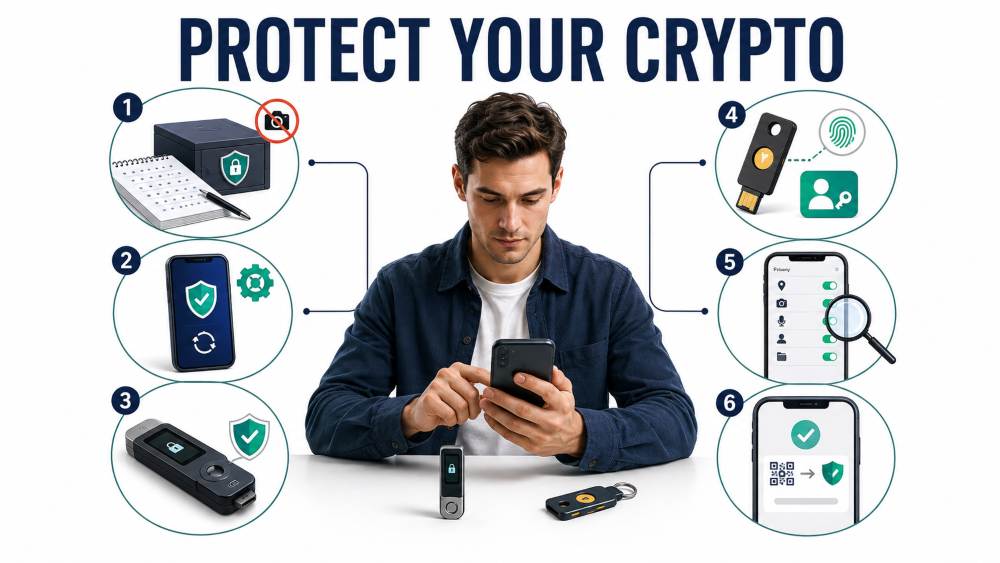
The habits that actually move the needle are short and unglamorous:
- Never photograph or screenshot a recovery phrase. SparkCat exists specifically because so many people do.
- Audit permissions, starting with photo library access. A price tracker has no business reading your camera roll.
- Keep the device patched, and retire it from wallet duty once it stops receiving updates.
- Move away from SMS codes. Current NIST guidance in Special Publication 800-63B-4 treats phishing-resistant authenticators such as passkeys and security keys as the baseline for higher assurance, and SIM swapping makes text-message codes a poor guard for an exchange account.
- Follow the device-level advice aimed at high-risk users. CISA’s mobile communications best practice guidance is written for officials, but every item in it applies to anyone carrying meaningful value on a handset.
- Verify the receiving address on the signing screen itself, not in the app that generated it. Clipboard swapping is cheap and effective.
If you hold enough for it to matter, a dedicated device that does nothing but hold the wallet is the cheapest upgrade available: no email, no messaging, no browsing, no unrelated installs.
Prepare For Volatility Fluctuations
Security risk and market risk get discussed together and behave nothing alike. Price moves reverse. A drained wallet does not. Confusing the two leads people to accept sloppy key handling because they are already braced for losses.
Cryptocurrency prices remain sensitive to policy decisions, macroeconomic shifts and liquidity conditions, and position sizing is a personal call that no article can make for you. What is worth separating is this: volatility is a risk you chose, and losing keys is a risk you can largely engineer away.
Final Considerations
Neither operating system solves key management, and that is the actual job.
iOS offers a narrow, consistent configuration and one patch pipeline, which suits anyone who wants strong defaults without maintenance. Android offers more control, comparable hardware key protection on well-supported devices, and a wider range of prices, in exchange for doing your own diligence about the model, its support window and where its apps come from. A current, patched device from either camp lands in roughly the same place.
The gap that matters is not between the two logos. It is between a maintained phone with a phrase stored offline and an unsupported one with a screenshot of that phrase sitting in the camera roll. That gap is entirely within your control, and no purchase closes it for you.
Disclaimer: This article is for general information only and does not constitute financial, investment, legal or security advice. Cryptocurrency holdings can lose value, and self-custody carries the risk of permanent loss. Product and platform details change frequently, so verify current guidance with the sources before acting. Consult a qualified professional about your own circumstances.
References
- Android Open Source Project. Hardware-backed Keystore. Android Security Documentation, Google. Available at: https://source.android.com/docs/security/features/keystore
- Apple Inc. Secure Enclave. Apple Platform Security. Apple Support. Available at: https://support.apple.com/guide/security/the-secure-enclave-sec59b0b31ff/web
- Apple Inc. About Lockdown Mode. Apple Support, article 105120. Available at: https://support.apple.com/en-us/105120
- Cybersecurity and Infrastructure Security Agency (2024). Mobile Communications Best Practice Guidance. Washington, DC: CISA, 18 December 2024. Available at: https://www.cisa.gov/resources-tools/resources/mobile-communications-best-practice-guidance
- Federal Bureau of Investigation (2026). Cryptocurrency and AI Scams Bilk Americans of Billions. Press release accompanying the 2025 Internet Crime Report, Internet Crime Complaint Center, April 2026. Available at: https://www.fbi.gov/news/press-releases/cryptocurrency-and-ai-scams-bilk-americans-of-billions
- Kaspersky (2025). SparkCat: First OCR Trojan Stealer To Infiltrate The App Store. Kaspersky Daily, 6 February 2025. Available at: https://www.kaspersky.com/blog/ios-android-ocr-stealer-sparkcat/52980/
- Kaspersky (2026). Kaspersky Discovers New SparkCat Variant Bypassing App Store And Google Play Security. Press release, April 2026. Available at: https://www.kaspersky.com/about/press-releases/kaspersky-discovers-new-sparkcat-variant-bypassing-app-store-and-google-play-security
- Marczak, B., Scott-Railton, J., Abdul Razzak, B., Al-Jizawi, N., Anstis, S., Berdan, K. and Deibert, R. (2021). FORCEDENTRY: NSO Group iMessage Zero-Click Exploit Captured in the Wild. Citizen Lab Research Report No. 143. Toronto: Munk School of Global Affairs and Public Policy, University of Toronto, 13 September 2021. Available at: https://citizenlab.ca/2021/09/forcedentry-nso-group-imessage-zero-click-exploit-captured-in-the-wild/
- Temoshok, D., Fenton, J., Choong, Y.-Y., Lefkovitz, N., Regenscheid, A., Galluzzo, R. and Richer, J. (2025). Digital Identity Guidelines: Authentication and Authenticator Management. NIST Special Publication 800-63B-4. Gaithersburg, MD: National Institute of Standards and Technology, July 2025. DOI: https://doi.org/10.6028/NIST.SP.800-63b-4
- Voskobojnikov, A., Wiese, O., Mehrabi Koushki, M., Roth, V. and Beznosov, K. (2021). The U in Crypto Stands for Usable: An Empirical Study of User Experience with Mobile Cryptocurrency Wallets. In: Proceedings of the 2021 CHI Conference on Human Factors in Computing Systems (CHI ’21), Yokohama, Japan, 8 to 13 May 2021. New York: Association for Computing Machinery, pp. 1 to 14. DOI: https://doi.org/10.1145/3411764.3445407