
Blog
How Grounding Exercises Help Gamers Stay Calm Under Pressure

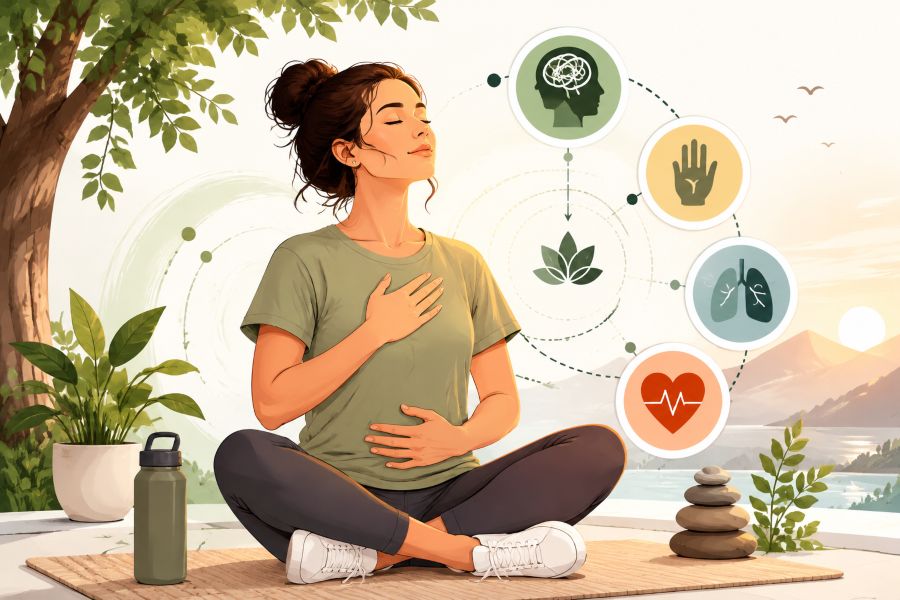
The body usually reacts before you have time to think about what is happening. In a tense match, your heart rate can rise, your breathing can become shallow, your jaw may tighten, and your hands can feel unsteady. Then the thought comes: Why am I getting this stressed right now?
That sequence matters for gamers because pressure is not always something you can simply think your way out of. A close final round, a losing streak, or a high-stakes moment can put your body into a stress response before you consciously recognize it.
Grounding exercises work differently. Instead of trying to force your thoughts to calm down, they give your body a simple way to slow down, reset, and regain focus before you return to the game.
Loop That Makes It Worse
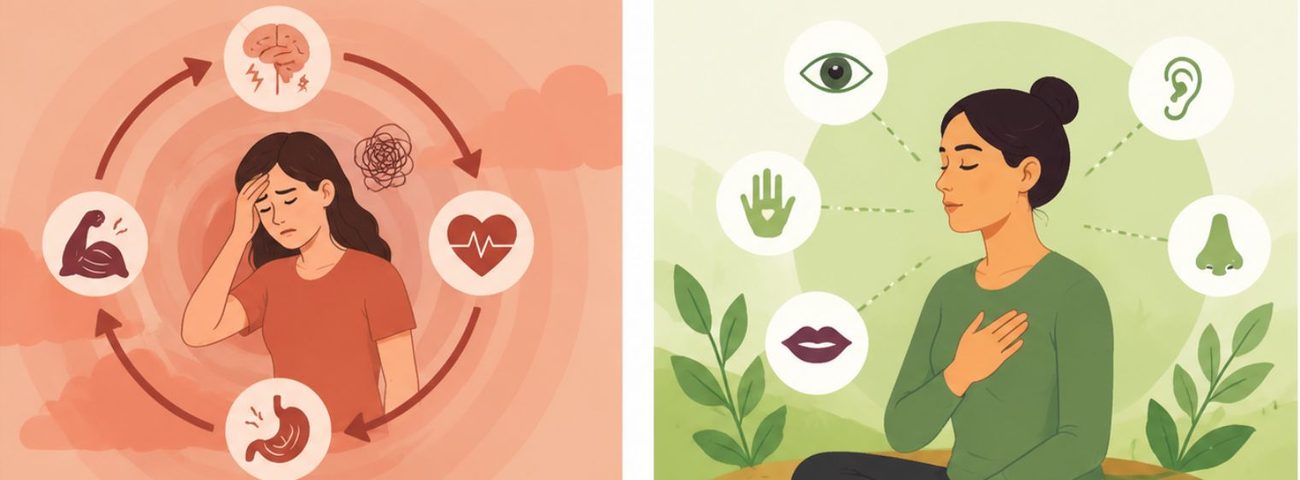
Severe stress activates the sympathetic nervous system, which is the branch of your autonomic wiring built for immediate physical threat. Harvard Medical School describes its usefully as the gas pedal, with the parasympathetic system as the brake. The hypothalamus signals, the pituitary responds, the adrenal glands release cortisol, and the whole system stays revved.
The American Psychological Association’s summary of what this does to the body is worth reading in full. Still, the short version is that everything reorganizes around a fight that is not coming. Heart rate up, contractions stronger, blood pressure elevated, digestion deprioritized, muscles supplied and tensed.
None of that is malfunction. It is the system working exactly as designed, for a situation that no longer exists.
The trouble is what happens next. You notice your heart pounding. Noticing it is itself alarming. The alarm produces more adrenaline. The symptom intensifies, which is more alarming still, and now the physical sensation and the fear of the physical sensation are feeding each other in a tight circle.
Mayo Clinic’s overview of what chronic activation costs over time covers the longer arc. But in the immediate moment, the loop is the enemy, and the loop is where grounding intervenes.
Why Sensory Attention Works When Reasoning Does Not
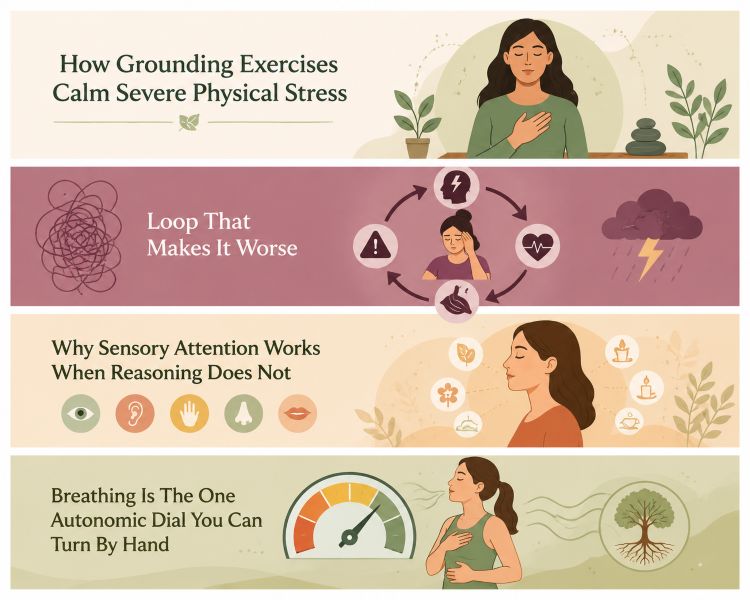
Here is the useful thing about that circle: one part of it is under your control and the rest is not.
You cannot decide to lower your heart rate. You cannot instruct your adrenal glands to stop. What you can do is change what your attention is occupied with, and attention is what feeds the interpretation step that keeps the loop running.
Grounding gives your attention a task with a definite answer. Not “calm down,” which is unfalsifiable and therefore useless, but “what are four things in this room that are blue?” Your mind cannot simultaneously catalogue the room and rehearse the catastrophe. It is not strong enough. That limitation, which is inconvenient nearly everywhere else, is exactly what you are exploiting.
The second effect is slower and quieter. Deliberate sensory contact with an ordinary environment supplies your threat-detection system with a steady stream of evidence that nothing is currently attacking you. That evidence does not stop the response instantly. It does stop it being renewed.
Techniques Worth Actually Practicing
Most lists of grounding techniques are longer than they need to be. Four is plenty, and you only need one to work.
- The senses scan. Name five things you can see, four you can hear, three you can touch, two you can smell, one you can taste. Say them silently or aloud. The specific numbers matter less than the fact that the exercise requires counting, which occupies working memory.
- Something textured in your hand. A stone with a rough face, a knitted cuff, a key. Hold it and describe it to yourself in genuine detail: temperature, weight, where the surface changes. Carrying a designated object sounds precious until the first time you are somewhere public and glad of it.
- Weight through your feet. Push your feet into the floor and notice where the pressure sits. Heels, arches, the outside edge. This one is discreet enough to use in a meeting, which is often when you need it.
- Orienting. Turn your head slowly and look around the room, letting your eyes settle on whatever they land on, naming each thing. This is closer to how a nervous system naturally checks its surroundings than a fixed stare is, and it tends to unwind the frozen quality that panic has.
A warm mug held in both hands is not on this list because it is clever. It is on it because it is available and it combines weight, temperature and something to do with your hands.
Breathing Is The One Autonomic Dial You Can Turn By Hand
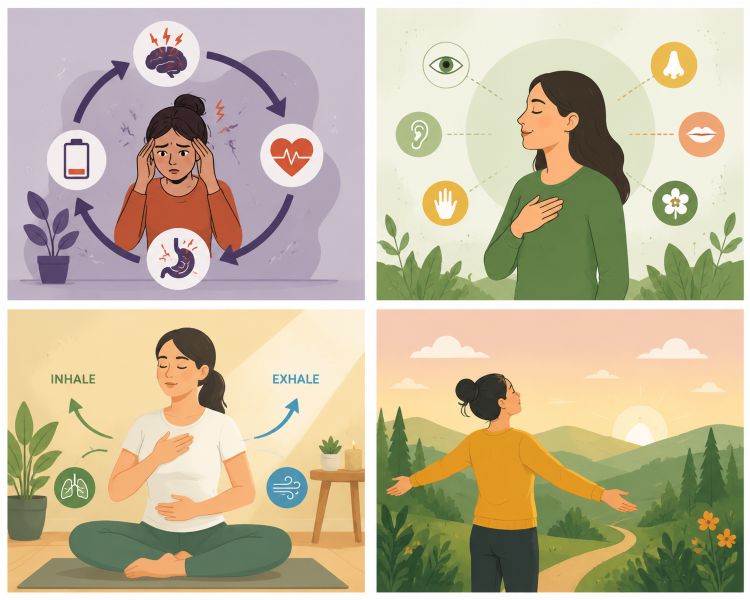
Breathing is unusual: it runs automatically, and it also accepts manual override. That makes it the most direct access you have to a system you otherwise cannot touch.
A systematic review in Frontiers in Human Neuroscience found that slow breathing at under ten breaths per minute produces consistent shifts in heart rate variability and respiratory sinus arrhythmia, alongside changes in cortical activity and reduced self-reported arousal. The physiology is not mysterious. Exhalation is when parasympathetic influence on the heart is strongest, so lengthening the exhale relative to the inhale biases the system toward the brake.
That prediction has been tested head to head. A randomized controlled study at Stanford, published in Cell Reports Medicine, compared three five-minute daily breathing protocols against mindfulness meditation over a month. The exhale-weighted protocol, cyclic sighing, produced the largest improvement in mood and the largest drop in respiratory rate, outperforming both box breathing and meditation.
Which gives you a ranked shortlist rather than a menu:
- Cyclic sighing. Two inhales through the nose, the second one shorter and topping up the first, then a long slow exhale through the mouth. One or two rounds is often enough to feel a change.
- Extended exhale. In for four, out for eight. Simpler to remember when you are not thinking clearly, whether you are trying to settle yourself after a demanding day or step away from the stimulation of an online casino such as Slotoro Casino.
- Box breathing. Four in, four hold, four out, four hold. Steadying, well suited to sustained pressure rather than an acute spike.
The NHS publishes a calming breathing exercise for stress and panic, and NHS inform has a fuller set including belly breathing and progressive muscle relaxation if the first thing you try does not suit you.
One practical caution. If controlled breathing makes you lightheaded or more panicky, stop and go back to a sensory technique instead. That reaction is not unusual, and it is not a failure. If you have a respiratory condition, check with your clinician before adopting a breathing practice.
Practice It When Nothing Is Wrong
This is the part that gets skipped, and it is most of the value.
A technique you have only ever attempted mid-panic is a technique you will not be able to execute mid-panic. Acute stress narrows attention and degrades recall, which means the moment you most need a five-step sequence is the moment you are least able to retrieve one.
So rehearse it while bored. Thirty seconds of feet-on-the-floor while the kettle boils. Two cyclic sighs at a red light. One senses scan on the walk from the car. You are not trying to feel calmer during these, because you already are. You are building the retrieval path.
Attach the practice to something that already happens daily, and it will survive. Rely on remembering to do it and it will not.
Where Self-Help Stops
Grounding manages the spike. It does not treat what is producing the spikes.
There is also a specific point here that deserves more care than it usually gets. Chest pain or tightness, breathlessness, fainting, or an irregular heartbeat should be assessed medically rather than assumed to be stress. These symptoms overlap heavily with cardiac and respiratory conditions, and “it is probably just anxiety” is a conclusion for a clinician to reach after examining you, not one to reach yourself while symptomatic. Getting it checked and being reassured is a good outcome, not a wasted appointment.
Beyond that, the National Institute of Mental Health’s guidance on stress that will not go away sets a reasonable threshold: when symptoms persist despite your own efforts, or start interfering with sleep, work, or relationships, that is the point to talk to a healthcare provider. Effective treatments exist, and they work better alongside grounding than instead of it.
Recognizing that line is a skill, not a concession.
What Grounding Is Actually For
It will not stop your body responding to stress, and any resource promising otherwise is selling something.
What it does is shorten the spike and loosen the loop. Over time, it does something more valuable, which is to reduce the fear of the next episode, because you have accumulated evidence that these states end and that you have something to do while they pass.
That is a smaller claim than most articles on this subject make. It is also true, which makes it worth more.
Disclaimer: This article is general information about stress management techniques and is not medical advice, diagnosis, or treatment. It is not a substitute for care from a qualified healthcare professional. Physical symptoms including chest pain, breathlessness, fainting, or irregular heartbeat require medical assessment and should not be self-diagnosed as stress or anxiety. Anyone whose symptoms are persistent, worsening, or interfering with daily life should speak to a doctor or mental health professional. If you are in immediate distress, contact your local emergency services or a crisis line.
References
- Harvard Health Publishing. Understanding the stress response. Harvard Medical School. Available at: https://www.health.harvard.edu/healthy-aging-and-longevity/understanding-the-stress-response
- American Psychological Association. Stress effects on the body. Available at: https://www.apa.org/topics/stress/body
- Mayo Clinic. Chronic stress puts your health at risk. Healthy Lifestyle: Stress Management. Available at: https://www.mayoclinic.org/healthy-lifestyle/stress-management/in-depth/stress/art-20046037
- Zaccaro, A., Piarulli, A., Laurino, M., Garbella, E., Menicucci, D., Neri, B. and Gemignani, A. (2018). ‘How Breath-Control Can Change Your Life: A Systematic Review on Psycho-Physiological Correlates of Slow Breathing’. Frontiers in Human Neuroscience, 12, 353. DOI: https://doi.org/10.3389/fnhum.2018.00353
- Balban, M.Y., Neri, E., Kogon, M.M., Weed, L., Nouriani, B., Jo, B., Holl, G., Zeitzer, J.M., Spiegel, D. and Huberman, A.D. (2023). ‘Brief structured respiration practices enhance mood and reduce physiological arousal’. Cell Reports Medicine, 4(1), 100895. DOI: https://doi.org/10.1016/j.xcrm.2022.100895
- National Health Service. Breathing exercises for stress. NHS Mental Health Self-Help Guides. Available at: https://www.nhs.uk/mental-health/self-help/guides-tools-and-activities/breathing-exercises-for-stress/
- NHS inform. Breathing and relaxation exercises. NHS 24, Scotland. Available at: https://www.nhsinform.scot/healthy-living/mental-wellbeing/breathing-and-relaxation-exercises/
- National Institute of Mental Health. I’m So Stressed Out! Fact Sheet. NIH Publication No. 20-MH-8125. Available at: https://www.nimh.nih.gov/health/publications/so-stressed-out-fact-sheet