
Blog
Social Casino Games in 2026: What That Coin Balance Actually Does

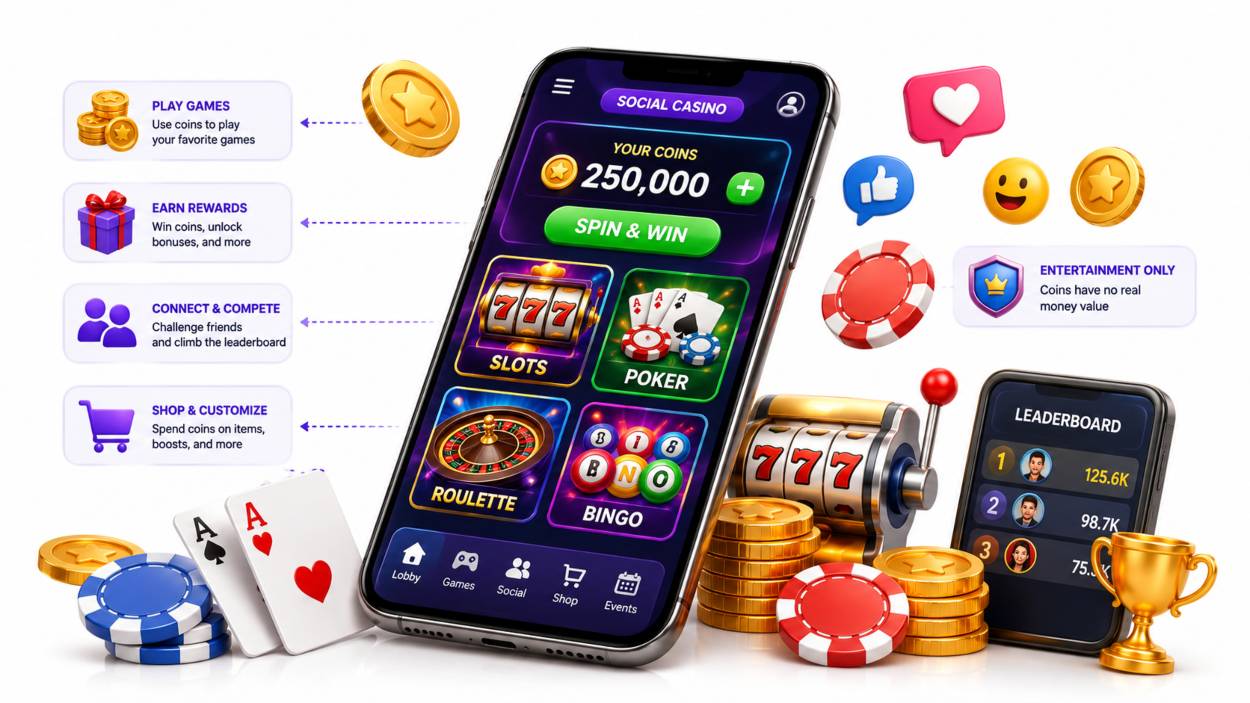
Open three casino-style apps on your phone, and they will look almost identical. Same reels. Same little thud when the symbols drop into place. Same coin icon in the corner with a number beside it that climbs and falls all session. Nothing on that screen tells you whether the number means anything once you close the app.
That gap between how these apps look and what they legally are has become the defining issue of 2026. The games have not changed much. The rules around them have changed a lot, and the labels people use to describe them have stopped matching the categories that regulators, courts, and app stores now recognize.
If you play these games, you do not need to follow the legislative back-and-forth. You need to be able to answer one question about any app you open.
One Question That Sorts the Whole Category
What does the coin do?
That is it. Everything else- the theme, the jackpot animation, the tournament ladder, the club chat- sits on top of that answer.
A coin that only buys you more spins inside the app is a ticket, like an arcade token. A coin that can be exchanged for cash, a gift card, or a prize under certain conditions is something else entirely, and it drags a long tail of age rules, identity checks, state restrictions, and tax questions behind it.
Most confusion in this space comes from people asking the wrong question first. They ask whether an app is “legit,” or whether it is “a real casino,” or whether other people have won money on it. Those questions have fuzzy answers. The currency question has a clear one, and it is usually sitting in the terms of service or the redemption page, which almost nobody reads.
Why the Labels Stopped Overlapping in 2026
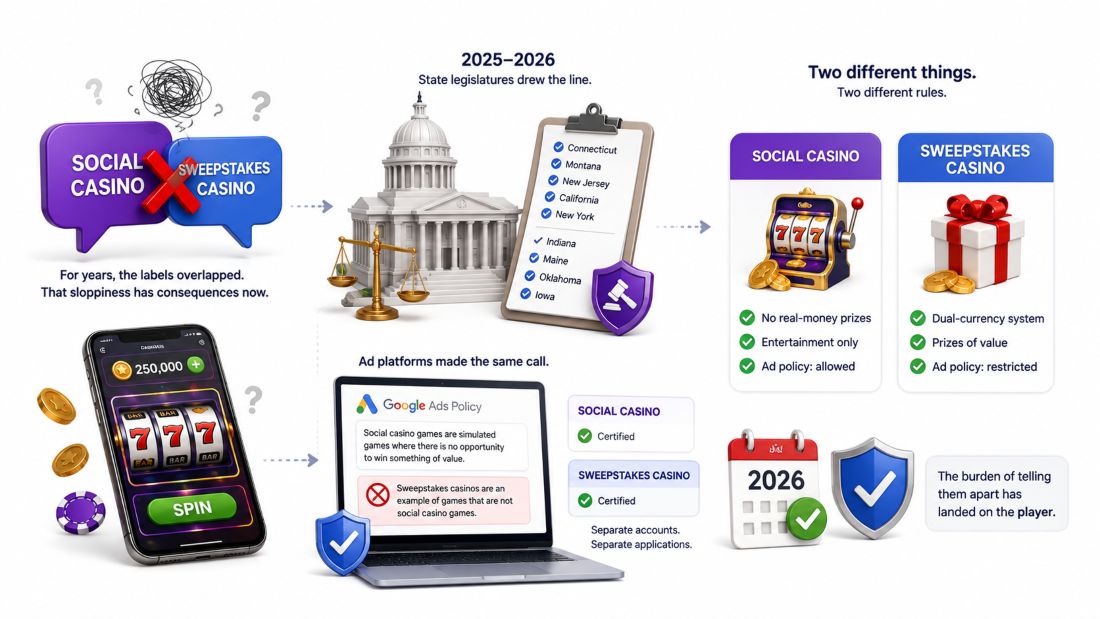
For years, “social casino” and “sweepstakes casino” got used interchangeably in app store listings, review sites, and casual conversation. That sloppiness had no consequences when nobody was enforcing anything. It has consequences now.
State legislatures spent 2025 and 2026 drawing lines through the middle of the category. A May 2026 legal analysis of sweepstakes casino legislation from Venable LLP tracks how quickly this moved: Connecticut, Montana, New Jersey, California, and New York enacted measures in 2025, and Indiana, Maine, Oklahoma, and Iowa followed with new legislation in the 2026 cycle. Maine’s LD 2007 is worth noting because of what it targets by name, which is online sweepstakes games built on dual-currency systems and casino-style simulations. New York went further and reached past operators into the supporting ecosystem, covering payment processors, geolocation providers, and media affiliates.
The more telling shift happened somewhere less obvious than a statehouse. It happened in ad policy.
Google’s advertising policy for gambling and games defines social casino games as simulated gambling-style games where there is no opportunity to win something of value. Then it adds a line that closes the door: sweepstakes casinos are given as an example of games that are not social casino games. An advertiser certified for one cannot use that certification for the other: separate accounts, separate applications.
Google did not make a moral judgment there. It made a classification decision, and it made the same one the state bills are making. When the ad platform, the legislature, and the plaintiff’s bar all independently decide that two things are not the same thing, the industry shorthand that treats them as interchangeable has run out of road.
None of this means a free coin app on your phone became gambling overnight. Most did not. It means the burden of telling them apart has landed on the player.
What a Social Casino Actually Is
Strip away the marketing and a social casino is a free-to-play mobile game that borrows casino formats for its core loop. Slots, blackjack, roulette, poker variants, bingo, keno, prize wheels, scratch-style games. You get a starting pile of virtual Currency, you spend it on rounds, and winning rounds gives you more of it.
What that Currency does not do, in a pure social casino, is leave the app. A jackpot can pay out ten million coins and still be worth exactly nothing outside the game, which is a strange thing to sit with the first time you notice it.
The “social” part is doing less work than the name suggests. On some platforms it means real social features: friend lists, clubs, gifting, chat, multiplayer tables, team events. On plenty of others it just means the game was built on a free-to-play model that happens to have originated on social networks, and the only social element left is a leaderboard you never interact with.
Machinery Behind a Session
The loop is standard free-to-play grammar, dressed in casino imagery.
You pick a game. You pick a virtual stake. Coins leave your balance. Some rounds return more coins than they took. Along the way, your play feeds a mission, a level bar, a collection album, or a tournament placement. When the balance runs low, you claim, earn, wait for, or buy more.
Swap “coins” for “energy” and “spin” for “level”, and you have most casual mobile games on the App Store. That is not an accident. The people building these apps are game designers working from the same retention playbook as everyone else in mobile.
The reward schedule is where the design effort concentrates. Daily login bonuses. Timed refills that regenerate while you are away. Consecutive-day streaks that reset if you miss one. Watch-an-ad top-ups. Friend gifts. Newsletter codes—limited-window events with their own currencies and their own leaderboards.
Each of those has a job, which is to give you a reason to open the app today rather than eventually. Knowing that does not make them less enjoyable. It does make it easier to notice when a streak counter, rather than actual interest, is the reason you are opening the app at 11:50 pm.
Games You Will Actually Find
| Game Type | What a Session Feels Like | Skill Involvement | Common Mobile Layer |
|---|---|---|---|
| Slots | Short reel rounds with themed bonus features | Low | Missions, collections, tournaments |
| Blackjack | Hand-by-hand decisions against a dealer | Moderate | Challenges, tiered tables, score events |
| Roulette | Bets placed across numbers, colors, and groups | Low | Shared tables, event rankings |
| Poker Variants | Card play against other users | Moderate to high | Clubs, chat, gifts, private tables |
| Bingo | Timed number-matching in shared rooms | Low | Themed rooms, team events, chat |
| Live Dealer | Streamed tables with a human presenter | Varies | Shared tables, dealer interaction |
| Arcade Formats | Wheels, scratch cards, crash-style games | Low | Quick missions, leaderboards |
Slots dominate for practical reasons. They need one input, they read well on a small screen, they support unlimited reskinning, and they generate clean data for mission design. A platform can build a hundred quests around spin counts, symbols collected, and features triggered without touching the underlying math.
Table games behave differently. Blackjack in a social app may use different deck counts, payout structures, and side-bet rules than a regulated table, so the muscle memory you build is only partly transferable. Poker rooms tend to carry the strongest community features, and for a lot of users the club and the chat are the actual product.
Live dealer streams show up on some platforms, and they are the easiest place to lose track of what you are playing with. A human dealer on a real table shuffling real cards makes the whole thing feel monetary. Ask the currency question anyway.
Reading a Two-Currency App Without Getting Lost
Sweepstakes platforms typically run two balances. One is for ordinary play and cannot be redeemed. The other is promotional, obtained through bonuses, mail-in entry, or bundled with purchases, and it is the one that can potentially convert into a prize.
The naming is not standardized and is not a reliable signal. Gold Coins, Sweeps Coins, SC, Tokens, Credits, Chips, or something invented for the brand. Two apps can use the same word for two different things.
Read the mechanics instead:
- How is each balance obtained, and is a purchase required for either
- Is there a genuine free alternative method of entry, and how burdensome is it
- Which balance is eligible for redemption
- What is the minimum redemption threshold
- Is there a playthrough requirement before redemption unlocks
- What identity verification is triggered, and at what point
- Which states or regions are excluded
- How long does prize processing actually take
A platform that answers all of that clearly before you spend anything is telling you something useful about how it operates. A platform that buries it, or that answers only after you have deposited, is also telling you something.
Three Models Wearing the Same Interface
| Social Casino | Sweepstakes Casino | Real-Money Casino | |
|---|---|---|---|
| Core Purpose | Free-play entertainment | Promotional play with possible prize redemption | Wagering deposited funds |
| Typical Currency | Nonredeemable virtual coins | Play currency plus promotional currency | Cash or cash equivalent |
| Direct Cash Wagering | Generally no | Depends on model and currency | Yes |
| Redeemable Prizes | Generally no | Possible for eligible users | Yes |
| Optional Purchases | Common | Common | Deposits and wagers |
| Identity Checks | Varies by platform | Common before redemption | Standard |
| Geographic Limits | Varies by platform | Frequently apply | Set by licensing and local law |
| Governing Framework | Casual and social gaming | Sweepstakes, gaming, and state law | Regulated gambling law |
The economics behind each row differ more than the table suggests. A social casino makes money selling entertainment time. A real-money operator makes money on the house edge, and its loyalty programs are calculated from wagered volume rather than deposit size, which is why two players who deposit the same amount can end up with wildly different reward totals.
That distinction trips people up constantly. Adults comparing real-money reward structures can use a Rainbet monthly bonus calculator to model an estimated monthly return from inputs like wager amount, game category, bonus period, and whether the account finished up or down. It produces an estimate built on observed data, not a promised payment, and Eligibility, regional access, and operator terms all still need checking directly. The point is structural: a free coin package and a rakeback program are not two versions of the same offer.
Purchase Is the Line, Not the Play
The long-running argument about whether social casinos lead people into real-money gambling usually gets framed around the games themselves. The research points somewhere more specific.
A six-month study following social casino players who had never gambled online found that roughly 26 percent had started gambling online by the follow-up. The finding that matters most is which variable predicted it—not time spent playing. Not motivation to build skill. Not self-enhancement. The single unique predictor was whether the player had made in-game purchases.
That reframes the practical advice considerably. Spinning free reels for an hour is a different behavior, statistically speaking, from tapping “buy coins” once. The purchase is where the relationship with the app changes, because it establishes that the balance is worth spending money on. Once that premise is in place, the leap to a platform where the balance is worth actual money is a much shorter one.
None of which makes a coin package dangerous by itself. It does mean the first purchase is a more meaningful moment than it feels like at the time, and it is worth noticing when you make it.
Why Winning for Free Teaches the Wrong Lesson
Free play gets defended as practice. You learn the interface, the terminology, the rhythm of a hand. Some of that holds up.
The math does not. Researchers who audited the demo versions of online casino games found that 39 percent of the 117 sites they visited ran payout rates above 100 percent during the free demo period, meaning players were winning more than they wagered. Those rates did not survive the switch to real money.
A payout rate over 100 percent is not a generous game. It is not a game at all in any commercial sense, since no operator could sustain it. It is an onboarding sequence, and its purpose is to leave you with a feeling of competence before the actual odds apply.
Social casinos are not required to publish return figures, and their coin economies are tuned for session length and retention rather than for accuracy to any real product. So a winning streak in a free app tells you that the app wanted you to have a winning streak. It tells you nothing about a machine you have not played.
What Free-to-Play Actually Costs
The price tag is real even when the download is free, and it shows up in two currencies: money and attention.
On money, the risk is not the single $4.99 package. It is that virtual coin pricing is deliberately hard to reason about. Buying nine million coins for $19.99 gives you no intuitive sense of what you spent, because the units on both sides of the transaction are incomparable. Track the dollars, not the coins. Three months of small purchases add up to a number most people would not have agreed to in advance.
On attention, interface design does real work. The FTC’s report on manipulative design practices catalogs the specific techniques that show up across app categories, including countdown timers on offers that are not actually limited, and purchase flows arranged so a mistake costs money. Casino-style apps are not uniquely guilty here, but they combine those patterns with variable-reward mechanics, which is a potent mix.
A few things follow from this:
- Expiring offers are a design choice, not a deadline. The same package will come back.
- Running out of coins is not a loss. There is nothing to recover. The balance was never worth anything, which is the entire premise of the format.
- Turn off one-tap purchasing. Requiring a password or biometric confirmation adds two seconds of friction, and two seconds is often enough.
- Watch for the tell. Chasing a balance, hiding what you spend, or playing past a limit you set are the same warning signs in a free app as anywhere else. The absence of a cash wager does not make them meaningless.
Who These Games Are Built For, and Who They Are Not
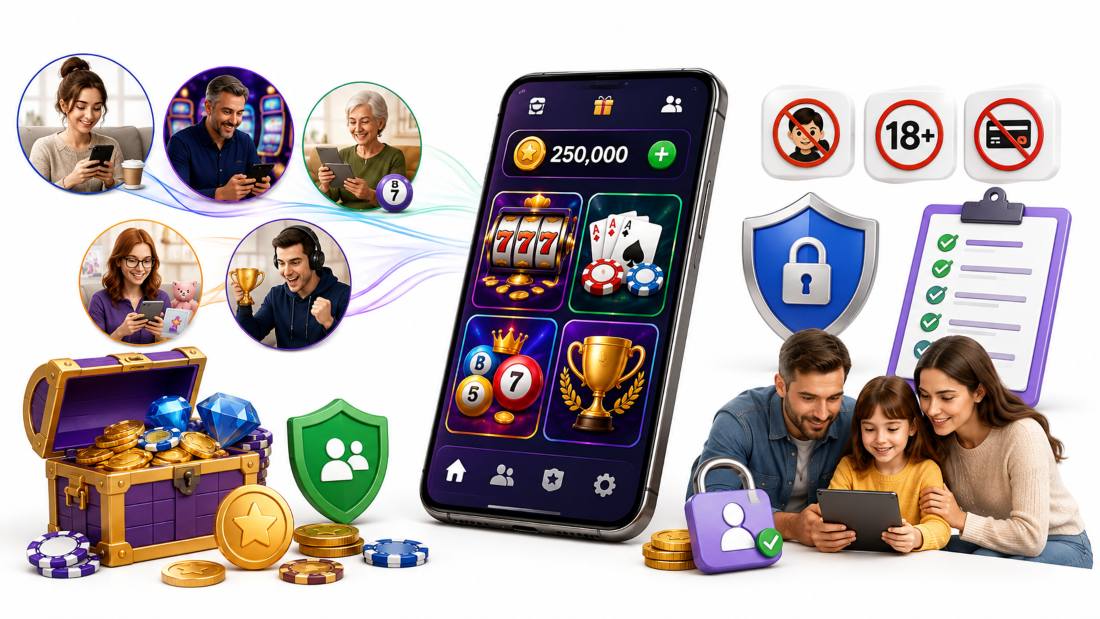
The audience is broader than the stereotype. Casual players filling ten-minute gaps. Casino-game fans who have no interest in wagering cash. Bingo and poker players who came for the room and stayed for the people. Collectors chasing album completion. Competitive players working leaderboards.
Age is where the picture gets more serious, and both major app stores treat it that way. Apple’s App Store Review Guidelines cover gambling, gaming, and lotteries as one of its most heavily regulated categories, with age rating and licensing requirements that apply to simulated gambling as well as the real thing. Google Play’s real-money gambling and contests policy bars apps that do not meet its eligibility requirements from carrying simulated gambling content or gambling ads at all.
The caution is well founded. Research on adolescents who play and spend money in simulated gambling games has found that these products disproportionately attract young people already vulnerable to gambling problems, and that real-money spending inside them is associated with heightened risk. The virtual Currency does not neutralize the mechanic. A child learning that near-misses feel like progress is learning the same lesson either way.
Parents sharing a device should assume casino-style apps are not appropriate for kids regardless of what the coins are worth, and should check that purchase authorization is not saved on the account.
Choosing a Platform: What to Actually Check
| Check | Why It Matters | What Good Looks Like |
|---|---|---|
| Currency Explanation | Determines everything else | Every balance defined before you play |
| Purchase Controls | Keeps spending visible | Easy limits and accessible purchase history |
| Redemption Terms | Essential for sweepstakes play | Full rules shown before participation, not after |
| Mobile Performance | Affects basic usability | Fast loads, readable controls, no mistap-prone layouts |
| Age Policy | Signals how seriously the operator takes it | Eligibility stated plainly and enforced |
| Privacy Settings | You are handing over data either way | Clear permissions, real account options |
| Notification Controls | Determines who sets your schedule | Promotional alerts can be switched off separately |
| Community Tools | Matters in chat-heavy formats | Working mute, block, and report functions |
| Support Access | You will need it eventually | A real channel and a published policy |
Test a few games before spending anything. Check whether buttons respond where you expect, whether the active Currency is displayed at all times, and whether the app makes it easy or awkward to find the terms.
Browser versions are worth considering if you would rather not install anything. Native apps usually run smoother and integrate better with the device, but review the permissions they request and the notifications they enable by default.
Habits That Hold Up
- Decide on the model before you pick a platform. Free-play entertainment, sweepstakes participation, or regulated real-money gambling are three different decisions with three different risk profiles. Choosing one first makes it easy to close the tab on anything that does not match.
- Read every balance in the account. Free, purchased, promotional, redeemable, or none of the above. If you cannot label each one, you do not know what you are playing.
- Set an entertainment budget, in dollars. Not in coins. A number that would not matter if it disappeared, because it might.
- Treat an empty balance as the end of the session. It is the most reliable natural stopping point these games offer, and buying past it is how casual spending turns into a pattern.
- Keep free results and real expectations in separate boxes. A virtual jackpot predicts nothing. Casino games are built with a mathematical edge for the operator, and no reward program or system changes that.
- Know where the support is. Anyone worried about their own gambling or someone else’s can reach the National Problem Gambling Helpline at 1-800-MY-RESET. It runs 24/7 by call, text, or chat, and connects people to local resources across all 50 states and US territories.
If You Start Thinking About Real Money
Some players do move from free-play apps to real-money platforms. That should be treated as a separate decision made from scratch, not as the next tier of something you are already doing.
Real-money play adds deposits, withdrawal conditions, payment methods, location verification, identity checks, and operator-specific terms that vary considerably. Comfort with an interface is not control over an outcome. The reels do not know how many free spins you have logged.
Bonus programs are the part most likely to be misread. A headline percentage tells you almost nothing on its own, because the real value depends on wagering requirements, game contribution rates, account level, timing, and regional Eligibility. A 200 percent match with a 40x playthrough on deposit-plus-bonus can be worth less than a modest weekly rakeback. Adults comparing those structures can review current bonus tools, live code drops, and casino analytics at Fair Gambling before committing to anything, keeping in mind that offers change and every promotion still needs checking against the operator’s current terms.
And the underlying fact does not move: real-money gambling is paid entertainment with a genuine chance of losing everything wagered. It is not an income strategy, and treating it as one is the single most expensive mistake available in this category.
Where Things Stand Legally in the US
Pure free-play games using nonredeemable coins are generally treated differently from gambling. The analysis gets complicated as soon as a platform introduces redeemable prizes, promotional Currency, purchases tied to gameplay, or sweepstakes mechanics.
Nothing here is uniform across states, and it is actively changing. Enacted laws, pending bills, enforcement actions, and platform-level exclusions are all moving at once, which is why a claim that any category is “legal nationwide” should be treated as marketing rather than information.
Before playing on anything with a redemption feature, check the platform’s excluded jurisdictions, your state’s current rules, the minimum age, how promotional Currency is actually obtained, what verification is required, and the operator’s current terms. Being able to load an app from your location does not establish that every feature is permitted there.
Getting Free Coins Without Getting Burned
Most social casinos give you plenty of ways to keep playing without paying: daily logins, timed refills, beginner missions, level rewards, free tournaments, friend gifts, newsletters, verified social channels, optional ad views, and seasonal events.
What to avoid is more important than what to chase. Coin generators do not exist. Modified APKs are a common malware vector. Any site asking for your account credentials in exchange for Currency is phishing, without exception, and no legitimate promotion has ever required your password.
Promo codes should come from the operator’s own channels or from sources that publish current terms and dates. Codes expire, apply to specific accounts, or exclude regions, and a code that “still works” months after posting usually never did.
What to Take Away
Social casino games can be a genuinely good way to spend fifteen minutes. Slots, card rooms, bingo halls, collections, and clubs, without wagering a cent. That version of the product is fine, and plenty of people enjoy it for years without incident.
The thing worth carrying into 2026 is that the interface is no longer a reliable guide to what you are using. Three legally distinct products are shipping in nearly identical packaging, and the boundaries between them are being redrawn by legislatures and ad platforms faster than the marketing language has adapted.
So before the first spin: identify the Currency, confirm whether purchases are optional or load-bearing, check the age and location rules, and decide how much time and money the session gets.
The best platform is not the one with the biggest welcome balance or the loudest promotion. It is the one that tells you exactly what its coins are worth before you have any reason to ask.
Social Casino Games FAQs
| Question | Answer |
|---|---|
| What is a social casino game? | A casino-style digital game played with virtual currency. It may include slots, blackjack, poker, roulette, or bingo. In a pure social casino, any winnings remain inside the game and cannot be withdrawn or exchanged for real money. |
| How do social casino games work? | Players receive or collect virtual coins and use them to play. Coins are earned through starting balances, daily rewards, missions, level-ups, tournaments, friend gifts, and optional in-app purchases. |
| Are social casino games free? | Most social casino games are free to start and continue providing free virtual currency. Optional purchases can extend playtime, unlock special events, or allow higher virtual stakes. |
| Can you win real money at a social casino? | No, not in a pure social casino. Virtual winnings cannot be redeemed for cash. Some sweepstakes platforms use a separate promotional currency that may qualify for prize redemption under specific terms and conditions. |
| What is the difference between a social casino and a sweepstakes casino? | A social casino uses non-redeemable virtual currency for entertainment only. A sweepstakes casino typically operates with two currencies, one of which may be redeemable for prizes, subject to eligibility requirements. They are treated as separate categories under Google’s advertising policies and in many state regulations. |
| How do social casinos make money? | Revenue commonly comes from virtual coin packages, subscriptions, advertising, event passes, cosmetic items, gameplay boosters, and content partnerships. |
| Can I play on mobile? | Yes. Most social casino games are available on iOS and Android through dedicated apps or mobile browsers. Features, performance, and account synchronisation may vary by platform. |
| Are social casino games legal in every US state? | It depends on the platform’s business model. Free-play social casinos with non-redeemable virtual currency are generally treated differently from sweepstakes or real-money gambling platforms. State laws continue to evolve, so users should review current local regulations and platform restrictions. |
| Are social casino prizes taxable? | Tax treatment depends on the type and value of the prize, your location, and applicable tax laws. If you receive redeemable prizes, keep accurate records and seek professional tax advice when appropriate. |
| Do social casinos require a deposit? | Pure social casinos generally do not require a deposit. They may offer optional virtual coin purchases. Sweepstakes and real-money gambling platforms have separate funding, eligibility, and redemption requirements. |
This article is for general information and does not constitute legal, financial, or gambling advice. Platform features, bonus terms, geographic availability, and applicable laws change frequently. Real-money gambling is for adults who meet local age and eligibility requirements. Play responsibly and never wager money you cannot afford to lose.