
Blog
Custom CRM Development Company: How to Choose One Without Repeating Everyone Else’s Expensive Mistake

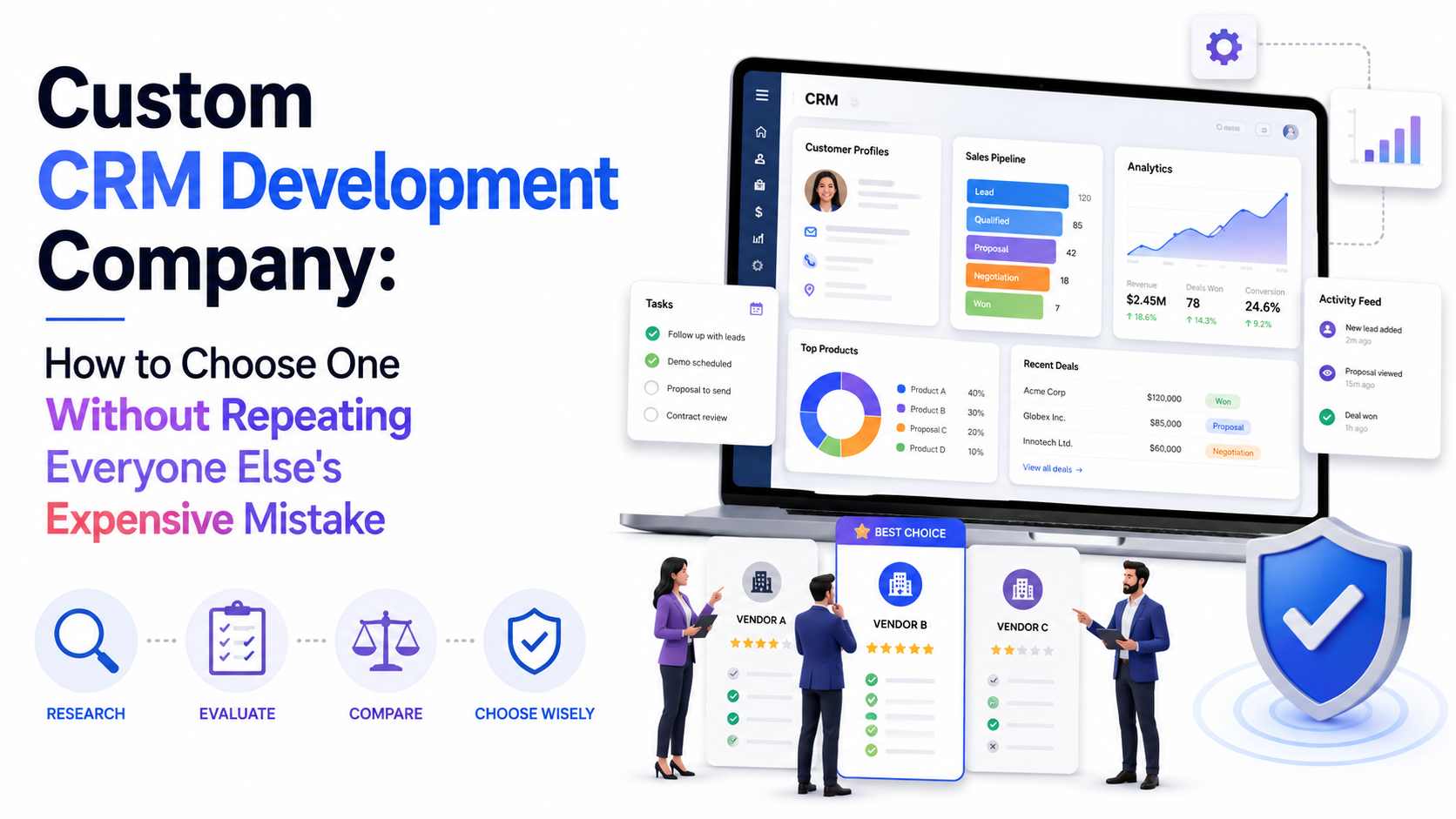
Here’s something nobody tells you before you sign a CRM contract. The majority of companies do not fail at CRM because they choose poor software. They failed because they chose a generic platform, spent a year discreetly modifying their sales procedure to fit it, and ultimately created a system that everyone uses but no one genuinely trusts. A good custom CRM development company flips that whole arrangement. The system gets shaped around how your team actually sells. Not the other way around.
That sounds like a small distinction. It isn’t. I’ve watched sales teams revolt against a perfectly functional CRM within four months simply because it forced them to record deals in a sequence that didn’t match reality. Once reps stop trusting the data, they stop entering it honestly, and a CRM running on dishonest data is worse than no CRM at all.
CRM data touches everything downstream. Forecasting, commission calculations, leadership reporting, and even how marketing decides where to spend next quarter’s budget. Get the foundation wrong, and every team built on top of it inherits the problem.
What Does a Custom CRM Development Company Actually Build?
In this sector, the term “custom” is used loosely, so let us be clear about that initially. It is not customary to add a few extra fields to Salesforce. That configuration is dressed more elegantly.
Instead of using someone else’s template, a true custom CRM begins with the data model itself. The structure, which includes the elements that do not fit neatly into a typical pipeline diagram, represents how your company truly handles interactions and closes sales.
63% of sales teams utilizing packaged platforms routinely circumvented the system rather than working through it, according to Forrester’s 2023 CRM industry research. Read that Number again. Nearly two out of three teams have basically given up on their own CRM and built a shadow process next to it.
A development team approaching this correctly doesn’t start by asking which fields need configuring. They ask how a deal actually moves from first contact to signature in your specific business, what makes a stage change happen, and where the current process quietly falls apart under real pressure. Those are different questions, and they produce a different kind of software.
Five Signs Your Business Has Outgrown Packaged CRM Software
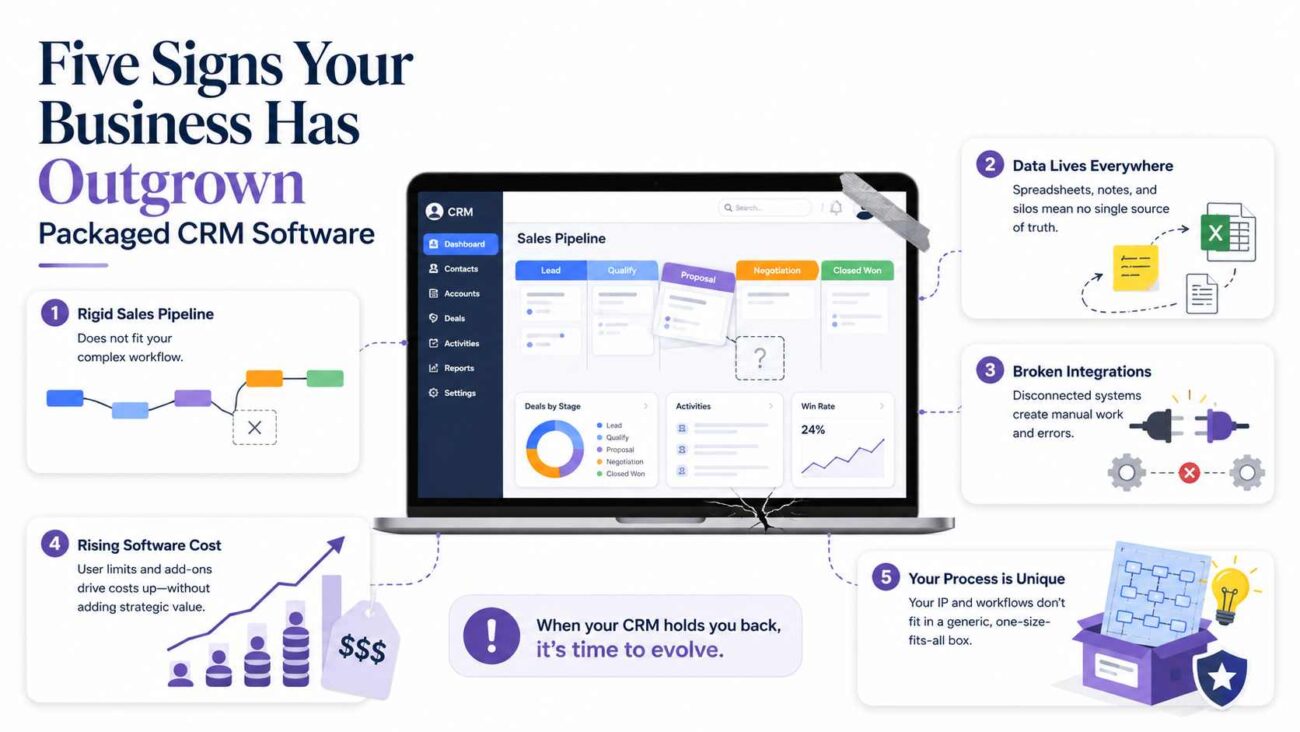
HubSpot, Pipedrive, and Salesforce. Most businesses begin with one of these, and to be honest, it is usually the best decision in the beginning. This is where the computation begins to change.
Standard stages do not neatly correspond to your sales process. Multiple decision-makers working on distinct deadlines, parallel approval tracks, and bending rather than straight-line contract structures. If this seems similar, you are trying to shoehorn your company into an unsuitable form.
The second sign shows up as fragmentation. Account managers keep separate spreadsheets for contract terms, renewal triggers, and relationship history. Not because they’re lazy, but because the CRM genuinely has nowhere to put that information. Once that happens, the CRM has quietly stopped being the source of truth, even though everyone still calls it that in meetings.
Integration friction is the third one, and it’s brutal in manufacturing and professional services, especially. Custom quoting engines, unusual billing structures, and compliance systems built for one regulatory environment. Packaged CRMs handle the common stuff fine. The specialized stuff is where things break.
Then there’s cost. Per-seat licensing on enterprise platforms gets painful past a few hundred users, particularly when half those seats are doing basic activity logging that never needed enterprise pricing in the first place.
The fifth one matters more than people give it credit for. If how your team qualifies leads or structures a proposal is part of why you actually win deals against competitors, that process is intellectual property. It shouldn’t be sitting inside a vendor’s generic platform where it works the same as every competitor using the same tool.
How a Custom CRM Development Project Actually Unfolds
There’s a gap between what gets promised in the sales pitch and what actually happens once the contract is signed. That gap is where most projects either quietly succeed or expensively fail.
Discovery is where the real work lives, and it takes longer than companies want it to. A capable team spends four to eight weeks digging into not just the documented sales process, but the exceptions living in individual reps’ heads. The deal closed differently because of an unusual client relationship. The approval step exists purely because something went badly three years ago, and nobody has removed it since. These details are tedious to surface, and they’re exactly what determines whether the finished system reflects reality or just a diagram of it.
Architecture decisions made in month one shape everything that comes after. Relational database or a more flexible document structure? Constructed API-first for unplanned integrations or closely linked to current requirements? These decisions demand more attention than they often receive since they are tedious to explain and costly to make incorrectly.
Almost always, a staggered rollout outperforms a single, major launch. For the majority of mid-sized teams, core contact management, deal tracking, and basic reporting will be live in two to four months. Once users are actually utilizing the system on a regular basis, forecasting tools and sophisticated automation will be added. You learn more from three weeks of real usage than from three months of speculation about what users might need.
What Custom CRM Development Actually Costs
Costs swing widely depending on user count, integration complexity, and how much custom logic your sales process actually requires.
| Cost Component | Typical Range | Primary Driver |
| Discovery and Process Mapping | $12,000 to $35,000 | Sales process complexity, stakeholder interviews |
| Core Platform Development | $60,000 to $250,000 | User count, custom workflow logic, reporting depth |
| Third Party Integrations | $5,000 to $40,000 | Number of connected systems, API quality |
| Data Migration | $8,000 to $45,000 | Volume and cleanliness of existing data |
| Training and Adoption | $6,000 to $25,000 | Team size, change management investment |
| Year One Maintenance | 15 to 18% of build cost | Bug fixes, enhancements, security updates |
Data migration is where most clients get caught off guard. Years of accumulated CRM data tend to be a mess underneath the surface. Duplicate contacts, inconsistent naming, deals logged with half the fields blank. A proper data audit before migration starts catches most of this while it’s still cheap to fix, rather than after it’s already broken something in production.
What Separates a Strong Development Partner From a Risky One
Writing code well is common enough. Understanding the sales process well enough to build something a sales rep actually wants to open every morning is rarer than it should be.
If a vendor proposes a solution architecture in the first meeting, before they’ve asked a single question about how your deals actually move, walk away. That’s a generic build with a custom label stapled to it.
Industry experience counts for more in CRM work than people assume going in. A firm that has built systems for complex B2B sales cycles already understands multi-stakeholder deal structures without you needing to explain them from scratch. A firm whose background is consumer CRM tools will bring assumptions that don’t transfer.
The partners worth hiring talk about adoption with the same seriousness they bring to architecture. A flawlessly engineered CRM that reps quietly abandon within a quarter has failed, full stop, regardless of how clean the codebase is.
Integration Architecture: Where Custom CRM Systems Earn Their Cost
The majority of expanding businesses utilize their CRM in conjunction with marketing automation, an ERP or accounting system, support software, and more and more AI communication tools. Whether your team trusts the figures or spends Friday afternoons reconciling spreadsheets that should already agree depends on how well those systems communicate with one another.
This is handled differently by custom development than by packaged platforms that rely on third-party app markets. The integration layer gets designed around your specific systems from the first sprint, instead of being bolted on later through a generic connector that breaks every time a vendor pushes an update.
A professional services firm connecting its CRM to a project management tool with unusual billing logic doesn’t need a generic Zapier-style connector here. It needs something built to understand exactly what should happen the moment a deal closes and a project kicks off, with every relevant field transferring the first time correctly, not the third time after someone notices the data is wrong.
Industry Considerations Development Partners Often Underscope
Tight integration with quotation engines, multi-step approval chains for large orders, and real-time inventory visibility are typically required by manufacturing and distribution companies so that representatives may quote against actual stock rather than numbers that went stale yesterday.
Since the majority of the real value is found in long-term account relationships rather than a single transaction, professional services firms require relationship tracking that continues long after the close date. Revenue forecasting tied to project milestones rather than just close dates matters here, and it’s something most packaged CRMs handle badly.
Healthcare and other regulated industries need careful handling of any patient or member data touching the CRM, with audit trails and access controls that satisfy compliance requirements most standard platforms weren’t designed around.
Real estate and high-value asset sales need long relationship timelines tracked alongside complex property data, built for sales cycles that genuinely run for months, not the thirty-day pipeline most CRM software assumes by default.
First Six Months After Launch Matter More Than the Build Itself

A CRM that launches cleanly and then gets quietly ignored within ninety days has failed. It doesn’t matter how good the engineering was. Adoption is the actual finish line here, not go-live day.
Sales representatives returning to spreadsheets or personal notes because the new technology felt like extra labor rather than something that made their job easier is the most frequent failure I have observed. Preventing that requires actual training, not just one onboarding session, as well as leadership conduct that makes it clear that using this tool is required.
Data quality issues testing missed will surface in the first few weeks of actual use. Duplicate contacts. Stage definitions: two teams. Reports that don’t quite match what leadership expected to see. None of this is unusual. Budget for thirty to sixty days of active developer support after launch instead of treating go-live as the end of the engagement.
Conclusion
It essentially boils down to one question when choosing a custom CRM development company: Is your sales process unique enough to warrant software designed around it, or is it generic enough that your team can continue using someone else’s template? Businesses that truly benefit from this approach regard adoption as a component of the project rather than something to worry about afterward, take discovery seriously, and select a partner who is already familiar with their industry. Seldom does software fail on its own. Someone is earlier shortcut, generally one that seemed harmless at the time, is the reason it fails.