
Blog
Why No-Download Casino-Style Games Keep Casual Players Engaged


Casual players usually make fast decisions. If a game feels slow to load, confusing to enter, or too demanding before the first real interaction, many users leave before the platform has had a genuine chance to win them over. This is one of the core reasons why no-download gaming has become so effective at retaining casual audiences. It removes the extra steps that most commonly get in the way of quick, uncomplicated entertainment.
That matters even more in casino-style gaming, where the typical user is not looking for a lengthy setup process. They want something immediate, visually familiar, and easy to understand from the very first screen. This is especially true for casino-style games for beginners, where simple interfaces, clear instructions, and quick-start options help new users feel comfortable right away. When an experience opens quickly and clearly communicates what to do next, users are far more likely to stay engaged and return later.
This is precisely why browser-based casino-style games continue to appeal to such a wide audience. The attraction is not simply the visual format or the game mechanics. It is the ease of entry. When users can move from curiosity to active play without navigating downloads, software installs, or technical friction, the platform feels immediately more approachable.
How Fast Access Changes First Impressions in Online Gaming
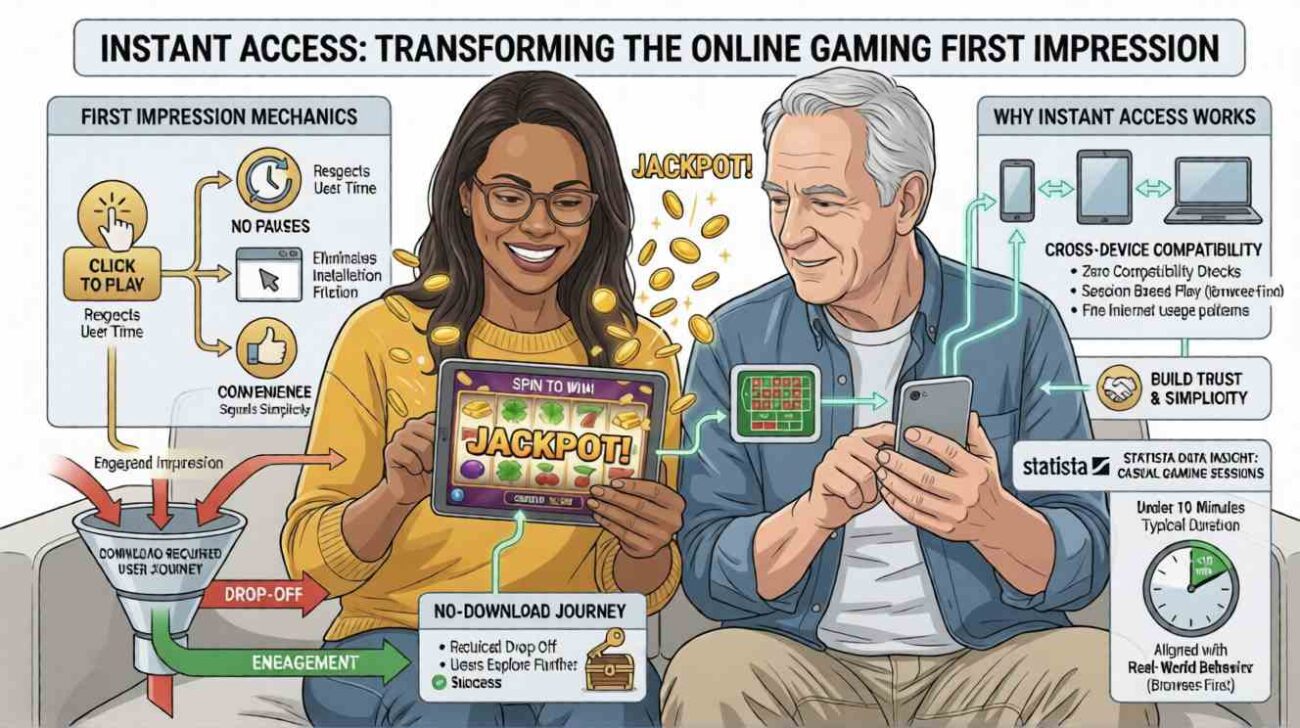
The first few seconds of any digital experience carry enormous weight. Users quickly form an opinion about whether a platform feels convenient or unnecessarily demanding. A no-download format creates a strong first impression precisely because it respects the user’s time. There is no extra software to manage, and there is no significant pause between clicking a link and starting to play.
Why Instant Access Creates a Meaningful Engagement Advantage
- Eliminating the download step removes one of the most common drop-off points in the early user journey.
- Browser-based access works across devices without requiring compatibility checks or installation permissions.
- Users who encounter zero friction in the first interaction are significantly more likely to explore the platform further.
- No-download platforms load within existing browsing sessions, fitting naturally into how people already use the internet.
- A fast, clean entry experience signals that the platform values simplicity, which immediately builds trust with new users.
Many casual players play in short bursts throughout the day. They may have a few free minutes during a break, or they may want light entertainment without turning it into a project. According to Statista’s digital media engagement research, casual gaming sessions typically last under 10 minutes, confirming that browser-first platforms are far better aligned with real user behaviour than those that require pre-session setup.
Why Casual Players Prefer Low-Friction Gaming Routines
A great deal of digital entertainment becomes stronger over time as it becomes a habit. That habit is considerably easier to build when the platform feels light and effortless to return to. Users are more likely to come back when they know they can quickly reopen the experience, understand what is happening immediately, and pick up where they left off without relearning.
In that sense, no-download gaming is not only about access. It is fundamentally about repeatability. The easier a platform is to revisit, the more frequently it appears in a user’s casual routine, and the stronger the engagement loop becomes over time.
Features That Make Casino-Style Formats Ideal for Casual Routines
- Short, self-contained sessions allow players to engage meaningfully without committing large blocks of time.
- Familiar visual loops and clear interaction patterns reduce the cognitive load required to enjoy each session.
- Consistent visual feedback and reward signals make it easy for users to understand progress without having to read lengthy instructions.
- Session-to-session continuity encourages repeat visits by fostering a sense of ongoing familiarity with the platform.
- Simple navigation between game types lets casual players explore the variety without feeling overwhelmed.
How Simplicity Helps New Players Feel Comfortable and Confident
New players rarely want to feel like they need a user manual before they can start enjoying themselves. They want to understand what the game is, what the basic interaction looks like, and whether the experience feels worth returning to. Simplicity answers those questions early and effectively. It lowers hesitation, reduces intimidation, and makes the whole platform feel far more welcoming from the outset.
What Beginner-Friendly Design Actually Looks Like in Practice
- Clear visual hierarchy that communicates the most important interaction without requiring the user to search for it.
- Minimal onboarding steps so that new users reach the core experience as quickly as possible.
- Readable in-game feedback that explains outcomes without requiring prior familiarity with the format.
- Consistent interface patterns that feel intuitive after only one or two sessions, reducing the learning curve significantly.
- Optional guidance rather than mandatory tutorials, giving confident users the freedom to explore at their own pace.
The Nielsen Norman Group’s research on user experience consistently finds that users form lasting impressions of a digital product within the first few interactions. A no-download platform that makes the early experience readable and low-effort gives itself the best possible chance of converting a first-time visitor into a regular user. Once players feel comfortable, they become considerably more open to exploring the full range of what the platform has to offer.
Why Short Gaming Sessions Can Still Deliver Genuine Satisfaction
A common assumption in digital product design is that longer sessions indicate stronger engagement. For casual audiences, this is frequently not the case. Short sessions can be just as meaningful, and in many contexts more sustainable, than extended play. A few genuinely enjoyable minutes are often enough to build familiarity, establish a positive association with the platform, and make a return visit feel worthwhile.
How Casino-Style Formats Are Built for Short-Session Engagement
- Each session has a clear beginning and end, which makes short play windows feel complete rather than interrupted.
- Visual feedback is immediate and easy to read, so users experience a sense of activity and response even in brief sessions.
- The rhythm of play in casino-style formats does not require deep concentration to feel engaging or satisfying.
- Players can close and return to the experience without losing context, making casual revisits straightforward.
- Short sessions that feel rewarding reduce the pressure associated with longer-form gaming commitments.
Research from the American Psychological Association on habit formation highlights that consistent, low-effort repetition is far more effective at building lasting habits than infrequent high-investment sessions. This principle applies directly to casual gaming platforms: a five-minute session that leaves the user satisfied is more valuable to long-term engagement than a longer session that feels demanding or inconclusive.
Why Accessibility Consistently Outperforms Complexity for Casual Audiences
Many digital entertainment products continue to compete by adding more layers, more mechanics, and more decisions for users to navigate. For casual players, this approach frequently backfires. Accessibility is the stronger advantage. If a platform feels easy to enter and easy to return to, it has a far better chance of becoming part of a user’s routine. Complexity only adds genuine value once the player has already reached a point where it feels enjoyable rather than overwhelming.
Why the Low-Friction Approach Keeps Growing in Popularity
- Removing barriers at the point of entry solves the most immediate problem casual users face: getting started quickly.
- Platforms that respect the user’s time by minimising setup steps signal that the experience is designed around player convenience.
- Accessible interfaces allow a much broader demographic to engage, including users with limited technical confidence.
- Simple platforms are easier to recommend, share, and return to, which supports organic growth through word of mouth.
- Low-friction design reduces the cognitive cost of choosing to engage, making the platform a natural default during idle moments.
The UK Gambling Commission’s guidance on responsible online gaming also recognises the importance of clear, transparent design in making gaming environments more navigable for all users. Platforms that prioritise clarity and ease of use serve their audiences more responsibly, as users are better able to understand what they are engaging with and make informed decisions throughout their experience.
How No-Download Gaming Fits the Way People Already Use the Internet
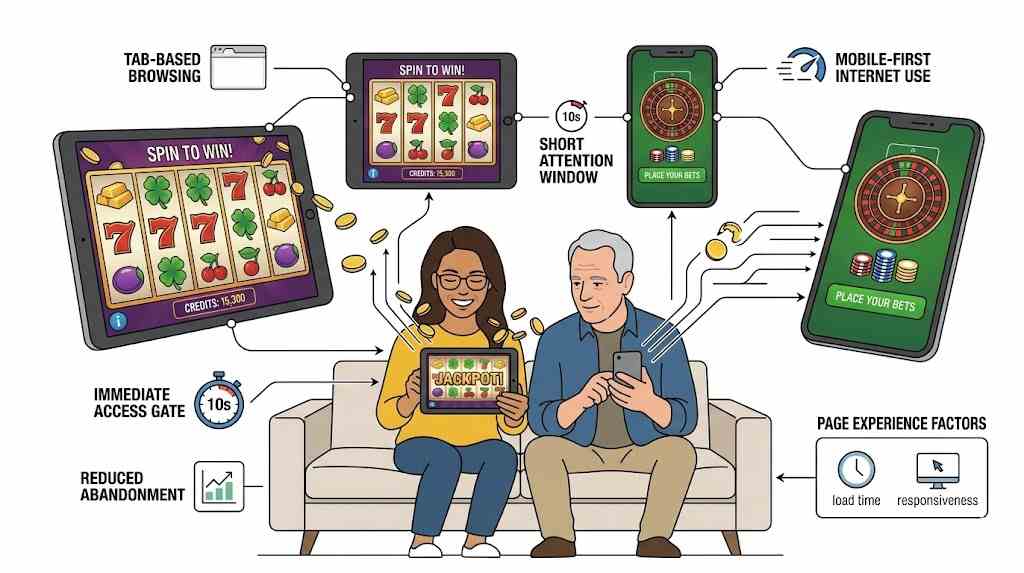
The broader reason no-download gaming platforms continue to perform well is behavioural alignment. People already move through the web in short, purposeful bursts. They open tabs, try new things quickly, and decide within moments whether something feels worth returning to. A no-download gaming experience fits that pattern naturally, without asking users to change their habits to participate.
Behavioural Patterns That No-Download Platforms Are Built Around
- Tab-based browsing means users expect to access new content instantly, without interrupting their existing session flow.
- Mobile-first internet use prioritises speed and responsiveness, both of which no-download platforms are well positioned to deliver.
- Short attention windows during browsing mean that the first ten seconds of an experience are disproportionately important.
- Users who discover a platform through social sharing or search expect immediate access, not a download gate.
- The absence of account creation or software requirements significantly reduces abandonment at the discovery stage.
According to Google’s research on page experience and user behaviour, load time and responsiveness are among the most significant factors in whether a user stays on a page or leaves immediately. This reinforces why no-download casino-style platforms have a structural advantage: they meet users where they already are, within the browser, and deliver the experience without asking anything extra in return.
This same low-friction philosophy also appears in broader browser gaming guidance and practical play resources, where the consistent focus is on helping users enjoy gaming more easily rather than making it feel harder or more complicated than it needs to be.
Conclusion
No-download casino-style games continue to grow in popularity, not because they are technically superior to other formats, but because they are behaviourally superior for casual audiences. They meet users at the moment of curiosity, remove every unnecessary obstacle between that moment and the first interaction, and deliver experiences that fit naturally into the short, fluid browsing sessions that define how most people use the internet today.
For casual players, accessibility is not a compromise. It is the feature. A platform that opens instantly, communicates clearly, and makes returning effortless has already solved the hardest problem in digital entertainment: making itself worth coming back to. No-download gaming does exactly that, and it is why this format will continue to attract and retain casual audiences well into the future.
Whether you are a platform operator thinking about user experience design or a casual player evaluating where to spend your free time, the evidence points in the same direction. Simplicity, speed, and low friction are not limitations. They are the foundation of genuinely sustainable engagement.
Disclaimer
This article is intended for general informational and educational purposes only. It does not constitute gambling advice, legal guidance, or a recommendation to engage in any form of real-money gaming. Casino-style games, including free-to-play browser-based formats, may not be suitable for all audiences. Readers in the United Kingdom are reminded that the UK Gambling Commission regulates online gambling, and that individuals should gamble responsibly and within their means. If you or someone you know is affected by problem gambling, free support is available through GamCare and BeGambleAware. External links in this article are provided for reference only and do not represent a commercial endorsement.