
Blog
Why Mobile Gamers Are Changing How We Discover Music


Who expected the biggest shift in music listening habits to come from free-to-play mobile games? According to Statista, mobile gaming now reaches over three billion players worldwide, more than any console or PC platform has ever managed. That staggering audience is quietly reshaping how music is found, consumed, and shared, and the ripple effects are only beginning to be felt across the entire entertainment industry.
While in-game soundtracks set the mood for everything from match-three puzzlers to battle royale shooters, a growing number of players are muting the default audio in favor of their own curated streaming playlists. Game sessions have effectively become personal listening sessions, hours-long windows of focused attention where new tracks can take root and become favorites.
Mobile Gaming and Music: Key Numbers at a Glance
| Metric | Figure | Source |
| Global mobile gamers (2024) | 3.09 billion | Statista |
| Average daily mobile gaming session | 30+ minutes | App Annie / data.ai |
| Spotify monthly active users (2024) | 602 million | Spotify Investor Relations |
| Users who listen to music while gaming | ~65% | Nielsen Music 360 |
| Music streams attributed to gaming contexts | Rising 20%+ YoY | MRC Data / Luminate |
Surprising Role of Subscriptions in the Mobile Gaming–Music Link
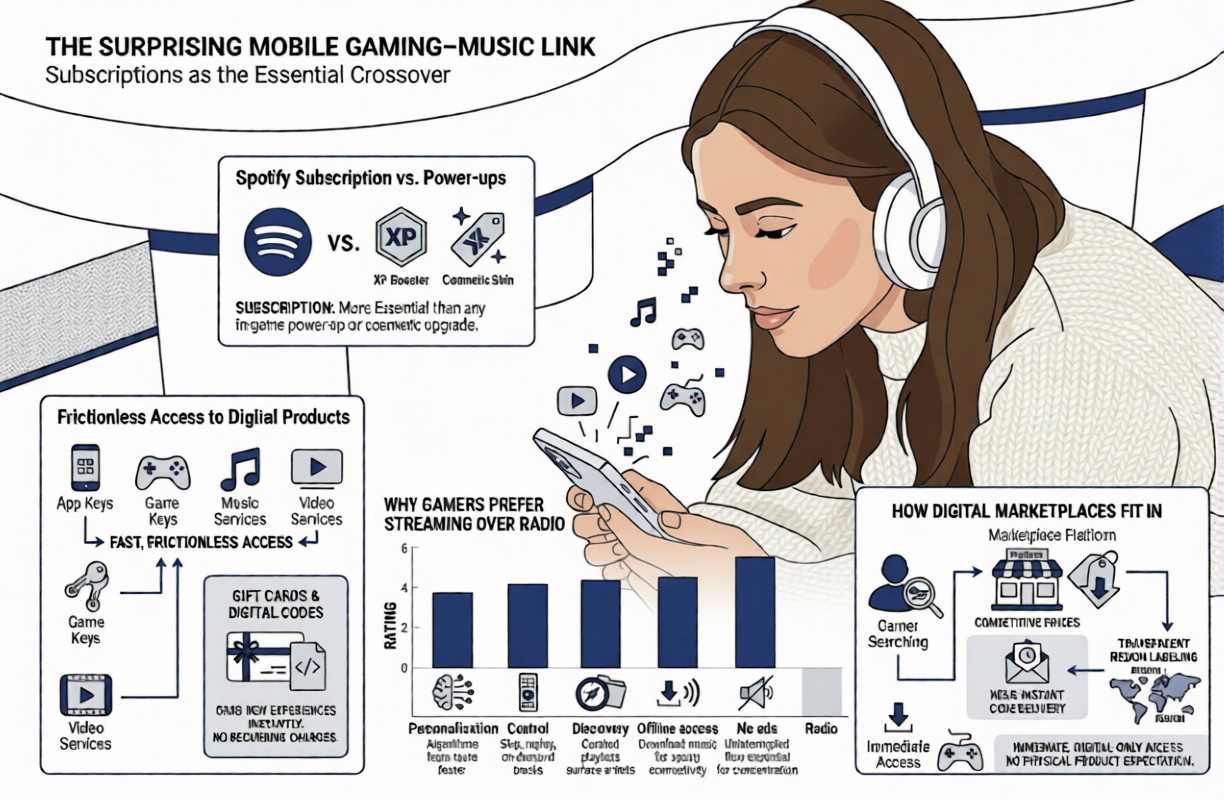
Players often realize their in-game sessions are the perfect time to explore new tracks, and that realization highlights the value of uninterrupted, ad-free playback. Many now regard a
A Spotify subscription is more essential than any in-game power-up or cosmetic upgrade. Instead of the same old radio hits, users tap into genre mixes, algorithm-driven gaming playlists, and recommendations from their favorite streamers and content creators.
This crossover creates fresh demand for convenience in both entertainment and music consumption. Today’s mobile gamer expects fast, frictionless access to digital products from apps and game keys to music and video services. Gift cards and digital codes let users grab new experiences instantly, without entering payment details every time, a genuine benefit for anyone cautious about recurring charges or subscription commitments.
Why Gamers Prefer Streaming Over Radio
- Personalization: Algorithms learn taste faster than radio programmers ever could.
- Control: Skip, replay, and queue tracks on demand without interruption.
- Discovery: Curated gaming playlists surface artists players would never find on their own.
- Offline access: Premium tiers let players download music for areas with spotty connectivity.
- No ads: Uninterrupted flow is essential when concentration matters in a game.
How Digital Marketplaces Fit In
Players searching for game keys and subscriptions increasingly turn to digital marketplaces for both. Platforms like Eneba offer competitive prices, near-instant code delivery, and transparent region labeling so buyers know exactly what they’re purchasing before they commit. This model appeals to mobile gamers who are already comfortable with digital-only purchasing. There is no physical product expectation, just immediate access.
Mobile Gaming Habits Are Powering the Next Generation of Music Fans
The daily routine of the average mobile gamer has evolved into something that blurs the line between gaming and listening. Long commutes, lunch breaks, and late-night sessions become private concerts streamed directly from a phone, with music discovery layered into every casual moment or competitive match.
Social Layer: Sharing Playlists as Social Currency
Many mobile games now actively encourage players to share their listening choices. Platforms like Discord, where millions of gaming communities are hosted regularly, feature music bots, shared listening rooms, and playlist channels. What someone is listening to has become as much a part of their gaming identity as their username or rank.
There is also a growing culture of gifting digital experiences between friends. Players swap playlist links, send subscription gift cards, and recommend tracks as quick thank-yous. It is no longer just “what are you playing?” but “what are you listening to while you play?”
What This Means for Artists and Labels
| Opportunity | How Gaming Enables It | Artist Benefit |
| Playlist placement | Gaming playlists have millions of followers | Sustained streams over weeks |
| Streamer endorsement | Streamers play music live on Twitch/YouTube | Organic viral exposure |
| In-game licensing | Tracks featured in game soundtracks | Royalties + new audience |
| Community sharing | Discord channels, Reddit threads | Fan-driven word-of-mouth |
| Gift card driven trial | Friends gift subscriptions for new music access | Expanded listener base |
Genre Winning in the Gaming Listening Environment
Not all genres benefit equally from the gaming context. According to Spotify’s annual Loud & Clear report, electronic, lo-fi hip-hop, synthwave, and instrumental genres see disproportionately high streams during gaming hours. These genres share qualities that make them ideal background scores: consistent tempo, minimal lyrical distraction, and long runtime tracks that do not demand active listening.
Top Genres by Gaming Session Popularity
| Genre | Why It Works for Gaming | Representative Artists |
| Lo-fi hip-hop | Relaxed beats, zero distraction | ChilledCow, Jinsang, Idealism |
| Electronic / EDM | High energy for competitive play | Deadmau5, Daft Punk, Rezz |
| Synthwave / Retrowave | Nostalgic, atmospheric, immersive | Carpenter Brut, Perturbator |
| Ambient / Instrumental | Maintains focus without lyrics | Brian Eno, Tycho, Moby |
| Hyperpop | Trending among Gen Z gamers | 100 gecs, Charli XCX, Arca |
What This Means for the Future of Music and Gaming
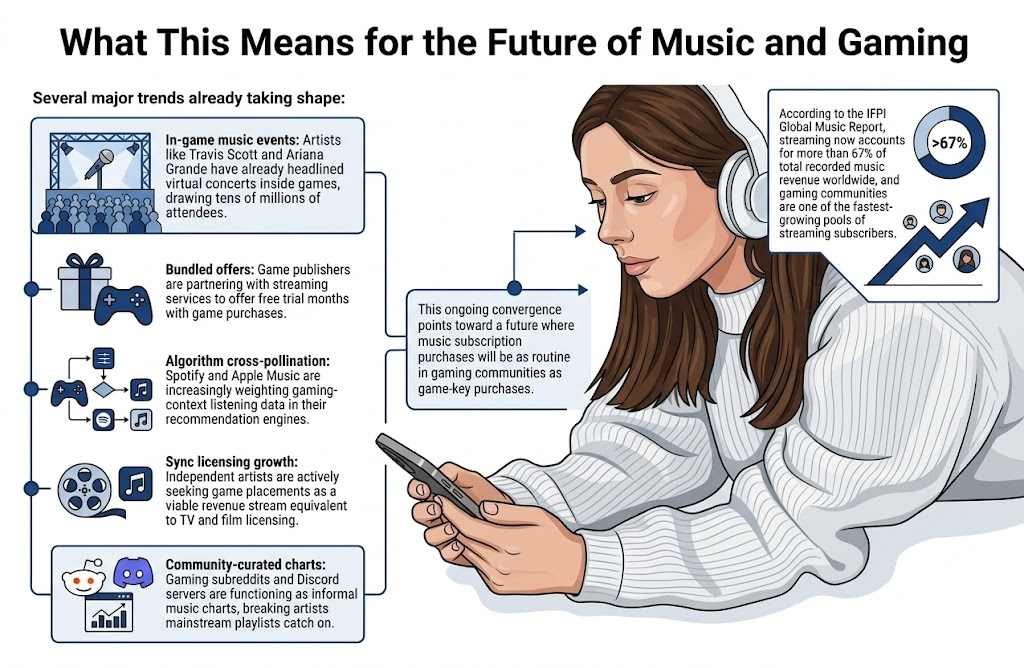
This ongoing convergence points toward a future where music subscription purchases will be as routine in gaming communities as game-key purchases. According to the IFPI Global Music Report, streaming now accounts for more than 67% of total recorded music revenue worldwide, and gaming communities are one of the fastest-growing pools of streaming subscribers.
Several major trends are already taking shape:
- In-game music events: Artists like Travis Scott and Ariana Grande have already headlined virtual concerts inside games, drawing tens of millions of attendees.
- Bundled offers: Game publishers are partnering with streaming services to offer free trial months with game purchases.
- Algorithm cross-pollination: Spotify and Apple Music are increasingly weighting gaming-context listening data in their recommendation engines.
- Sync licensing growth: Independent artists are actively seeking game placements as a viable revenue stream equivalent to TV and film licensing.
- Community-curated charts: Gaming subreddits and Discord servers are functioning as informal music charts, breaking artists weeks before mainstream playlists catch on.
What Developers and Labels Should Do Now
| Stakeholder | Recommended Action | Expected Outcome |
| Game developers | Integrate Spotify/Apple Music API for in-game playback | Longer session times, premium feel |
| Music labels | Pitch emerging artists to gaming playlist curators | Faster audience growth |
| Independent artists | Target gaming-specific playlist submissions | Niche but loyal new fans |
| Digital marketplaces | Bundle game keys with music subscription trials | Higher conversion, lower churn |
| Streamers / influencers | Use DMCA-safe licensed tracks openly | Sustainable content & artist exposure |
Conclusion
The intersection of mobile gaming and music streaming is not a passing trend. It is the natural consequence of two industries that have both gone digital-first, colliding in the daily habits of billions of people. As Apple Music and Spotify compete for subscriber growth, and as game developers look for new ways to deepen engagement, the overlap will only become more intentional and more structured.
For new artists and emerging genres, being on a gamer’s chosen playlist can matter as much as topping traditional charts. For players, the flexibility of digital codes, gift cards, and competitive marketplaces means the soundtrack to every gaming session is entirely within their control. And for the broader entertainment industry, the message is clear: the gamer is the new tastemaker.
With digital platforms and marketplaces offering flexible access to both games and music subscriptions, the boundary between “gamer” and “music fan” is dissolving. The future of music discovery will be shaped, in no small part, by the billions of people who play games on their phones every single day.