
Blog
CS2 and Valorant Odds in Ontario: A Fan’s Checklist


Esports betting does not behave like traditional sports betting with a different screen attached. CS2 and Valorant have their own paces, match structures, patch cycles, player roles, and map logic. A strong football bettor can still misread an esports market if they treat every shooter like a normal head-to-head fixture.
Ontario adds another layer because esports betting sits inside a regulated online gambling market. Someone comparing Ontario betting sites is not only looking at odds or sign-up access. The more useful question is whether the operator, the market, and the match information are sufficiently clear to support a careful decision.
The smarter approach is to treat CS2 and Valorant as tactical games first and betting markets second. Before following a price, fans need to understand what the match format is testing, which maps are likely to appear, whether a recent patch has changed the meta, and how reliable the event itself is.
Why CS2 And Valorant Need Different Betting Logic
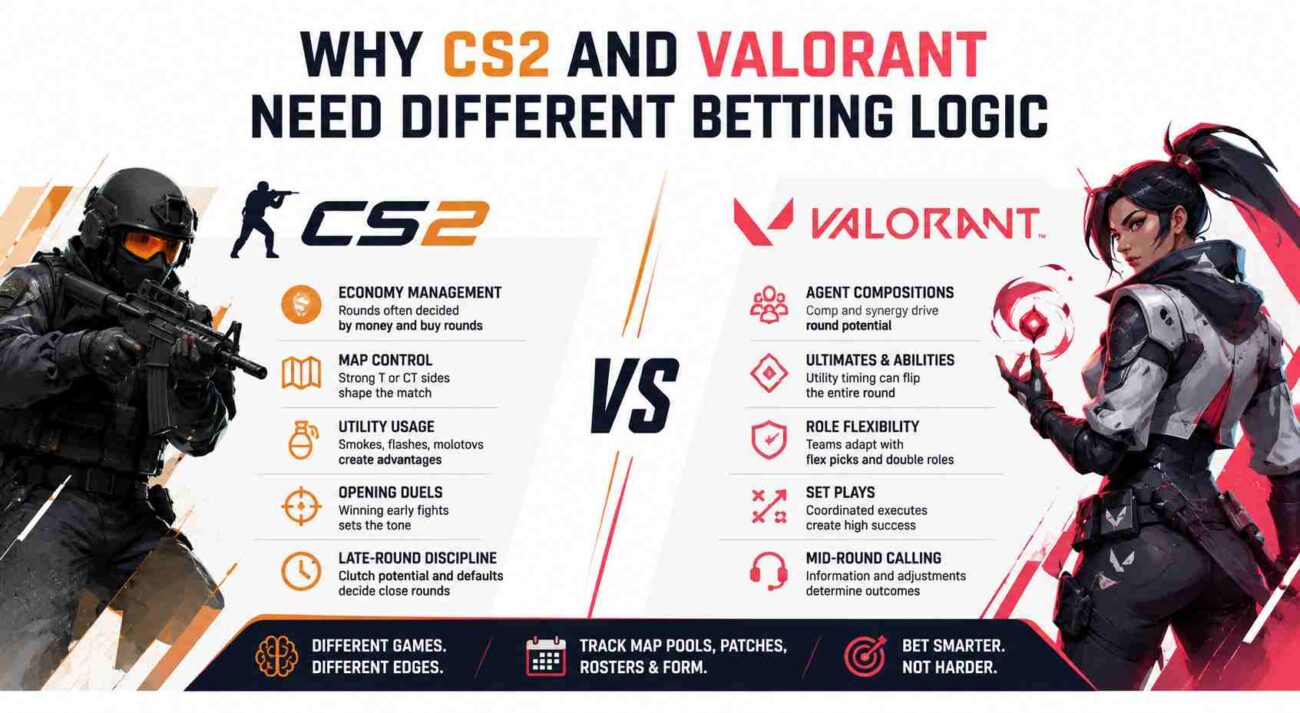
CS2 and Valorant are both tactical shooters, but they reward different kinds of reading. CS2 is heavily shaped by economy management, map control, utility usage, opening duels, and late-round discipline. Valorant adds agent compositions, ultimates, role flexibility, and ability timing to the same broad tactical frame.
That difference matters because a market can look similar on the surface. A team may be priced as a favorite in both games, but the reasons behind that price can be completely different. In CS2, the edge may come from a deep map pool or stronger CT-side structure. In Valorant, it may come from agent flexibility, set plays, or superior mid-round calling.
A bettor who only follows team names misses too much. Esports markets often move around roster news, map vetoes, patch reactions, and tournament pressure. Those factors can change faster than in many traditional sports.
First Check Is The Match Format
Format is the foundation. A best-of-one match can create more volatility because one poor map, a pistol-round swing, or a slow start can decide the result. A best-of-three gives stronger teams more time to adjust, but it also makes map selection far more important.
In CS2, format affects how much weight to place on the veto. A team with two excellent maps and three weak ones may look dangerous in a short format but vulnerable in a deeper series. In Valorant, a best-of-three may reveal whether a team can maintain agent flexibility across maps rather than relying on a single polished setup.
| Factor to check | CS2 angle | Valorant angle | Why it matters |
| Match format | BO1 can magnify pistol rounds and economy swings | BO1 can punish slow adaptation to agent comps | Short formats increase volatility |
| Map pool | Veto strength and comfort maps are central | Map-agent combinations shape strategy | Map selection can change the favourite |
| Recent patch | Weapon, economy or map changes can shift habits | Agent, weapon and map changes affect the meta | Older stats may lose value |
| Roster stability | Roles and communication depend on continuity | Agent roles need clear coordination | Stand-ins can distort pricing |
| Event level | LAN, online and qualifier pressure differ | International events test depth and preparation | Context changes performance signals |
Map Pools Can Be More Important Than Recent Form
Recent form is useful, but map context can override it. A team may have won four matches in a row, yet still be fragile on the one map likely to decide the next series. That is especially important in CS2, where veto order often reveals confidence before the first round begins.
In Valorant, maps interact with agent selection. A team may look excellent on one map because its preferred agents fit the layout. On another map, the same team may need a different initiator, controller, or sentinel setup, which can expose weaker coordination.
Fans should avoid reading the map win rate as a simple number. The sample size matters. So does opponent quality. A 70 percent win rate against weaker teams is not the same as a 55 percent rate against elite opposition.
The better question is not “Who has better form?” It is “Which version of this team appears if these maps are played?”
Patch Timing Can Make Old Stats Dangerous
Esports changes asas the season progresses. A patch can adjust weapons, maps, agents, or game systems, and those changes can affect how teams play. This is one of the biggest differences between esports and many traditional sports.
In CS2, a map adjustment or weapon change can alter common angles, timing windows, and utility lineups. A team that built a clear identity around one setup may need time to adapt. In Valorant, agent balance changes can reshape pick rates, site executes and defensive setups.
That does not mean every patch destroys old information. Some elite teams adapt quickly. Others need official matches before the new shape becomes clear. The problem is treating pre-patch stats as if nothing changed.
A practical checklist before following esports odds should include:
- Has there been a game patch since the team’s last major match?
- Did the patch affect a map, weapon, or agent central to this matchup?
- Are the available stats from the same version of the game?
- Has the team already played official matches on the new patch?
- Are analysts discussing a real tactical change or only surface-level hype?
This habit protects fans from one of the easiest mistakes in esports betting: using clean numbers from a stale environment.
Roster News Is Not Just A Headline
A roster move in esports can change more than individual skill. It can affect communication, roles, practice structure, map pool, and emotional stability. A high-fragging player joining a team is exciting, but that does not guarantee immediate improvement.
CS2 teams rely on role balance. Entry players, anchors, AWPers, and in-game leaders all shape the round structure. If one role changes, others may need to shift. That adjustment can take time, especially against disciplined opponents.
Valorant has a similar issue, but with agent roles layered on top. A player may be mechanically strong but less comfortable on a required agent. A team may also need to rebuild set plays if a new player changes how space is taken or retaken.
For Ontario fans, this is where careful source selection matters. Roster rumors, scrim leaks, and social media clips can shift attention quickly, but confirmed team announcements and official match sheets carry more weight.
Market Type Changes: The Risk Profile
Not every esports bet is asking the same question. A match winner market is broad. A map winner market is narrower. Round handicaps, totals, and player props can be more sensitive to format, patch version, and team style.
For example, a strong favorite may still lose a map if it starts slowly or experiments during a group-stage match. A player prop may look attractive based on average kills, but that number can change if the player’s role shifts from star duelist to supportive utility. A total rounds market can be affected by both teams’ defensive strength, economic patterns, and map balance.
The most common mistake is mixing confidence levels. A fan may be confident that a team is stronger overall and then use that confidence to justify a more specific market that requires different evidence. Overall strength does not automatically support every type of bet.
The cleaner approach is to match the evidence to the market. If the evidence is about map comfort, consider markets linked to maps. If the evidence is only about the team’s overall quality, avoid overly specific conclusions.
Integrity And Licensing Belong In The Same Conversation
Esports betting needs two forms of trust. The first is competitive trust: the match should be organized, monitored, and meaningful. The second is operator trust: the betting site should be authorized for the market and clear about the rules.
Ontario’s regulated environment provides players with a framework for checking operators, but players still have work to do. The operator should be registered or approved for Ontario access, market rules should be visible, and responsible gambling tools should be easy to find. For esports, users should also check whether the event is recognized, properly scheduled, and covered by reliable sources.
This matters because esports can include many event tiers. A global LAN is not the same as a small online qualifier. Lower-tier matches may have less public information, thinner markets, and more uncertainty around rosters or schedules.
A serious fan does not need to avoid every smaller event. They need to demand more evidence before treating the market as readable.
How Canadian Fans Can Build A Stronger Pre-Bet Routine
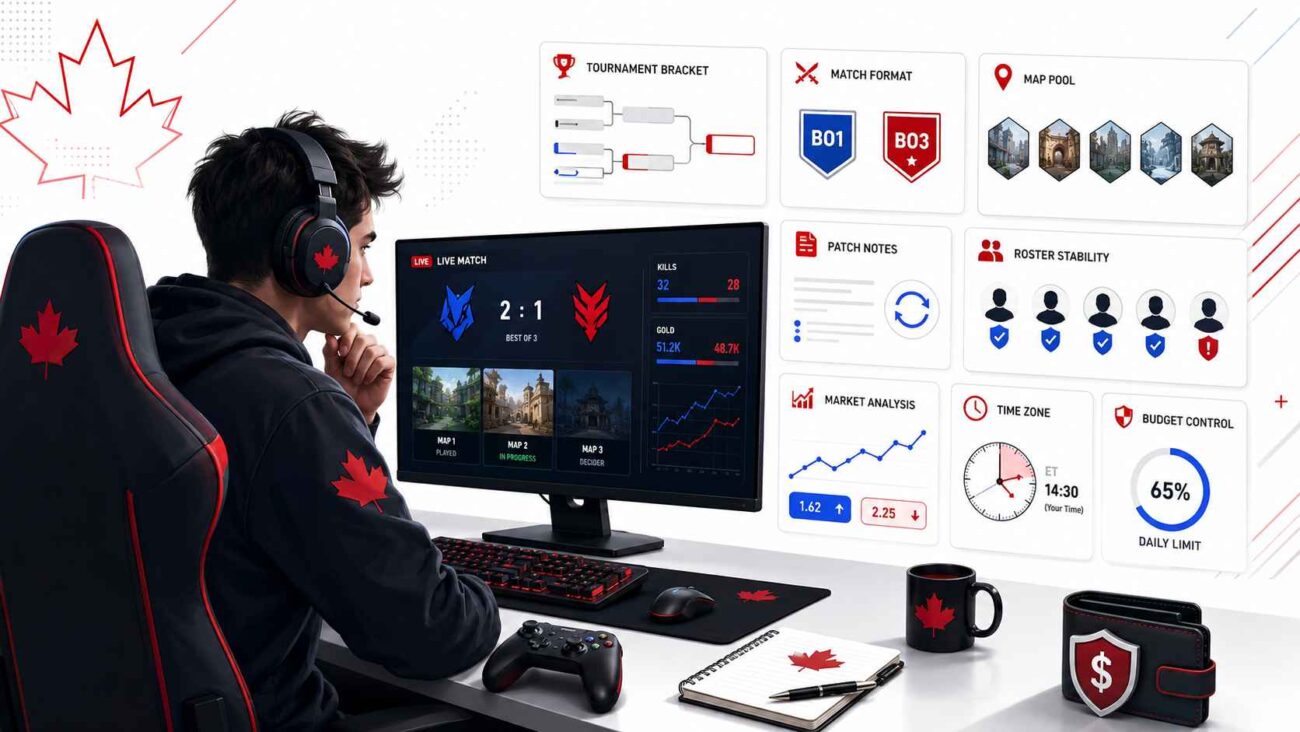
A useful esports routine is short, repeatable, and based on information quality. It should slow the decision down before the odds create urgency.
Start with the event. Is it official, visible, and properly scheduled? Then move to format. Is it BO1, BO3, or another structure? After that, check maps, patch version, roster stability, and market type.
The final step is personal control. Esports spans time zones, and Canadian fans may follow late matches from Europe, North America, or Asia. Late viewing can make decisions more impulsive, especially during live markets.
A simple rule helps: decide your limit before the match, not during a clutch round. If the market needs an instant reaction to make sense, it may not be the right market to follow.
Final Closing
CS2 and Valorant reward informed reading, but they punish lazy assumptions. A famous team name, recent win streak, or exciting highlight does not explain enough on its own. The useful signals sit deeper: format, map pool, patch timing, roster stability, event reliability, and market type.
Ontario fans have another responsibility as well. The betting environment should be checked with the same care as the match. A regulated operator, clear rules, and responsible gambling tools are part of the decision, not an afterthought.
The strongest esports approach is not to chase the fastest-moving market. It is important to understand what the game is testing before accepting the odds.