
Blog
Crypto iGaming Platforms Making Waves in 2026


There is a moment most crypto holders eventually hit. You have a wallet sitting there with something in it, you are bored on a Tuesday night, and it occurs to you that this money could actually be doing something more entertaining than waiting for a chart to move.
The answer to “can I gamble with this” has been yes for years. The harder question is where, and that one has gotten genuinely difficult, because every crypto casino homepage now says the same six things. Instant payouts. Provably fair. Thousands of games. Huge welcome bonus. VIP club. Anonymous play. If you lined up ten of these sites side by side with the logos removed, most people could not tell them apart.
So the useful version of this article is not just a list. It is a list plus the small set of things that actually separate a platform worth your time from a platform that is very good at marketing. Four operators are covered below, each with a real reason people use them and a real reason some people do not. Read the vetting section first if you have never done this before. It will save you more money than any bonus code.
What Actually Changed in Crypto Betting

The “wild west” framing you still see in a lot of older content is out of date, and it matters that you know why.
Most crypto-facing operators have historically licensed out of Curaçao, and for two decades that meant a master licence holder issuing sub-licences with fairly light oversight. That system is gone. Under the National Ordinance on Games of Chance, sub-licences expired, and operators now have to hold a direct licence from the Curaçao Gaming Authority, which maintains a public register, runs its own checks on beneficial owners, and has powers to suspend or revoke. Physical presence requirements kicked in at the start of 2026. Annual costs went from trivial to roughly fifty thousand euros.
That reshuffled the field. Some operators upgraded, some moved to alternative jurisdictions like Anjouan, and some quietly disappeared. The practical takeaway for you is simple: a licence seal in a site footer used to be close to meaningless, and now it is worth clicking. If the seal does not open into a live certificate on a regulator’s own database, treat that as information.
The second shift is quieter but affects your bankroll more directly. Stablecoins have become the default deposit currency on a lot of these sites, and that changes the math of playing. Depositing in Bitcoin means you are running two positions at once: your bet and your exposure to the coin. Depositing in USDT or USDC means the only thing moving is the bet. Neither is wrong. Just know which one you are doing.
The third shift is identity. The idea that crypto gambling is permanently anonymous is fading, because global anti-money-laundering standards for virtual assets and the providers that handle them keep tightening, and licensed operators sit downstream of that. Plenty of sites will let you deposit and play without documents. Most will ask for them eventually, usually at a withdrawal threshold or when something looks unusual. Assume verification is deferred rather than abolished, and you will never be caught out by it.
Four Numbers That Tell You More Than Any Bonus
Bonuses are the loudest thing on the page and the least predictive of whether you will enjoy a platform. These four are quieter and much more useful.
- House edge, or RTP. This is the single number with the most influence on how long your money lasts. In regulated markets, it is not optional information either: the UK’s remote gambling and software technical standards require operators to make the return to player percentage, the house edge, or the probability of winning available before you commit to a bet. A crypto site that publishes RTP per title is telling you something about how it thinks. A site that buries it is also telling you something.
- Withdrawal time, and who controls it. Blockchain settlement is fast. The delay in crypto gambling is almost never the chain; it is the operator’s internal review queue. When a site advertises instant withdrawals, what it is really claiming is that it does not manually gate most cashouts. Test this with a small amount before you care about it.
- Coin and network support. More coins are not automatically better. What matters is whether the platform supports the specific network you actually hold your funds on, because sending USDT over the wrong chain is one of the most common and most permanent ways people lose money in this space.
- The terms nobody reads. Bonus wagering multipliers, maximum bet while a bonus is active, dormancy and inactivity fees, and any clause about “irregular play” or “advantage play.” That last category is where most account freezes come from, and the wording is often vague enough to cover strategies that are completely ordinary elsewhere.
How Provably Fair Actually Works, and What It Does Not Prove
Almost every platform here advertises provably fair gaming, and the phrase is thrown around so casually that most players have no idea what it guarantees.
The mechanism is straightforward. Before a round, the operator generates a server seed and shows you a cryptographic hash of it rather than the seed itself. You supply or are assigned a client seed. The two get combined with a counter to produce the outcome. Afterward, the operator reveals the original server seed, and you can hash it yourself and confirm it matches what you were shown before you bet. The hash functions doing that work are standardized algorithms, specified publicly in NIST’s Secure Hash Standard, which is why anyone can verify the result independently rather than taking the casino’s word for it.
Here is the part that gets glossed over. Provably fair proves the result was not changed after you placed the bet. It does not prove the game’s underlying math is generous, and it does not prove the odds are good. A game can be flawlessly provably fair and still carry a five percent house edge. Verification is a check against cheating, not a check against losing. Both of those things can be true at once, and understanding the difference makes you a much harder player to sell to.
Duel: Built Around the Edge, Not the Bonus
Most casinos compete on how much they give back to you after taking their cut. Duel took a different route and went after the cut itself.
Its in-house Duel Originals are published at 100% RTP, which is another way of saying the house takes nothing on those specific titles over the long run. Dice, Blackjack, Plinko, Crash, Mines, Keno and a handful of others sit in that category, each with its RTP displayed on the tile rather than hidden in a help file. On third-party slots, where the provider sets the maths, Duel’s angle is instant rakeback rather than a rewritten edge. The sportsbook is pushing in the same direction with a stated ambition of zero-edge player-versus-player markets.
The tone of the place is the other thing people notice. The slogan is deliberately blunt, and the design is stripped down, with no wall of flashing thumbnails and no fake bet feed. Registration is quick, deposits and withdrawals are fast, and every result runs through a provably fair system you can check yourself. Fiat funding is available if you would rather not move crypto around.
Where it might not suit you: this is not a bonus-hunter’s platform. If your enjoyment comes from stacking welcome offers, free spins and elaborate promo calendars, the deliberate lack of them will feel thin. Duel’s whole argument is that a lower edge beats a bigger bonus over time, which is mathematically defensible but emotionally less exciting.
BetFury: For People Who Want a Cut of the House
BetFury has been running since 2019 and built its identity around a single idea: what if playing also earned you a piece of the business?
That comes through the BFG token. You accumulate it as you wager, and staking it draws from a pool funded out of the platform’s adjusted net gaming revenue, paid out on a rolling basis in a spread of assets. Layered on top are rakeback on every wager and periodic cashback on net losses, plus a VIP track that leans into crypto-native rewards like NFT loot boxes. Games are provably fair, and the crypto support is broad.
Where it might not suit you: it is crypto only, so there is no fiat on-ramp. The token is also worth thinking about honestly. BFG is a tradeable asset with a market price, which means the value of your dividends moves independently of how well you are playing, and the yield figures quoted on staking pages are variable rather than promised. Treat it as a rewards mechanism with upside, not as income. It is also worth reading the account terms, which include an inactivity fee if a balance sits untouched for long enough. That is not unusual in this sector, but it does catch people who deposit, wander off, and come back a year later.
Cloudbet: The Sportsbook-First Veteran
Cloudbet launched in 2013, which in crypto gambling terms makes it close to ancient. Longevity is not proof of quality, but surviving three market cycles and a licensing overhaul does mean something.
The sportsbook is the main event here rather than the casino. Esports coverage is a genuine strength, with real-time markets on major titles like League of Legends rather than the token esports tab a lot of sportsbooks bolt on. In MMA, Cloudbet signed a multi-year deal with the Professional Fighters League in January 2025 as its official betting and casino partner, which is the kind of arrangement that tends to come with better market depth on those events. The VIP club runs on cash rewards, unlocking up to $2,500 as you climb.
On the money side, it is crypto native. Deposits land close to instantly and withdrawals are typically processed within a couple of minutes, though as always that reflects normal operation rather than a guarantee on every transaction.
Where it might not suit you: the casino catalog is respectable but not enormous, so if slots volume is your priority you will find bigger libraries elsewhere. There is also no fiat option, which means your first step is always getting crypto somewhere else.
Yeet: Volume, Streamers, and Community
Yeet is the maximalist option. The slot catalog runs past 7,000 titles, which is more than anything else on this list, and it is backed up with live dealer tables, a sportsbook, and a set of Yeet Originals. Crypto support covers 19 or more coins.
What actually differentiates it is the social layer. Yeet leans hard into streamer partnerships and community events, which gives the platform an atmosphere that the more utilitarian sites do not have. If you already spend time in gambling-adjacent streaming communities, this will feel like the natural home.
Where it might not suit you: players have flagged that some terms and conditions are written loosely enough to cover a wide range of behavior, and there are reports of accounts being restricted over betting patterns that would be considered ordinary on other platforms. This is not a reason to avoid Yeet outright, but it is a strong reason to actually read the bonus terms and the section on prohibited play before you deposit, rather than after something goes wrong.
Side by Side
| Feature | Duel | BetFury | Cloudbet | Yeet |
|---|---|---|---|---|
| Best for | Lowest possible edge | Earning while playing | Sports and esports | Sheer game volume |
| Standout feature | 100% RTP Originals | BFG token dividends | PFL and esports markets | 7,000+ slots and streamer community |
| Fiat accepted | Yes | No | No | Crypto-focused |
| Provably fair | Yes | Yes | Yes | Yes |
| Main trade-off | Few bonuses | Token value fluctuates | Smaller casino library | Broad bonus terms and conditions |
Details on these platforms change. Treat the table as a starting point and confirm current terms, coin support and licensing on the site itself before depositing.
Practical Stuff Nobody Puts in the Marketing
- Send a test transaction first. Deposit the minimum, play a little, and withdraw it. You will learn more about a platform in that twenty-minute loop than from any review, including this one.
- Check the network, not just the coin. USDT exists on multiple chains. Picking the wrong one at the withdrawal screen is unrecoverable. Slow down for those ten seconds.
- Decide what you are betting in. If you deposit a volatile asset, you are exposed twice. A flat night at the tables can still end with a smaller balance in dollar terms. Stablecoins remove that variable if you would rather keep the two decisions separate.
- Turn on the boring security features. Two-factor authentication and withdrawal address allowlisting take two minutes and are the difference between a bad day and a catastrophic one.
Understand the tax picture, because there are two layers. In the US, gambling winnings are fully taxable and reportable whether or not the operator issues you a form, and the IRS covers this under Topic 419 on gambling income and losses. Separately, the IRS treats digital assets as property rather than currency, so disposing of crypto can trigger a capital gain or loss on its own. Note also that the deduction rules for gambling losses changed for the 2026 tax year. Rules vary enormously by country, so this is general information rather than advice, and anything meaningful is worth running past an actual tax professional.
Keeping It Fun, Which Is the Entire Point
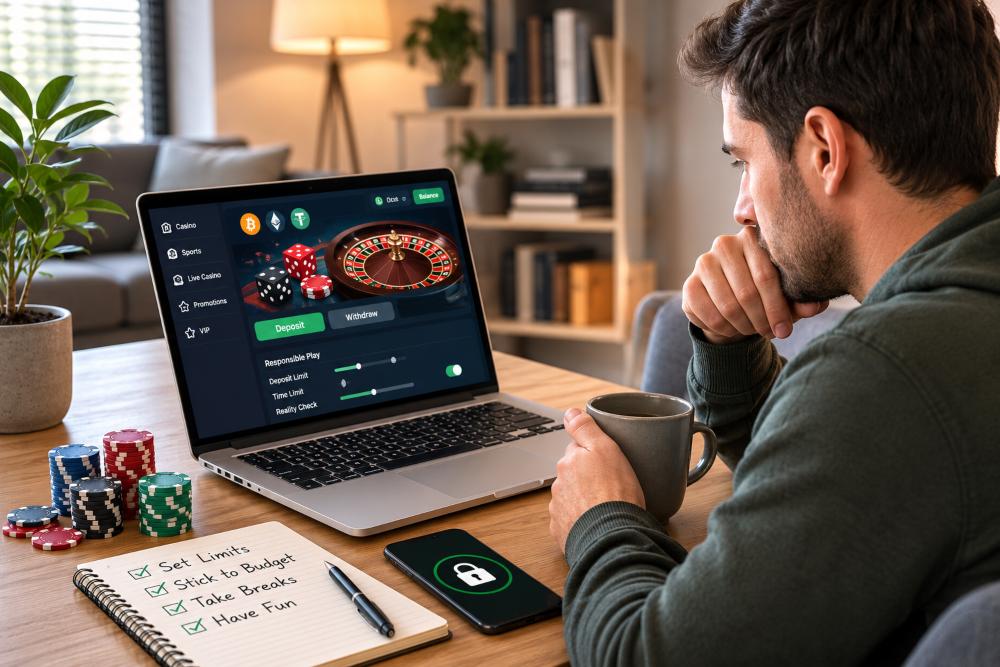
This is the section people skip, so it will be short and worth reading anyway.
Crypto gambling compresses everything. Deposits clear in seconds, withdrawals in minutes, and no card statement or bank transfer is creating natural friction. That speed is the product, and it is also the risk, because the pauses that would normally let you notice how long you have been playing have been engineered out.
The scale of the underlying issue is not small. The 2024 Lancet Public Health Commission on gambling estimated that hundreds of millions of adults worldwide are exposed to some level of gambling-related risk, and identified online and mobile products specifically as the fastest-growing part of the picture.
None of that means you cannot enjoy this. It means the guardrails are worth setting up on day one, while you are calm, rather than on a bad night. Deposit limits, session time limits and reality checks are built into most licensed platforms, and self-exclusion exists for a reason. The simplest rule is still the best one: only stake what you are entirely willing to lose, and stop the moment the money stops feeling like entertainment.
If it stops being fun, or if someone you know seems to be struggling, the National Problem Gambling Helpline in the US runs 24/7 by call, text and chat on 1-800-MY-RESET, with the older 1-800-522-4700 line still active. Most countries have an equivalent, and there is nothing unusual about using it.
So Which One Should You Pick
If you care most about keeping the maths on your side, Duel’s zero-edge approach is the clearest expression of that idea currently available. If you want your play to generate something beyond the immediate result, BetFury’s token model is genuinely different from a standard loyalty scheme. If you came for sports and especially esports or MMA, Cloudbet has the depth and the track record. And if you want the biggest possible library with a social scene attached, Yeet is the one, provided you read the terms first.
The honest answer is that most people end up with two accounts rather than one, because no single platform is best at everything. Start small, verify a withdrawal, and let the experience rather than the homepage tell you where to stay.
This article is for readers of legal gambling age in jurisdictions where online gambling is permitted. Availability, terms and licensing vary by country and change frequently. Confirm the current position for your location before depositing.