
Blog
Choosing the Best Crypto Casino Software Development Company


Launching a crypto casino in 2026 means picking a development partner who can handle more than slot graphics and a payment plugin. Your platform typically needs multi-chain wallets, provably fair RNG, smart contract settlement, KYC/AML modules, anti-fraud systems, and integrations with crypto payment gateways like CoinsPaid, NOWPayments, and Plisio, often alongside a sportsbook engine and an affiliate layer.
Whether you’re an iGaming operator adding crypto rails, a Web3 startup building an on-chain casino, or an entrepreneur entering the crypto gambling market, the development partner you choose shapes your launch timeline, compliance posture, and long-term operating cost.
This article helps you evaluate every crypto casino software development company on the shortlist, with comparison tables, vendor profiles, and engagement model breakdowns.
What to Look for in a Crypto Casino Software Development Company
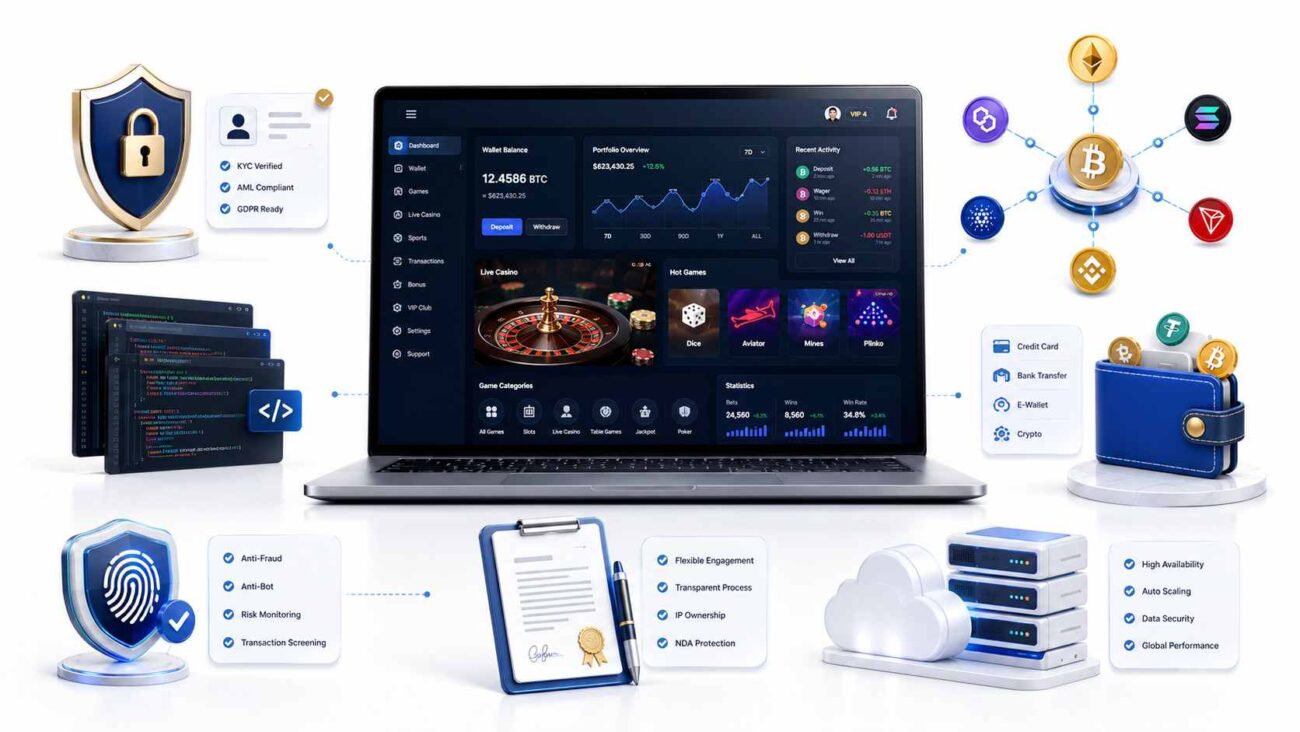
Picking a crypto casino software development partner is different from hiring a generic web shop. Your vendor needs documented experience with on-chain mechanics, multi-currency payments, and gambling-specific compliance modules, not just a portfolio of consumer apps.
The wrong choice can leave you with a stack that’s hard to license, expensive to scale, or vulnerable to bonus abuse and bot farms. Here are the criteria to filter your shortlist before you move on to proposals and pricing.
- Crypto-native technical depth. Verify the vendor has shipped multi-chain wallets, smart contract settlement, and provably fair RNG before. Ask which chains they’ve worked with (BTC, ETH, USDT, TRON, SOL, TON) and whether they’ve built on-chain game logic, not only off-chain.
- Compliance and KYC/AML module experience. Your platform typically needs KYC/AML workflows, responsible gaming controls, age verification, and GeoIP blocking that flex across multiple licensing jurisdictions. A partner that has only built unregulated platforms will leave you exposed when you move into a licensed market.
- Payment gateway and multi-wallet integration coverage. Confirm prior integrations with the gateways you’re likely to use, including CoinsPaid, NOWPayments, BitPay, Coinbase Commerce, Plisio, and whether they’ve handled fiat on/off-ramps. Integration depth here is the difference between a two-week setup and a two-month one.
- Anti-fraud, anti-bot, and player safety tooling. Bonus abuse, multi-accounting, and bot farms can wipe out your margin in the first quarter. Ask for the specific anti-fraud features the vendor has actually built and how they tune them for your traffic.
- Verifiable iGaming and Web3 track record. A vendor with five iGaming projects but no crypto work, or five Web3 projects but no gambling experience, will reinvent the wheel on your build. Look for documented work spanning both domains, and check public review profiles for client feedback you can independently verify.
- Transparent engagement model and IP ownership. Clarify upfront whether the vendor offers fixed-price, time-and-materials, or dedicated-team contracts, and whether the source code, game logic, and player data belong to your business at the end. Hidden revenue-share clauses or restricted IP terms can lock you into a vendor for years.
10 Crypto Casino Software Development Companies: Detailed Look
The crypto casino software market in 2026 spans full-stack custom builds, modular platforms, and turnkey white-label products, with vendors leaning toward traditional iGaming tooling on one end and Web3-native architectures on the other.
Choosing among them depends on whether you want speed to market, deep customization, on-chain mechanics, or a single back-office covering both casino and sportsbook. Below is every crypto casino software development company on this shortlist, with a breakdown of services, expertise, and what each delivers:
| Company | Services | Key Expertise | What You Get |
| OmiSoft | Custom crypto casino builds, smart contracts, white-label clones, Telegram Mini Apps | Web3, blockchain, AI, multi-chain integration | Full-stack delivery and single-vendor coverage |
| SoftGamings | Turnkey, white-label, game aggregation | 3,000+ game catalog, crypto payment support | Fast market entry with broad content access |
| EveryMatrix | Modular casino, sportsbook, PAM, bonus engine | Scalable enterprise platform tooling | Flexible plug-in expansion across regulated markets |
| Digitain | White-label casino + sportsbook, crypto rails | Multi-product compliance, blockchain features | Single back-office for casino-plus-betting brands |
| Prometteur Solutions | Custom crypto casino + sportsbook, mobile-first builds | Scalable engineering, RNG-certified games | Tech-aware build with deep customization |
| Apptunix | Custom crypto casino mobile apps | Blockchain mobile development, iOS/Android | App-store-grade casino experience |
| Suffescom Solutions | Crypto casino, smart contracts, NFT/DeFi betting | Web3-native gambling architectures | On-chain-first builds with tokenized mechanics |
| EvaCodes | Blockchain casinos, Play-to-Earn, provably fair systems | Transparency-led on-chain architecture | Verifiable gameplay with audit-friendly logs |
| Simpltry | Crypto casino suite, DeFi lottery, white-label | Quick-deploy crypto stacks for startups | Faster go-to-market with templated frontends |
| Developcoins | Custom crypto casino games, NFT mechanics | Provably fair RNG, custom game logic | Distinctive game library with NFT integration |
OmiSoft
OmiSoft is a top crypto casino software development company specializing in custom Web3, blockchain, and AI-powered iGaming products. The company has shipped 70+ launched projects across 200,000+ hours of development with 110+ in-house engineers, holding AWS Partner status and top-rated profiles on third-party review platforms.
OmiSoft’s iGaming practice covers Solidity and Rust smart contracts, multi-chain wallet integration across Ethereum, Solana, TON, Polygon, and 10+ other networks, and ready-to-deploy white-label products, including Stake-style casino clones, Pump: fun launchpads, and Polymarket clones.
The firm’s adjacent build capabilities include crash games, sportsbook software, NFT-based casino games, Telegram Mini App casinos, and tap-to-earn TON development, positioning OmiSoft as a single-vendor option for operators consolidating crypto and iGaming engineering.
SoftGamings
SoftGamings delivers turnkey and white-label crypto casino solutions backed by access to 3,000+ games across its aggregator network. The provider’s platform supports operators that prioritize broad content libraries and rapid market entry over deep customization.
SoftGamings’ native cryptocurrency layer sits alongside the company’s core platform tooling, including game aggregation, player account management, and payment integrations. The provider’s footprint suits operators valuing established infrastructure and predictable deployment patterns over bespoke architecture.
EveryMatrix
EveryMatrix builds modular, scalable iGaming platforms designed for operators who need to plug in capabilities over time. The vendor’s product suite includes casino, sportsbook, payment, and bonus management modules deployable separately or together.
Their tooling targets growing and enterprise operators that expect frequent feature expansion across regulated markets. The company’s flexibility shows in its ability to integrate cryptocurrency rails and advanced player analytics into existing operator stacks.
Digitain
Digitain provides a versatile white-label iGaming platform covering both casino and sports betting under a unified back-office.
The company’s solution includes support for crypto payments, blockchain-aware modules, and integrated risk management tooling. Digitain’s compliance footprint spans multiple regulated jurisdictions, making the platform a fit for operators running multi-product brands across regions.
Prometteur Solutions
Prometteur Solutions develops customizable, mobile-first crypto casino platforms with a focus on scalable architecture and full sportsbook coverage. The firm’s builds typically integrate cryptocurrency wallets, RNG-certified games, and live dealer modules.
The vendor’s engineering output skews toward tech-aware operators that want platform-level control and ongoing iteration. The company’s mobile-first orientation makes the team a candidate for operators prioritizing mobile traffic and emerging-market deployments.
Apptunix
Apptunix focuses on blockchain-integrated mobile applications, including custom crypto casino apps for iOS and Android. The company’s mobile-first practice covers crypto wallet integration, in-app payments, and casino-specific UX patterns.
Their strength lies in app-store-grade development, with projects that suit operators looking for mobile-led builds where the iGaming logic is wrapped around a strong native-app experience.
Suffescom Solutions
Suffescom Solutions works across crypto casino development, smart contract engineering, and NFT- and DeFi-driven betting models. The team’s practice extends into decentralized gambling formats, on-chain RNG, and tokenized player rewards.
The company’s focus on Web3-native builds fits operators who want blockchain-first architectures. The provider’s involvement with decentralized betting positions it for projects exploring on-chain game logic and DeFi integration.
EvaCodes
EvaCodes designs and builds blockchain-powered casino platforms with provably fair mechanics and Play-to-Earn integration. The studio’s emphasis lies in transparency-led gambling architectures and verifiable on-chain outcomes.
EvaCodes’ work suits Web3-first operators and projects where on-chain auditability is a core marketing claim, not a back-office feature. Their portfolio leans toward smart-contract-heavy builds.
Simpltry
Simpltry offers a crypto casino suite, DeFi lottery products, and white-label deployments to accelerate go-to-market. The vendor’s product set is built for startups and operators that need a working stack quickly, with crypto payments included from day one.
Their deployment model favors scalable starter platforms that can grow as traffic increases without re-architecting the core. The firm’s mix of secure crypto handling and templated frontends typically suits early-stage operators.
Developcoins
Developcoins partners with operators to develop custom blockchain and Web3 casino games with provably fair RNG and NFT-integrated mechanics. The studio’s portfolio covers slot, table, crash, and dice game formats across multiple chains.
Developcoins’ work suits brands looking for distinctive game mechanics. The company’s NFT integration practice enables operators to experiment with collectible rewards, tournament passes, and on-chain player progression.
Common Mistakes When Hiring a Crypto Casino Software Development Company
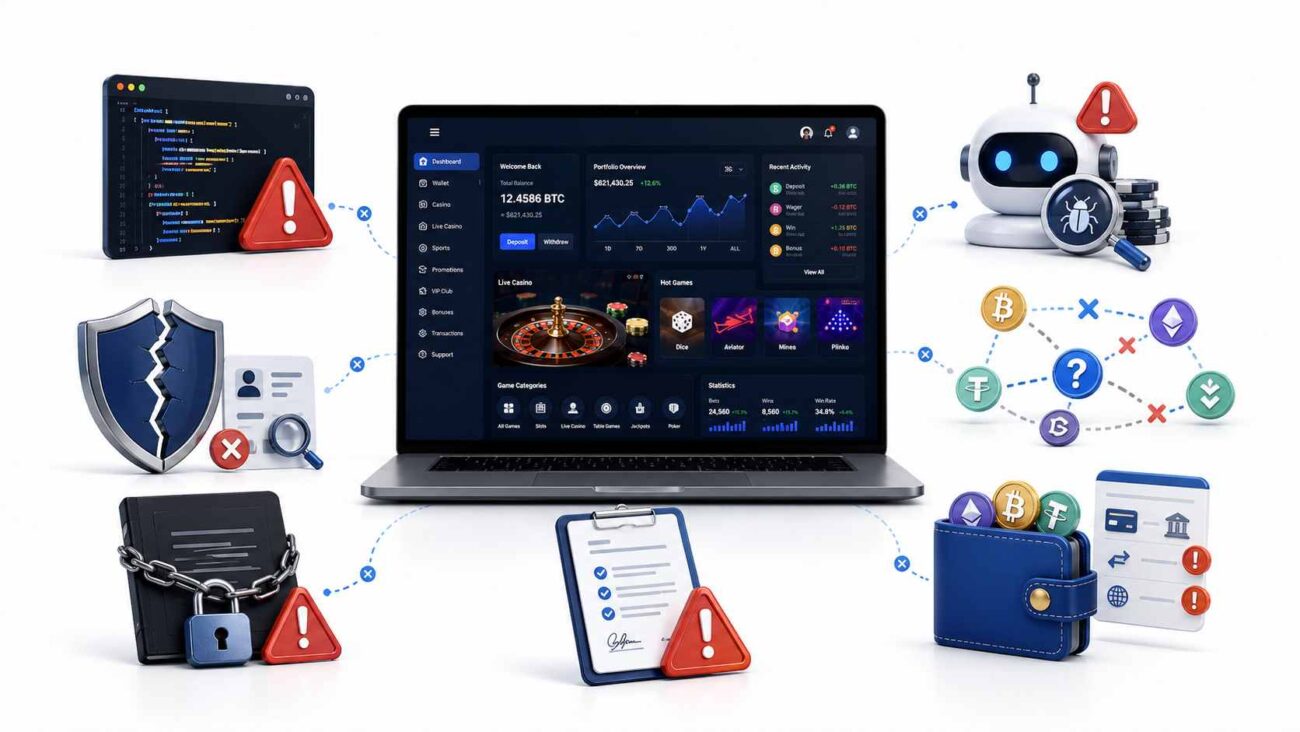
Even strong buyers make avoidable mistakes when hiring a crypto casino software development company. Usually, because they apply generalist software procurement instincts to a vertical that punishes them, iGaming has its own compliance landscape, fraud profile, and IP traps, and crypto adds a layer of multi-chain complexity most dev shops haven’t actually shipped.
The patterns below come up repeatedly across operator post-mortems, so flag them before you sign anything. Avoiding them keeps your build faster, cheaper, and clear of legal and technical surprises.
Hiring a Generic Dev Shop Without iGaming Experience
Generic development shops typically miss the operational realities of running a gambling platform, such as provably fair architecture, responsible gaming controls, anti-bonus-abuse logic, and regulator-friendly audit trails. They tend to design like consumer apps, not regulated financial software, which forces costly rework when you apply for a Curaçao or Anjouan license. Even when the day rate looks attractive, the rebuild bill can erase the savings within a quarter.
Locking Yourself Into a White-Label or Revenue-Share Deal Without Exit Terms
White-label and revenue-share contracts can fast-track your launch, but the long-term commercial terms are easy to overlook. Watch for:
- GGR clauses without ceilings. Some white-label providers take 5–25% of gross gaming revenue indefinitely, which compounds as your business grows.
- Restricted IP and source-code rights. Without clear ownership, you cannot port your platform to another vendor or upgrade the core stack independently.
- Player-data export limits. If the vendor controls your player database, switching platforms later becomes contractually and technically painful.
- Lock-in via game aggregator dependencies. Aggregator deals signed by the vendor on your behalf may stay attached to their account, not yours.
Underestimating What Your Platform Needs for Anti-Fraud and Bot Defense
Crypto casinos attract sophisticated abuse, including bot farms hitting welcome bonuses, multi-accounting via VPNs and burner wallets, and bonus hunters who arbitrage promotion structures across operators. A development partner that treats fraud defense as a post-launch add-on will hand you a platform that bleeds margin within weeks of going live. Push for device fingerprinting, behavioral scoring, and withdrawal-pattern monitoring to be in scope from day one, not retrofitted under pressure.
Skipping Verification of Your Vendor’s Real Crypto Work
Many shops position themselves as crypto-native after one Bitcoin payment integration. Before signing, validate:
- Live deployments you can inspect. Ask for live URLs of crypto casinos the vendor has shipped, not screenshots or NDA-shielded summaries.
- Specific chains and wallets are supported. Confirm hands-on work with the chains your business actually needs, such as BTC, ETH, USDT, TON, SOL, and TRON.
- Smart contract experience versus payment plugin experience. These are different skill sets, and you need to know which one the vendor genuinely has.
- Public review profiles and prior client references. Cross-check what’s on the vendor’s site against independent reviews and direct conversations with past clients.
Underspecifying Multi-Chain and Payment Gateway Requirements
Vague scoping on multi-chain support and payment rails is the single biggest source of mid-project change orders in crypto casino builds. If you commit to a vendor before deciding whether your platform will support BTC and ETH alone or also add USDT, TON, SOL, and TRON, the architecture written in week one may not hold by week ten. Pin down the chain list, the supported wallets, and the payment gateways (CoinsPaid, NOWPayments, BitPay, Plisio, Coinbase Commerce) before the contract.
Conclusion
Picking the right crypto casino software development company in 2026 is less about brand recognition and more about whether a vendor’s actual capabilities, which include multi-chain wallets, provably fair mechanics, compliance modules, and anti-fraud architecture. You should align your business plans with how you plan to operate.
The vendor landscape today spans full custom builds, modular platforms, and turnkey white-label products. Hence, your choice ultimately depends on your engagement model, license target, and whether your roadmap leans toward on-chain or off-chain casino logic.
Treat any shortlist you build as a starting point for evaluation. Pair it with direct reference checks, contract reviews, and architecture conversations before committing. As crypto gambling continues to evolve through 2026, the operators least likely to face costly rebuilds are typically those whose development partner can absorb regulatory, payment, and on-chain shifts as they arrive.
Disclaimer
This article is for general informational and business research purposes only. It does not provide legal, financial, investment, tax, compliance, or gambling-licensing advice. Online gambling, crypto payments, casino software, KYC, AML, player verification, responsible gambling, and crypto asset handling are regulated differently across jurisdictions.
Before launching, operating, investing in, or partnering with any crypto casino platform, readers should consult qualified legal, financial, technical, and compliance professionals in the relevant market. Operators must also confirm licensing requirements, age restrictions, responsible gambling rules, anti-money laundering obligations, data protection duties, payment rules, and consumer protection standards before taking any commercial action.
References to companies, tools, payment gateways, blockchain networks, or software features are provided for informational comparison only and should not be treated as endorsements or guarantees. Cryptocurrency values can be volatile, blockchain transactions may be irreversible, and gambling-related products may carry legal, financial, and consumer protection risks.
References
- Financial Action Task Force. (2021). Updated Guidance for a Risk-Based Approach to Virtual Assets and Virtual Asset Service Providers. Paris: FATF. Published 28 October 2021.
- Gambling Commission. (2026). Licence Conditions and Codes of Practice. Birmingham: Gambling Commission. Version effective from 6 April 2026.
- Gambling Commission. (2020, updated 2025). The Prevention of Money Laundering and Combating the Financing of Terrorism: Guidance for Remote and Non-Remote Casinos. Fifth edition, Revision 5. Birmingham: Gambling Commission. Published 13 November 2020. Last updated 22 October 2025.
- Gaming Laboratories International. (2020). GLI-19: Standards for Interactive Gaming Systems, Version 3.0. Lakewood, New Jersey: Gaming Laboratories International, LLC. Released July 2020.
- Malta Gaming Authority. (2023). Policy on the Use of Distributed Ledger Technology by Authorised Persons. Malta: Malta Gaming Authority. Published 30 January 2023.
- Curaçao Gaming Authority. (2025). About the Curaçao Gaming Authority and the National Ordinance on Games of Chance. Curaçao: Curaçao Gaming Authority. The authority notes that the National Ordinance on Games of Chance was enacted on 24 December 2025.