
Blog
How Much Crypto Belongs In Your Portfolio?


You’re enthusiastic about the decision to open your portfolio to digital currencies. At the same time, you’re worried because cryptocurrencies are a form of financial assets you’ve never engaged with before. But investors are always talking about diversification, and you’ve kept an eye on the market over the last couple of months, so you feel you’ve started to understand how it works. Bitcoin is the cryptocurrency with the largest market capitalization and makes headlines regularly; Ethereum powers new applications, and smaller altcoins promise exposure to emerging technologies. You think you’re ready. But before you start researching how to buy cryptocurrency, we recommend deciding how much money you’re comfortable putting into highly volatile assets.
How Does Your Overall Financial Picture Look?
Let’s not think about how much crypto you’ll add to your portfolio yet. Before we reach that point, we have something more important to check: the amount of money already invested and the financial responsibilities you need to handle.
- Do you have an emergency fund?
- Are you carrying expensive debt?
- Do you have savings for a home deposit, car, or another major expense you’re planning for the future?
These are just a couple of questions to answer before you decide how much to invest in crypto, because your financial security remains your priority. Maybe at this point you have $10,000 in savings, but you want to use the money to buy a house next year. If you allocate the entire sum, or a big portion of it, to Bitcoin because you believe it will rally in the near future, you might put your goal at risk.
How Much Risk Can You Tolerate?
If we were to ask you to describe your investing style, would you say that you’re comfortable with taking risk? How would you react if you woke up one morning and realized your crypto assets lost 40% of their value? This is not an unrealistic scenario when we’re talking about volatile assets. Bitcoin and most of the cryptocurrencies have experienced substantial declines across multiple market cycles. Smaller altcoins tend to be even more volatile than Bitcoin, and some could never bounce back.
So, we recommend establishing the allocation in a way that reflects your financial capacity to absorb losses and your emotional ability to tolerate them. Investor.gov’s guide to asset allocation and risk tolerance is a good starting point for thinking this through.
If you know that you’re getting anxious every time one of your assets drops 5%, you might struggle to allocate a large portion of your portfolio to cryptocurrencies. Even if your finances could technically support the risk, the emotional pressure you feel could make you sell impulsively.
Start Creating A List: Choose Between Bitcoin, Ethereum, And Other Cryptocurrencies
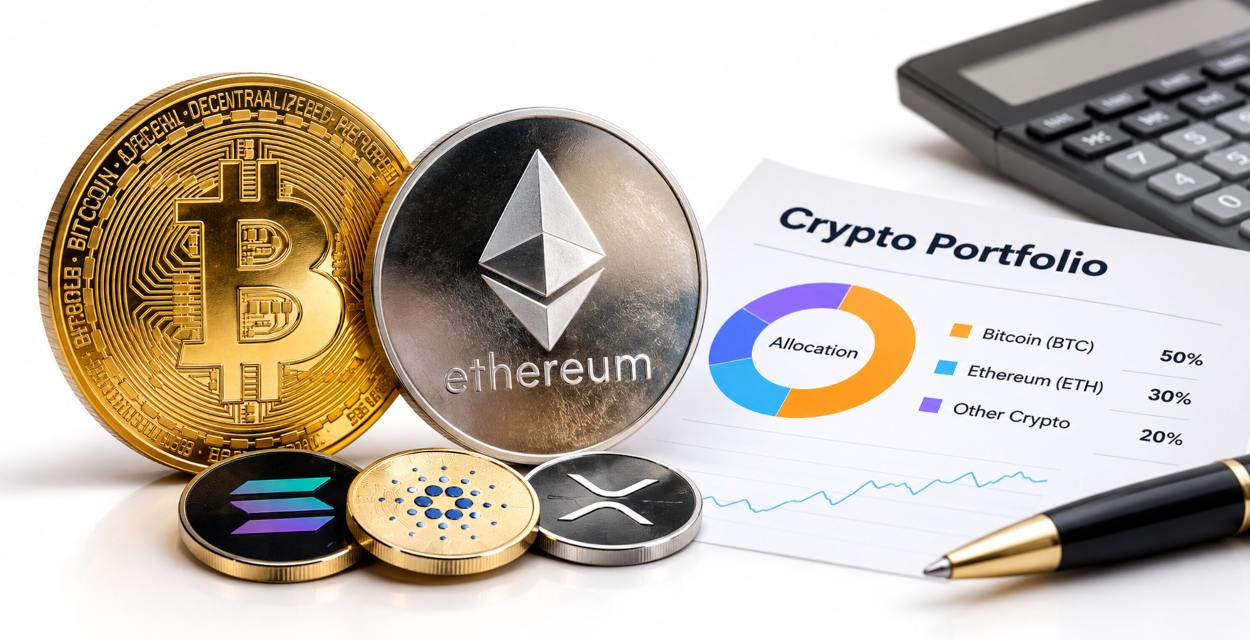
Now you know how much of your overall portfolio could go into crypto, so you can get to the next step and decide how to divide the amount. Bitcoin and Ethereum are the most popular cryptocurrencies, so most investors usually turn to them when they first welcome digital currencies into their portfolio. But we recommend researching the two projects before purchasing anything because they offer different types of exposure.
- Bitcoin has a fixed maximum supply of 21 million coins and is commonly viewed as a scarce digital asset.
- Ethereum, meanwhile, supports smart contracts and decentralized applications, with ETH serving as the network’s native asset.
- Both have established ecosystems, but neither is free from market, regulatory, or technological risks.
Smaller cryptocurrencies can offer exposure to different blockchain projects, sectors, and applications. However, they may also come with lower liquidity, less established adoption, and greater price volatility.
What Is Your Investment Time Horizon?
When do you need the money you’re investing? Do you rely on the profit for some major investment? Your answers will significantly influence how much crypto exposure makes sense for your current investment plan. Let’s say that your goal is to invest the money you need to use in a year or two. Then buying volatile assets might be unsuitable for you because you cannot afford to lose the funds, and no one can promise that everything will go well in the crypto sector. Even if you stick to Bitcoin and Ethereum, which have strong long-term potential, you still face risk because they can drop sharply at an inconvenient moment. A longer investment horizon will give you more flexibility to tolerate the market’s volatility.
Make Sure Crypto Doesn’t Take Over Your Portfolio
History shows that one of the biggest allocation mistakes happens after a successful rally. Let’s say that you decided to invest $500 in Bitcoin, as part of your $10,000 portfolio. The crypto allocation is 5%. In time, Bitcoin’s price increases steadily, and your holdings become worth $1,200, and the rest of the portfolio remains stable. Now you have a larger crypto allocation than you originally planned, even if you didn’t purchase extra crypto. This is why portfolio allocation should not be a one-time decision. Price movements can gradually change your exposure, sometimes leaving you with more risk than you planned to take.
Rebalancing can help address this. It involves reviewing your portfolio at regular intervals and adjusting positions to bring them closer to your target allocation. Depending on your strategy, this might mean reducing some crypto exposure after a strong rally or reconsidering your allocation if your financial circumstances change.
End Goal Is To Make An Allocation Plan You’re Comfortable With
We cannot tell you there is a magic percentage that works for everyone because every investor has their unique conditions. If you’re a beginner cautiously trying to learn about crypto, then you might prefer a very small allocation. But if you’re someone with a high risk appetite and a longer investment horizon, you can consider a larger one. One thing you should always keep in mind: build your decision around your financial situation.
Disclaimer
This article is for general information only and is not financial or investment advice. Cryptocurrencies are highly volatile and you could lose some or all of your money. Consider speaking with a qualified financial adviser before investing.