
Blog
Why Cybersecurity Visibility Matters In An Always-Connected World

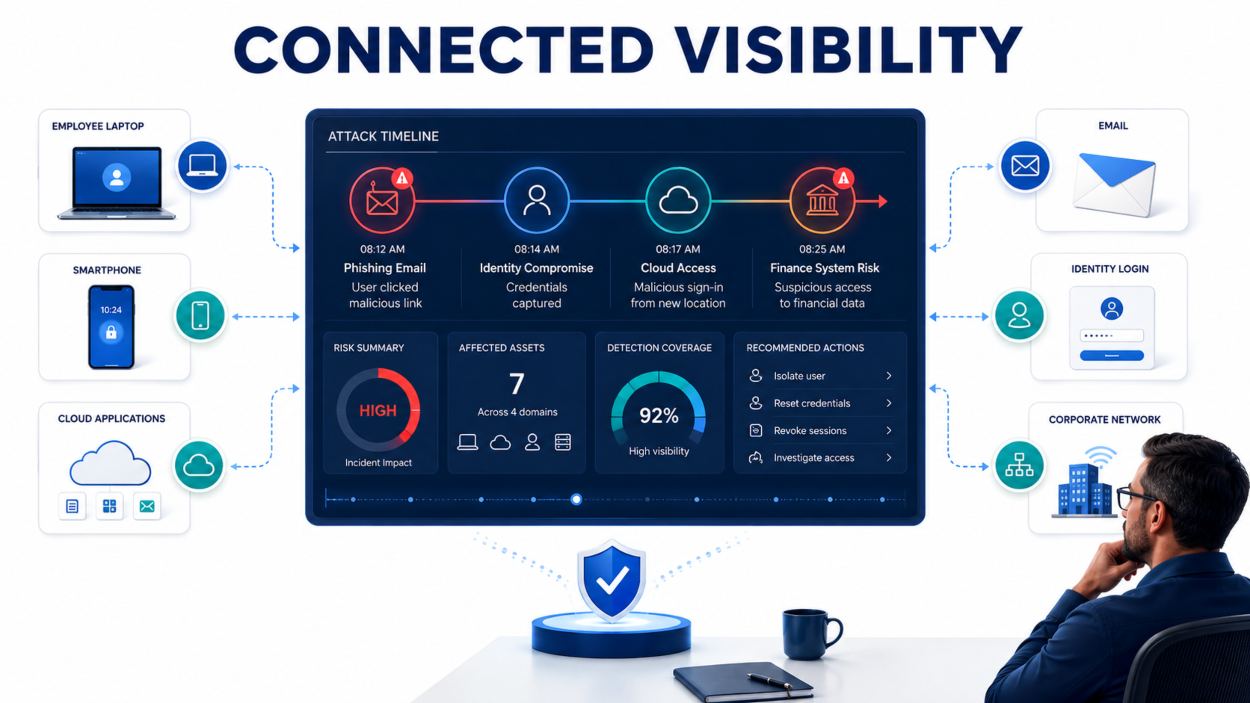
Most organisations do not get breached because nobody was watching. They get breached because the watching was spread across six tools that never compared notes.
That distinction matters. It changes what you buy, how you staff, and what you expect a security programme actually to deliver.
Attack Surface Grew Faster Than The Ability To Watch It
Work stopped happening in one building on one network some time ago. A single employee might touch a corporate laptop, a personal phone, three software-as-a-service applications, a VPN, a shared cloud drive, and a messaging platform before lunch. Each of those is a legitimate business tool. Each is also a place where an attacker can appear, and a place that generates its own separate log.
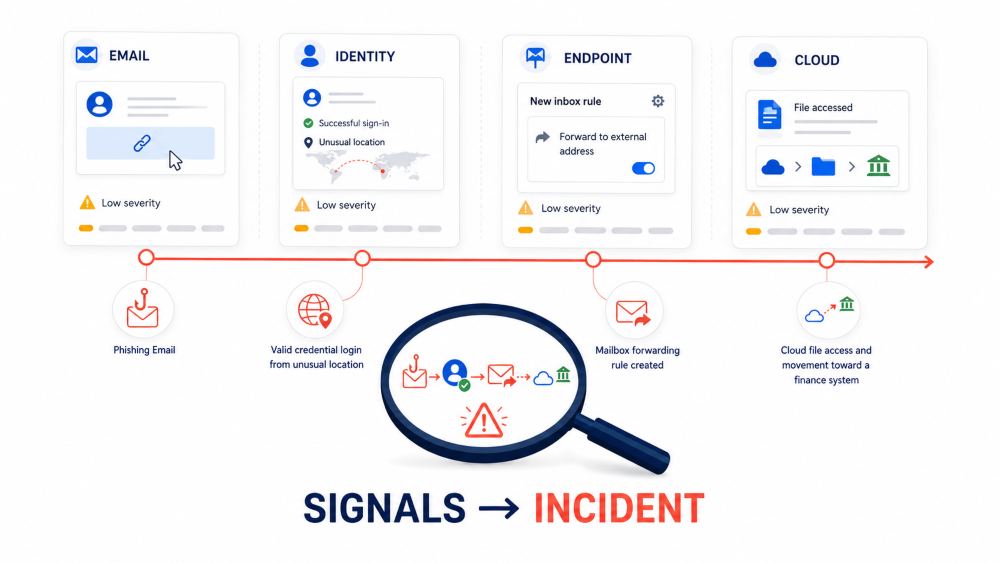
The awkward part is that attacks do not respect those boundaries. A convincing phishing email leads to a harvested password. That password is used to sign in from an unfamiliar location. The session is used to create a mail forwarding rule, then to reach a file store, then to move sideways into a finance system. Five stages, five different tools recording one fragment each, and no single tool holding the story.
The MITRE ATT&CK knowledge base is useful here precisely because it documents how real intrusions chain techniques together across initial access, persistence, credential access, and lateral movement. Reading it makes the fragmentation problem obvious. Defences are usually bought by category. Attacks are executed as sequences.
Why Isolated Alerts Create Blind Spots
Traditional controls are built around one domain. The endpoint agent watches processes. The email gateway inspects messages. The identity provider logs authentications. The firewall sees traffic. Every one of those is worth having, and none of them is wrong. The gap opens between them.
Consider what each tool sees during the intrusion described above:
- The email gateway sees a message that passed filtering because it contained no attachment and no known-bad link.
- The identity platform sees a successful login with valid credentials, from a new country, which may or may not exceed the risk threshold that triggers an alert.
- The endpoint agent sees nothing at all, because the attacker never touched the laptop.
- The cloud platform sees file access that looks like normal user behaviour, because a real user account is performing it.
Individually, not one of those events is compelling. Together, they are an incident in progress. Stolen credentials remain one of the most reliable ways into an organisation, a pattern that Verizon’s annual Data Breach Investigations Report documents year after year, and credential-based intrusions are exactly the kind that survive on this sort of low individual severity.
Fragmentation also costs time during the response itself. An analyst who has to log into four consoles, export three sets of logs, normalise the timestamps, and hand-build a timeline is spending the most valuable hour of the incident on data assembly rather than on containment. IBM’s Cost of a Data Breach research has consistently found that the length of time taken to identify and contain a breach tracks closely with what it ends up costing. Time spent stitching evidence together is time the attacker keeps.
There is a quieter failure mode too. When alerts arrive as unranked noise from a dozen sources, teams start triaging by severity label alone. Severity scores such as those defined by the Common Vulnerability Scoring System describe the technical characteristics of a weakness, not whether it sits on an internet-facing server holding customer records. Without context, high-scoring but irrelevant findings get attention while a medium-scoring one in a critical position waits.
What Extended Detection And Response Actually Changes
Extended detection and response is, at its core, a correlation layer. It ingests telemetry from endpoints, network, identity, email, vulnerability data, and cloud services, then relates those signals to each other so that a sequence of individually unremarkable events can be surfaced as one connected chain.
The practical difference is what an analyst sees at the start of an investigation. Instead of an alert, they get a story: this user, this device, this session, this process, this destination, in this order. For organisations evaluating the model, platforms such as XDR extended detection and response bring that centralised visibility together with detection, investigation, and response capabilities in one console.
Two things are worth being honest about.
First, this is not a replacement for skilled people. It is a better starting position for them. The judgement calls- whether to isolate a machine mid-shift, whether to force a password reset across a department, whether an anomaly is an attack or a badly configured integration- still belong to humans who understand the business.
Second, correlation quality depends entirely on what you feed it. An XDR deployment connected to two of your seven data sources is a partial view wearing the language of a complete one, which is arguably worse than knowing your view is partial.
Turning Visibility Into Action
Visibility that does not shorten the path to a decision is just a more attractive dashboard. The useful question is what happens in the first fifteen minutes after something is confirmed.
That means having answers ready before the incident:
- Scope. Which accounts, devices, and data are implicated, and how confident are you in that boundary?
- Containment authority. Who is allowed to disconnect a device or deactivate an executive’s account at two in the morning without waiting for approval?
- Automation limits. Which actions are safe to trigger automatically, and which must stay manual because the blast radius of a false positive is too high?
- Evidence preservation. What gets captured before you start remediating, so that later analysis and any legal or regulatory obligation are still serviceable?
The UK National Cyber Security Centre’s incident management guidance is a good, plainly written starting point for building this, and it is free.
A consolidated data set also makes proactive threat hunting realistic rather than aspirational. Analysts can search across connected telemetry for indicators tied to techniques they know are being used against their sector, instead of waiting for a rule to fire. Feeding that hunt with the CISA Known Exploited Vulnerabilities Catalog is a sensible habit, since it lists flaws confirmed to be exploited in the wild rather than merely theoretical.
What This Approach Does Not Fix
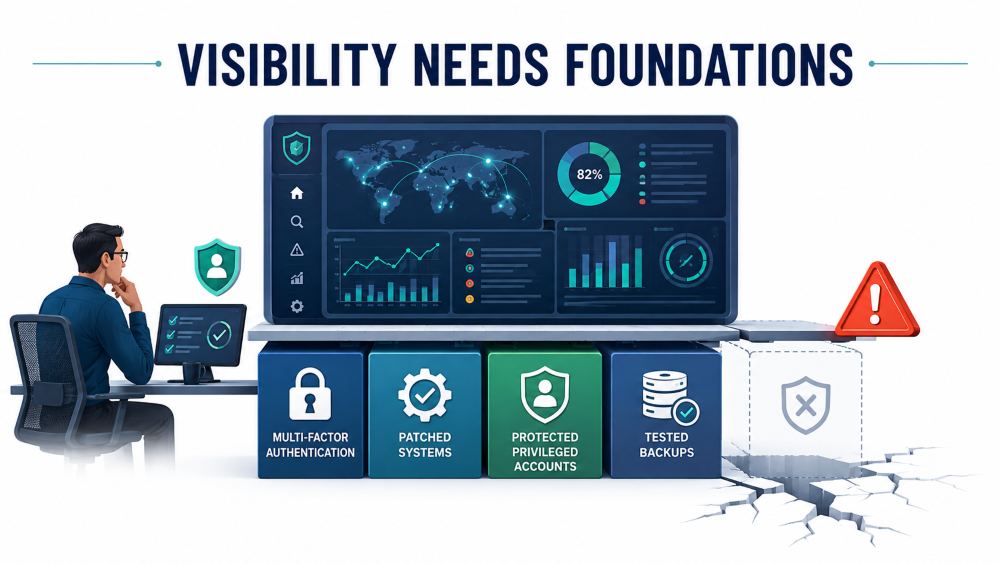
No detection platform substitutes for hygiene. If privileged accounts are shared, if multi-factor authentication is optional, if unsupported systems remain in production, if backups have never been restore-tested, then better visibility mostly means watching preventable problems happen in higher resolution.
The NIST Cybersecurity Framework is helpful for keeping the balance honest, because it treats governance, identification, and protection as peers of detection and response rather than as preliminaries. And for organisations rethinking access itself, NIST Special Publication 800-207 on zero trust architecture sets out the reasoning for removing implicit trust from internal network positions, which addresses the lateral movement problem closer to its root.
There are also operational costs worth budgeting for honestly. Telemetry volume drives licensing and retention decisions. Tuning takes months, not days. Alert fatigue does not disappear on installation; it moves. Any vendor conversation that skips these is a conversation to be sceptical of.
Building A More Complete Security Strategy
The organisations that handle incidents well are rarely the ones with the longest tool list. They are the ones that can answer, quickly and with evidence, three questions: what happened, how far did it reach, and what do we do next.
Connected visibility is what makes those questions answerable in minutes instead of days. It sits between noticing a single strange signal and understanding the whole incident, and in an environment where work happens everywhere at once, that gap is where most of the damage is done.
Questions Worth Asking Before You Commit
If you are evaluating a platform, these tend to separate substance from demo polish:
- Which of our existing data sources are supported natively, and which require custom work?
- How long is telemetry retained at full fidelity, and what does extending that cost?
- What can the platform do automatically, and can we constrain it per asset group?
- How are correlated detections explained, so an analyst can verify the reasoning rather than trust a score?
- What does the first ninety days of tuning realistically involve, and who does it?
Conclusion
Visibility is not a product you install once and tick off a list. It is a condition you maintain, and it degrades quietly every time a new application, contractor, or device joins the environment without joining the monitoring.
What is worth taking from all of this is fairly simple. Attacks arrive as sequences, so defences that only report in fragments will always be one step behind the story. Correlated telemetry closes that distance, but only if the sources are genuinely connected, the people reading it are supported rather than replaced, and the basics underneath it are sound.
If you are deciding where to spend next, start by writing down what your team would actually be able to see and do in the first hour of a credential compromise tonight. The honest answer to that usually points to the right investment more reliably than any vendor comparison chart.