
Blog
Bankroll Habits That Still Cost Experienced Poker Players

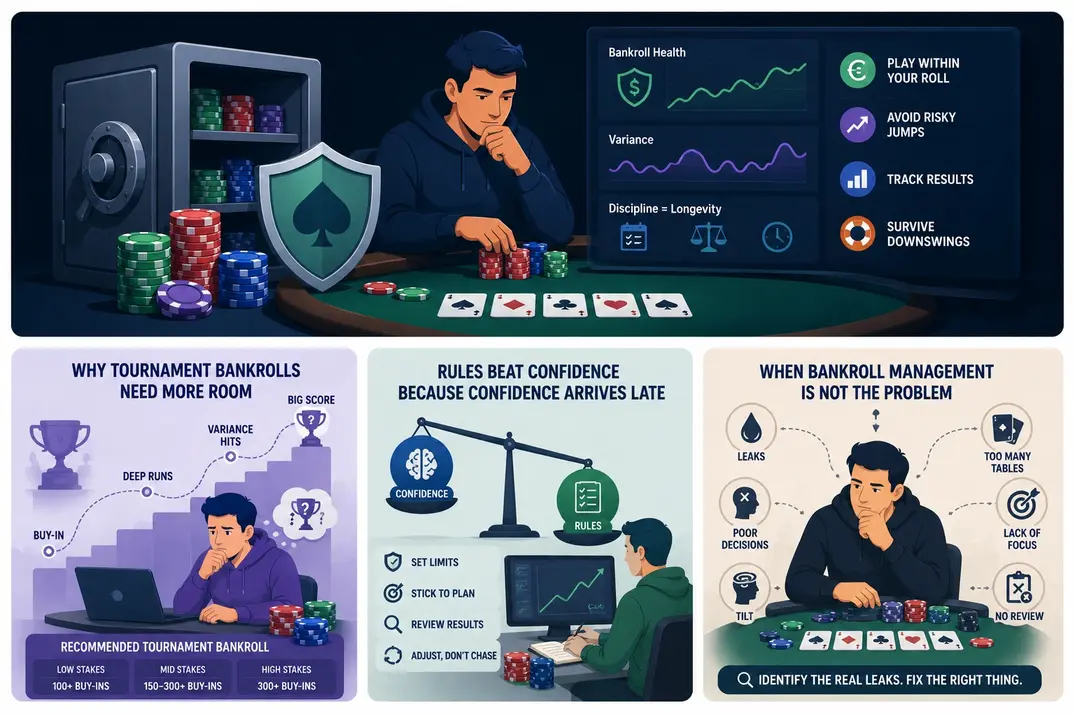
Nobody loses a bankroll because they never learned the rules. Ask any regular what a sensible tournament roll looks like, and you will get a coherent answer inside ten seconds. Watch the same player three months into a good run, and the answer has quietly stopped applying to them.
That is the shape of the problem. Bankroll rules do not fail through ignorance. They erode, one reasonable-sounding exception at a time, and almost every exception is attached to something actually true. The game really was soft. The score really did happen. The month really was good.
Being good enough to beat a game and having the bankroll to survive it are separate questions, and the second one does not care how well you answered the first.
Bankroll Depth Is A Ratio, Not A Number
A bankroll figure on its own tells you almost nothing. Five thousand is a comfortable roll, a marginal one, or an act of vandalism depending entirely on what you do with it.
What matters is how many buy-ins it represents in the format you actually play, which means the number moves the moment anything else does. Before picking a stake, the honest inputs are:
- Full buy-ins available at that level.
- Typical field size, if tournaments.
- Tables played at once.
- Rake and entry fees as a share of the buy-in.
- How easily you can drop back down.
- Total exposure in a single session.
A cash player sitting 100bb deep and an MTT player entering four-figure fields are running two different risk profiles that happen to share a currency. Six-max, heads-up, turbos and deep-stack events all pull on the roll differently. The buy-in count is the only figure that travels between them.
Why Tournament Bankrolls Need More Room
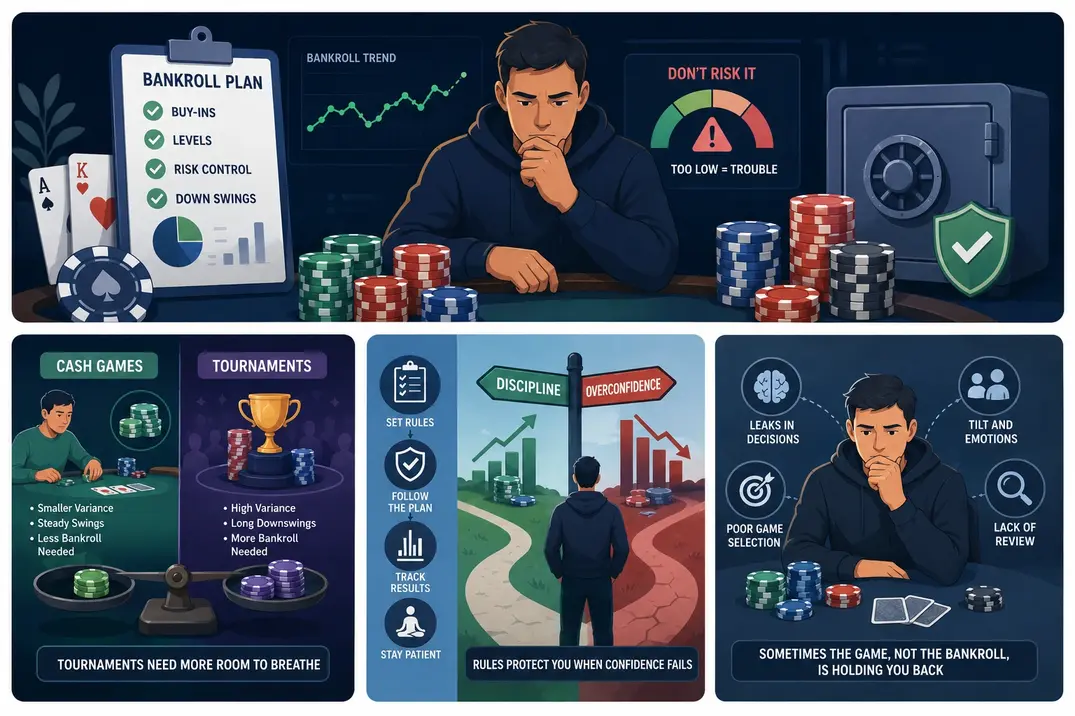
Tournament variance is not just bigger; it arrives differently. Most of the return sits in a handful of deep runs, which means long stretches of the schedule are structurally unprofitable even when you are playing well. Top-heavy payouts and large fields sharpen that further.
This catches cash players moving across more than anyone. They are used to results that settle gradually, a graph that wobbles but trends. Tournament results do not settle; they lurch, and a roll sized around modest fields will not hold up once the schedule tilts toward huge ones.
Math Almost Nobody Actually Runs
There is a formal version of all this. The optimal fraction of a bankroll to risk on a favourable bet was worked out by a Bell Labs researcher in 1956, and the result is less comforting than people expect: the correct fraction is small, and it shrinks fast as your edge shrinks or your variance grows.
Two things follow that are worth sitting with. First, betting more than the optimal fraction does not just add risk; it eventually reduces long-run growth even when you hold a genuine edge. Overbetting a winning game is still a losing plan. Second, because nobody can measure their own edge precisely, serious players who use this framework deliberately bet a fraction of the fraction. Half or a quarter, typically.
That is what conventional buy-in guidelines are, stripped of the maths. They are a conservative estimate wrapped in a rule of thumb, and the conservatism is the point rather than an artefact of caution.
Shots Need An Exit Written Down First
Taking a shot is not a bankroll failure. Taking one without knowing where it ends is.
Four things should be settled before you sit down, and settled in writing somewhere you will actually see them:
- How many buy-ins the shot gets.
- Which bankroll figure ends it.
- Whether one big win changes the plan, and it should not.
- What sample makes the higher stake permanent rather than temporary.
A soft 2/5 game still produces ordinary losing sessions. A soft $215 still busts on level one. Game quality moves your expected value; it does not reduce the size of the swing when the swing goes against you. Those are separate variables, and players collapse them constantly.
What A Heater Actually Does To Your Judgement
After a strong few weeks, something predictable happens to how you think about the balance. Recent profit stops feeling like bankroll and starts feeling like winnings, which is a different psychological category entirely.
This is measurable, and it is not specific to poker. Experimental work on how prior gains and losses change risk-taking found a clear house money effect, where people take more risk after a win because they are mentally spending someone else’s money. The same research found the mirror image after losses, where any option offering a route back to even becomes disproportionately attractive. Both effects push toward the same place: bigger buy-ins at exactly the wrong moment.
There is a second layer worth being careful about. The instinct to dismiss all streaks as illusion has itself been challenged. The canonical hot hand study was reanalysed and found to contain a selection bias, and once corrected, the evidence for genuine streakiness reappeared. So a heater is not automatically noise, and you may genuinely be playing better.
That does not rescue the bankroll argument; it complicates its usefully. Playing well and running well feel identical from the inside; they usually occur together, and neither tells you your true edge has moved enough to justify a new stake. A heater is good play, soft games and positive variance arriving as one indistinguishable lump.
Rules Beat Confidence Because Confidence Arrives Late
Set your move-up rules before the run starts, because the moment you need them is the moment you will find them least persuasive.
The specific figures matter less than fixing them in advance: the minimum roll for the next limit, the buy-ins allocated to a shot, the number that sends you back down, the sample that makes the move permanent. Written first, these are just arithmetic. Written during a heater, they are negotiation.
Research tracking hot hand and gambler’s fallacy beliefs over time suggests these intuitions are stable features of how people read sequences rather than errors you outgrow with experience. You do not stop feeling them. You decide in advance not to let them hold the pen.
Keep Poker Money In Its Own Box
Bankrolls get unreadable the moment they stop being a ring-fenced pot. Deposits, withdrawals, sports bets and casino play all move through the same cashier, and within a few months the balance sitting there has almost no relationship to how you have run at the tables.
The accounting is different in kind. If you are reading something like HitnSpin Bonuses, you are looking at welcome offers, cashback percentages and wagering multipliers, and this is where a distinction gets lost that costs people real money: a bonus balance carrying a 40x playthrough requirement is not bankroll. It is a conditional credit you have to turn over before any of it is yours. Counting it as buy-ins is how players end up sitting in games their actual, withdrawable money does not cover.
Poker bankroll is buy-ins you could put on the table this minute, after rake and fees. Everything else belongs in a different column. Clean tracking separates poker deposits, cash-game buy-ins, tournament entries, rake, fees, withdrawals and any outside money you have topped up with. That last one matters most. Regular reloads after losing weeks make the cashier balance a flattering fiction, and the flattery always runs in the direction of playing higher.
Volume Is A Multiplier On Everything
More hands do not change your edge. They change how quickly variance expresses itself, in both directions.
Six tables reach more decisions per hour than one by an obvious margin. Fifteen tournaments expose five times the buy-ins of three. Neither is a mistake by itself, but both compress the timeline on which your roll gets tested, and a bankroll adequate for a light schedule may be thin for a heavy one at the same stakes.
Leaks scale too. A marginal river call that costs a little is a rounding error across two hundred hands and a genuine line item across twenty thousand. Fatigue works the same way. The eighth hour of a six-table session is not the same product as the first.
Two players with an identical roll at identical stakes can be carrying very different risk, so session records should include table count, hours, hands or tournaments completed, and total buy-ins exposed. That is what shows whether extra volume is buying you earnings or just accelerating the downswing.
Moving Down Is A Skill, Not A Demotion
After months at a limit, dropping back feels like undoing something. That feeling keeps more players in games their bankroll no longer supports than any misunderstanding of the maths ever has.
A pre-set move-down rule takes the decision away from your ego and hands it to a number. Roll drops below the threshold, you drop limits, you rebuild. Holding buy-ins in reserve is what preserves the option to keep playing at all, study the leaks that showed up, and take a better-funded shot later. Players who refuse to move down do not avoid the demotion. They take it involuntarily and with no reserve left.
Your Edge Is Real. It Just Needs Time To Show Up.
The reason any of this is worth the discipline is that skill in poker is measurable rather than theoretical. Analysis of the 2010 World Series of Poker found that players identified as highly skilled before the events began returned over 30% on investment, against roughly minus 15% for everyone else.
That is a substantial gap. It is also a gap that only became visible across a full series, which is the entire argument in one sentence. Your edge is real, and it needs a sample to assert itself. Bankroll management is not a brake on the edge. It is the thing that keeps you at the table long enough for the edge to finish arriving.
Experienced players break bankroll rules for reasons that sound completely sound at the time. The lineup is soft, the structure is good, the run is hot, the value is obvious. Those things can all be true at once. Bankroll depth, shot limits and move-down rules still apply, because they were never arguments about whether the game was good.
When Bankroll Management Is Not The Problem
One honest caveat, because the framing above assumes a specific situation: you are playing a game you can beat, you want to keep playing it, and the only open question is sizing.
If the pattern is different, bankroll rules are the wrong tool and will not help. Chasing losses, playing to recover rather than because you want to, hiding the extent of play from people close to you, borrowing to reload, or being unable to stop when the plan said stop are not sizing problems and no buy-in count fixes them.
In Great Britain, GamCare runs the National Gambling Helpline free and around the clock, and the National Gambling Support Network provides free treatment and support across the country. Practical controls including deposit limits, blocking software and self-exclusion through GAMSTOP exist, and all of them work better when set up early rather than at a crisis point. One limitation worth knowing about that last one: GAMSTOP covers operators licensed by the Gambling Commission, so it does not block sites licensed elsewhere. Outside Great Britain, your national regulator will list the equivalent scheme.
None of that is a footnote to the article. It is the boundary of what the article is about.
Disclaimer
This piece is general information about bankroll practice, not financial advice or a guarantee of results. Gambling involves risk of loss, and no bankroll approach removes that risk or makes any game profitable. The research cited describes group-level findings that do not predict individual outcomes, and some of it, including the hot hand literature, remains actively debated. Anyone gambling should only use money they can afford to lose, and should check that any operator they use is licensed by the appropriate regulator for their jurisdiction. Must be 18 or over, or the legal age where you live.
References
- Gilovich, T., Vallone, R., and Tversky, A. (1985). The hot hand in basketball: on the misperception of random sequences. Cognitive Psychology, 17(3), pp. 295-314.
- Kelly, J. L., Jr. (1956). A new interpretation of information rate. Bell System Technical Journal, 35(4), pp. 917-926. https://doi.org/10.1002/j.1538-7305.1956.tb03809.x
- Levitt, S. D., and Miles, T. J. (2014). The role of skill versus luck in poker: evidence from the World Series of Poker. Journal of Sports Economics, 15(1), pp. 31-44. https://doi.org/10.1177/1527002512449471
- Miller, J. B., and Sanjurjo, A. (2018). Surprised by the hot hand fallacy? A truth in the law of small numbers. Econometrica, 86(6), pp. 2019-2047. https://doi.org/10.3982/ECTA14943
- Thaler, R. H., and Johnson, E. J. (1990). Gambling with the house money and trying to break even: the effects of prior outcomes on risky choice. Management Science, 36(6), pp. 643-660. https://doi.org/10.1287/mnsc.36.6.643