
Role of Repetition in Making Simple Games Addictive Without Rewards

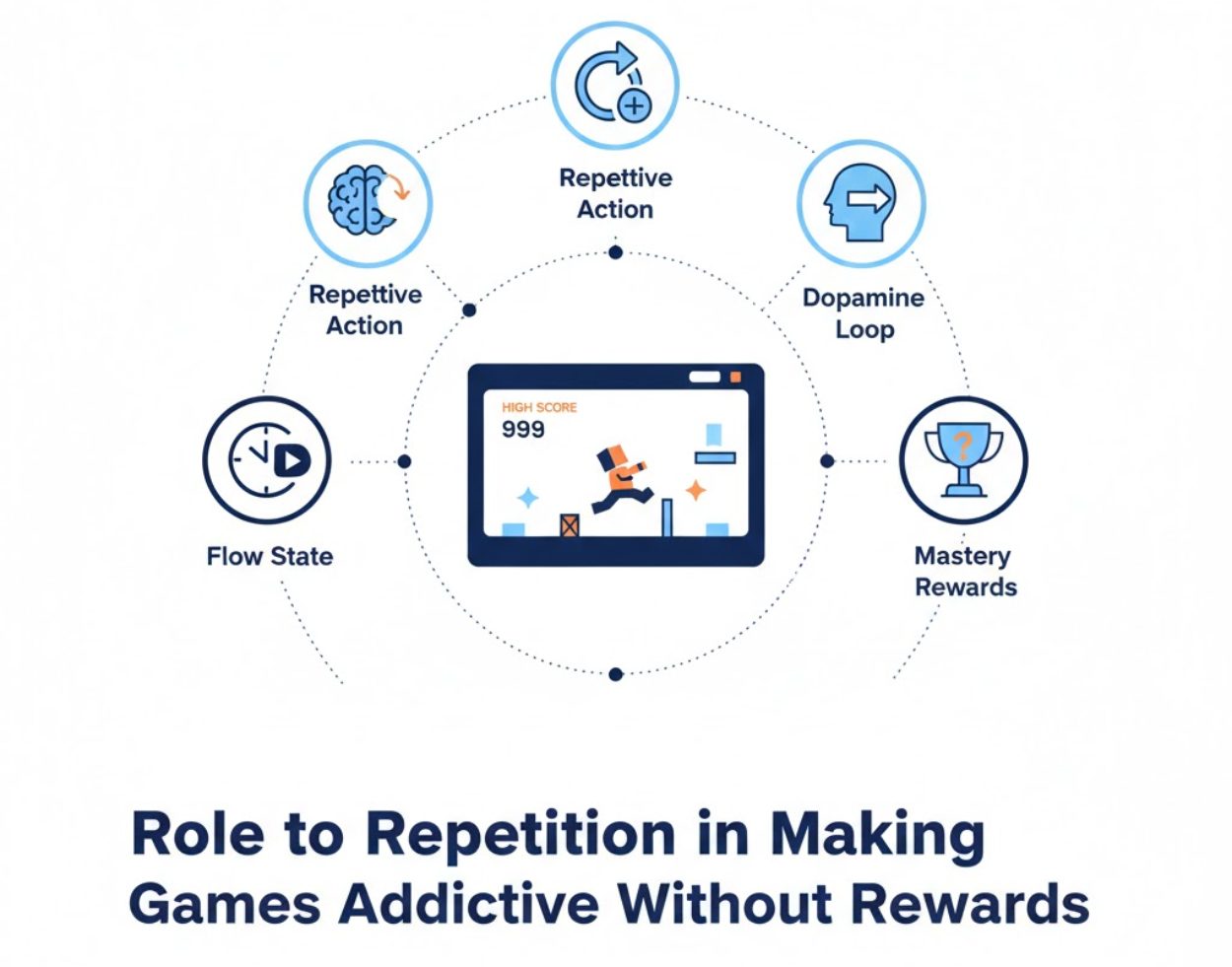
Some games offer nothing tangible. No coins, no upgrades, no prizes. Yet players return compulsively. The game ends. They restart. They fail again. They try once more. This pattern, repeated thousands of times, reveals a fundamental aspect of human psychology and the nature of engagement.
This phenomenon isn’t accidental. It emerges from deep psychological principles about how our brains process challenge, learning, and satisfaction. Understanding these mechanisms can help us recognise when simple games move from entertainment to compulsion and why that transition feels so seamless.
Why Simple Games Don’t Need Rewards
Shift from External to Internal Motivation
Modern games, including casino online games, often rely heavily on external rewards, such as point systems, achievement badges, daily login bonuses, and progression unlocks. These are examples of extrinsic motivation behavior driven by external outcomes. Simple games, by contrast, tap into intrinsic motivation, the satisfaction derived from the activity itself.
Psychologist Edward Deci’s research on self-determination theory demonstrates that intrinsic motivation often produces deeper, more sustainable engagement than external rewards. When you play a simple game or even a casino online game, the reward isn’t a virtual trophy; it’s the feeling of improvement, the satisfaction of smooth execution, and the challenge of self-mastery.
Repetition as Its Own Reward
In simple games, repetition replaces reward structures. Each attempt offers slightly different information: Did you jump too early? React too slowly? Misjudge the distance? This constant feedback loop creates what behavioural psychologists call a variable-interval schedule, where improvement appears unpredictably but frequently enough to maintain hope.
This schedule is remarkably powerful. B.F. Skinner’s research showed that variable reinforcement creates stronger, more persistent behavior than consistent rewards. You never know which attempt will yield a breakthrough improvement, so every attempt feels potentially significant.
Neuroscience of Improvement Without Rewards
How Your Brain Tracks Subtle Progress
While you might not level up in a traditional sense, your brain meticulously tracks improvement. Each time you play, your neural pathways become slightly more efficient. Your reaction time decreases by milliseconds. Your pattern recognition sharpens. Your motor control refines.
Neuroscientific research on procedural learning shows that the basal ganglia, brain regions responsible for habit formation and motor learning, strongly activate during repetitive skill-based tasks. As you practice, these neural circuits strengthen through a process called long-term potentiation, making previously difficult movements feel automatic.
This creates a paradox: the game stays identical, but you change. That transformation, however subtle, registers as progress. And progress, even without external validation, triggers dopamine release in your brain’s reward centres.
Pattern Recognition and Cognitive Satisfaction
The human brain evolved to detect patterns because pattern recognition provided survival advantages. When you identify patterns in a simple game, the rhythm of obstacles, the timing of jumps, and the sequence of challenges, your brain experiences genuine satisfaction.
Research in cognitive psychology demonstrates that pattern completion activates the brain’s reward system independently of external reinforcement. This is why solving puzzles feels satisfying even without prizes, and why mastering a game’s timing can be pleasurable even when nothing unlocks.
Frictionless Loop: Why Restarting Feels Effortless
Removing Psychological Barriers to Retry
Traditional games often insert friction into the retry process: loading screens, menus, and consequences for failure. Simple games eliminate these barriers. When you fail, the game restarts instantly. This design choice is psychologically significant.
Decision fatigue research shows that every choice depletes mental energy. By removing the decision to retry and making restarts automatic or nearly instant, simple games reduced the psychological effort required to continue playing. There’s no pause for reflection, no opportunity to question whether you should stop. The game flows seamlessly from attempt to attempt.
Zeigarnik Effect and Unfinished Business
The Zeigarnik effect, discovered by psychologist Bluma Zeigarnik, describes our tendency to remember uncompleted tasks more vividly than completed ones. When you fail at a simple game, your mind treats it as unfinished business. This creates psychological tension that can only be resolved by trying again.
Because the retry is instant, resolving that tension requires minimal effort. The psychological discomfort of failure transitions immediately into the hope of success. This rapid cycling between tension and potential resolution creates a powerful engagement loop.
From Conscious Effort to Automatic Flow
Development of Muscle Memory
Initially, playing requires conscious thought. You deliberately time each action and think through each decision. But through repetition, control migrates from your prefrontal cortex (conscious decision-making) to your cerebellum and motor cortex (automatic execution).
Research on motor learning shows this transition happens remarkably quickly with simple, repeated movements. Within hours of practice, your brain begins automating frequent patterns. This automation has profound psychological effects: the game begins to feel smooth, effortless, and increasingly satisfying.
Flow States in Minimal Gaming
Psychologist Mihály Csíkszentmihályi identified ‘flow’ as a state of complete absorption in which skill matches challenge perfectly. Simple games excel at inducing flow because they maintain this balance automatically. As you improve, you naturally attempt more ambitious runs. As you push yourself, the challenge rises naturally.
Flow states are inherently pleasurable and time-distorting. During flow, the outside world fades, self-consciousness disappears, and time perception warps. This is why ‘just one more try’ can suddenly become an hour of gameplay without awareness. You’re not being rewarded, you’re experiencing flow, which is its own powerful reinforcement.
Liberation of Zero Stakes
How Removing Consequences Changes Engagement
When games include progression systems, failure carries psychological weight. You risk losing progress, breaking streaks, or wasting resources. This creates performance anxiety that paradoxically reduces enjoyment.
Simple games eliminate these stakes. Nothing accumulates. Nothing is lost. This absence of consequences creates a sense of psychological safety that enables pure experimentation. Research on learning environments shows that reducing fear of failure dramatically increases both engagement and actual learning.
Practical insight: This is why simple games often feel more relaxing than complex ones, even when they’re objectively more difficult. The difficulty is technical, not emotional. You can fail endlessly without feeling punished.
Comfort of Predictable Failure
Paradoxically, failure in simple games becomes comforting rather than frustrating. Because the game’s rules remain constant, each failure provides clear information. You know exactly why you failed and approximately how to improve.
This predictability reduces the emotional sting of loss. You’re not failing randomly; you’re learning systematically. Behavioural psychology research shows that predictable challenges with clear causes foster persistence, while unpredictable or unclear failures lead to abandonment.
Time Compression and Session Length
Why ‘Just One More’ Becomes Dozens
Simple games employ remarkably short play cycles. Each attempt might last 10-60 seconds. This brevity creates a dangerous illusion: the time commitment seems trivial. ‘One more try’ feels like nothing.
But this is deceptive. Twenty 30-second attempts equal ten minutes. Sixty attempts equal thirty minutes. 100 attempts are easily achievable when you’re engaged, and nearly an hour is the equivalent. The game feels quick, but sessions extend far longer than intended.
Research finding: Studies on time perception show that engagement dramatically compresses perceived time. Activities that capture attention feel shorter than they actually are. Combined with short individual attempts, this creates significant time distortion.
Absence of Natural Stopping Points
Traditional games include natural breaks: level completions, save points, and story chapters. These create psychological moments to pause and evaluate. Simple games intentionally lack these structures.
Without natural stopping points, the decision to quit must be entirely self-directed. This requires active effort and conscious choice, precisely the resources that flow states and engagement deplete. This is the mechanism that transforms ‘five minutes’ into hours.
Protective strategy: Set external timers before playing. Your engaged brain won’t accurately track time, so external reminders become essential for maintaining control.
Psychology of Self-Competition
Internal Goals and Personal Records
Even without leaderboards or score displays, players naturally create internal goals. You remember your best run. That memory becomes the benchmark. Beating it becomes the objective.
Self-determination theory explains why this is particularly powerful. Goals we set for ourselves create stronger motivation than externally imposed targets. When you’re competing against your own best performance, you’re engaging in the most personally meaningful form of challenge.
Reframing Failure as Data
In simple games, failure communicates specific information. You died at obstacle 7 instead of obstacle 5. You survived three seconds longer. You reacted 100 milliseconds slower than necessary.
This transforms failure from emotional defeat into neutral feedback. Carol Dweck’s research on growth mindset shows that this reframing is psychologically crucial. When failure is seen as information rather than judgment, persistence increases dramatically. You’re not losing; you’re experimenting and learning.
Hidden Dangers of Endless Loops
When Engagement Becomes Compulsion
The same mechanisms that make simple games engaging can enable problematic patterns. The lack of stopping points, the frictionless retry loop, and the time compression aren’t accidental. They’re design choices that maximise engagement.
Warning signs of problematic gaming:
- Regularly playing longer than intended (time distortion)
- Difficulty stopping even when experiencing negative emotions (irritability, frustration)
- Gaming interferes with sleep, work, or relationships
- Using games primarily as emotional regulation or escape
- Feeling irritable or restless when unable to play
- Lying about or minimising time spent gaming
The World Health Organisation officially recognised Gaming Disorder in 2019. While simple games aren’t inherently more addictive than complex ones, their frictionless design can make problematic patterns harder to recognise.
Role of Dopamine and Habit Formation
Each small success in a simple game, surviving slightly longer, reaching a new obstacle, executing a perfect sequence, triggers dopamine release. This neurochemical doesn’t just signal pleasure; it reinforces the behavior that preceded it.
With hundreds or thousands of attempts, you’re training your brain to crave that activity. The dopamine system doesn’t distinguish between productive skill development and compulsive repetition. Both get reinforced equally.
Important consideration: If you find yourself thinking about the game when not playing, planning your next session while occupied with other activities, or experiencing relief specifically when starting to play, you may be developing habit-level engagement that warrants attention.
Practical Strategies for Healthy Gaming
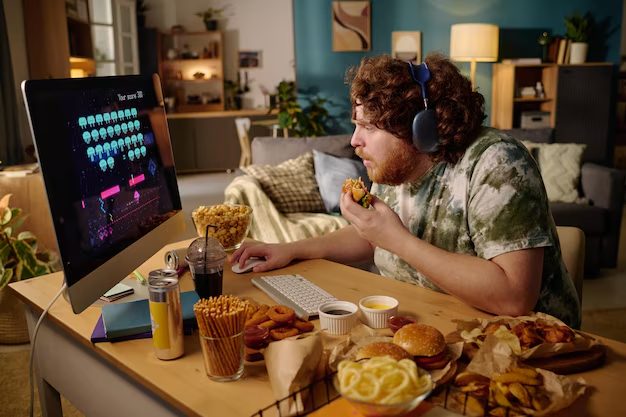
Setting Boundaries That Actually Work
1. External Time Constraints
Don’t rely on willpower during engaged play. Set physical timers, phone alarms, or use apps that force-close games after specified durations. Your engaged brain cannot accurately judge the passage of time.
2. Attempt Limits Instead of Time Limits
Sometimes limiting attempts works better than limiting time. ‘I’ll try 10 more times’ creates a concrete endpoint. Count attempts using physical tokens (moving coins from one pile to another) to maintain awareness.
3. Environmental Modifications
Play in public spaces rather than private rooms. Social visibility naturally limits session length. Make accessing games slightly inconvenient, remove shortcuts, add folder depth, and require multi-step launching. Small friction significantly reduces automatic engagement.
4. Scheduling and Containment
Designate specific gaming windows. This transforms gaming from ‘whenever available’ to ‘planned activity,’ reducing impulsive engagement. Schedule activities immediately after gaming to create natural endpoints.
Recognising When Help Is Needed
If self-imposed boundaries consistently fail, if gaming causes significant life disruption, or if you experience distress about your gaming but cannot stop, professional support may be beneficial.
Therapists specialising in behavioural addictions can provide structured interventions. Cognitive-behavioural therapy (CBT) has proven effectiveness for problematic gaming patterns. Support groups, both online and in-person, offer a sense of community.
Remember: Seeking help isn’t an admission of weakness. These games are intentionally designed to maximise engagement using sophisticated psychological principles. Professional guidance provides equally sophisticated counter-strategies.
Why This Matters Beyond Gaming
Applications in Learning and Skill Development
Understanding these mechanisms isn’t just about gaming awareness. The same principles apply to the acquisition of productive skills. Deliberate practice, immediate feedback, low-stakes repetition, and intrinsic satisfaction drive mastery in any domain.
Musicians, athletes, programmers, and artists all benefit from understanding how repetition without explicit rewards builds genuine competence. The challenge is harnessing these psychological mechanisms intentionally rather than being caught up in them accidentally.
Digital Design Ethics and Consumer Awareness
As users, understanding these engagement mechanisms helps us make informed choices about what we consume and how we consume it. Not all engagement is problematic, but unconscious engagement removes agency.
As designers, recognising the power of these patterns creates ethical responsibility. Maximising engagement isn’t inherently wrong, but maximising engagement without regard for user well-being is. The industry increasingly acknowledges this tension.
Conclusion
Simple games demonstrate that elaborate reward systems aren’t necessary for deep engagement. Repetition itself, when paired with clear feedback, gradual improvement, and frictionless retry loops, creates a powerful psychological pull.
This isn’t inherently good or bad. Flow states are genuinely pleasurable. Skill mastery provides authentic satisfaction. The problem emerges when engagement becomes unconscious, when hours slip by unnoticed, when gaming displaces essential activities.
The solution isn’t avoiding simple games entirely. It’s understanding their psychological mechanisms well enough to engage consciously. Set boundaries before playing. Recognise when sessions extend beyond intention. Notice if gaming becomes a form of emotional regulation rather than entertainment.
Ultimately, these games reveal fundamental truths about human psychology: we’re drawn to challenge, we find satisfaction in improvement, and we experience pleasure in mastery. Understanding these drives helps us direct them intentionally toward games when we choose recreation, toward meaningful pursuits when we choose growth, and away entirely when we recognise compulsion replacing choice.
IMPORTANT DISCLAIMER
This article discusses psychological mechanisms that can lead to compulsive gaming behavior. While simple games can provide entertainment and stress relief, the patterns described here may contribute to problematic gaming habits in some individuals.
Please be aware:
- If you find yourself unable to stop playing despite negative consequences (missed obligations, sleep deprivation, neglected relationships), you may be experiencing problematic gaming behavior.
- Set time limits before playing and use alarm systems to enforce breaks.
- Gaming should enhance your life, not replace essential activities like sleep, work, or social connections.
- If you’re concerned about your gaming habits, consider consulting a mental health professional specialising in behavioural addictions.
Additional Resources
For Further Reading:
- Csikszentmihalyi, M. (1990). Flow: The Psychology of Optimal Experience
- Deci, E. L., & Ryan, R. M. (2000). Self-Determination Theory and the facilitation of intrinsic motivation, social development, and well-being
- Dweck, C. S. (2006). Mindset: The New Psychology of Success
- King, D. L., & Delfabbro, P. H. (2018). Internet Gaming Disorder: Theory, Assessment, Treatment, and Prevention
Support Resources:
- Game Quitters: www.gamequitters.com (online community and resources)
- SAMHSA National Helpline: 1-800-662-4357 (24/7 support)
- Psychology Today Therapist Finder: Filter for ‘Internet Addiction’ or ‘Behavioural Addictions’
- WHO Resources on Gaming Disorder: www.who.int