
Live Casino vs. RNG Casino Games: Key Differences Explained

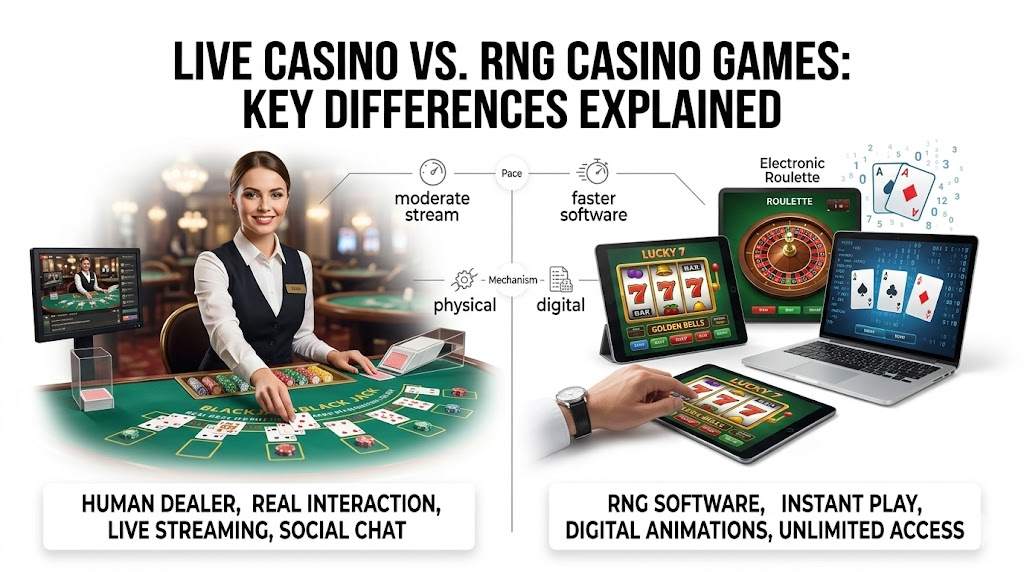
Today, online casinos offer two distinct ways to play classic games. You can join a live-streamed table with a real dealer or play a fast digital version powered by software. At first glance, both options seem similar, but once you start playing, the differences become clear in speed, experience, strategy, cost, and even psychology.
What Is the Difference Between Live Casino and RNG Games?
Before into the finer details, it is worth establishing a clear foundation. Many players assume that because the game names are the same blackjack, roulette, baccarat the experience must be largely identical. In reality, the two formats differ in almost every meaningful way, from how outcomes are generated to how you interact with the game itself. Knowing these distinctions upfront will help you make smarter decisions every time you log in.
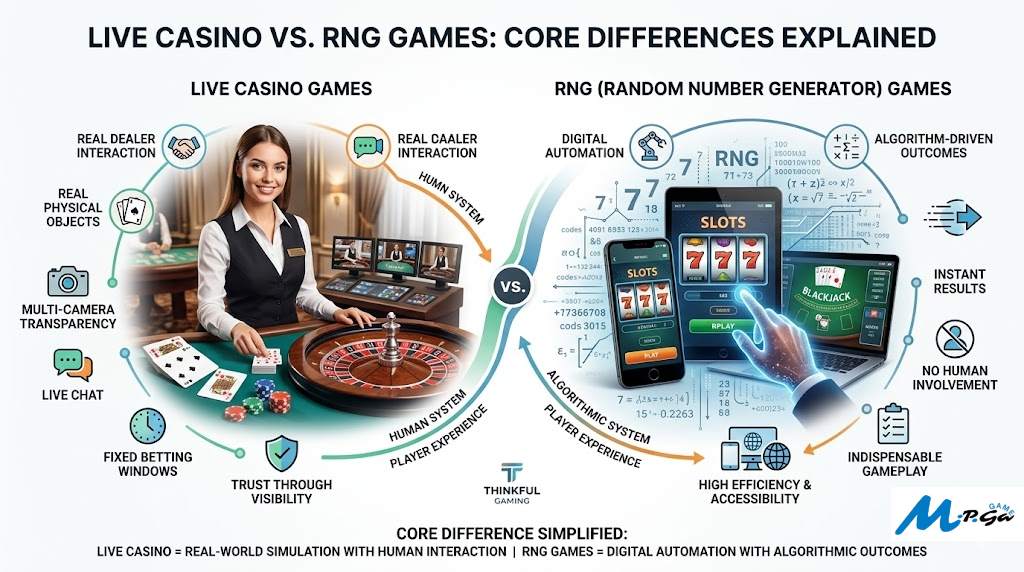
Understanding the core difference is the foundation for everything else. While both formats offer the same games, like blackjack or roulette, they are built on completely different systems and player experiences.
Live Casino Games Explained in Detail
Live casino games recreate the atmosphere of a physical casino using real-time video streaming. These games are hosted by professional dealers in studios designed to look like luxury casinos.
In a live game, you are not playing against software directly. Instead, you are watching a real person deal cards or spin a wheel while your bets are placed digitally. This hybrid model combines physical gameplay with the convenience of online play.
Key components of live games:
- Real dealers handling cards or spinning wheels
- Multi-camera angles for transparency
- Live chat for interaction
- Fixed betting windows
This format appeals to players who want authenticity and trust built through visibility.
RNG Games Explained in Detail
RNG games rely entirely on software. A Random Number Generator produces outcomes that simulate randomness at a mathematical level.
Each spin or hand is generated independently, meaning:
- No memory of previous results
- No patterns you can predict
- No human involvement
Important characteristics:
- Fully automated gameplay
- Instant results
- No waiting time
- Works on almost any device
This makes RNG games highly efficient and widely accessible.
Core Difference Simplified
- Live casino = real-world simulation with human interaction
- RNG games = digital automation with algorithm-driven outcomes
How Casino Software and Live Studios Work Behind the Scenes
Most players focus entirely on what appears on their screen and rarely think about the complex infrastructure that powers their experience. Yet understanding what happens behind the scenes reveals why the two formats feel so different, and why one demands significantly more resources than the other. This behind-the-scenes knowledge also helps explain the cost differences and technical requirements you will encounter as a player.
To fully understand the difference, it helps to look at what happens behind the scenes.
Live Casino Infrastructure
Live casino providers operate large-scale studios that function like broadcast centers. These include:
- Professional dealers working in shifts
- High-definition camera setups
- Real casino equipment, like cards and wheels
- Streaming systems delivering video in real time
Each table is streamed to thousands of players simultaneously. Even though everyone watches the same dealer, bets are processed individually for each player.
This system requires:
- Strong internet infrastructure
- Real-time synchronization
- Continuous monitoring
RNG Game Development
RNG games are built using software engineering and mathematical modeling. Developers design:
- Probability frameworks
- Game mechanics
- Visual animations
- Payout systems
Why This Matters
Understanding this difference helps explain:
- Why live games feel slower and more immersive
- Why RNG games are faster and more scalable
- Why do technical requirements differ significantly
RTP and House Edge Explained
Among all the technical terms you will encounter in online gambling, RTP and house edge are the two most important for evaluating a game’s long-term value. These figures are not just marketing numbers; they represent real mathematical expectations that play out over time. Understanding them properly will help you compare games more accurately and set realistic expectations before you place a single bet.
RTP and house edge are the most important concepts for understanding long-term outcomes in casino games.
Understanding RTP in Depth
Return to Player (RTP) represents the percentage of total bets a game returns to players over time.
For example:
- RTP of 96% means $96 is returned for every $100 wagered (over millions of rounds)
Important points:
- RTP works over long periods, not short sessions
- Short-term results can vary widely
- RTP does not guarantee profit
House Edge Breakdown
House edge is simply the casino’s advantage:
- House edge = 100% minus RTP
Example:
- RTP 99.5% → House edge 0.5%
Rule-Based Differences
The key factor affecting RTP is the game’s rules, not its format.
Blackjack Example:
- Fewer decks → better odds
- Dealer stands on soft 17 → better for players
- Doubling rules → impact returns
These rule differences apply equally to live and RNG games.
Practical Insight
If two games have identical rules:
- Live and RNG versions will produce the same mathematical results
Game Speed and Its Real Impact on Your Bankroll
Speed is one of the most underestimated variables in online casino play. It is easy to focus on a game’s RTP or house edge while completely ignoring how quickly rounds are being played. Yet the pace at which you play has a direct and measurable impact on how much money you risk over any given session. A game with a slightly worse RTP played slowly costs you less than a game with better odds played at high speed.
Game speed is one of the most overlooked but critical factors in online gambling.
Why Speed Is More Important Than It Seems
The faster you play:
- The more bets you place
- The more exposure you have to the house edge
- The quicker your bankroll can change
Example Comparison
| Format | Hands per Hour | Risk Exposure |
|---|---|---|
| Live Blackjack | 60 | Moderate |
| RNG Blackjack | 250 | High |
Financial Impact
Even with identical RTP:
- Faster play increases total money wagered
- More wagers = higher expected losses over time
Behavioral Impact
- Fast games encourage impulsive betting
- Slow games allow more thoughtful decisions
Practical Tip
If you want to control spending:
- Choose slower formats like live games
If you want efficiency:
- Choose RNG games
Fairness, Transparency, and Trust
Fairness is non-negotiable for any reputable online casino, and both live and RNG formats are held to high standards of integrity. However, the way fairness is established and communicated to players differs considerably between the two. For some players, seeing is believing, while others are comfortable placing their trust in certified mathematical systems. Understanding how each format ensures fair play helps you decide which level of transparency you are comfortable with.
Trust is a major factor when choosing between live and RNG formats.
RNG Certification Process
RNG systems are tested by independent laboratories using:
- Statistical randomness checks
- Long-term simulations
- Outcome distribution analysis
These tests ensure:
- True randomness
- No manipulation
- Accurate RTP
Live Game Monitoring
Live games rely on physical transparency:
- Players can see cards and wheels in real time
- Cameras capture every angle
- Systems verify results automatically
Psychological Difference
Even though both are fair:
- RNG requires trust in math and certification
- Live games build trust through visibility
Bonus Wagering and Real Value
Casino bonuses can appear extremely generous on the surface, but the real value of any offer depends heavily on which games you use to clear it. This is where many players unknowingly lose out: They claim a bonus with excitement, only to discover that their preferred games contribute very little toward the wagering requirement. Understanding contribution rates and how they apply to each format is essential before accepting any offer.
Bonuses are a major part of online casinos, but not all games contribute equally.
Understanding Wagering Requirements
A bonus requires you to wager a certain amount before withdrawal.
Example:
- $100 bonus with 30x wagering
- Total required bets = $3,000
Contribution by Game Type
| Game Type | Contribution |
|---|---|
| RNG Slots | 100% |
| Live Games | 0 to 20% |
| RNG Table Games | Usually 0% |
Real Impact
If a game contributes less:
- You must wager significantly more
Example
Using slots:
- $3,000 required
Using live games (20% contribution):
- $15,000 required
Key Insight
Slots are the most efficient for bonuses, regardless of player preference. The full range of operator terms, including bonus weighting on live tables and wagering requirements, is covered across the live casinos reviewed on CasinoJan.com.
Demo Mode and Learning Curve
Every experienced player will tell you that learning a game before wagering real money is one of the smartest habits you can develop. Demo mode gives you the freedom to explore rules, experiment with different approaches, and build genuine confidence without any financial pressure. However, this valuable learning tool is not equally available across all formats, and that gap can influence how quickly a new player becomes comfortable with casino games.
Learning before risking money is an important advantage.
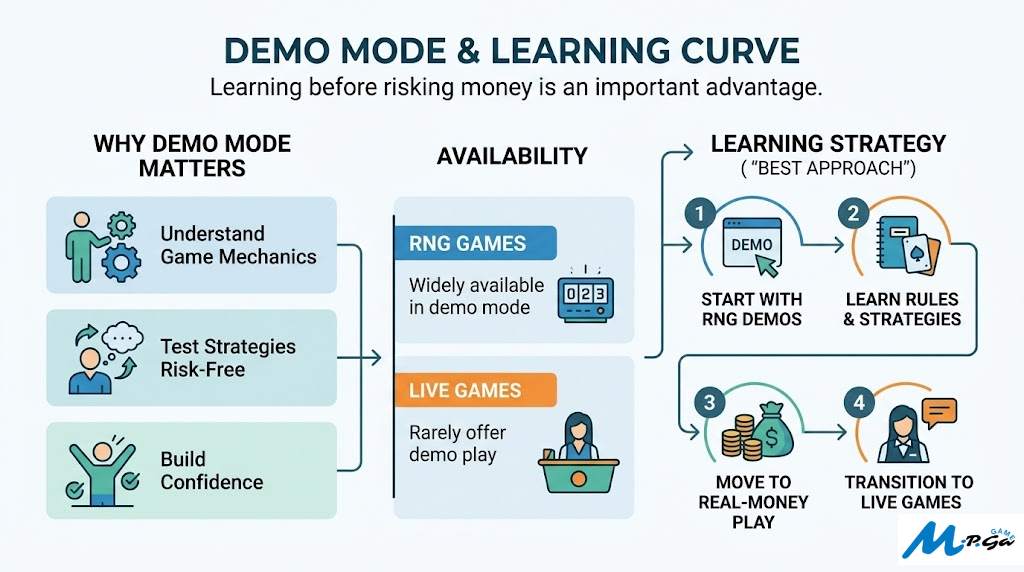
Why Demo Mode Matters
Demo mode allows players to:
- Understand game mechanics
- Test strategies risk-free
- Build confidence
Availability
- RNG games: widely available in demo mode
- Live games rarely offer demo play
Learning Strategy
Best approach:
- Start with RNG demos
- Learn rules and strategies
- Move to real-money play
- Transition to live games
Internet, Data Usage, and Technical Requirements
The device you use and the quality of your internet connection play a much larger role in your casino experience than most players anticipate. While RNG games are lightweight and forgiving of slower connections, live casino games are bandwidth-intensive by nature. Choosing a format that does not match your technical setup can lead to frustrating interruptions, buffering, and disconnections at the worst possible moments.
Technical requirements can affect your overall experience.
Data Consumption Breakdown
| Format | Data Usage per Hour |
|---|---|
| RNG Games | Very Low |
| Live SD | 150 to 200 MB |
| Live HD | 300 to 400 MB |
Performance Considerations
RNG games:
- Load quickly
- Work on low-end devices
- Minimal lag
Live games:
- Require a stable internet
- Sensitive to connection drops
- Better on newer devices
Practical Advice
If you have limited data or slower internet:
- RNG games are the better choice
Social and Psychological Experience
Casino games are not purely mathematical exercises; they are experiences that carry emotional weight, social dynamics, and psychological patterns. The format you choose shapes not just your financial exposure but also your mood, decision-making, and overall enjoyment. Recognizing how each format affects your psychology can help you play more mindfully and avoid patterns that lead to poor choices.
The emotional experience differs greatly between formats.
Live Casino Psychology
Live games provide:
- Interaction with dealers
- Social engagement
- Real-time excitement
This creates a more immersive environment.
RNG Game Psychology
RNG games focus on:
- Speed
- Repetition
- Results
They can feel more mechanical but also more efficient.
Risk Consideration
- Fast RNG play can lead to overuse
- Live games encourage pacing
Strategy Differences Between Formats
Many players approach both formats with identical strategies, which is a mistake. While the fundamental rules of a game like blackjack do not change between live and RNG versions, the practical application of strategy shifts significantly depending on speed, environment, and the psychological pressures each format creates. Adapting your approach to fit the format you are playing is a key habit that separates disciplined players from impulsive ones.
Different formats require different approaches.
RNG Strategy Approach
- Focus on speed and volume
- Use strict bankroll limits
- Avoid chasing losses
Live Game Strategy
- Take time between decisions
- Observe gameplay flow
- Focus on discipline
Key Reality
No strategy guarantees profit. The house edge always exists.
Variance and Volatility
Variance is a concept that many casual players overlook, yet it directly determines the shape of your session, whether you experience dramatic swings or a steadier, more gradual progression. Both live and RNG games carry variance, but the way speed interacts with volatility creates noticeably different experiences depending on your format of choice. Understanding this relationship helps you set appropriate expectations and choose games that match your risk tolerance.
Variance determines how results fluctuate over time.
Understanding Variance
- High variance → big wins, less frequent
- Low variance → smaller, frequent wins
Application
- Slots: high variance
- Table games: lower variance
Important Insight
Speed amplifies variance effects:
- Faster play increases swings
- Slower play smooths the experience
Accessibility and Convenience
The ability to play whenever you want, on whatever device you have available, is one of the defining advantages of online casinos over their land-based counterparts. However, the two formats are not equally accessible, and the differences in availability, waiting times, and device compatibility can meaningfully affect which option suits your lifestyle. Convenience is not just about speed; it is about fitting seamlessly into your schedule and circumstances.
Convenience plays a major role in user preference.
RNG Games
- Instant access
- No waiting
- Available anytime
Live Games
- Limited table availability
- Possible waiting times
- Scheduled sessions
Cost Considerations Beyond Bets
When most players calculate the cost of a casino session, they think only about the size of their bets and the house edge. In reality, there are additional costs that quietly add up over time and vary significantly between live and RNG formats. From data consumption to minimum bet requirements and session length, these hidden factors can influence your overall budget in ways that are easy to overlook until they become a problem.
There are hidden costs beyond just wagers.
Live Game Costs
- Higher data usage
- Higher minimum bets
- Longer sessions
RNG Game Costs
- Lower stakes
- Lower data usage
- Flexible session length
Pros and Cons Expanded
No format is universally superior; each comes with genuine strengths and real limitations that will matter differently depending on who you are as a player. Laying out the advantages and disadvantages side by side gives you a clearer picture of the trade-offs involved. It helps you make choices that align with your specific priorities rather than following general assumptions.
Live Casino Games
Advantages
- Realistic experience
- Social interaction
- High transparency
Disadvantages
- Slower gameplay
- Higher costs
- Limited bonus benefits
RNG Casino Games
Advantages
- Fast gameplay
- Bonus-friendly
- Accessible
Disadvantages
- No social interaction
- Repetitive gameplay
- Higher risk due to speed
Choosing Based on Player Type
There is no single correct answer when choosing between live and RNG casino games. The right format depends entirely on what you are trying to get out of your session: entertainment, efficiency, social engagement, or strategic practice. Identifying your player type honestly is the most effective way to consistently choose the format that delivers the experience you actually want.
Choosing the right format depends on your goals.
| Player Type | Preferred Format | Key Reason |
|---|---|---|
| Casual Players | Live games | Entertainment and slower pace |
| Bonus Players | RNG slots | Efficiency and quick gameplay |
| Strategic Players | RNG table games | Control and faster decision-making |
| Social Players | Live games | Interaction and social experience |
Frequently Asked Questions
Players new to online casinos often arrive with the same fundamental questions, and getting clear answers early can prevent costly misunderstandings. The following questions address the most common points of confusion between live and RNG formats, covering fairness, preference, accessibility, and practical guidance for beginners.
| Question | Answer |
|---|---|
| Are RNG games less fair than live games? | No. Both are fair when properly licensed and tested. |
| Why do some players prefer live games? | Because they can see real outcomes and interact with dealers. |
| Can I switch between formats? | Yes, many players use both depending on goals. |
| Which is better for beginners? | RNG games are due to demo mode and simplicity. |
Final Thoughts
Live and RNG casino games are fundamentally different in experience but identical in mathematical fairness when the rules are the same. After examining every aspect of both formats, from how outcomes are generated to how bonuses are cleared, from data consumption to psychological impact, it becomes clear that neither option is universally superior. Each format has been designed with a specific type of player experience in mind, and the one that serves you better will depend entirely on your personal goals, playing style, and circumstances on any given session. RNG games are best suited for players who prioritize speed, efficiency, and bonus play, offering instant access, flexible stakes, and the ability to practice through demo mode before committing real money. Live games, on the other hand, deliver far greater value for those seeking realism, social interaction, and the kind of immersive entertainment that closely mirrors a physical casino environment. What many experienced players eventually discover is that the smartest approach is to use both formats strategically rather than committing exclusively to one. Use RNG table games to sharpen your strategy and clear bonus requirements efficiently, then switch to live games when you want a richer, more engaging experience. The key is to stay informed, remain disciplined with your bankroll regardless of which format you choose, and never lose sight of the fact that the house edge is always present in both. Understanding when each format works in your favor, and being honest about your own playing habits and tendencies, is ultimately what separates a thoughtful player from an impulsive one.
Disclaimer: This content is for informational purposes only and does not promote or encourage gambling. Online gambling involves financial risk and may not be legal in all jurisdictions. Players should verify local laws before participating. Always gamble responsibly and within your limits. If gambling becomes a problem, seek help from professional support organizations.
References
- eCOGRA. (2023). Testing and certification standards for online gaming systems
- iTech Labs. (2022). RNG auditing and compliance procedures
- BMM Testlabs. (2021). Gaming product certification guidelines
- Parke, A., & Griffiths, M. (2007). The role of structural characteristics in gambling behavior. International Journal of Mental Health and Addiction. https://doi.org/10.1007/s11469-007-9083-8
- Harrigan, K., & Dixon, M. (2010). Slot machine design and player behavior. Journal of Gambling Studies. https://doi.org/10.1007/s10899-009-9153-3
- Gaming Laboratories International. (2020). Standards for RNG testing and certification