
ARC Raiders Loot Guide: Insider Strategies to Get the Best Gear Every Run


You drop into a raid with a plan, spend 12 minutes clearing rooms, and extract with a bag full of junk you’ll never use. Sound familiar? Most players waste their best runs hauling back low-value clutter while the actual game-changing items sit two buildings over.
Understanding the Loot Rarity System
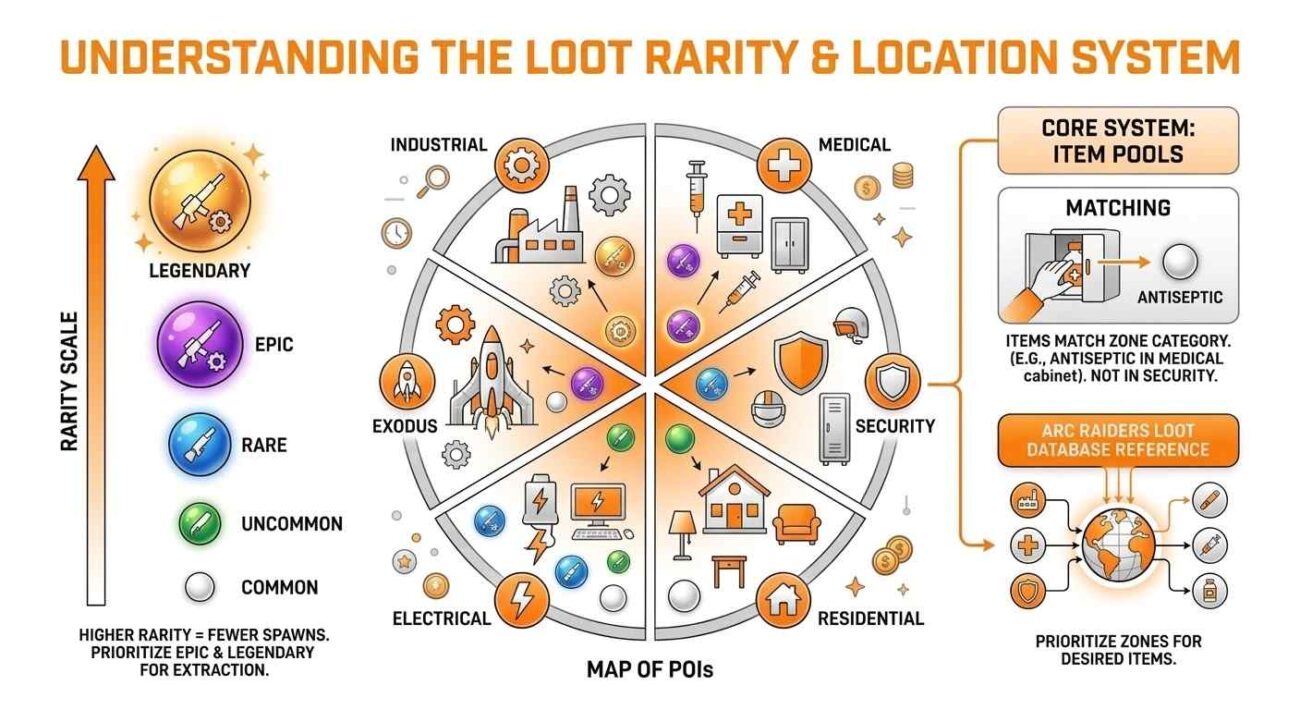
Before you can loot smart, you need to understand what you are actually looking at. ARC Raiders uses a standard rarity scale: Common, Uncommon, Rare, Epic, and Legendary. The rule of thumb is simple. Anything Epic or higher is worth extracting.
What trips up newer players is how spawn rates work. Higher rarity items do not just spawn less often. They are also tied to specific location types on the map. Each POI (point of interest) is tagged with a category such as Industrial, Medical, Security, Residential, Electrical, or Exodus. Items are matched to the relevant location type so that an Antiseptic can appear in any cabinet inside a Medical zone. Still, it will not reliably spawn in a Security room.
The connection between location type and item pool is the core system; everything else builds on it. If you want to go deeper, the ARC Raiders loot database is a reference for checking exactly which items are tied to which zone categories. Knowing this lets you prioritize the zones that contain the items you are actively searching for.
Where the Best Loot Actually Spawns
Here’s where location knowledge separates consistent players from everyone else. The map highlights red POIs as high-value zones for a reason. They have higher enemy density, better containers, and stronger drop pools. Knowing which red zones to prioritize is what matters most.
Red POI priorities by location type:
- Security zones: Best for Weapon Parts, Access Keys, Ammo, and Armor Plates. Expect heavy resistance and often require a key or hack tool to reach the main loot rooms.
- Industrial zones: Best for Batteries, Gears, and Electronic Components. Factories and warehouses are your spots here.
- Medical zones: Antiseptics, Syringes, Bandages, and Stim-shots. These are PvP hotspots because every squad needs meds to stay alive.
- Exodus zones: The highest-risk, highest-reward category. Items like Exodus Modules and Magnetic Accelerators spawn here, and they’re among the most valuable crafting components in the game.
If you’re still building out your character and want a clearer picture of how loot progression connects to your overall development, checking out a breakdown of Arc Raiders Ranking systems can help you understand which gear tiers actually matter for where you’re at in the game. This helps you focus on collecting items that match your current rank and progression stage.
Non-Negotiables: Items to Always Extract With
Every experienced raider has a mental priority list before they even start looting. Here’s the short version of what should always take a slot in your extract:
- ARC Powercells: Used to craft Shield Recharges. Always worth a slot.
- Gun Parts: Needed to repair weapons. Weapons found in crates almost always have low durability, which keeps them usable.
- Duct Tape: Cheap and easy to overlook, but essential for weapon mod crafting. Every mod slot you can fill makes a weak weapon competitive.
- Blueprints: Always extract these. They gate your crafting progression and can’t be substituted.
- Weapon Mods: Especially early on, before you can craft silencers and higher-tier attachments. Any mod you find is an upgrade over nothing.
- Keys: Every key opens a locked room with rare loot. Safe-slot any key you find and find the door.
- Anything Epic rarity or above: No debate needed. It goes in your bag.
If your inventory is full, recycle lower-value items into Basic Materials instead of dropping them. The Basic Materials stack up to 50 per slot, freeing up significant space mid-raid.
Keep/Sell/Recycle Framework
This is the decision you’re making on every item that doesn’t fit the non-negotiable list above. GamesRadar’s loot breakdown covers the full item list in detail, but the decision logic breaks down cleanly into three categories:
| Action | When to Use It |
| Keep | Quest items, upgrade materials, ARC Parts, anything Epic+ |
| Sell | Diamond-marked trinkets (Playing Cards, Music Album, Statuette), duplicate consumables under 1,000 credits |
| Recycle | Bulk electronics like Power Banks and Fried Motherboards; their crafting material value beats the sell price |
Trinkets are a special case. Items like Lance’s Mixtape and the Snow Globe have zero gameplay function, but they sell well and are one of the fastest ways to build Coins early. If you’re saving up for a Raider Hatch key or a stash expansion, clearing out your trinket stockpile is the quickest route to get there.
Map-Specific Loot Strategies
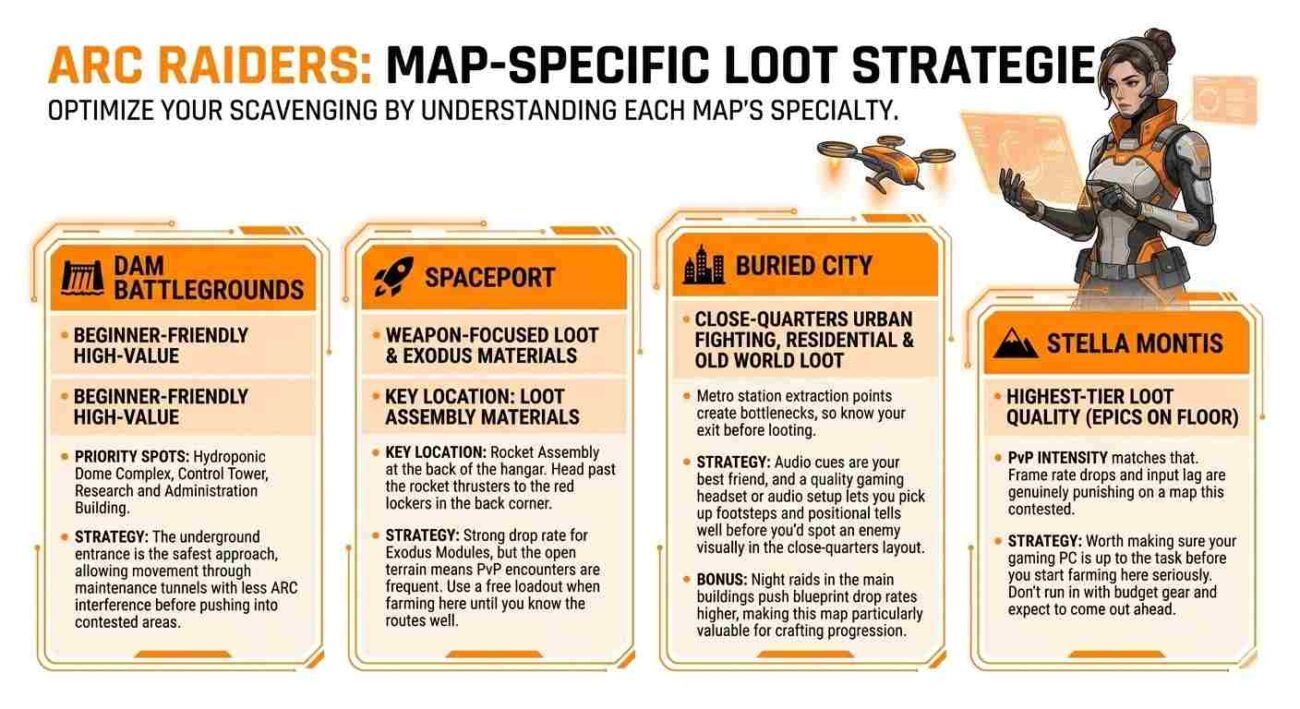
Each map in ARC Raiders specializes in specific loot categories. Running the same approach on every map is one of the most common mistakes players make.
- Dam Battlegrounds is the most beginner-friendly high-value map. The Hydroponic Dome Complex, Control Tower, and Research and Administration Building are priority spots. The underground entrance is the safest approach, allowing movement through maintenance tunnels with less ARC interference before pushing into contested areas.
- Spaceport is where you go for weapon-focused loot and Exodus materials. The Rocket Assembly at the back of the hangar is the key location. Head past the rocket thrusters to the red lockers in the back corner. Strong drop rate for Exodus Modules, but the open terrain means PvP encounters are frequent. Use a free loadout when farming here until you know the routes well.
- Buried City is close-quarters urban fighting with strong residential and Old World loot. Metro station extraction points create bottlenecks, so know your exit before looting. Audio cues are your best friend, and a quality gaming headset or audio setup lets you pick up footsteps and positional tells well before you’d spot an enemy visually in the close-quarters layout. Night raids in the main buildings push blueprint drop rates higher, making this map particularly valuable for crafting progression.
- Stella Montis is the highest-tier map in terms of loot quality, with Epics that can literally be sitting on the floor. PvP intensity matches that. Frame rate drops and input lag are genuinely punishing on a map this contested, so it’s worth making sure your gaming PC is up to the task before you start farming here seriously. Don’t run in with budget gear and expect to come out ahead.
Inventory and Extraction Tips That Actually Save Runs
A few habits that make a consistent difference:
- Use your safe slot. If you pick up an Exodus Module or a rare key, safe-slot it immediately. You’re guaranteed to keep it even if you get knocked before extraction.
- Stack before you extract. Recycle anything recyclable at the end of your route to collapse multiple slots into a single stack of Basic Materials. This is free inventory space.
- Audit your bag mid-raid. When you’re close to full, look at every slot and ask if it’s earning its weight. Swapping a 200-credit filler for a 1,200-credit find is a bigger deal than most players realize.
- Don’t chain high-risk zones. If you get an Exodus Module from Rocket Assembly, extract it. Don’t push for more in the same raid when you already have something worth keeping.
FAQ
| Question | Answer |
|---|---|
| What’s the best loot in ARC Raiders? | Weapon Parts, ARC Powercells, and Weapon Mods are the most consistently valuable items throughout the game. In general, any item with Epic rarity or higher is always worth extracting. |
| Where do the best items spawn? | The best loot usually appears in Red POIs (high-value zones). Exodus areas such as Rocket Assembly at Spaceport and Stella Montis are known for spawning Epic gear and important crafting materials. |
| What should I always keep in my safe slot? | Always place Keys and any Epic+ items in your safe slot as soon as you find them. These items are too valuable to risk losing if you fail to extract. |
| Should I sell or recycle trinkets? | Sell them. Trinkets such as Playing Cards, Music Albums, and Statuettes have no crafting use and are mainly designed to generate Coins for gear purchases and stash upgrades. |
Conclusion
Looting efficiently in ARC Raiders is less about grabbing everything you see and more about understanding the systems behind where valuable items spawn. Players who consistently leave raids with the best gear are not simply lucky. They follow clear priorities, know which zones contain the items they need, and make smart inventory decisions during the run.
By learning how loot pools connect to location types, prioritizing high-value red POIs, and sticking to a simple keep, sell, or recycle framework, you can dramatically increase the value of every extraction. Small habits such as safe-slotting rare items, stacking materials before leaving, and avoiding unnecessary high-risk pushes can often be the difference between a successful run and losing everything.
The more familiar you become with each map and its loot specialization, the easier it becomes to plan efficient routes and maximize your rewards. Over time, these strategies turn random looting into a consistent system that supports your progression, crafting upgrades, and long-term gear development.
Master the locations, manage your inventory wisely, and every raid will start feeling far more rewarding.
Disclaimer
This guide is created for informational and educational purposes based on publicly available gameplay knowledge and player strategies. Game mechanics, loot tables, item values, and map balance in ARC Raiders may change over time through updates, patches, or developer adjustments.
The strategies discussed here are intended to help players improve their understanding of the game, but do not guarantee specific loot outcomes or in-game success. Player experiences may vary depending on skill level, team coordination, map conditions, and game updates.
All game names, trademarks, and related content belong to their respective owners and developers. This guide is not affiliated with or endorsed by the official developers or publishers of ARC Raiders.