
AI-Powered Test Automation: Future of Software Quality Assurance Explained

As applications grow increasingly complex and delivery cycles compress, software quality assurance faces unprecedented challenges. Traditional test automation requires substantial manual effort for script design, maintenance, and execution management. Artificial intelligence is fundamentally transforming this landscape by introducing capabilities that learn, adapt, and optimize autonomously.
AI powered test automation represents a paradigm shift: rather than static scripts that break with every change, intelligent systems continuously learn from application behavior, adapt to modifications, and refine testing strategies in real time. Understanding and implementing AI-driven testing enables organizations to achieve faster time-to-market, reduced costs, and superior software quality.
Self-Learning Test Script Generation
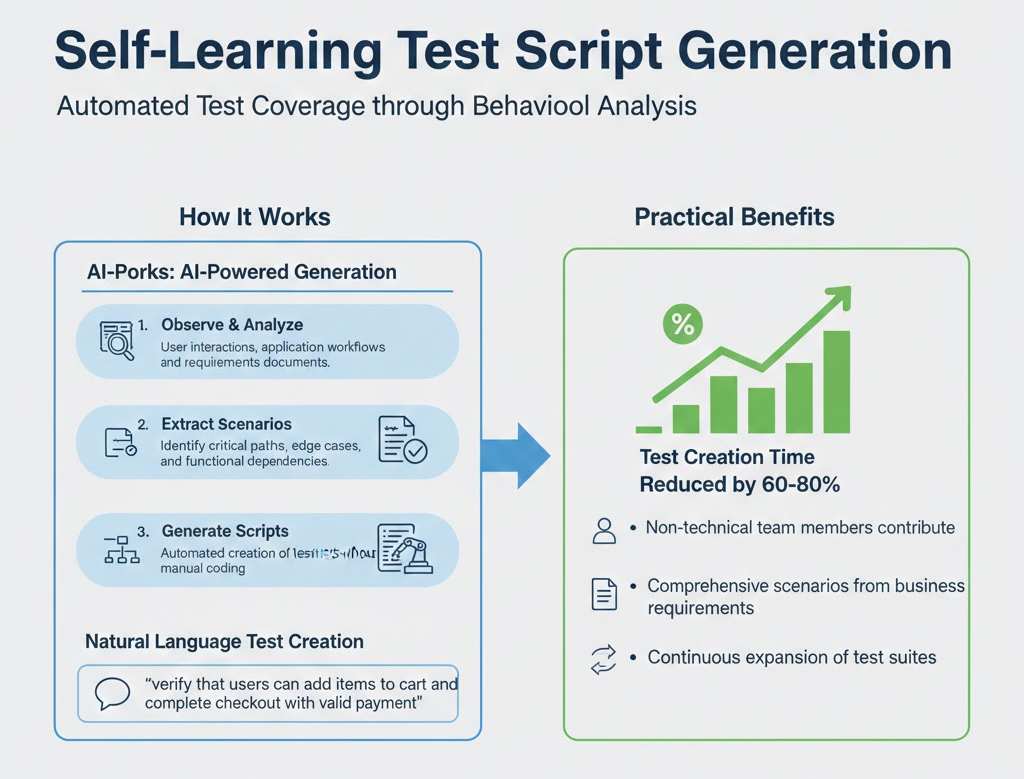
Modern AI systems eliminate the traditional bottleneck of manual test script creation by automatically generating comprehensive test coverage through behavioral analysis.
How It Works: Machine learning algorithms observe user interactions and application workflows to identify critical paths, edge cases, and functional dependencies requiring validation. By analyzing requirements documents and user stories, AI systems extract testable scenarios and generate corresponding automation scripts without manual coding.
Natural Language Test Creation: Teams can now describe test scenarios in plain language. For example, writing “verify that users can add items to cart and complete checkout with valid payment” triggers AI to generate the complete automation sequence, including element identification, data validation, and assertion logic.
Practical Benefits:
- Test creation time reduced by 60-80% compared to manual scripting.
- Non-technical team members contribute directly to test coverage.
- Comprehensive scenarios are automatically generated from business requirements
- Continuous expansion of test suites as new features are analyzed
Visual Recognition and Interface Testing
Computer vision technology enables AI to validate user interfaces with human-like perception but machine-scale consistency.
- Advanced Visual Validation: AI-powered visual testing captures and analyzes screenshots across browsers, devices, and screen resolutions. Machine learning models understand layout semantics and detect rendering defects, alignment issues, overlapping elements, and design inconsistencies that impact the user experience.
- Intelligent Change Detection: Unlike pixel-perfect comparison tools that flag every minor variation, AI distinguishes meaningful visual regressions from acceptable changes. Dynamic content, timestamps, and personalized elements are automatically ignored while layout shifts, missing elements, or broken styling trigger alerts.
- Accessibility Assurance: Visual AI validates compliance with accessibility standards by checking color contrast ratios, text readability, focus indicators, and responsive design breakpoints. This ensures applications remain usable for all audiences without specialized accessibility testing tools.
- Real-World Impact: Organizations report 90% reduction in visual regression bugs reaching production and significantly improved consistency across platforms and devices.
Dynamic Test Optimization and Prioritization
AI transforms test execution from a time-consuming, comprehensive approach to an intelligent, risk-based strategy.
Predictive Test Selection: Machine learning analyzes historical test results, recent code changes, and defect patterns to predict which tests are most likely to uncover issues in the current build. This enables smart test subset selection rather than running entire suites unnecessarily.
Intelligent Prioritization: High-value tests execute first, providing rapid feedback on critical functionality. For example, payment processing and authentication tests run before less critical UI refinements, enabling faster go/no-go decisions.
Test Suite Health Management: AI identifies and addresses test suite problems proactively:
- Redundant tests providing duplicate coverage are consolidated.
- Flaky tests with inconsistent results are flagged for investigation or removal.
- Slow-running tests are optimized or parallelized.
- Coverage gaps are automatically identified and filled.
Measurable Results: Teams typically achieve a 40-50% reduction in overall test execution time while maintaining or improving defect detection rates.
Intelligent Defect Analysis and Reporting
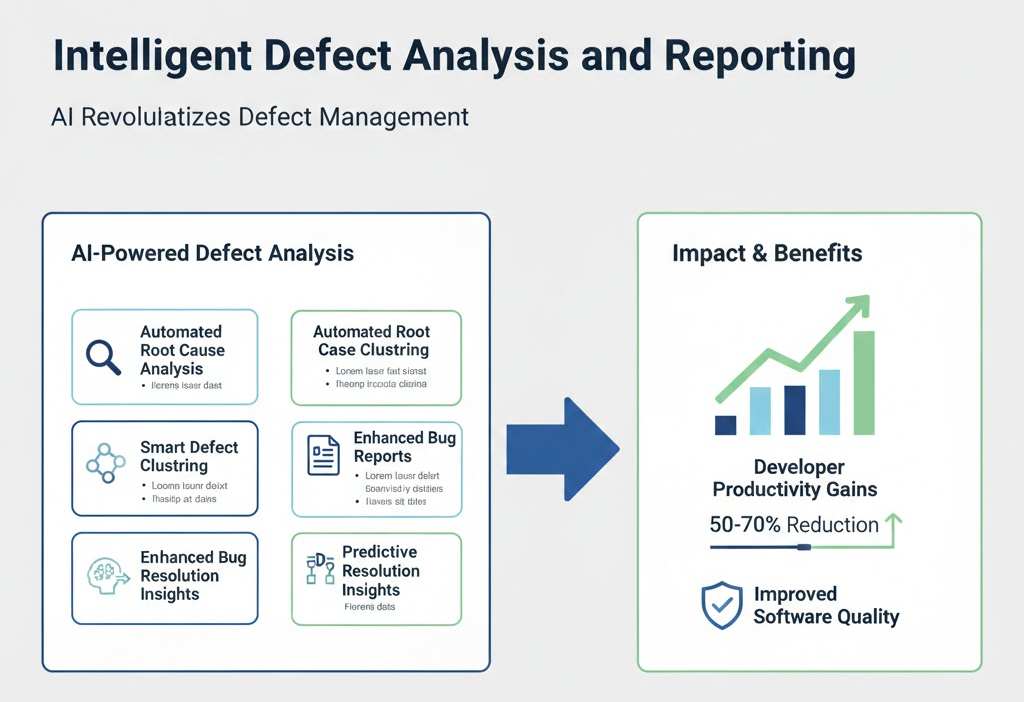
AI revolutionizes defect management by automating the analysis, classification, and prioritization of test failures.
Automated Root Cause Analysis: Machine learning distinguishes genuine application defects from environmental issues, test data problems, or infrastructure failures. This eliminates hours of manual investigation and focuses developer attention on real bugs.
Smart Defect Clustering: AI identifies patterns across failures, grouping related defects that share common root causes. A single underlying issue might manifest as multiple test failures; AI consolidates these into a single actionable report.
Enhanced Bug Reports: Natural language generation creates comprehensive defect documentation, including:
- Clear description of failure symptoms
- Step-by-step reproduction instructions
- Screenshots and logs from the failure point
- Potential business impact assessment
- Suggested areas of code to investigate
Predictive Resolution Insights: Analytics forecast the complexity of defect resolution, helping teams prioritize fixes by severity, impact, and effort required.
Developer Productivity Gains: Development teams report a 50-70% reduction in time spent triaging and reproducing reported defects.
Continuous Adaptation to Application Changes
Traditional automation’s greatest weakness is brittleness when applications evolve. AI-powered testing addresses this fundamental challenge.
Self-Healing Test Scripts: When UI changes occur, AI-powered systems use multiple identification strategies (visual recognition, functional relationships, semantic understanding) to locate elements even after modifications. Tests automatically update their locators without human intervention.
Intelligent Change Classification: AI distinguishes between changes requiring test adaptation versus those indicating functional regressions:
- Cosmetic changes (button colors, spacing adjustments) trigger automatic test updates
- Functional changes (removed features, altered workflows) flag for human review
- Unexpected behavior changes are reported as potential defects
Maintenance Effort Reduction: Organizations implementing self-healing AI report 70-85% reduction in test maintenance effort, transforming automation from a maintenance burden to a sustainable asset.
Learning from Context: AI understands the functional intent behind tests, not just the mechanical steps. When a checkout button moves from top-right to bottom-left, AI recognizes the same functional action and adapts accordingly.
Getting Started with AI-Powered Testing
Organizations should approach AI testing adoption strategically:
- Assessment Phase: Evaluate current automation pain points, maintenance costs, and coverage gaps. Identify areas where AI can deliver immediate value, such as visual testing, test maintenance, or defect analysis.
- Pilot Implementation: Start with a single application or feature area. Implement AI-powered testing alongside existing approaches to build confidence and demonstrate value before full-scale adoption.
- Team Enablement: Invest in training for QA teams, developers, and stakeholders. AI-powered testing changes workflows and responsibilities; successful adoption requires organizational alignment.
- Metrics and Iteration: Track meaningful metrics including test creation time, maintenance effort, defect detection rates, and time-to-resolution. Use data to refine AI implementation and demonstrate ROI.
Future of Quality Assurance
AI-powered test automation represents more than incremental improvement over traditional approaches. It fundamentally redefines what’s possible in software quality assurance by overcoming the limitations that have constrained automation for decades.
Intelligent testing systems that learn, adapt, and optimize autonomously enable organizations to maintain comprehensive quality coverage despite accelerating development cycles and increasing application complexity. The competitive advantages are clear: faster releases, higher quality, and reduced costs.
Opkey is leading this transformation by integrating machine learning, natural language processing, generative AI, and agentic AI to deliver the fastest and most reliable testing experience. From determining what to test through automated test creation, self-healing maintenance, and intelligent defect analysis, Opkey supports teams throughout the entire testing lifecycle with minimal human intervention.
Organizations embracing AI-driven quality assurance with platforms like Opkey gain a sustainable competitive advantage, deploying high-quality software faster and with greater confidence than those relying on traditional manual and scripted approaches.