
Blog
The Shift From Desktop to Mobile Web: How Publishers Must Adapt Their Ad Strategies

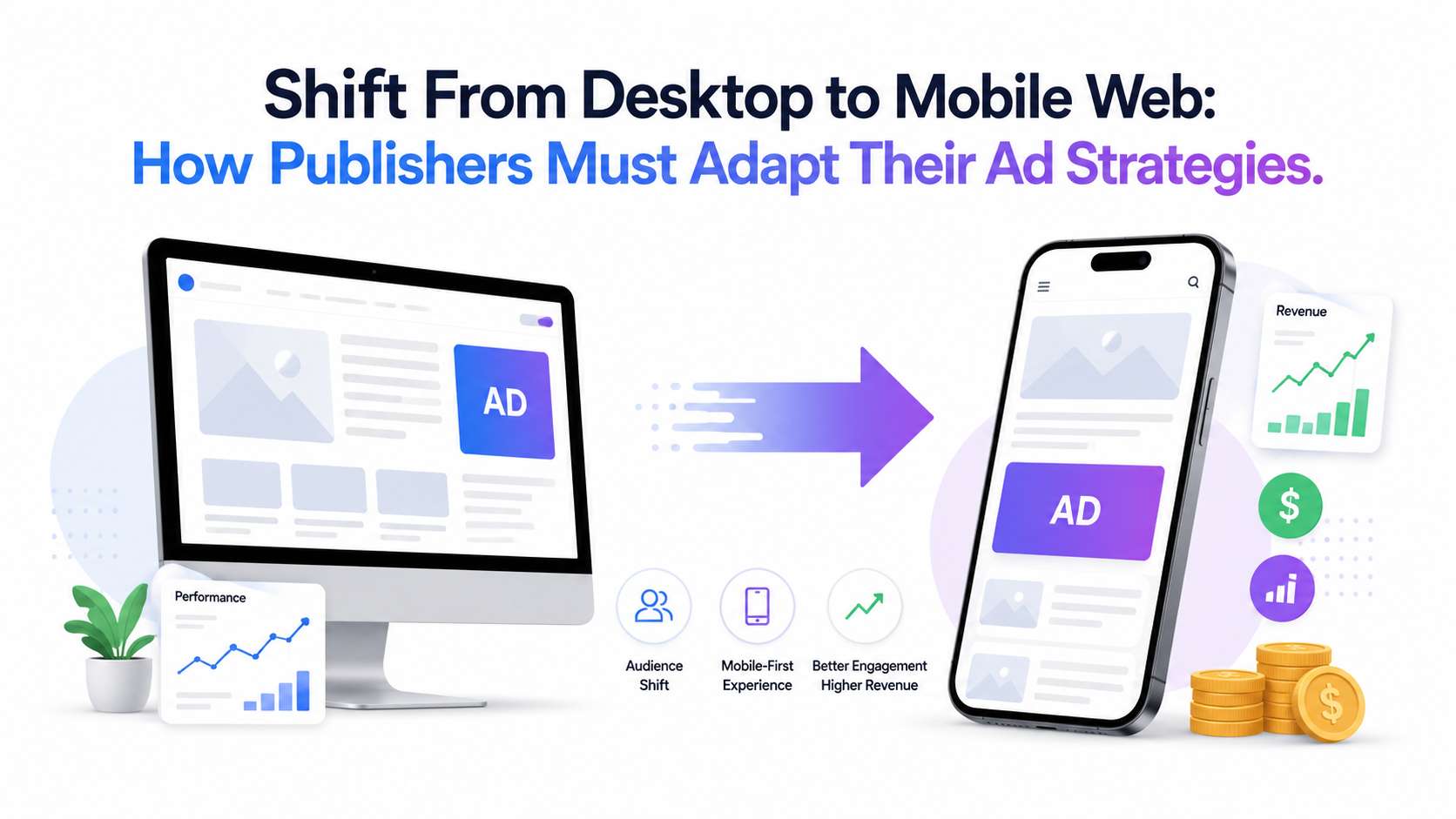
Many publishers are aware that mobile traffic has exceeded desktop traffic. However, what they are unwilling to recognize is that their current advertising technology (adtech) stack is not compatible with mobile environments. In order to make the same margins as they did with desktop advertising, publishers started very early on with big banners that used to pay very well and easy pay-per-click (PPC) money.
If publishers continue implementing advertising technology stacks that decelerate their mobile pages, they face further losses and the prospect of missing out on the potential growth of mobile revenue. For instance, we’ve seen time and time again that publishers who choose to rely on a single lazy-load setting lose most or all of their programmatic viewability and CPMs.
Building a Monetization Channel That Doesn’t Depend on Your Traffic
Search traffic is rented. An algorithm change, a competitor’s new piece of content, or seasonal fluctuations can easily reduce your search traffic by half in one quarter. If your entire business model is built on page views with ads, you don’t have an actual business when that happens.
Push notifications are much more valuable in this sense. They’re an asset that you fully own. Not only did the user explicitly opt-in for updates (suggesting an initial somewhat higher ‘likelihood to convert’), but notifications can also be sent without the end user visiting the page. And, as opposed to email, there’s no need for you to fill out an email field on your lead generation form. We just need to get a single browser permission on your site.
Android is especially significant here, as it generates about 74.13% of the world’s mobile operating system market share. Implementing push ad notifications android on your website can send ads directly to the end user’s mobile homepage regardless of them surfing the web on your page. This is a conversion with little to no dependence on the session count itself.
Finally, but most importantly for many publishers, the percentage of users who accept the browser’s prompt on your website to send notifications plays a substantial role in the efficacy of this business model. It’s vital that we do not ask too aggressively and that this browse prompt isn’t automatically triggered upon landing on the site. Give the user a little bit of time to read until you’ve asked them to activate push reading. Users who already showed interest in the article/landing page are much more likely to sign up for the service.
Why Your Mobile Ad Layout May Be a Self-Inflicted SEO Problem
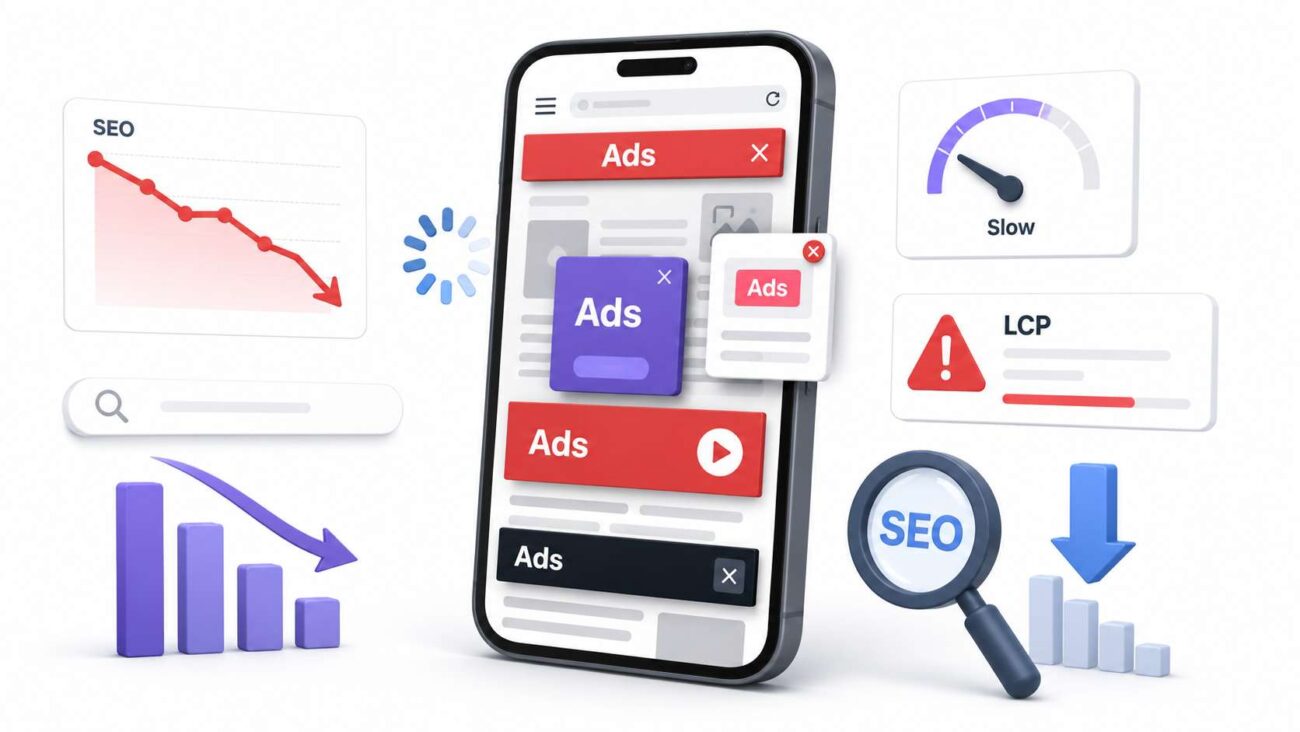
When Google prioritizes the indexing of your mobile site over your desktop site, the quality of your desktop site isn’t the prioritized version any longer. It’s the mobile one. And if you’re running all your ads, all the time, regardless of user and performance context, the mobile experience you’re providing is the worse one, too.
This is amplified if you’re running lazy-loading ad units that spike the largest contentful paint (LCP) metric, which will likely start spiraling your page off of any first-page search rankings. For a lot of sites, this will not only destroy your mobile access, but also a majority of your desktop search visitors as well. Mobile SEO is still the canary in the coal mine, after all.
But speed begets speed. A ponderous experience not only grates on an instinctual, spammy level (recall that your website sits on an economic fringe, and the ads you’re running are literally selling someone else’s stuff to your customers). It also signals that your site may not have the indexable depth worth crawling, which is why search keeps knocking you further down the hierarchy.
Banner Blindness is Worse on a 6-inch Screen.
Desktop interfaces enabled the birth of sidebars and headers with spaces for leaderboards. Mobile environments, on the other hand, present our interface in a single column where every possible ad pixel is in competition for the reader’s attention, including reader-hostile ads. Every insertion is noisy. Every ad devalues all the others fighting for space in the mobile view intended for optimal readability. Every element added to the layout comes with the trade-off of reduced engagement and shares for all ads currently visible in the mobile view, even those ads and clicks on which the publisher is actively losing money.
Timing and Placement Aren’t Just UX Concerns, They’re Revenue Decisions
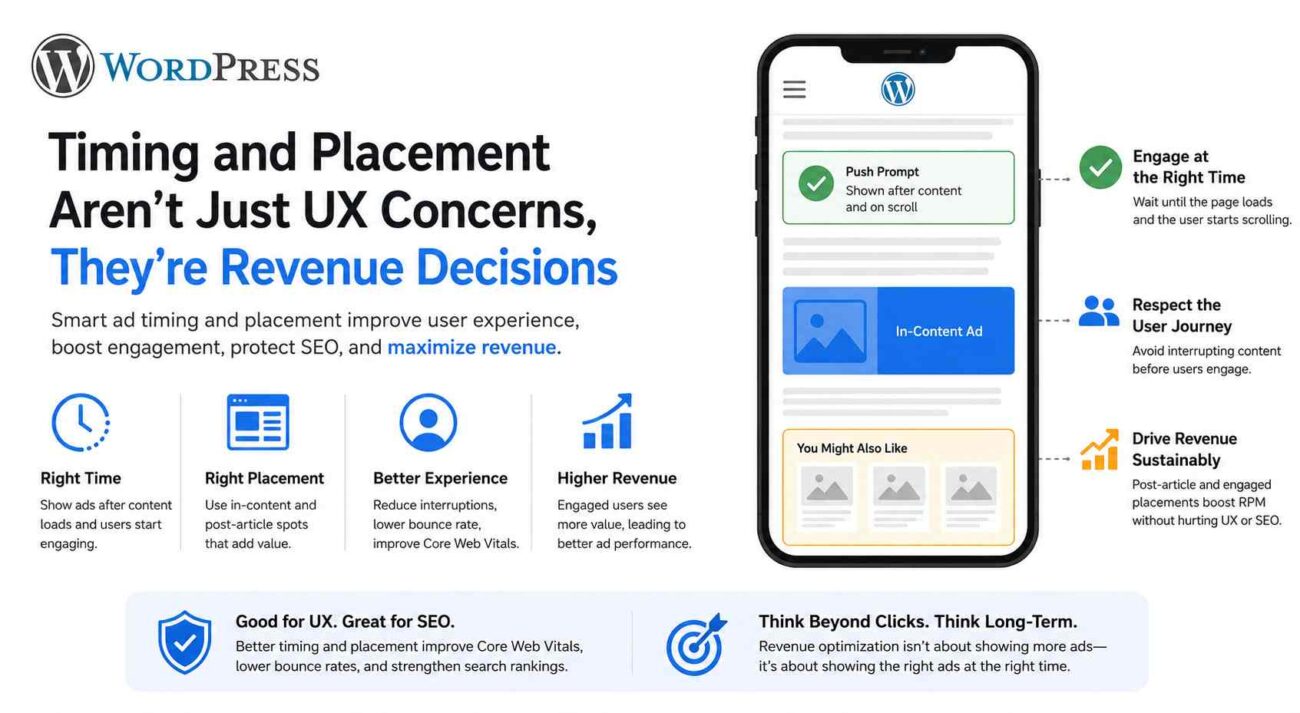
Website operators often view ad placement timing optimization like a user experience practice. While it certainly has UX implications, it’s more accurate to think of it as a revenue optimization parameter. Experiencing a push opt-in prompt at the wrong time doesn’t just mean the user will decline the prompt; it also makes a negative first impression that contributes to an increased bounce rate, which then loops back into your Core Web Vitals performance data, and eventually, your overall search performance.
Website operators should apply this sense of caution to mobile ad monetization formats, particularly units that interrupt page content or the user’s progress through the site before they’ve had a chance to see the content. For example, push notifications sent from the mobile browser immediately, or in-content, shouldn’t fire until the page has loaded and the reader is starting to scroll.
The upgrade trend in ad filtering is toward measuring true user engagement with creative elements. Fullscreen mobile interstitials, for instance, will likely continue to be penalized, but push notifications, which aren’t sent until the user has seen the content and new ad, can offer similar output while doing less harm to user experience metrics. Post-article units, especially performance-type units that recommend other articles that are possibly interesting, that don’t load until other content and ads do, can be key for increasing revenue-per-view while not reducing site performance meta metrics.
Conclusion
The move from desktop to mobile web is not just a traffic change. It is a full business shift for publishers. Mobile users expect fast pages, clean layouts, simple reading, and fewer interruptions. If publishers keep using desktop-style ad strategies on mobile pages, they risk lower viewability, weaker CPMs, higher bounce rates, and poorer search performance.
A stronger mobile ad strategy should focus on speed, timing, placement, and user intent. Ads should load without hurting Core Web Vitals, prompts should appear only after users show interest, and layouts should protect the reading experience. Push notifications, post-article units, and smarter mobile placements can help publishers build revenue that is less dependent on search traffic alone.
The publishers that adapt early will not simply protect their ad income. They will build a more stable, user-friendly, and future-ready monetization model for the mobile web.