
Blog
Custom Software vs. Off-the-Shelf Platforms: Which One Actually Saves Businesses More Money

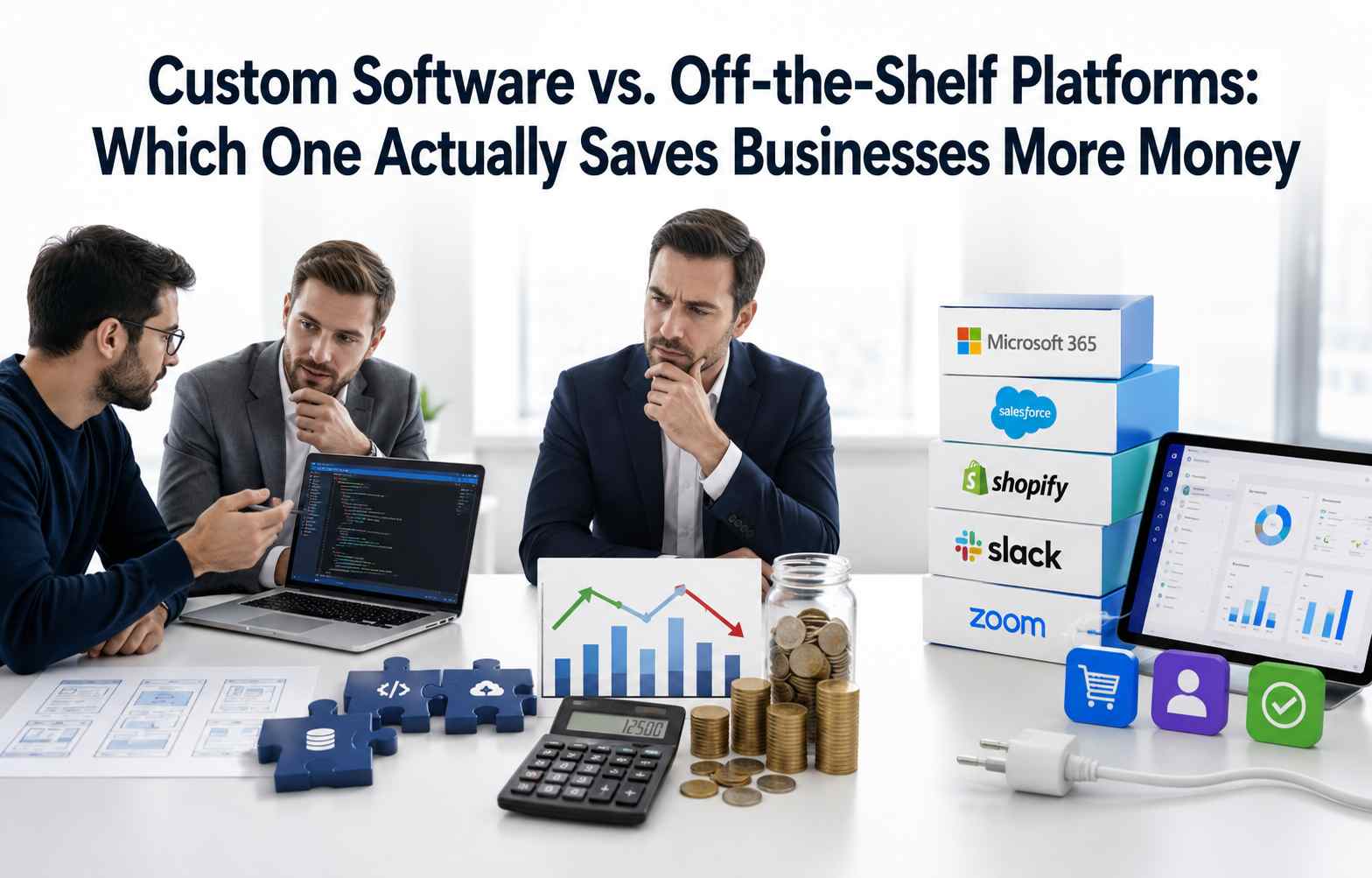
Most businesses frame this as a technology decision. It isn’t. Every company – from a lean gaming startup to a regulated EHR software development company managing patient records – eventually hits the same fork in the road: build exactly what you need, or buy something that almost fits. The answer changes dramatically depending on where you sit on the cost curve, and most popular advice gets that math wrong.
Off-the-shelf platforms win on speed. Custom software wins on total cost over time. The crossover point, based on Deloitte’s 2024 software ROI analysis, typically hits between years two and three – but only when the custom build is scoped correctly from day one.
What Does ‘Off-the-Shelf’ Actually Cost After Year One?
The price on the sticker is not the actual cost. When you consider per-seat licensing, add-on modules, API call limits, and the inevitable tier upgrade when your company expands, a $300 monthly SaaS subscription seems affordable. According to Gartner’s 2023 software spending study, mid-size companies often underestimate their SaaS total cost of ownership by 40%.
The hidden costs compound fast. Data migration fees when you eventually switch platforms. Developer time spent building workarounds for features the platform doesn’t support. Training cycles every time the vendor pushes a major update without warning. None of these appear in the sales demo.
For businesses in regulated sectors – healthcare compliance, fintech, legal tech – the problem gets sharper. A generic platform wasn’t designed around your compliance requirements. You end up paying consultants to make it fit, which erodes the cost advantage even in year one.
How Do Custom Software Costs Actually Break Down?

Budget anxiety is real, and the numbers don’t help. Getting a quote for custom software and seeing $80,000 or $200,000 staring back at you is genuinely uncomfortable – especially when a SaaS tool costs $299 a month. But that comparison is doing something dishonest. It’s measuring one-time development cost against a monthly subscription, not against what that subscription actually costs over five years.
McKinsey tracked this closely in their 2023 technology investment report. Yes, 45% of custom projects overshoot their initial budget. That number gets cited constantly. What gets left out is the other finding in the same report – projects that started with a proper discovery phase came in within 10% of their estimate 76% of the time. The problem isn’t custom development. It’s skipping the planning work because everyone’s eager to start building.
Scope creep is where budgets die, not the technology itself. A project that starts as “we need a client portal” quietly becomes “we need a client portal plus an internal dashboard plus automated invoicing plus a mobile app.” Each addition seems reasonable in isolation. Together, they double the timeline and triple the cost. Businesses that draw a hard line around their MVP – and actually hold it – get different results entirely.
Then year two arrives, and the math flips. No renewal invoice. No per-seat pricing that punishes you for growing. Infrastructure costs exist, sure, but they move with your actual usage rather than against some pricing tier a vendor sets to protect their margins, not yours.
Which Industries Are Getting This Decision Wrong?
Gaming Studios: Where Custom Tooling Pays Off Fastest
Mid-size gaming studios are among the clearest cases where off-the-shelf platforms consistently underdeliver. Unity and Unreal Engine are production tools, not business operations infrastructure. Studios that try to manage production pipelines, QA workflows, and player analytics through generic SaaS platforms spend enormous developer hours on integration glue that a custom internal tool would have eliminated.
Riot Games and CD Projekt Red both maintain substantial internal tooling alongside their commercial engines. That’s not ego engineering – it’s the recognition that their workflows are specific enough that generic tools create friction. Developer friction is one of the most expensive costs a studio can absorb. A senior developer spending 20% of their time working around bad tooling is a $30,000+ annual waste at current industry salaries.
Healthcare Tech: Compliance Calculation
Healthcare software decisions carry stakes that general business software doesn’t. HIPAA compliance, HL7 FHIR integration, audit trail requirements – these aren’t features you can bolt onto a platform designed for a different context. An EHR software development company building custom solutions understands that the compliance architecture has to be foundational, not retrofitted.
Epic and Cerner are genuinely good products – for the hospitals and large health systems they were built for. That’s not a criticism, that’s just scope. A platform designed to handle a 2,000-bed hospital network carries assumptions baked into every workflow, every screen, every data field. A smaller practice or a specialized clinic inherits all of that complexity without getting any of the benefits.
The AMA put a number on this in their 2023 physician survey. 73% of doctors using EHR systems said the platform adds administrative burden rather than reducing it. Read that again – nearly three out of four physicians feel their software makes their job harder. That’s not a training issue. You don’t fix that with a longer onboarding session or a better help desk.
That’s what a fit problem looks like at scale. The software was built for someone else’s operation, and the people actually using it feel that every single day.
What Is the Real 3-Year Total Cost of Ownership Comparison?
| Factor | Custom Software |
| Upfront Cost | $25K–$500K+ |
| Year-3 TCO | Lower (no recurring fees) |
| EHR/Healthcare | HIPAA-ready builds |
| Scalability | Built for your roadmap |
| Time to Launch | 3–18 months |
| Integration Depth | Full API control |
| Gaming Studios | Engine-level custom tools |
Source: Deloitte 2024 Software ROI Analysis; Gartner 2023 SaaS TCO Report; AMA 2023 Physician Survey
Does Company Size Change the Right Answer?
Significantly. Businesses with fewer than 20 people almost always benefit from off-the-shelf platforms in the early stages. The operational complexity doesn’t justify a custom build, and the speed advantage of deploying existing software matters more than fit. The calculus shifts around the 50-person mark, where workflow specificity increases and the compounding cost of workarounds starts showing up in productivity metrics.
Scale changes the risk profile completely. A 500-person company isn’t just buying software anymore – it’s building operational dependency on a vendor whose priorities will never fully align with theirs. When Salesforce restructured its pricing in 2022 and again in 2023, companies with hundreds of seats didn’t get a courtesy call. They got an invoice. That’s the part nobody discusses during the procurement decision, when everything feels collaborative, and the sales rep is still returning your messages.
Custom infrastructure doesn’t eliminate costs. It eliminates that specific vulnerability – the one where a vendor’s quarterly earnings pressure becomes your budget crisis.
Gaming makes this easy to see because the size contrast is so stark. A five-person indie studio has one job: ship the game. Every hour spent building internal tooling is an hour not spent on the thing that actually generates revenue. Off-the-shelf wins there, cleanly and obviously.
Flip it to a studio with 80 developers running a live-service title, and the logic inverts. At that size, repetitive friction compounds across dozens of people daily. A QA workflow that wastes 30 minutes per developer per day is roughly 40 hours of lost output every week across the team. Custom tooling that eliminates that friction pays for itself faster than most finance teams would guess – and it keeps paying, every week, indefinitely.
What Are the Hidden Risks of Custom Software That Nobody Mentions?
The risk that kills custom projects more than any other is knowledge concentration. When the two developers who built your custom platform leave the company, you own code that nobody else fully understands. That’s not a hypothetical – it’s standard. A 2023 Stack Overflow developer survey found that 62% of software teams had experienced significant productivity loss due to departing team members who held concentrated system knowledge.
The mitigation isn’t complicated, but it requires discipline from the start. Comprehensive documentation. Code reviews that spread knowledge across the team. Architecture decisions written down with their rationale, not just their outcome. Companies that treat documentation as an afterthought pay for it heavily when staff turnover hits.
Vendor dependency on custom builds is another underappreciated risk. Your custom software depends on frameworks, cloud providers, and third-party APIs. When AWS changes its pricing or a framework reaches end-of-life, you face update costs that weren’t in the original project budget. Off-the-shelf vendors absorb those infrastructure changes, which is part of what you’re paying for in that subscription fee.
How Should a Business Actually Make This Decision?

Start with one brutally honest question: Does your business actually run differently from everyone else in your industry? Not “do we have unique values” or “are we disrupting the space” – operationally, mechanically, does your team work in ways that generic software wasn’t built to handle?
If the answer is no, stop overthinking it. Off-the-shelf tools exist precisely because most companies share the same basic workflows. Buy the platform, deploy it in two weeks, move on.
The trouble starts when the answer is yes – and you ignore it anyway because the upfront cost of custom development feels scary. A healthcare practice managing non-standard clinical workflows, a gaming studio with content pipelines that don’t fit any existing template, a fintech company whose compliance requirements sit outside what any commercial tool was designed for – these businesses don’t have a software preference problem. They have a fit problem. And a bad fit gets more expensive every single year, not less.
Gartner’s numbers give you a starting point for the actual calculation. Take what you’re currently spending on SaaS across the relevant category. Add 40% to account for the hidden costs of integration hours, workaround development, and the support tickets nobody logged properly. Run that number out five years, factoring in realistic team growth, and the seat-count increases that follow.
Then get a properly scoped custom development estimate. Not the optimistic one the agency leads with – the real one, with discovery included. Put those two numbers side by side.
Most people are surprised by how close they are.
Bottom Line
Nobody gives you a straight answer on this because the straight answer is genuinely uncomfortable: it depends, and the math takes time to do honestly. Most businesses skip the math and go with whatever feels cheaper today. That’s how you end up locked into a platform that almost works, paying annually for the privilege.
The real question was never “which costs less.” It was always “when does the cheaper option stop being cheaper?” Off-the-shelf gets you moving fast – that’s legitimate, that matters. But fast and cheap in year one can quietly become expensive and rigid by year three, when your team has grown around the platform’s limitations instead of your actual needs.
A gaming studio juggling live-service pipelines and a specialized EHR software development company navigating HIPAA requirements are running completely different operations – but they’re facing the same decision trap. The vendor demo shows you the price. It doesn’t show you the five-year cost, the workaround hours, or what it costs when you finally outgrow it.
Do the math on where your business is actually headed. That number tells you more than any comparison article ever will.