
Blog
Common Mistakes When You Buy Similarweb Traffic for Website Growth


Buying Similarweb traffic can be a powerful lever for boosting visibility, improving perceived authority, and accelerating early-stage growth. But it can also burn budgets fast – and damage your domain – when handled carelessly. Most site owners assume the hard part is finding a provider. The hard part is actually how you order, configure, and measure the traffic once it starts flowing.
This guide breaks down the six most common mistakes marketers and website owners make when buying Similarweb traffic, plus practical fixes for each. If you’re planning a campaign through a provider like Similarwebrank.com, read this first.
Why Buying Traffic Strategically Matters
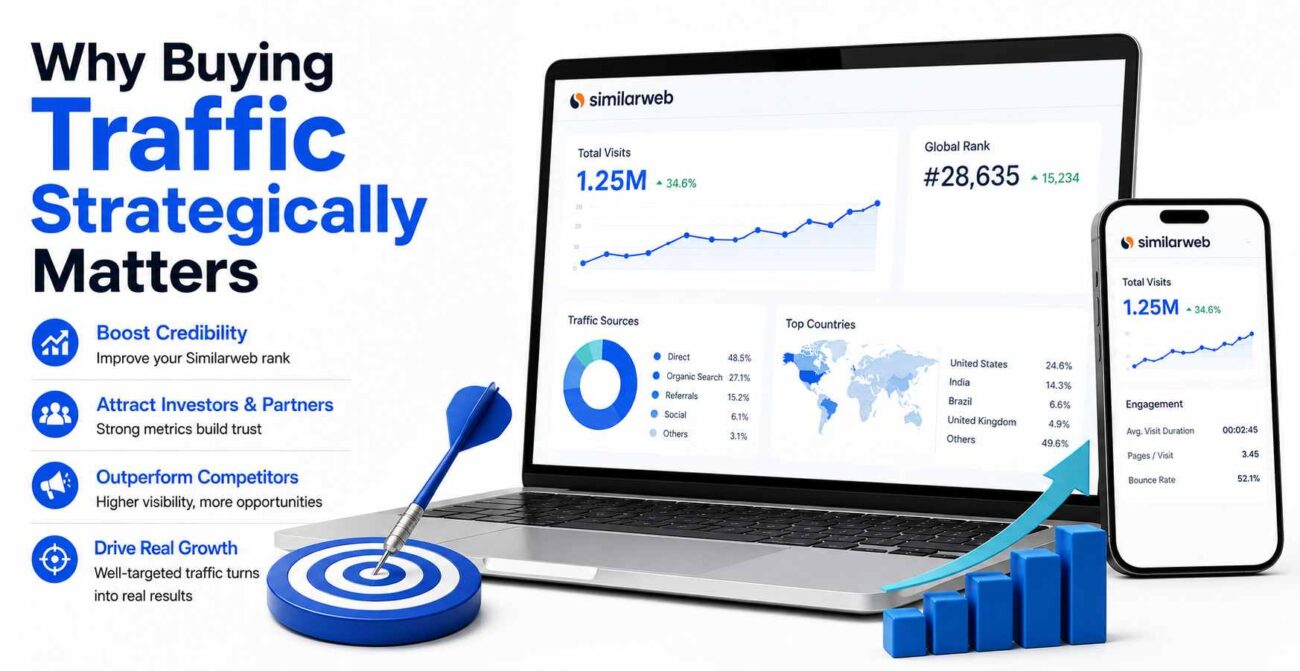
Similarweb is a benchmark. Investors, partners, advertisers, and competitors look at your Similarweb rank before they look at your pitch deck. That’s why so many SaaS, e-commerce, and media sites buy traffic to move metrics in the right direction.
But traffic itself isn’t the goal – credible, well-distributed, measurable traffic is. The mistakes below are what separate campaigns that quietly lift your numbers from campaigns that get your account flagged as suspicious.
6 Most Common Mistakes
1. Buying a Sudden Traffic Spike
The most common – and most damaging – mistake. A site averaging 5,000 monthly visits suddenly jumps to 80,000 overnight. Similarweb’s algorithm flags unusual growth curves, and so does Google Analytics. Spikes without a corresponding event (PR launch, viral content, paid ads) look exactly like what they are: purchased traffic.
Fix: Ramp traffic gradually. Start at +20–30% over your baseline in week one. Scale by similar increments week over week. A 90-day plan with a smooth growth curve looks organic; a 7-day blast does not.
2. Choosing the Wrong Geographic Distribution
A US-based legal services site receiving 70% of its new traffic from Bangladesh and Vietnam is an obvious red flag. Geo-mismatch is one of the fastest ways to tank trust signals, kill conversion rates, and confuse analytics platforms – including Similarweb’s own audience-quality scoring.
Fix: Match traffic geography to your actual target market. If you serve the US, EU, and Canada, request a geo split that reflects that – say 60% US, 25% EU, 15% Canada. Reputable providers let you specify country-level breakdowns; if yours doesn’t, switch.
3. Poor Traffic Source Distribution
Some buyers order 100% direct traffic because it’s the cheapest tier. But a site whose visitors arrive only via direct URL – with no organic, referral, or social inflow – looks artificial. Healthy sites have diversified acquisition channels. Yours should, too.
Fix: Build a realistic channel mix. A reasonable starting blend looks like:
- Organic search: 35–45%
- Direct: 20–30%
- Referral: 15–20%
- Social: 10–15%
- Other: ~5%
Adjust to fit your niche. A B2B SaaS will lean organic; a viral consumer brand will lean social. Just don’t go monolithic on one channel.
4. Running Campaigns Without Clear Goals
“I want more traffic” is not a goal. It’s a wish. Without measurable objectives, you can’t tell whether the campaign worked, whether to scale it, or whether to pivot. Most buyers skip this step and end up unable to justify the spend.
Fix: Define KPIs before you order. Pick two or three of these:
- Target monthly visit count by month 3
- Target Similarweb global or category rank
- Bounce rate ceiling (e.g., under 65%)
- Average session duration floor (e.g., over 45 seconds)
- Pages per session minimum (e.g., 1.8+)
Write the numbers down. Review weekly. Adjust the campaign based on the data, not vibes.
5. Ignoring Analytics During the Campaign
The campaign launches, the traffic starts coming, and the marketer goes back to other work. Two months later, they check Google Analytics, see 95% bounce rate and a five-second average session, and realize the traffic was worthless. By then, the budget is gone.
Fix: Set up tracking before the first visit lands. Configure goals in GA4 (or Plausible, Matomo, whatever you use). Watch these metrics weekly:
- Bounce rate per source
- Average session duration per geo
- Engagement events, firing or not
- Behavior flow – are visitors going past the landing page?
If a channel underperforms, swap it. Most quality providers allow mid-campaign adjustments.
6. Sending Bought Traffic to Weak Landing Pages
This is the silent campaign-killer. You can buy beautifully distributed, perfectly paced traffic – and still get nothing – if visitors land on a slow, ugly, or confusing page. Worse, high bounce rates from bought traffic feed back into Similarweb’s “engagement” signals and lower your perceived quality.
Fix: Audit your landing pages before buying. Specifically:
- Page load under 2.5 seconds (test with PageSpeed Insights)
- Clear value proposition above the fold
- Mobile rendering verified on real devices, not just emulators
- A single, obvious primary CTA
- No intrusive popups in the first 10 seconds
A polished landing page can turn purchased traffic into actual engagement signals – which is the whole point.
Quick Recap – Mistakes & Fixes
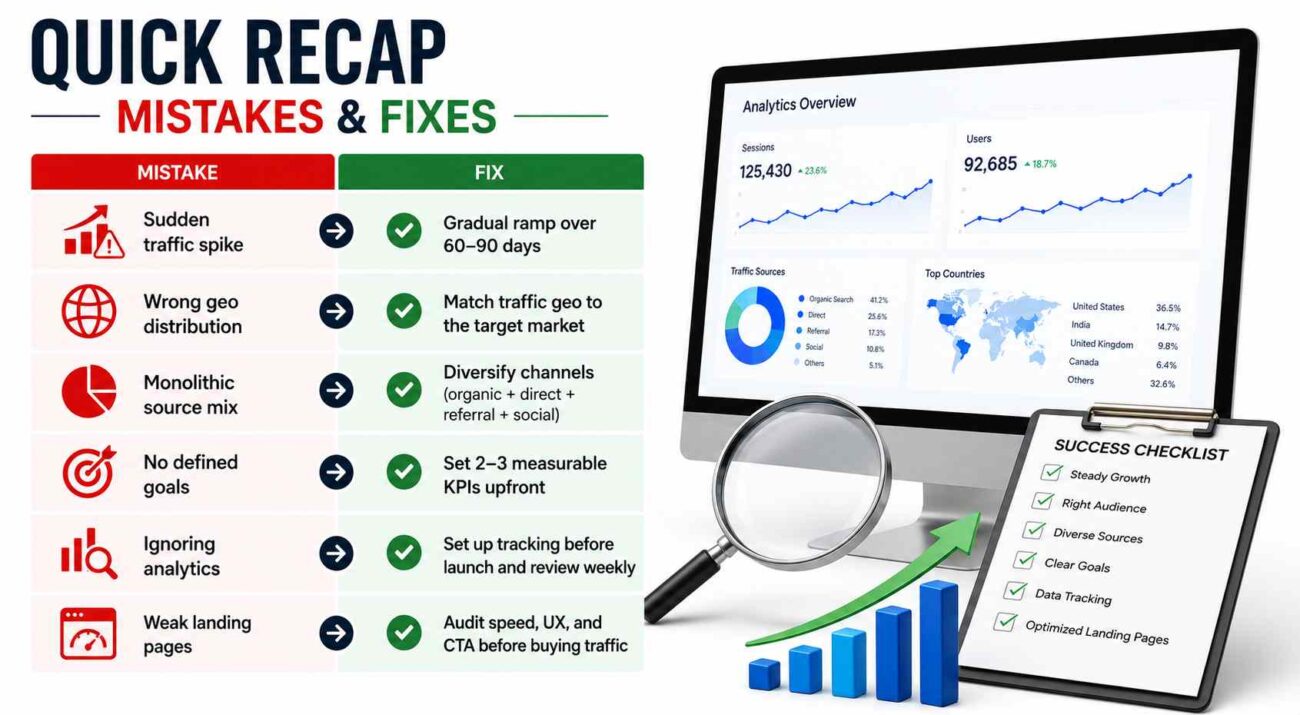
| Mistake | Fix |
|---|---|
| Sudden traffic spike | Gradual ramp over 60–90 days |
| Wrong geo distribution | Match traffic geo to the target market |
| Monolithic source mix | Diversify channels (organic + direct + referral + social) |
| No defined goals | Set 2–3 measurable KPIs upfront |
| Ignoring analytics | Set up tracking before launch and review weekly |
| Weak landing pages | Audit speed, UX, and CTA before buying traffic |
FAQ
| Question | Answer |
|---|---|
| Is buying Similarweb traffic safe for my site? | It can be, when done right. Gradual ramping, realistic geo and channel distribution, and matching traffic to a solid landing experience keep risk low. Aggressive spikes from low-quality providers are the main danger. |
| How long before I see results in my Similarweb rank? | Similarweb updates rankings monthly with a partial weekly refresh. Expect meaningful movement within 4–8 weeks of consistent traffic, assuming the campaign is properly distributed. |
| What bounce rate is acceptable for purchased traffic? | Aim for under 70%. Anything above 80% suggests either low-quality traffic or a landing-page problem. The closer you get to your organic bounce rate baseline, the better. |
| Can buying traffic hurt my Google rankings? | Purchased Similarweb traffic doesn’t directly impact Google SEO — Google uses its own signals. But poor engagement metrics on your site (high bounce, low time-on-page) can hurt SEO indirectly, which is why landing pages and traffic quality matter. |
| How much should I budget for a starter campaign? | Most credible campaigns start in the $300–$800 range for a 30–60 day test. Avoid sub-$100 offers — that’s where bot traffic and instant-spike risk concentrate. |
| Should I tell my analytics team about the campaign? | Yes. Surprise t |
Final Thought
Buying Similarweb traffic is a tool, not a strategy. Used carefully – with gradual ramps, realistic distribution, clear KPIs, active monitoring, and strong landing pages – it becomes a legitimate accelerator for early-stage growth. The six mistakes above account for most failed campaigns. Avoid them, and you’ll be in the small percentage of buyers who actually get what they paid for.