
Blog
Canada’s Smart Guide to Playing the Latest Online Casino Games

Canada’s online casino sector is moving faster than at any point in its short regulated history. Ontario’s iGaming market alone has produced more than CA$2.8 billion in gross gaming revenue across recent fiscal reporting, according to iGaming Ontario, and the rest of the country is watching closely. The result is a steady stream of new releases, fresh operators and tighter consumer-protection standards reshaping how Canadians play.
For players tracking the new online casinos entering the Canadian market, the smart approach in 2026 is no longer about chasing the biggest welcome offer. Industry observers say licensing, game mechanics, payment flexibility and responsible-play tools now matter more than headline bonuses, and the gap between regulated and unregulated brands has never been wider.
A Regulated Market on the Rise
Ontario remains the only Canadian province operating a privately licensed online casino model, jointly overseen by the Alcohol and Gaming Commission of Ontario (AGCO) and iGaming Ontario (iGO). The framework launched in April 2022 and has since attracted dozens of internationally established brands, setting a benchmark that the rest of Canada is gradually moving toward.
Alberta is preparing its own competitive open-market model, while British Columbia, Quebec, Saskatchewan and Manitoba continue to operate through provincial lottery corporations such as PlayNow, Loto-Québec and PlayAlberta. The result is a regulatory patchwork that Canadian players need to understand before signing up anywhere.
What’s New on the Game Floor

This year’s release calendar has been dominated by three categories shaping how Canadians play online:
- Crash and instant-win games, where multipliers climb until a player cashes out, rewarding timing over luck.
- Megaways slots, offering up to 117,649 ways to win per spin with adjustable volatility settings.
- Live dealer game shows, blending studio entertainment with classic table action streamed from regulated studios.
Studios including Evolution, Pragmatic Play Live and Hacksaw Gaming have pushed the format further, releasing titles that allow players to tailor risk levels to their bankroll, a feature regulators have welcomed because it gives users more visible control over their sessions.
Smart Play: The Four Pre-Deposit Checks
Smart play begins long before the first wager. Consumer specialists consistently point to four checks Canadian players should run before depositing at any new site:
- Licensing. Confirm the operator is registered with iGaming Ontario or the relevant provincial regulator.
- Game RTP. Look for a Return-to-Player percentage of 96% or higher on slots, published in each game’s info panel.
- Withdrawal terms. Check processing times and verification requirements upfront, not after a win.
- Wagering requirements. A welcome offer with 35x playthrough is reasonable; anything above 50x deserves caution.
The Responsible Gambling Council (responsiblegambling.org) also advises Canadians to set deposit and time limits before play begins, rather than mid-session when discipline is harder to maintain.
Payment Landscape
Canadian players now have more deposit options than at any point in the past decade. Interac e-Transfer remains the dominant method, valued for its speed and bank-grade security. Pay-by-bank services and instant-withdrawal options have also expanded, particularly at newly licensed Ontario sites where verification is completed at sign-up.
Cryptocurrency deposits are not permitted at AGCO-licensed casinos, a deliberate regulatory choice aimed at curbing anonymity-related risks and keeping the audit trail clean.
Bonuses Without the Headache
Welcome bonuses are still the most visible feature of new casino launches in Canada, but the structure has shifted. Many operators now offer smaller, low-wagering bonuses spread across the first week of play instead of one large matched deposit. Free-spin packages have also become more transparent, with maximum-win caps clearly disclosed in line with AGCO marketing standards introduced in 2022 and tightened since.
Players are still advised to read bonus terms in full, paying particular attention to game weighting. Slots typically contribute 100% toward wagering requirements, while live dealer titles may contribute as little as 10%, which changes the maths considerably.
Mobile-First Game Design
Roughly seven in ten Canadian online casino sessions now begin on a smartphone, according to recent industry tracking. Studios have responded by designing games portrait-first, with simplified controls, reduced data usage and faster load times. Progressive jackpot networks have been redesigned to display real-time prize pools on smaller screens without compromising the gameplay experience.
Player Protection Moves Front and Centre
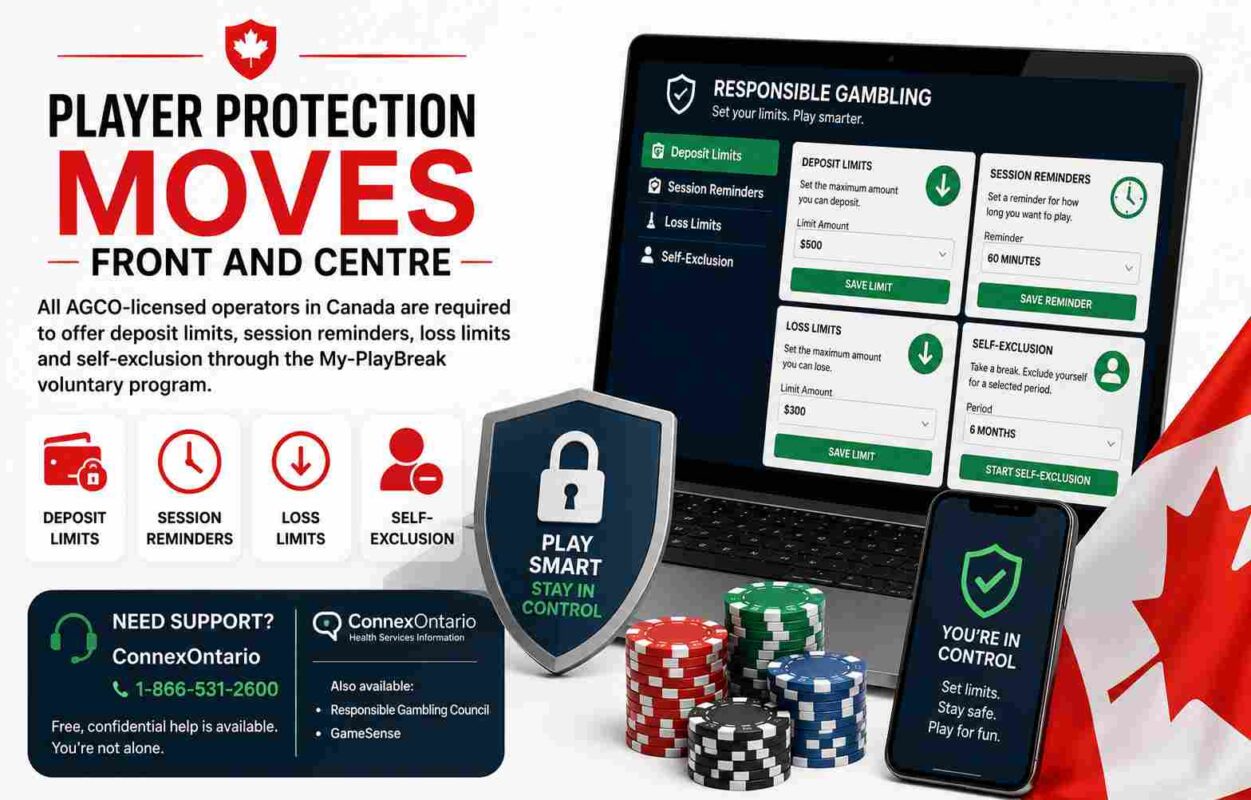
All AGCO-licensed operators in Canada are required to offer deposit limits, session reminders, loss limits and self-exclusion through the My-PlayBreak voluntary program. Several brands have gone further, deploying AI-driven flags that warn players when their behaviour starts to match higher-risk patterns.
For players outside Ontario, ConnexOntario (1-866-531-2600) remains a national point of contact for problem gambling support, alongside provincial programs such as the Responsible Gambling Council and GameSense.
Bottom Line
Canada’s online casino landscape in 2026 is fast-moving and competitive, but the smartest players are those treating it less like entertainment and more like an informed consumer decision. Licensing status, game mechanics, payment flexibility, and player tools should all factor into where to sign up long before the first reel spins.
As more operators enter the regulated space and provinces debate further liberalization, 2026 may be remembered as the year Canadian iGaming finally grew up.
Disclaimer
This article is for general informational and educational purposes only. It does not promote gambling, guarantee winnings, or encourage readers to sign up with any online casino. Online gambling involves financial risk and may not be suitable for everyone.
Readers should only participate in online gambling if they are of legal age in their province or territory and should always check the licensing status of any platform before creating an account or depositing money. Laws, regulations, payment rules, bonus terms, and responsible gambling requirements can change, so readers should verify current information through official provincial regulators.
Never gamble with money needed for rent, bills, education, food, debt payments, or family expenses. Set limits before playing, avoid chasing losses, and stop immediately if gambling stops feeling like entertainment. Anyone concerned about their gambling, or someone else’s gambling, should seek free and confidential support through services such as ConnexOntario, the Responsible Gambling Council, or their provincial support program.
References
- iGaming Ontario. “iGaming Ontario’s Market Performance Report.” iGaming Ontario, last updated April 29, 2026, with data updated through March 2026. This report covers operator activity from Ontario’s market launch on April 4, 2022, through the latest reported month. Accessed May 26, 2026.
- Alcohol and Gaming Commission of Ontario. “Registrar’s Standards for Internet Gaming.” AGCO, updated May 14, 2026. The standards came into force on April 4, 2022, when Ontario’s regulated internet gaming market launched—accessed May 26, 2026.
- Alcohol and Gaming Commission of Ontario. “Overview of Internet Gaming in Ontario.” AGCO. This official overview explains Ontario’s regulated internet gaming framework and notes the April 4, 2022, launch of the province’s competitive iGaming market. Accessed May 26, 2026.
- Alcohol and Gaming Commission of Ontario. “Limit-Setting Features.” AGCO. This resource explains financial and time-based limit-setting requirements for regulated internet gaming operators in Ontario. Accessed May 26, 2026.
- iGaming Ontario. “Responsible Gambling.” iGaming Ontario. This player-facing resource explains responsible gambling and safer gambling expectations in Ontario’s regulated market. Accessed May 26, 2026.
- Responsible Gambling Council. “Responsible Gambling Council: Home.” Responsible Gambling Council. This source provides public education, safer gambling guidance, and information on recognizing gambling-related harm. Accessed May 26, 2026.
- Responsible Gambling Council. “Take a Break from Gambling: Help for Problem Gambling.” Responsible Gambling Council. This page explains voluntary self-exclusion as a harm-reduction option for people who want to step away from gambling—accessed May 26, 2026.
- ConnexOntario. “Mental Health, Addiction and Problem Gambling Services.” ConnexOntario. ConnexOntario provides free, confidential support information for mental health, addiction, and gambling-related concerns, including the 1-866-531-2600 support line. Accessed May 26, 2026.