
Blog
Why Classic Casino Games Translated So Well to Online Play


The first time I tried online blackjack, what surprised me was not the convenience, which was obvious, but how little the actual game lost in translation. The cards moved on a screen instead of a felt table, but every decision I had to make was identical to the one I would have made in person. That fidelity is the quiet reason classic casino games translated to digital so smoothly when so many other physical experiences did not.
Games Were Already Mostly Visual Logic
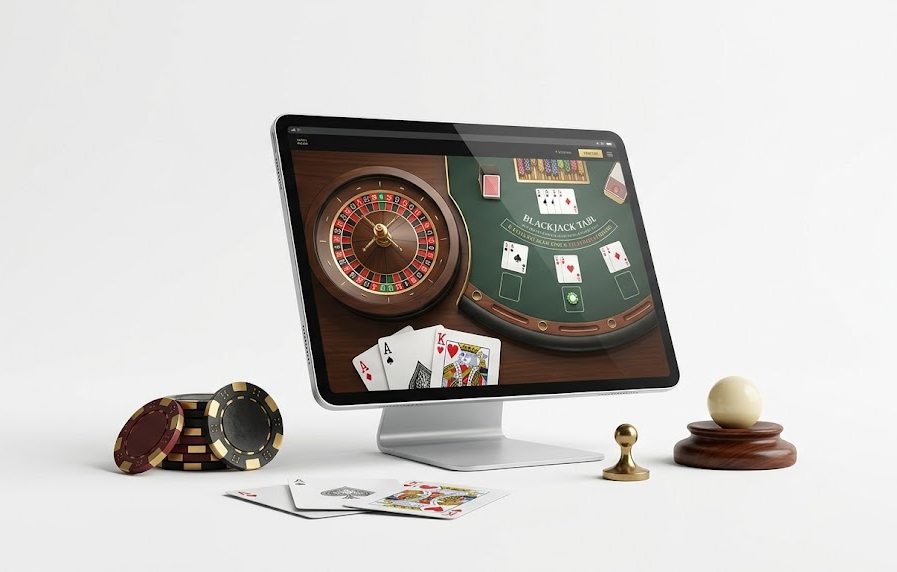
Classic casino games are heavily visual. A roulette wheel is a visual instrument; the ball lands somewhere, and you can see where. A blackjack table is visual; the cards face up tell most of the story. Baccarat is visual; the cards reveal in a particular order. The games rely on what the eye can see in a single layout, and that layout transfers cleanly to a screen.
Compare this with games that rely on heavy physical interaction, pool, darts and foosball and the difference is obvious. Those games can be simulated, but they lose something in translation because their charm depends on the physical sensation of the action. Classic casino games never depended on physical sensation in the same way. They depended on watching what unfolded on the table. Britannica’s overview of casino game design documents how the games developed around what casino patrons could observe at a fixed seat, and that observation-based design happens to be perfect for digital delivery.
Math Is the Same Math
A digital roulette wheel and a physical roulette wheel run on the same probabilities under fair operation. A digital blackjack shoe and a physical one produce the same statistical outcomes. The translation does not change the math, which means the strategies that work at a physical table also work online. Players who learned the games offline can play online without re-learning anything fundamental.
This continuity matters. Players who arrive at online casinos already comfortable with classic games do not face a learning curve. They face a familiar experience in a new wrapper. The wrapper is different audio, different ambiance, different pacing, but the core game is the same. Players in eligible states who want to confirm this can try a few rounds of DraftKings online roulette and recognize the rhythm immediately if they have any prior experience with the physical game.
Social Layer Was Always Optional
Some casino games, such as poker, most obviously depend on the social layer. Reading the table is half the game. Other games, slots, certainly, but also roulette in many of its modes work fine as solitary experiences. The classic games that translate well online tend to be those where social play is a nice-to-have rather than a load-bearing element.
Live dealer formats have started bringing some social texture back. A real dealer, real chat with other players, real banter. The combination of online convenience with restored social texture has produced a hybrid experience that did not exist five years ago and is now a meaningful share of online casino play.
Pacing Adjusted Without Losing Identity
Online versions of classic games are usually faster than their physical counterparts. The dealer is faster. The bets clear faster. The next round arrives faster. Some traditionalists initially opposed this acceleration, but most players have adapted, and many prefer the digital pace for its efficiency.
Importantly, the acceleration did not change the games themselves. The rules are the same. The probabilities are the same. The decisions are the same. Only the cycle time has tightened. A Variety piece on game format adaptation across media covered how this kind of pacing adjustment has happened in many entertainment categories during digital transitions, and the casino category followed a recognizable arc.
Lobby Concept Is New and Worked Out
One genuinely new feature of online casino play is the lobby. A physical casino has a floor you walk around and see the games. An online casino has a lobby where you scroll and see thumbnails. The lobby concept did not exist before the Internet, and operators had to invent it from scratch.
Early lobbies were chaotic. Modern lobbies are more carefully designed, with filters, search, recommendations, and clear navigation between game categories. The lobby has become its own art form, and getting it right is a meaningful differentiator between operators. A great lobby surfaces the right games to the right players without overwhelming them; a poor lobby buries good games behind clutter.
Mobile Was the Bigger Shift
The move from desktop to mobile was a bigger adjustment than the move from physical to digital. Desktop casino interfaces could mimic the table layout. Mobile interfaces had to rethink everything for vertical orientation, touch input, and small screen real estate. Some classic games translate better to mobile than others.
Roulette adapted well, since the wheel and the bet layout could be presented in stacked vertical sections. Blackjack adapted well for similar reasons. Some more complex table games struggled because their layouts did not compress cleanly. The games that thrived on mobile were the ones whose visual logic survived the format change.
Sound Design Matured
The sound design of online classic games has matured dramatically since the early days. Early online casinos used stock sounds that felt cheap. Modern operators commission custom audio that captures the texture of physical casino floors, the clatter of chips, the whir of the wheel, the soft murmur of background activity, without becoming intrusive.
Good audio is one of the underrated features of a polished online casino. Players rarely talk about it, but they feel it. A game with rich, restrained audio feels premium. A game with cheap or absent audio feels generic. The audio layer is where many of the small production-value decisions add up.
Trust Took Longer Than Capability
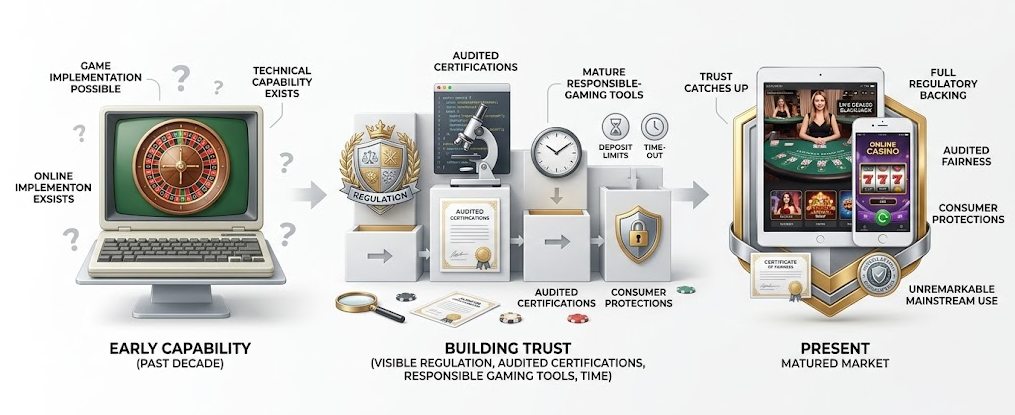
Technical capability for online classic games existed before regulatory and consumer trust did. The games could be implemented faithfully years before most players were comfortable using them. Building trust required visible regulation, audited certifications, mature responsible-gaming tools, and time.
We are now in a phase where the trust has caught up with the capability in many regulated markets. Players in eligible states have access to platforms with full regulatory backing, audited fairness, and consumer protections. The games themselves are no different than they were technically a decade ago, but the trust infrastructure around them has matured to the point where mainstream adult use is unremarkable.
Persistent Magic of the Originals
Despite all of the digital innovation, the underlying magic of classic casino games is unchanged. A roulette wheel is fascinating because of what it has always been: a spinning circle, a small ball, and the reveal of where chance landed. A blackjack hand is satisfying because of what it has always been: the tension between hitting and standing on a borderline total.
Digital delivery wraps these games in modern infrastructure, but the core appeal is centuries old. That continuity is part of why these games keep finding audiences. They are not chasing trends; they are sitting on enduring human curiosity about chance, decision, and revelation. Trends come and go; classic games persist.
Closing Thought
Classic casino games translate well to online play because their original design happened to fit the digital medium almost by accident. The visual logic, the optional social layer, the universal math, and the deep cultural familiarity all worked in their favor. The result is a category that connects centuries-old games to modern infrastructure with surprisingly little friction. Players who appreciate the originals can find them online in versions that respect what made them work in the first place, and the format is likely to stay strong for as long as people remain curious about what the wheel will do next.
Disclaimer
This article is intended for informational and educational purposes only. Online casino gaming involves financial risk and may not be legal in all jurisdictions. Readers should only participate in gambling activities where permitted by local law and should use licensed, regulated platforms. The mention of specific operators or casino products does not constitute financial, legal, or gambling advice, nor does it represent an endorsement. Always gamble responsibly and seek support from responsible gaming organizations if gambling stops being a form of entertainment.
References
- Cotte, J., & Latour, K. A. (2009). Blackjack in the Kitchen: Understanding Online versus Casino Gambling. Journal of Consumer Research, 35(5), 742–758.
- Kim, H. S., Wohl, M. J. A., Salmon, M. M., Gupta, R., & Derevensky, J. (2015). Do Social Casino Gamers Migrate to Online Gambling? An Assessment of Migration Rate and Potential Predictors. Journal of Gambling Studies, 31, 1819–1831.
- Kim, H. S., Wohl, M. J. A., Gupta, R., & Derevensky, J. L. (2017). Why do young adults gamble online? A qualitative study of motivations to transition from social casino games to online gambling—Asian Journal of Gambling Issues and Public Health, 7(6).
- Gainsbury, S. M., Hing, N., Delfabbro, P. H., & King, D. L. (2014). A taxonomy of gambling and casino games via social media and online technologies. International Gambling Studies, 14(2), 196–213.
- Ross, A., & Nieborg, D. (2021). Spinning is winning: Social casino apps and the platformization of gamble-play convergence: The International Journal of Research into New Media Technologies, 27(1).
- Auer, M., & Griffiths, M. D. (2023). The relationship between structural characteristics and gambling behaviour: An online gambling player tracking study. Journal of Gambling Studies, 39, 265–279.
- Auer, M., & Griffiths, M. D. (2023). Using artificial intelligence algorithms to predict self-reported problem gambling with account-based player data in an online casino setting. Journal of Gambling Studies, 39, 1273–1294.
- Hing, N., Rockloff, M., & Browne, M. (2023). Adoption, Adaptation or Exposure? Novel Digital Gambling Activities and Links with Gambling Problems. Current Addiction Reports, 10, 254–261.
- Harris, A., Parke, A., Schüll, N., & Griffiths, M. (2021). A speed-of-play limit reduces gambling expenditure in an online roulette game: Results of an online experiment: addictive Behaviors, 120, 107229.
- Shi, S. W., Prentice, C., & He, W. (2018). From gambling exposure to adaptation: Implications for casino sustainability. Journal of Retailing and Consumer Services, 41, 31–36.