
Blog
5 Things That Make a Game Look Expensive: Production Choices That Signal Quality

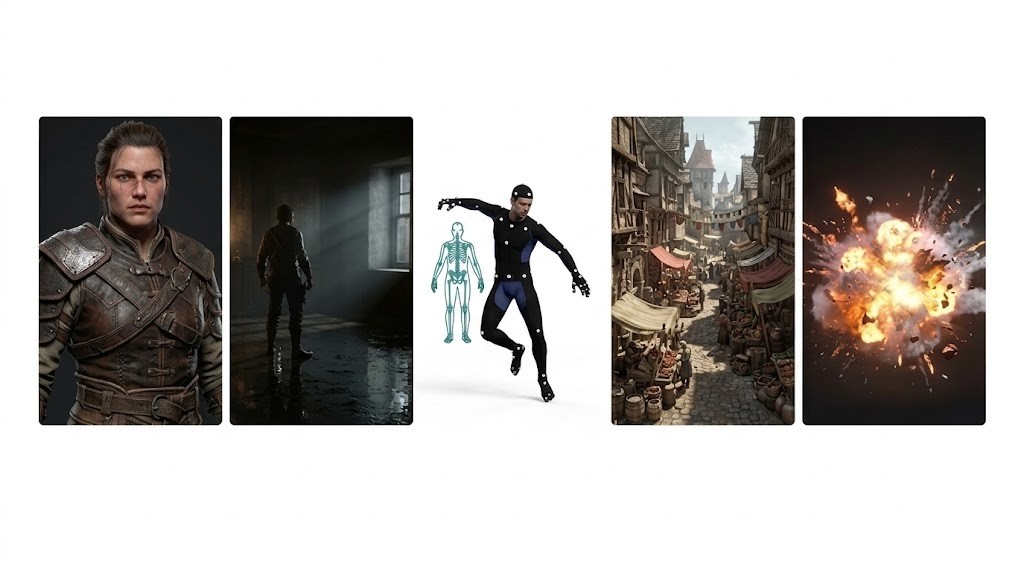
Players decide whether a game looks worth their time within seconds of seeing it – and that snap judgment does not come from reading patch notes or feature lists. It comes from a handful of visual and audio cues that signal, almost instinctively, whether real craft and investment went into the product. According to the UK Competition and Markets Authority, modern AAA games launching in 2024-2025 carry average development budgets of $200 million or more, a figure driven largely by the relentless demand for higher production values. But the signals that communicate quality to players are not always the ones that cost the most. They are the ones handled with the most intention.
This breakdown covers five production choices that consistently set games that feel expensive apart from those that do not, and why each one carries more weight than it might seem.
Why Production Quality Communicates Value Before Gameplay Does
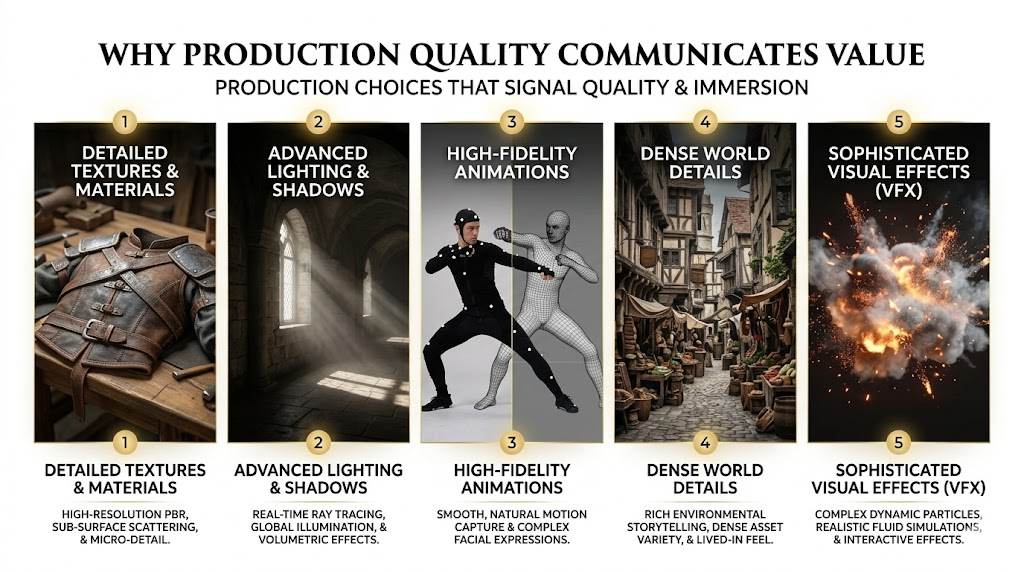
A game can have brilliant mechanics and a compelling story, yet still lose players at first glance. The reverse is also true: strong visual production creates enough goodwill that players are willing to overlook imperfections elsewhere. This is not superficial. Research on visual style and player experience consistently shows that production quality shapes immersion, emotional engagement, and overall satisfaction before a single gameplay loop.
The implication for anyone commissioning a game is straightforward. Production decisions made during development, including engine choice, art direction, animation budget, and audio investment, directly affect how the finished product is received, how it is reviewed, and ultimately how it sells.
5 Key Things That Make a Game Look Expensive
1. Lighting That Reacts Rather Than Sits Still
Static lighting is one of the clearest markers of a lower-budget production. In a polished game, light behaves. It shifts as the player moves through environments, responds to time of day, reflects off surfaces with physical accuracy, and casts shadows that match the geometry around them. This is not decoration; it is the difference between a world that feels built and one that feels rendered.
Dynamic global illumination, ray tracing, and physically-based rendering are the technical approaches behind this effect. What players experience is simpler to describe: the game feels real, even when it is stylized. A dungeon with torchlight that actually flickers and casts moving shadows across stone walls communicates a level of care that players register immediately, even if they cannot name the technique behind it.
The gap between studios that handle lighting well and those that do not is often less about access to tools and more about the expertise to use them. Unreal Engine development services are closely associated with this capability precisely because UE5’s Lumen system, its real-time global illumination solution, is what separates many polished AAA-level environments from amateur builds. The technology is available; the knowledge to implement it at a quality is not universal.
2. Character Animation That Carries Weight
Animations reveal production investment faster than almost any other element. A character whose movements feel weightless, whose transitions between states snap rather than blend, or whose idle animations look mechanical will undermine the credibility of even excellent art assets. Players feel this before they articulate it.
High-quality animation is built in layers. The base movement needs to feel physically grounded – feet that react to terrain, bodies that shift momentum when changing direction, hands that interact with objects rather than clip through them. On top of that, blend trees and transition logic need to be tuned carefully so that moving from a walk to a run to a jump feels continuous rather than stitched together.
Motion capture adds an extra layer of authenticity to character performances, particularly in story-driven games where facial expressions and body language carry narrative weight. It is expensive, but its absence is noticeable in any game where human characters are central to the experience.
3. Environmental Storytelling Through Asset Detail
Players do not consciously catalog the density of environmental detail in a scene. But they feel the difference between a space that looks like a backdrop and one that looks inhabited. Scattered objects with wear and age, surfaces with context-appropriate damage, backgrounds that reward closer inspection – these are the details that make a world feel like it existed before the player arrived.
This is sometimes called environmental storytelling, but it is also simply good art direction applied consistently. The challenge is not just creating individual high-quality assets. It is maintaining that quality and coherence across an entire game world, which requires a scalable production pipeline and a clear visual style guide that every team member working on assets follows.
The table below illustrates how this plays out across different production tiers:
| Production Level | Environmental Detail | Player Perception |
| Low budget | Repeated assets, flat surfaces, minimal wear | World feels empty or placeholder |
| Mid-tier | Varied assets, some detail, inconsistent style | World feels serviceable but forgettable |
| High production | Unique assets, cohesive style, contextual wear | World feels lived-in and credible |
| AAA | Layered detail, interactive elements, narrative context | World feels real, rewards exploration |
The jump from mid-tier to high production is often where outside specialist teams make the greatest difference – not by adding more assets, but by maintaining the consistency that in-house teams under time pressure tend to lose.
4. Sound Design That Matches the Visual Ambition
Sound design is consistently underestimated in pre-production planning, and consistently noticed by players when it is absent or mismatched. A game with stunning visuals and generic, flat sound effects signals that the production ran out of either budget or attention before finishing the job. Players register this as a credibility gap, even if they describe it as the game “not quite feeling right.”
High-quality audio operates on multiple levels simultaneously:
- Ambient sound layers create the sense that environments extend beyond what is visible, making spaces feel genuinely inhabited.
- Reactive sound design ties audio feedback to player actions in ways that reinforce impact – footsteps that change with surface material, weapons that sound distinct in open versus enclosed spaces.
- Music that adapts to moment-to-moment gameplay rather than looping indifferently in the background
- Voice performance and dialogue mixing that places characters believably in the same sonic space as the environments they inhabit
The research is consistent on this point: immersive sound design enhances the sense of physical presence within a virtual environment in ways that visual quality alone cannot replicate. Studios that invest comparably in audio and visuals tend to produce games that reviewers describe as “polished.” At the same time, those who prioritize one at the expense of the other often find the gap noted explicitly in coverage.
5. UI and UX That Gets Out of the Way
Interface design is rarely what marketing campaigns lead with, but it is among the first things players interact with and one of the fastest ways a game can feel unfinished. A cluttered heads-up display, menus with inconsistent visual language, text that does not scale properly, or button prompts that appear at the wrong moment – any of these create friction that a polished game quietly removes.
The quality marker here is restraint combined with responsiveness. High-production game UI communicates what the player needs to know without competing with the game world for attention. It uses the same visual language as the rest of the game’s art direction. It responds to input quickly enough that the interface feels like an extension of the game rather than a separate layer on top of it.
This is also where cross-platform development introduces real complexity. A UI designed for a mouse and keyboard needs significant rework to feel natural on a controller, and vice versa. Studios that handle this transition well typically treat each platform’s interface as a distinct design problem rather than a port of the original.
What These Signals Have in Common
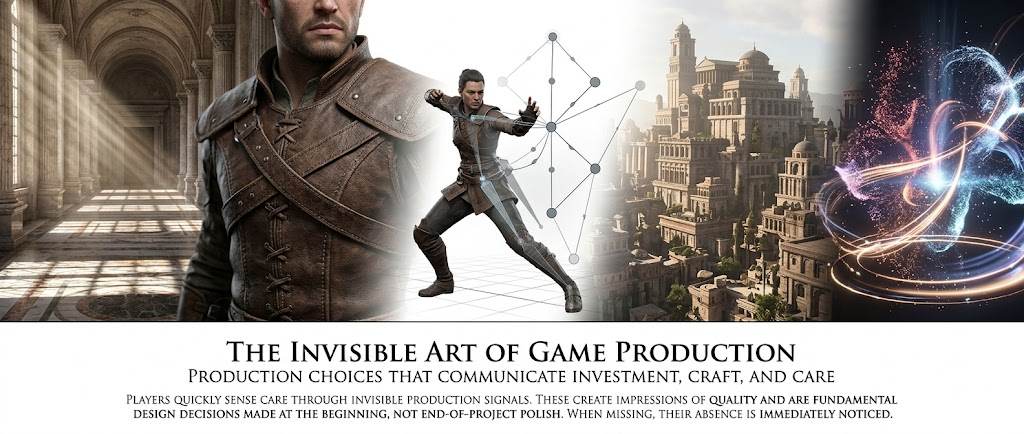
None of the five elements above are features that get announced in trailers. Players do not wishlist a game because of its global illumination system or its blend tree logic. But they do decide, within the first few minutes of a demo or the first few seconds of a trailer, whether the game looks like it was made by people who cared or like it was shipped before it was ready.
The production choices that signal quality are almost always invisible when done well. They create an impression of craft, investment, and attention that players absorb without analyzing. When they are missing, players notice immediately, even if they cannot name what is wrong. For anyone making decisions about game production budgets, team structure, or partner selection, these signals deserve serious weight. They are not polish applied at the end of a project, they are design decisions made at the beginning, whose consequences run through every stage of development.
FAQ
Does a game have to be photorealistic to look expensive?
- No, some of the most critically praised games of recent years use stylized art directions, cel-shading, painterly environments, and flat color palettes. Production quality is about intentionality and consistency, not realism. A stylized game with coherent art direction and quality animation reads as polished. A realistic-looking game with flat lighting and choppy movement does not.
How much of a game’s budget typically goes toward visuals?
- Art production, including environments, characters, textures, and effects, typically accounts for 25-30% of a AAA game’s development budget, according to industry analysis. For mid-tier productions, the proportions are often similar, but the absolute spend is lower, making trade-offs between quality and coverage harder.
Can a small studio achieve AAA-level visual quality?
- With the right engine, specialist partners, and a tightly scoped art direction, a small studio can produce work that reads as high quality. The key is choosing a visual style that plays to the team’s strengths and maintaining ruthlessly consistent standards. Attempting to achieve photorealistic fidelity across a large open world with a small team is a different problem than executing a stylized, tightly scoped environment at a high standard.
What is the most common production mistake that makes a game look cheap?
- Inconsistency. A single stunning character model surrounded by flat, repeated environment assets signals a production that ran out of resources mid-way. Players perceive the gap between the highest- and lowest-quality elements in a game more acutely than they perceive the average quality. Coherence matters as much as peak quality.
How does engine choice affect the final visual quality players see?
- The engine sets the ceiling for what is achievable and the floor for what tools are available to the team. Different engines have different strengths in lighting, particle systems, physics simulation, and rendering pipelines. Teams that specialize in a particular engine develop the expertise to push it closer to its ceiling – which is why engine specialization, not just engine availability, affects output quality.
Closing Thoughts
What makes a game look “expensive” is rarely a single standout feature. It is the consistency of many small decisions working together. Lighting that behaves naturally, animations that feel grounded, environments that tell a story, sound that supports immersion, and interfaces that stay out of the way all contribute to a unified experience.
Players may not consciously analyze these elements, but they notice when something feels off. That reaction shapes first impressions, reviews, and long-term engagement. For developers and publishers, this means production quality is not just about higher budgets. It is about making deliberate choices early, maintaining standards throughout development, and ensuring that no part of the experience breaks immersion.
In the end, games that feel premium are those where every detail, visible or not, reflects intention and care. That is what players respond to, and that is what separates a good game from one that feels truly polished.
References
- UK Competition and Markets Authority – Online gaming and digital markets report, 2024–2025, https://www.gov.uk/cma
- Unreal Engine 5 – Lumen Global Illumination and rendering documentation, Epic Games, 2024, https://docs.unrealengine.com/5.0/en-US/lumen-global-illumination-and-reflections-in-unreal-engine/
- International Game Developers Association – Developer satisfaction and production practices report, 2023, https://igda.org/resources-archive/developer-satisfaction-survey-summary-report-2023/
- Human–Computer Interaction – Research on visual design, UX, and player engagement in interactive systems, various publications
- Game Developers Conference – State of the Game Industry Report, 2024, https://gdconf.com/state-game-industry
- Nielsen Norman Group – User interface design principles and usability research, 2023, https://www.nngroup.com/articles/