
Blog
7 Vetted Match-3 Level Design Outsourcing Companies

Outsourcing match-3 level design is a different decision from hiring a game development studio. A full-service studio takes a project; an outsourced level-design team extends your pipeline. That requires a different kind of partner.
The good ones work inside your editor, follow your naming conventions, match your review cycle, and deliver content that drops straight into your build without extra formatting or engineering time. Coordination stays light because its process is built for integration.
The weak vendors sound similar on a sales call. The problems show up in week one, when the first batch arrives in the wrong format, misses difficult targets, and forces your engineers to fix work that should have been production-ready.
This guide reviews the top match-3 level-design outsourcing companies for studios that need external production support.
What to Look for in a Match-3 Level Design Outsourcing Partner
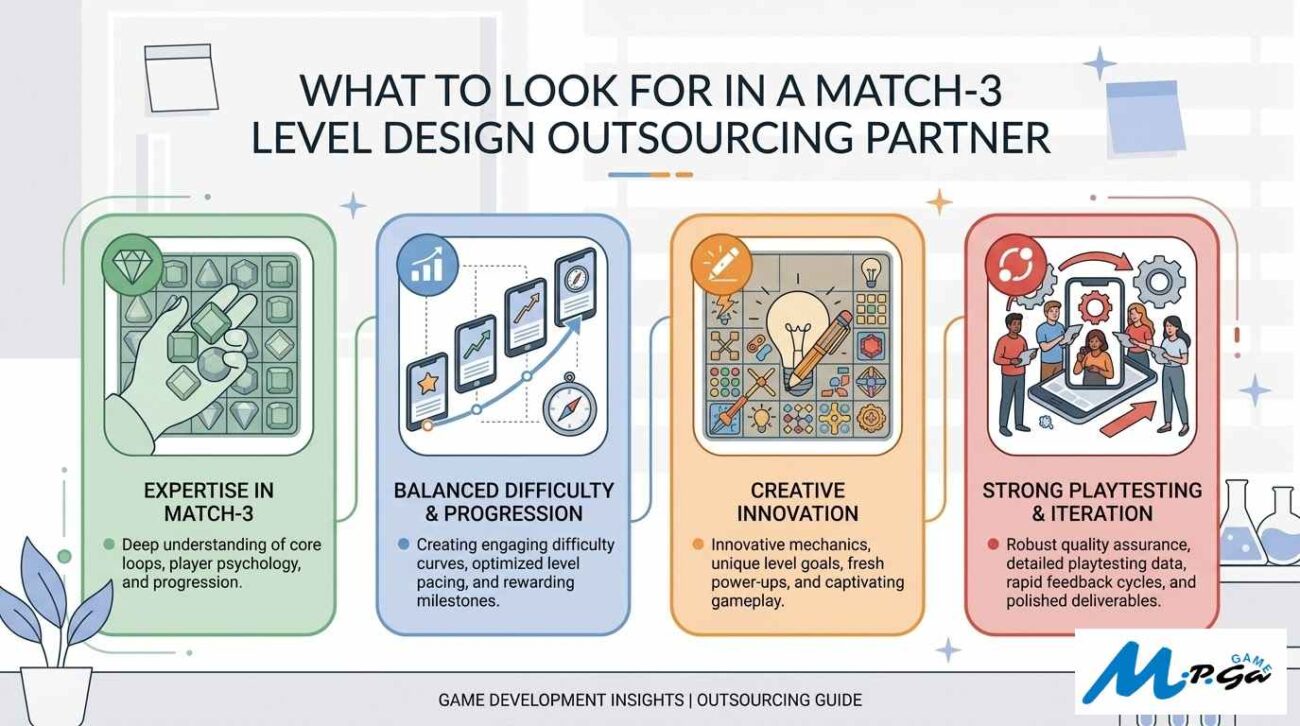
Five criteria separate outsourcing partners that integrate cleanly from those that create more work than they save.
- Pipeline compatibility. The first question is whether the studio works inside your editor or sends files you have to interpret. A good partner builds levels directly in your tools, using your naming conventions, balance-sheet format, and stack. That removes a coordination layer. A vendor that sends static files that your engineers must convert adds one. The gap compounds over hundreds of levels.
- Onboarding speed. Every week between contract and first delivery is a week your pipeline stalls. Strong partners have a defined onboarding process: they request editor access, documentation, and balance sheets on day one and start shipping within days, not weeks. Ask how long their onboarding takes and what they need from you to begin. Their answer shows whether they’ve done this before.
- Output consistency and QA. Volume without quality control turns into churn. Ask how many revision rounds are included, who owns QA before delivery, and what happens when a level underperforms in live data. Studios with a clear answer to that last question have shipped at scale. Studios that hesitate probably haven’t.
- IP protection and confidentiality. Match-3 games built on licensed IPs need partners with solid NDAs and documented data-security practices. This becomes critical fast, and most teams only realize it when it’s already a problem.
- Scalability without quality drop. A team that can ship 50 levels a month is useful. A team that can scale to 200 when your roadmap demands it, without quality slipping on level 151, is worth a long-term contract. Ask for proof of sustained output at volume.
Best Match-3 Level Design Agencies to Outsource Your Work
The market for match-3 level design outsourcing is larger than it looks from the outside, and the quality range is wider than most teams expect until they make a bad hire. The companies below have verifiable production histories: named titles, documented throughput, or published case studies.
SolarSpark
SolarSpark is a remote-first studio built exclusively around casual puzzle game production. With 7+ years in the genre and 2,000+ levels shipped across live titles, including Monopoly Match, Matchland, KitchenMasters, MatchCruise, and CandyPins, it is the only company on this list that does nothing but match-3 level design.
- Level design services: Level production, difficulty curve planning, fail-rate balancing, obstacle and booster logic design, live-ops pipeline, competitor benchmarking, product audit and retention diagnostic.
- Notable case: For Monopoly Match (Beematch), which is a licensed IP title live on App Store and Google Play, the team handled level design on a game carrying one of the most recognizable brand names in casual gaming, where IP weight makes retention failures more costly and more visible than on original titles.
- Verdict: The strongest pure outsourcing specialist on this list. For studios with a live or in-development game that need level design covered without adding engineering overhead, SolarSpark is the first call to make.
- Caveat: SolarSpark does not handle art, engineering, or full-cycle development.
U2A Games
U2A Games is a puzzle level design studio focused on match-3 and adjacent genres, including match-2, mahjong, tile match, bubble shooter, and solitaire. With 20,000+ levels shipped across 4 Top 100 Grossing titles on the App Store and Google Play, this team can provide capacity of 300+ levels per week.
- Level design services: Level production, difficulty curve development, obstacle balancing, KPI-driven rebalancing for live games, full project assessment, and level-specific quality review.
- Notable case: U2A has delivered level design across 4 separate Top 100 Grossing puzzle titles on both major app stores. Their team carries 15+ years of combined lead-level experience across the genre.
- Verdict: The right call when throughput is the primary constraint.
- Caveat: U2A does not handle art, engineering, or full-cycle development.
Room 8 Studio
Room 8 Studio is an international art production and game development outsourcing company with 1,000+ employees, production hubs across Ukraine, Poland, and Canada. It also partners with 7 of the top 10 global publishers, including EA, Nintendo, Ubisoft, Gameloft, and Activision. Level design is a staffed, dedicated function backed by a published methodology.
- Level design services: Level production, game economy design, difficulty balancing, live-ops level content, obstacle and booster design, analytics-backed level review, full-cycle development with level design integrated from concept.
- Notable case: For Meow Match (Ember Entertainment), Room 8 delivered thousands of levels with 86% hitting the target difficulty rating.
- Verdict: The strongest enterprise-scale outsourcing option on this list. For large publishers running live games at volume, Room 8 has the infrastructure, the track record, and the methodology to sustain output without a quality ceiling.
- Caveat: Enterprise onboarding and process overhead make Room 8 a poor fit for small studios or short-term sprints.
iLogos Game Studios
iLogos has been in game production since 2006 with 458+ projects shipped across mobile, PC, and console, and a client list that includes EA, Sony, Disney, Rovio, Supercell, Ubisoft, Warner Bros., and Playrix. For match-3 specifically, they built a proprietary engine purpose-built for the genre.
- Level design services: Level production, level design inside proprietary match-3 engine, difficulty balancing, mechanics prototyping, live-ops level content, soft launch support, full-cycle development with level design integrated throughout.
- Notable case: For Candy Crush Jelly Saga (King), iLogos worked inside King’s level design process and used their proprietary tooling to construct unique levels that expanded on the mechanics envisioned by King’s team.
- Verdict: The most technically credentialed match-3 outsourcing partner. The proprietary engine and Candy Crush Jelly Saga credentials represent a quality bar.
- Caveat: iLogos is built for technically complex, large-scale engagements. Studios that need a simple level design pipeline without full-service overhead will find the model heavier than necessary.
Innovecs Games
Innovecs Games is a division of Innovecs with 9 years of operation, 300+ games shipped, and a team of 200+ developers across engineering centers in Ukraine, Romania, Hungary, and Poland. Their model is explicitly built for co-development and pipeline integration.
- Level design services: Level production, difficulty balancing, obstacle design, UI/UX for match-3, co-development level design support, and ongoing pipeline integration.
- Notable case: Cookie Jam, one of the match-3 genre’s established titles, is in Innovecs’ verified portfolio, placing them in a small group of outsourcing studios on this list that can point to a named, recognizable title.
- Verdict: The strongest co-development outsourcing option on this list for studios that need specific production gaps filled without handing off the whole project to a single vendor.
- Caveat: Match-3 is one service line among many at Innovecs. The genre depth is concentrated among the specialists higher on this list, and should be tested before a long-term engagement.
Logic Simplified
Logic Simplified is an India-based game development company with over a decade of operating history, specializing in Unity-powered casual and puzzle games. Match-3 is explicitly in their service portfolio, with analytics, A/B testing, and customer journey mapping integrated into the development process from the start.
- Level design services: Level production, difficulty progression design, obstacle and blocker placement, booster and power-up integration, A/B tested level balancing, customer journey mapping applied to level flow, monetization-integrated level design.
- Notable case: Logic Simplified delivered a match-3 mobile game for iOS and Android within a few months. A client cited the team’s calm professionalism and ability to deliver a quality product under tight timelines.
- Verdict: A credible, accessible outsourcing option for studios that want analytics and monetization designed alongside levels from day one.
- Caveat: No publicly named match-3 titles with verifiable App Store links appear in their portfolio.
Galaxy4Games
Galaxy4Games is a game development studio with 15+ years of operating history across casual, RPG, and arcade genres, with match-3 as a named service line. Their distinguishing characteristic as an outsourcing partner is a level of public transparency about real production outcomes; published case studies document actual D1 and D7 retention numbers.
- Level design services: Level production, difficulty curve development, booster and obstacle design, progression system design, LiveOps level content, A/B testing integration, analytics-based balancing, and modular level system setup.
- Notable case: For Puzzle Fight, a match-3 PvP hybrid, Galaxy4Games documented D1 retention growing to 30% after market testing and iteration cycles, with D7 retention identified as the next optimization target.
- Verdict: The most transparent data-driven outsourcing option. For studios that want to evaluate a partner’s methodology through published evidence rather than pitch decks, Galaxy4Games offers more visibility into their process than almost anyone else in this market.
- Caveat: Match-3 is one of several genre priorities at Galaxy4Games alongside RPG, arcade, educational, and Web3.
How the Top Match-3 Level Design Outsourcing Companies Compare
Choosing between outsourcing partners is easier when the criteria are explicit. The table below evaluates all seven companies across four dimensions that matter specifically in an outsourcing context.
| Company | Model | Pipeline Integration | Onboarding Speed | Quality Throughput | Match-3 Specialization | Notable Credential |
|---|---|---|---|---|---|---|
| SolarSpark | Specialist | ●●●●● | ●●●●● | ●●●●● | ●●●●● | Monopoly Match, 2,000+ levels, 7+ yrs genre-exclusive |
| U2A Games | Specialist | ●●●●● | ●●●●● | ●●●●○ | ●●●●● | 4 Top 100 Grossing titles, 20,000+ levels shipped |
| Room 8 Studio | Full-service enterprise | ●●●●● | ●●●○○ | ●●●●○ | ●●●●○ | Meow Match — 86% hit target difficulty |
| iLogos Game Studios | Full-service | ●●●●○ | ●●●○○ | ●●●●○ | ●●●●● | Candy Crush Jelly Saga (King) |
| Innovecs Games | Co-development | ●●●●● | ●●●●○ | ●●●○○ | ●●●○○ | Cookie Jam |
| Logic Simplified | Full-service | ●●●○○ | ●●●●○ | ●●●○○ | ●●●○○ | Match-3 mobile delivery under tight timeline |
| Galaxy4Games | Full-service | ●●●●○ | ●●●●○ | ●●●○○ | ●●●○○ | Puzzle Fight — D1 retention 30% documented |
How to Onboard a Match-3 Level Design Outsourcing Partner Efficiently
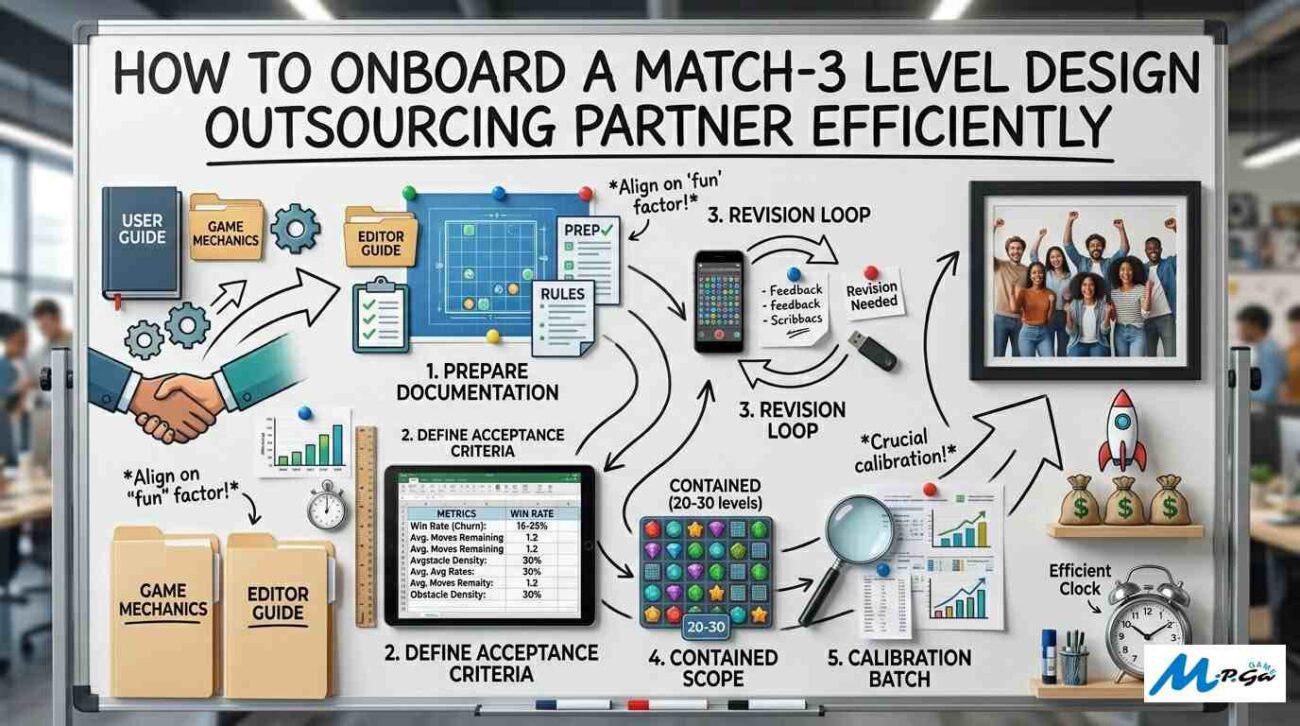
The onboarding phase is where most outsourcing relationships either establish a productive rhythm or start accumulating friction. What you do in the first week determines how much management overhead the engagement creates for the next six months.
| Step | Key Practice | Description |
|---|---|---|
| 1 | Prepare Documentation Before Day One | Ensure all essential materials are ready before onboarding, including level editor access, user guides, design rules, balance sheets (difficulty, moves, obstacles), and clear acceptance criteria. Delays in documentation can significantly slow down timelines. |
| 2 | Define Acceptance Criteria Explicitly | Avoid vague instructions. Use measurable benchmarks, such as win rates, difficulty ranges, and obstacle limits, to reduce revisions and enable effective self-QA by the studio. |
| 3 | Establish the Revision Loop Upfront | Agree in advance on revision rounds, feedback timelines, review responsibilities, and how underperforming levels will be handled post-launch. Clear processes prevent confusion later. |
| 4 | Start with a Contained Scope | Begin with a small batch (20–30 levels) instead of committing to large-scale production. This helps evaluate onboarding speed, quality, and workflow efficiency before scaling. |
| 5 | Treat the First Batch as Calibration | Use the initial batch to identify gaps in communication, assumptions, and documentation. The goal is alignment, not perfection, ensuring smoother execution in future batches. |
Final Thoughts
Outsourcing match-3 level design works when the brief is clear, the success criteria are measurable, and the partner is chosen for the specific problem you’re solving.
The studios in this guide collectively cover the full range of what the market offers in 2026: one pure specialist focused on level design, two accessible full-cycle options for teams building from scratch, one co-development partner designed to plug into an existing pipeline, and one enterprise-scale studio built to support large live games.
The right choice depends on one question more than any other: are you extending an existing pipeline, or building a new one? Either way, the first step is to define what a “good” level means in your game, in measurable terms, before you talk to anyone.